

Mexico Travel Guide for Catholic Pilgrims
What to Know Before Traveling to Mexico
This Mexico travel guide gathers what a Catholic pilgrim needs to settle before flying to Mexico City for Our Lady of Guadalupe. Check your passport and your medicines the week you register. Read the notes on weather, altitude, and dress a month before you fly, and keep the sections on money, water, and the Basilica for the week you pack.
The wise men were foreigners in Bethlehem. They came out of the East, spoke another language, and knelt before a Child born among another people, and the Church has always read their arrival as the moment Christ was shown to the nations. Tepeyac tells that story again in the Americas. Our Lady spoke to Juan Diego in Nahuatl, his own language, and left an image his people could read at a glance. An American pilgrim arrives there as a guest in a devotion that belongs first to the people of Mexico, and the welcome is warm. A guest who comes a little prepared, with a few words of Spanish, some sense of the altitude and the crowds, and a readiness to pray beside Mexican families, receives far more from the visit.
Already registered? Your pilgrim packet arrives two to three weeks before departure with hotel details, your final itinerary, and guidance from your Pilgrimage Manager. This guide is what you need before that packet reaches you. For the interior preparation, begin our pre-pilgrimage spiritual retreat.
Mexico Entry Requirements for U.S. Citizens
U.S. citizens do not need a visa for a pilgrimage to Mexico, and there is no travel authorization to apply for online before you fly. What matters is carrying the right passport, packing the right medicines, and knowing how Mexico now admits visitors when they land.
The paper visitor card is gone at the airport. Mexico still requires every visitor to hold its entry permit, the Forma Migratoria Múltiple or FMM, which many travel sites still call the tourist card, but at every international airport in the country it is now issued digitally as you pass immigration. Nobody hands you a form on the plane, and there is no card to lose during the week.
-
Fly on a passport book, not a passport card
The wallet-sized U.S. passport card is accepted at land crossings, but it cannot be used to board a flight to Mexico. Bring the passport book. Mexico asks only that it be valid when you enter and that it have a blank page for the entry stamp, but airlines read every rule strictly, so we recommend six months of validity to spare. If you are close, renew first.
-
Know what happens at immigration
An immigration officer, or in some halls an automated E-Gate, scans your passport and records your entry. The officer decides how many days you may stay, which for a pilgrimage is never in question, and stamps your passport with the date. If an E-Gate prints a small receipt with a QR code, keep it inside your passport until you are home.
-
Check every medicine before you pack it
Some medicines sold freely in American drugstores are controlled in Mexico. Pseudoephedrine, the active ingredient in Sudafed and many cold and sinus remedies, is illegal there, and travelers can be arrested for carrying it even with a prescription or a letter from a doctor. Read the labels on everything in your cold and allergy kit, carry prescriptions in their original labeled bottles, and leave vaping devices at home, since those are illegal to bring into Mexico as well.
-
Declare what needs declaring
Personal belongings, religious articles, and a phone and laptop for your own use are ordinary luggage. Goods worth more than $500 that you are bringing into Mexico must be declared on arrival by air, and so must cash above $10,000. Mexican rules allow one laptop or tablet per person free of duty.
Traveling with a child or grandchild? Bring a copy of each child’s birth certificate or other proof of your relationship. Any minor who is a Mexican citizen, including a child who holds both U.S. and Mexican citizenship, needs notarized written permission from a parent or guardian to travel without that parent. Mexican authorities have stopped children from leaving the country without it, so tell your Pilgrimage Manager early if this applies to your family.
Mexico City Weather, Rainy Season, and Altitude
Central Mexico has two seasons rather than four. From November through April the days are dry, sunny, and mild, with cold mornings. From June through September storms build most afternoons, while May and October sit between the two. Because Mexico City and Puebla stand more than a mile and a quarter above the sea, the sun is strong and the nights stay cool in every month.
| Month | Mexico City | Puebla | Rain days, Mexico City | What it feels like |
|---|---|---|---|---|
| January | 72° / 47° | 72° / 42° | 3 | Dry and sunny, with the coldest mornings of the year. Early Mass at Tepeyac calls for a jacket. |
| February | 76° / 49° | 76° / 45° | 2 | Clear skies and warming afternoons, while the mornings stay chilly. |
| March | 79° / 52° | 79° / 48° | 4 | Warm and dry, with jacarandas flowering purple along the city streets. |
| April | 82° / 56° | 82° / 52° | 7 | The warmest month, with hazy afternoons and strong sun at altitude. |
| May | 81° / 57° | 82° / 54° | 11 | Still warm, as the first afternoon storms arrive. |
| June | 78° / 57° | 78° / 55° | 16 | The rains settle in, and storms build on most afternoons. |
| July | 76° / 55° | 76° / 53° | 22 | The wettest stretch in Mexico City, with rain on most days. |
| August | 76° / 56° | 77° / 54° | 21 | Much like July, green and mild, with an umbrella needed daily. |
| September | 75° / 56° | 75° / 54° | 18 | Rain continues, and this is one of the wettest months in Puebla. |
| October | 74° / 53° | 75° / 51° | 10 | The rains ease through the month, leaving fresh, clear days. |
| November | 73° / 50° | 74° / 46° | 4 | The dry season returns, with mild, sunny days and cool nights. |
| December | 72° / 47° | 73° / 43° | 1 | The driest month, with cold mornings and the feast of Our Lady on the 12th. |
- Dry and sunny
- Changing seasons
- Rainy season, wet afternoons
Average daytime highs and overnight lows in Fahrenheit, from Mexico’s National Meteorological Service 1991–2020 climate normals for the Tacubaya observatory in Mexico City and the Puebla observatory. Rain days count the average number of days with measurable rain.
Warm afternoons, cold mornings
Thin, dry air lets the day’s warmth escape quickly after dark, so the gap between afternoon and dawn is wide. In January Mexico City averages a high of 72°F and a low of 47°F, and Puebla drops to 42°F. An early Mass at Tepeyac in winter can feel like autumn in the Midwest, and by early afternoon the same plaza feels like late spring.
The rainy season
The rains arrive in May, settle in by June, and fade through October. July and August average more than twenty days with rain in Mexico City, while December averages one. Summer rain often comes as a heavy storm in the afternoon or evening rather than a gray day, so carry a compact umbrella and plan outdoor visits for the morning. From November through April you can usually leave it in your suitcase.
Is Mexico City’s altitude a problem?
Mexico City sits at about 7,350 feet, roughly two thousand feet higher than Denver, and Puebla is only a little lower. That is just below the 8,000 feet at which the CDC begins to warn about altitude illness, so most pilgrims never become unwell. Many do notice it, as shortness of breath on the stairs up Tepeyac Hill, a mild headache the first evening, or a restless first night. It usually eases within a day or two.
Take the first day gently, drink plenty of bottled water, and go easy on alcohol, which works faster at altitude. Climb stairs at your own pace and stop when you need to. If you have heart or lung disease, talk with your doctor before you register, and see our guide to pilgrimage activity levels.
Sun and air at seven thousand feet
There is less atmosphere overhead to filter the sun, and a cool morning can hide how quickly skin burns. The Basilica itself asks visitors to wear sunscreen and bring water. Mexico City’s air can also be hazy, especially in the dry months, so pilgrims with asthma should pack their inhalers in their day bags.
Arriving at Mexico City Airport
Guadalupe pilgrimages fly into Mexico City International Airport, known by its Spanish initials as AICM. Flights from the United States take a few hours rather than a night, so most groups land the same day they leave home and begin at Tepeyac within a day of arrival.
Passport control
Follow the signs for Migración. Lines move steadily, and you will either stand before an officer or be directed to an E-Gate. Take your passport out of its cover, answer that you are visiting on a pilgrimage, and look at the camera when asked. Keep any receipt the machine prints.
Customs and the traffic light
After baggage claim comes Aduana, Mexican customs. Travelers give customs a declaration, and one per family is enough, then activate a random selection system. A green light means you walk on, and a red light means an officer will look through your bags. Red is routine and says nothing about you, so wait calmly and repack when the officer is finished.
Meeting your guide
The arrivals hall beyond customs is busy with drivers holding signs and porters offering to help. Your guide meets the group once everyone is through, so stay together inside the hall and let your Pilgrimage Manager direct the walk to the coach.
The first day
Pilgrims from the Midwest and the East feel little or no jet lag, since Mexico City keeps Central time. The adjustment is to the altitude. Eat lightly, drink water, and rest when the itinerary gives you the chance. Our advice on the first day of a pilgrimage covers the rest.
Traffic in a city of millions
Greater Mexico City is one of the largest cities in the world, and its traffic sets the pace of every day. A drive that takes half an hour at dawn can take twice as long at midday. Keep water, a snack, and a warm layer in your day bag, and use the slow miles for the Rosary or for the readings of the day’s Mass.
Going home
Arrive at the airport with the same passport you entered on. Bottles of holy water from the Basilica belong in checked luggage, well wrapped, since airport security limits liquids in carry-on bags. When you land in the United States, the free Mobile Passport Control app can shorten the line, and any food you bring home should be declared.
General Information
- Country
- United Mexican States
- Capital
- Mexico City (Ciudad de México, or CDMX)
- Language
- Spanish, with 68 Indigenous languages including Nahuatl
- Time zone
- Central time all year
- Country code
- +52
- Emergency number
- 911
- Travel assistance
- 078
- Electricity
- 127V · Type A and B plugs
Will people speak English?
Hotel staff and many people who work around the major shrines speak some English, and your guide translates wherever you need it. Beyond that, Spanish is the language of daily life, and Mass at the Basilica is celebrated in Spanish. A few words go a long way, and Mexicans are generous with visitors who try. Begin every exchange with buenos días or buenas tardes, since launching straight into a question without a greeting sounds abrupt. The Local Custom section below lists the phrases pilgrims use most.
What time is it at home?
Mexico stopped changing its clocks in October 2022, and Mexico City now keeps Central Standard Time all year. From early November to mid-March that matches Chicago and runs one hour behind New York. While the United States is on daylight saving time, Mexico City is two hours behind U.S. Eastern time and one hour behind Central. In 2026 the United States falls back on November 1, so a November pilgrim from the Midwest will find the clocks in step with home.
Emergency numbers
Mexico uses 911 for police, ambulance, and fire, and it works from any phone with no area code. Not every operator speaks English, so ask a Spanish speaker to help with the call if you can. Dial 078 for the government’s free travel assistance line. Private hospitals in Mexico usually require payment before treatment or before a patient is released, and Medicare does not pay for care there, which is one reason we recommend travel insurance. Your Pilgrimage Manager is always the first person to find.
The earthquake alert
Mexico is an active earthquake zone, and Mexico City has the first earthquake warning system in the world built to alert the public. Sensors near the Pacific coast detect a strong quake as it begins and set off loudspeakers across the city, which sound a siren and the words alerta sísmica before the shaking arrives, sometimes with a minute or more of warning. If you hear it, stay calm, move away from windows, avoid elevators, and follow hotel staff or your guide. The same loudspeakers are tested from time to time, so the siren is not always a real quake.
Pesos, Cards, and Tipping in Mexico
How much cash will I need?
You will need less than you might expect, because hotels, restaurants, and larger shops take cards, but much of what a pilgrim pays for by hand is a cash purchase. Plan on pesos for candles, the vendors outside the Basilica, markets in Puebla and Tlaxcala, a bottle of water on the road, and the public restrooms that charge a few pesos at the door. Small bills and coins are the most useful, since street vendors often cannot change a large note.
The dollar sign on Mexican prices
Mexico writes its peso with the same $ symbol Americans use for the dollar. A price of $150 on a menu or a rosary stall means 150 pesos, not 150 dollars. Where confusion is possible, you may see MX$ or MXN. Some businesses near the busiest sites will accept U.S. dollars, but they set their own exchange rate and give change in pesos, so paying in pesos almost always costs less.
Should I buy pesos before I leave?
Buying pesos at home costs more than it should, because your home bank and the airport exchange counter both set their own rate and add a fee. Withdraw pesos from an ATM after you arrive, and choose a machine inside a bank or a hotel lobby rather than one on the street, where card skimmers are more common.
- Always choose to be charged in pesos. When an ATM or card terminal offers to bill you in U.S. dollars, it is using its own poor rate. This is dynamic currency conversion, and declining it costs nothing.
- Withdraw once and withdraw enough, since most U.S. cards add a flat fee to every foreign withdrawal.
Visa, Mastercard, and the rest
We recommend Visa and Mastercard, which are accepted wherever cards are. American Express is taken in many hotels and larger restaurants but less often elsewhere, and Discover is not as common abroad. Before you leave:
- Tell your card issuer your travel dates, so your purchases are not flagged.
- Check your foreign transaction fees, so you are not surprised by extra costs.
- Carry a second card, kept somewhere other than your wallet.
- Check your account online during the trip for any charge you do not recognize.
Tipping in Mexico
A gratuity for your guides and coach driver is customary. Your pilgrim packet explains how Tekton handles it, so the whole group works from the same expectation and nobody is left guessing on the last day.
At a meal you pay for yourself, look at the bill for the word propina or servicio. When service has not been added, a tip of about 10 to 15 percent for table service is usual in Mexico City and Puebla. If you pay by card, the server may ask how much to add before running it.
A Faith Lived in the Street
In much of the United States faith is kept indoors. In Mexico, and above all around Tepeyac, it walks down the middle of the road. Our Lady of Guadalupe looks out from taxi dashboards, market stalls, bakery walls, and the backs of buses, and her shrine receives pilgrims every day of the year.
The pilgrims you will walk beside
Parishes, dioceses, workers’ associations, and whole towns come to the Basilica in organized peregrinaciones, often carrying a banner with their parish name, sometimes with a band, and sometimes after walking or cycling for days. In the plaza you may see traditional dancers in feathered headdresses offering their dance to Our Lady. Some pilgrims cross the last stretch of stone on their knees to fulfill a manda, a promise made to her in a time of need.
Give these pilgrims room, and never photograph someone at prayer from close by. The courtesy works in the other direction too. Mexican families are often delighted to see Americans who have come so far, and a smile and a buenos días are usually returned warmly.
December 12 at Tepeyac
On the eve of the feast, crowds gather through the night to sing Las Mañanitas, the traditional birthday song, to Our Lady at midnight, and a Mass is celebrated at the main altar as the day begins. Government estimates for the feast run into the millions. If your pilgrimage falls near December 12, expect closed streets, long waits, and a joy that is hard to describe, and follow your guide’s timings closely.
The shape of the Mexican day
Breakfast in Mexico is substantial, and the main meal of the day, the comida, is eaten in the middle of the afternoon rather than at noon. Supper, when it comes, is lighter and later. Restaurants are glad to serve American hours, but if the group’s lunch arrives at two or three o’clock, you are eating on local time. A server will not bring the bill until you ask for it, because rushing a guest is considered rude, so ask for la cuenta, por favor when you are ready.
Courtesy in a crowd
Mexicans say con permiso when they need to pass someone, which is gentler than a simple “excuse me.” If someone does not hear you, they may answer ¿mande?, a polite way of asking you to repeat yourself. Older people and clergy are addressed with respect, and a handshake with a greeting is the usual beginning to any introduction.
Visiting the Basilica of Our Lady of Guadalupe
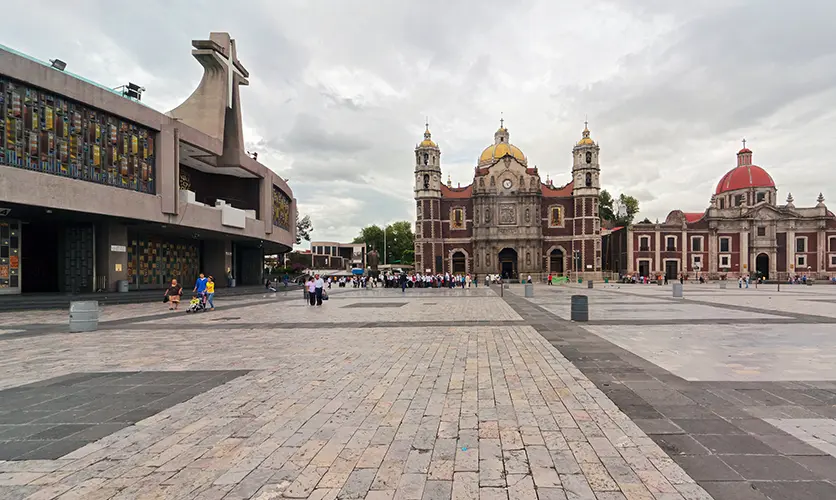
The shrine at Tepeyac is not a single church but a hillside of churches, chapels, and courtyards gathered around an immense stone plaza. Knowing how it fits together before you arrive lets you spend your time there praying rather than searching for the next door.
The tilma and the moving walkway
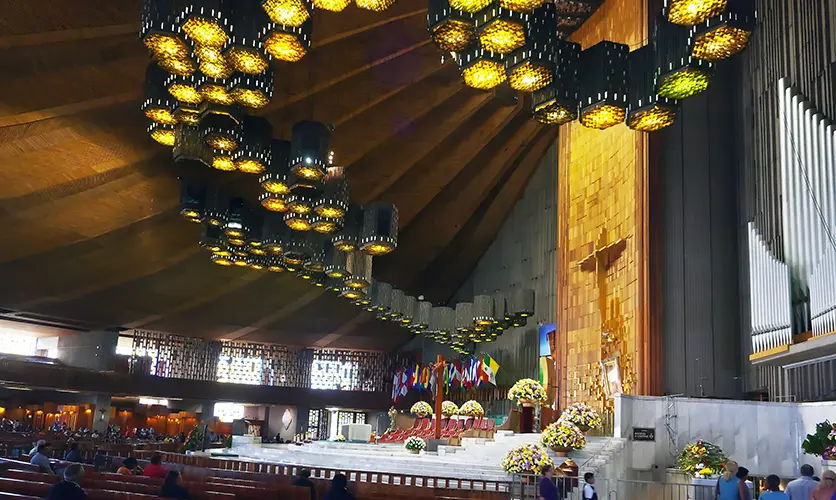
The round modern Basilica, consecrated in 1976, seats about ten thousand people, and in 2026 it marks fifty years since its consecration. Juan Diego’s tilma hangs above and behind the main altar, where it can be seen from every seat. To come closer, follow the signs to the passage beneath the sanctuary, where slow moving walkways carry pilgrims past directly under the image. The walkway does not stop, and the moment passes quickly, so decide beforehand what you want to say to her. You may ride it again, and many pilgrims do.
The main altar through the day
Mass is celebrated at the main altar almost every hour from six in the morning until eight at night, in Spanish, and the walkways keep moving during the liturgy. Tekton groups celebrate their own Mass in English at times and chapels reserved in advance. If you visit the main church while a Mass is under way, move quietly along the sides and never cross in front of the altar.
Up Tepeyac Hill
The small church at the top of the hill, the Capilla del Cerrito, stands where Juan Diego gathered the roses. It is reached by stairs and garden paths lined with images of the apparitions, and it is open from seven in the morning until six in the evening. At this altitude, take the climb slowly, rest at the landings, and turn around at the top for the view over the domes of the Old Basilica and the city beyond.
The Old Basilica and the chapels below
The Old Basilica, completed in 1709, sheltered the image for 267 years before it moved to the new church. Mexico City stands on the bed of a drained lake, and the soft ground has tilted several of the older buildings, so do not be surprised if a floor seems to slope under your feet. Nearby, the little Capilla de Indios preserves the foundations of the first chapel that received the image in December 1531, and the Capilla del Pocito stands over a spring.
Blessing your religious articles
Rosaries, medals, and images bought at the shrine can be blessed at the Capilla de Bendiciones, open daily, where priests bless religious articles for pilgrims. Buy first, then bring everything together. If you fill a bottle with holy water, seal it well and pack it in your checked suitcase for the flight home.
Phone, Data, and Water
Will my phone work in Mexico?
In all likelihood it will, since many unlimited plans from the major U.S. carriers include Mexico at no extra charge, though the amount of fast data varies from plan to plan, so check yours before you leave. Coverage is strong in Mexico City and Puebla and patchier on the roads between the shrines.
- Your own plan. The simplest choice if Mexico is included. Confirm the data allowance with your carrier.
- eSIM. A good option if your plan charges for Mexico. Buy and install it before departure.
- Hotel Wi-Fi. Widely available, and enough if you are content to check in once a day.
Put the phone away on the walkway. The passage beneath the tilma lasts a few seconds. A photograph can be bought at the shrine shop, and the moment itself cannot be taken twice.
Can I drink the tap water?
The U.S. State Department advises that tap water in many parts of Mexico is not safe to drink, so plan on never drinking from the tap. Drink bottled or purified water, which your hotel and restaurants will provide, and use it to brush your teeth as well. If you are not sure how the ice in a drink was made, ask for it sin hielo, without ice. Take care with raw vegetables and with fruit you have not peeled yourself.
Food, and dietary needs
Mexican food in central Mexico is far more varied than what most Americans know by the name, and Puebla is famous for mole poblano, the rich sauce said to have first been made by nuns in a convent kitchen. Not every dish is spicy. If you want to check, ask ¿pica?, meaning “is it hot?” If you have a serious allergy or a dietary requirement, tell your Pilgrimage Manager well before departure so arrangements can be made rather than improvised.
What to Wear in Mexico City and at the Basilica
Unless your pilgrimage has a very specific formal occasion, you can dress much as you would at home. The adjustments Mexico asks for are about the altitude, the sun, and the respect a shrine expects.
Dress in layers you can add and remove all day. A sweater or light jacket for an early Mass at Tepeyac will be too warm by noon, and the evening turns cool again quickly. From November through February mornings can fall into the forties, so a warmer layer is worth its space. From June through September add a compact umbrella or a packable rain jacket.
Shoes matter more than anything else you pack. Expect a vast stone plaza, stairs up Tepeyac Hill, uneven sidewalks in Mexico City, cobbled streets in Puebla and Tlaxcala, and long walks at Teotihuacán. Choose comfortable, broken-in shoes with good grip, and bring a second pair.
For churches and other holy sites, it is expected that your knees and shoulders be covered. This applies to both men and women, and bare midriffs are frowned upon. Modesty and respect are the key. You will not need a head covering, and women do not need to wear skirts or dresses unless that is your preferred style. Jeans are acceptable, unless your priest has told you differently. A sun hat is wise outdoors, but take it off at the door, since the Basilica does not allow caps inside. Our post on packing like a true pilgrim covers the rest.
Electricity, Plugs, and Adapters
- Socket type
- Type A and B — the same as the U.S.
- Voltage
- 127V, 60 Hz
- Adapter needed?
- Usually not
- Converter needed?
- No
No adapter, with one exception
Mexico uses the same flat-pin plugs as the United States, and its 127 volts at 60 hertz sit close enough to American current that phones, laptops, hair dryers, curling irons, and CPAP machines work without a converter. The exception is the outlet itself. Some rooms in older buildings have only two slots, with no round hole for a grounding pin, so a three-prong plug will not fit. A small three-to-two prong adapter costs a few dollars and solves the problem. Never force a plug or cut off its grounding pin, and check with your manufacturer or doctor if you have any question about a medical device.
Bring a short extension cord or a travel power strip. Hotel rooms do not always have an outlet near the bed or the desk, and a CPAP machine, a phone, and a camera battery will all want one on the same night.
Questions Pilgrims Ask
Do I need a visa to go to Mexico as a U.S. citizen?
U.S. citizens do not need a visa to visit Mexico for up to 180 days. To fly there you need a U.S. passport book, because a passport card cannot be used for air travel. Mexico asks that the passport be valid when you enter, and we recommend six months of validity to spare. On arrival an immigration officer or an automated E-Gate records your entry digitally, and the officer decides how long you may stay.
Do I need an FMM to fly into Mexico?
Every visitor still needs Mexico's entry permit, the FMM, but air travelers no longer fill out a paper card to get it. At every international airport in Mexico the permit is issued digitally as you pass immigration. The officer stamps your passport with your entry date, and an E-Gate may print a receipt with a QR code, which you should keep with your passport. Air travelers can download a record of the digital FMM from Mexico's National Migration Institute.
Does Mexico City cause altitude sickness?
Most pilgrims feel the altitude in Mexico City without becoming ill. The city sits at about 7,350 feet, just below the 8,000 feet at which the CDC begins to warn about altitude illness. Many visitors notice shortness of breath on stairs, a mild headache, or restless sleep for the first night or two. Take the first day gently, drink plenty of bottled water, go easy on alcohol, and talk to your doctor before you travel if you have heart or lung disease.
When is the rainy season in Mexico City?
The rainy season runs from about June through September, with May and October as transition months. Mexico's National Meteorological Service averages show about 22 days with rain in July and 21 in August in Mexico City, against one to four days a month from November through March. Summer rain often comes as a heavy afternoon or evening storm, so pack a compact umbrella or a rain jacket for a pilgrimage between June and October.
Can you drink the tap water in Mexico City?
Plan on not drinking it. The U.S. State Department advises that tap water in many parts of Mexico is not safe to drink. Drink bottled or purified water, which hotels and restaurants provide, and use it to brush your teeth as well. If you are unsure how the ice in a drink was made, ask for it without ice by saying sin hielo, and take care with raw vegetables and with fruit you have not peeled yourself.
What is the dress code at the Basilica of Guadalupe?
The Basilica of Our Lady of Guadalupe asks visitors to dress with decorum and respect. Its posted rules do not admit low-cut tops, crop tops, tank tops, shorts above the knee, miniskirts, or caps into the churches, chapels, museums, and crypts of the shrine. Covering your knees and shoulders and removing your hat at the door meets the standard for men and women alike. Wear comfortable shoes as well, since the plaza is large and the chapel on Tepeyac Hill is reached by stairs.
Can I bring Sudafed to Mexico?
Leave any medicine containing pseudoephedrine at home. The U.S. State Department warns that pseudoephedrine, the active ingredient in Sudafed and many cold and sinus remedies, is illegal in Mexico, and that travelers can be arrested for carrying it even with a prescription or a letter from a doctor. Check the label of every cold, allergy, and sinus medicine you plan to pack, carry prescriptions in their original labeled containers, and ask your doctor or pharmacist for an alternative. Vaping devices are also illegal to bring into Mexico.
Do I need a plug adapter for Mexico?
In most rooms you will not need one. Mexico uses the same Type A and Type B plugs as the United States, at 127 volts and 60 hertz, so American chargers and appliances work without a voltage converter. Some outlets in older buildings have only two slots, so a three-prong plug such as a CPAP cord or a laptop charger may need an inexpensive three-to-two prong adapter. Never force a plug or remove its grounding pin.
Next Steps
Come as a Guest to Her Little House
For thirty years Tekton has brought pilgrims up the hill where Our Lady asked for a church to be built. Everything on this page exists to settle the practical questions early, so that when you reach Tepeyac you arrive the way a welcomed guest should, ready to receive what the house has to give.