
Greece Travel Guide for Catholic Pilgrims
What to Settle Before You Fly to Athens
This Greece travel guide covers what to know before traveling to Greece on a Catholic pilgrimage, in the order you will need it. Check your passport the day you register. Read the weather and dress sections a month before you fly. Save the notes on arrival, money, and the ancient sites for the week you pack.
The wise men who went looking for Christ were scholars. They had studied the sky for years, and they could have stayed home with what they knew. Their learning became worship only when they set out and knelt. Greece is where St. Paul stood among the learned men of Athens and told them of a God they honored without knowing. Settle the facts on this page ahead of time, and the road will have room to do what reading cannot.
Already registered? Your pilgrim packet arrives two to three weeks before departure with hotel details, your final itinerary, and guidance from your Pilgrimage Manager. This guide is what you need before that packet reaches you. For the interior preparation, read St. Luke and St. Paul, companions on the road and begin our pre-pilgrimage spiritual retreat.
Greece Entry Requirements for U.S. Citizens
Greece asks nothing of a U.S. pilgrim in advance beyond a valid passport. It belongs to the European Union and the Schengen Area, and Americans visit for up to ninety days without a visa. What changed in 2026 is the border check itself, which now records your fingerprints and a photograph instead of stamping your passport.
ETIAS is not in operation. The European Travel Information and Authorisation System has been delayed again, no revised launch date has been published, and no applications are being accepted anywhere. Greece is in the Schengen Area, so ETIAS will apply here when it launches. Until then, any website offering to sell you one is not the official portal. Tekton will tell registered pilgrims what to do when a real date is announced.
-
Check your passport against two dates
It must be valid for at least three months after the day you leave the Schengen Area, and it must have been issued within the last ten years. On a pilgrimage that continues from Greece into Turkey, you leave the Schengen Area when the coach crosses the border, but Turkey then applies its own passport rules, and airlines read every rule strictly at check-in. Travel with six months to spare. If you are close to either limit, renew before you register.
-
Expect fingerprints and a photograph
The European Union's Entry/Exit System replaced the passport stamp in 2026. The first time you enter the Schengen Area, a border officer or kiosk scans your passport, takes four fingerprints, and photographs your face. It is free, it takes a few minutes once you reach the front of the line, and later trips are quicker because the record is kept. Children under twelve are not fingerprinted.
-
Keep your return ticket and confirmation reachable
Like every Schengen country, Greece lets a border officer ask where you are staying, how you are leaving, and whether you have the means to pay for your stay. For a Tekton pilgrim, your return flight and your pilgrimage confirmation answer all three. Keep both on your phone and on paper, in your day bag rather than a checked suitcase.
-
Plan for a second border
Most Tekton pilgrimages to Greece continue into Turkey, crossing by coach in Thrace after Philippi. Turkey sets its own entry rules, separate from Greece's, and they have changed more than once in recent years. Your Pilgrimage Manager confirms Turkey's current requirements with the whole group before departure, so there is nothing to apply for on your own unless you are told otherwise.
Carry copies, kept apart from the original. Photograph your passport page and email it to yourself, and keep a paper copy in a different bag. Send your Pilgrimage Manager a photograph of the page when you register, so the name on your airline ticket can be checked against it. Maiden names, middle initials, and suffixes are the usual trouble.
Greece Weather Month by Month
Greece is not one climate. Athens is dry and hot, with most of its rain falling between November and February. Thessaloniki and the north, where St. Paul first preached in Europe, run cooler and wetter. And the plain beneath Meteora swings from frosty winter nights to summer afternoons as hot as anything in Athens.
| Month | Athens | Thessaloniki | Trikala, near Meteora | Rain, Athens (in) | Rain, Thessaloniki (in) | What it feels like |
|---|---|---|---|---|---|---|
| January | 56° / 45° | 51° / 38° | 51° / 35° | 2.2 | 1.3 | Mild in Athens, cold and damp in the north, with frost on the plain beneath Meteora. |
| February | 58° / 45° | 54° / 40° | 58° / 39° | 1.7 | 1.3 | Still cool and showery. Clear, calm spells between storms, and short days for coach travel. |
| March | 63° / 49° | 60° / 44° | 63° / 42° | 1.8 | 1.6 | Rain eases and the countryside turns green. March 25 is the Annunciation and a national holiday. |
| April | 70° / 54° | 67° / 50° | 69° / 48° | 1.1 | 1.5 | Wildflowers at Delphi and Philippi. Warm afternoons, cool evenings, and an occasional shower in the north. |
| May | 80° / 63° | 77° / 59° | 80° / 56° | 0.8 | 2.0 | Warm and bright almost everywhere, with a few showers in Thessaloniki. Among the best months to walk the sites. |
| June | 89° / 71° | 86° / 67° | 91° / 65° | 0.5 | 1.2 | Summer arrives. Hot afternoons in Athens and Meteora; start at the ruins early. |
| July | 94° / 76° | 90° / 71° | 92° / 69° | 0.4 | 1.1 | The hottest, driest stretch. Heat-wave closures at the Acropolis are most likely now. |
| August | 94° / 76° | 90° / 71° | 94° / 68° | 0.2 | 1.0 | Just as hot, and almost rainless in Athens. August 15 fills roads and churches across Greece. |
| September | 85° / 69° | 82° / 64° | 87° / 63° | 1.0 | 1.5 | Still hot early in the month, easing toward the end, with the sea still warm. |
| October | 76° / 61° | 72° / 56° | 76° / 54° | 1.5 | 1.7 | Warm days, cooler nights, and the first autumn rain in the north. Our current itinerary travels now. |
| November | 66° / 54° | 62° / 48° | 63° / 48° | 2.8 | 1.6 | Rain returns in earnest. Mild by day, chilly at night, and grey in the north. |
| December | 58° / 48° | 53° / 41° | 54° / 43° | 3.0 | 1.9 | The wettest month in Athens. Short days, and cold nights beneath Meteora, where snow is possible. |
- Hot and mostly dry
- Mild and changeable
- Cool and damp, with short days
- Most comfortable months for walking
Average daytime highs and overnight lows in Fahrenheit. Athens figures are 1991–2020 climate normals for downtown Athens from the National Observatory of Athens. Thessaloniki figures are 1991–2020 normals from the Aristotle University of Thessaloniki. Trikala, the nearest town station to Meteora, has only a short recent record, so treat that column as a rougher guide.
The north is a different season
A Greece pilgrimage that follows St. Paul moves steadily north, from Athens and Corinth through Delphi and Meteora to Veria, Thessaloniki, Kavala, and Philippi. Every step north takes a little warmth out of the evening. In October, Athens averages a low of 61°F and Thessaloniki 56°F, and the nights beneath Meteora are cooler still. The outdoor Mass beside the river at Philippi can begin in a jacket and end in the sun.
Rain follows the same pattern. Athens is one of the driest cities in Europe in summer, while the north keeps a scattering of showers even in May and June. A compact umbrella earns its place in any month but July and August.
The months Tekton groups travel
Our current Greece and Turkey itinerary departs in early October: warm afternoons in Athens and Corinth, mild days in the north, and cooler evenings at Meteora and in Istanbul. Pack for all three. Short sleeves for the ruins, a light jacket for the evening, and one warmer layer you can leave on the coach.
Summer heat at the ruins
From June through August, midday on the Acropolis or at ancient Corinth is a serious physical undertaking, with bare stone underfoot and no shade overhead. Greek authorities have closed the Acropolis during the hottest hours in recent heat waves. The section on visiting the ancient sites explains what that means for your day.
Passport Control at Athens Airport, and the Road North
Tekton pilgrimages to Greece land at Athens International Airport, Eleftherios Venizelos, east of the city. From there the route follows St. Paul by coach: south to Corinth, north through Delphi and Meteora, and on to Philippi and the Turkish border. Knowing what each stage asks of you makes the long days lighter.
What to expect at passport control
Athens airport has run the European Union's Entry/Exit System for every traveler from outside the EU since March 30, 2026. Each first-time arrival gives fingerprints and a photograph, and that has made the lines longer than they used to be. Waits of thirty minutes to an hour have been common when several long-haul flights land together, and longer on the worst days of summer. If your flight connects through Frankfurt, Munich, Rome, or another Schengen airport, you register there instead, and Athens feels like a domestic arrival.
Have your passport open to the photo page, keep the group together, and be patient. Your guide meets the group once you are through customs.
The first day, and the second
Flights from the United States reach Athens after a night in the air, and the rest of that first day is usually free. Stay outside in the daylight, eat something light, and hold out until a normal Greek bedtime. The second day asks a great deal. On our current itinerary it climbs the Acropolis in the morning, drives the coast road to Corinth, and ends with Mass where St. Paul lived and preached for a year and a half.
Long days on the coach
Greece rewards the effort, but the distances are real. Delphi and Meteora fill one long day, and Thessaloniki and Kavala another. Our Greece and Turkey itinerary is rated Activity Level 3, with early starts, many steps, and stairs at nearly every site. Keep water, a snack, and any motion-sickness remedy in your day bag, and use the coach hours for the Rosary, a nap, or the Acts of the Apostles, chapters 16 through 18.
Crossing into Turkey, and going home
After the Mass at Philippi, the coach drives east into Thrace and crosses the land border into Turkey. Leaving Greece there records your exit from the Schengen Area, and Turkish passport control follows a few minutes later. Keep your passport on your person, not in the luggage bay. Border crossings by road can take time, and the coach cannot move until everyone is through.
Check your watch at the border. Turkey keeps the same clock all year, and Greece moves its clocks back in late October. On a pilgrimage that crosses before that date the time does not change; after it, Turkey is an hour ahead. If your group flies home from Athens rather than Istanbul, the airport asks international travelers to arrive at least two and a half hours before departure. Bottles of holy water and blessed oils, and any Greek olive oil you buy, belong in checked luggage, wrapped well.
General Information

- Capital city
- Athens
- Largest city
- Athens
- Official language
- Greek
- Alphabet
- Greek, with English on most road signs
- Time zone
- 7 hours ahead of U.S. Eastern
- Country code
- +30
- Emergency number
- 112
- Tourist Police
- 1571
Will people speak English?
In the areas where you will be traveling, you are likely to meet mostly people who speak English, especially hotel staff, younger Greeks, and anyone who works at the major sites. Your knowledgeable Catholic and other Christian guides speak it fluently. English thins out among older people in the northern towns and at the monasteries, and if you have a hard time communicating with someone, a smile and a little body language go a long way.
Reading the signs
Greek uses its own alphabet, the one the New Testament was first written in. You will notice that road signs are usually in both Greek and English, with the Greek words on top and the English spelling underneath. Shop signs and menus outside Athens are often Greek only.
Place names shift between English, Greek, and Scripture, so your itinerary and the road signs may not match. The Berea of Acts 17 is today's Veria, also spelled Veroia. Thessalonica is Thessaloniki. Kavala was Neapolis, the harbor where St. Paul first set foot in Europe.
Yes sounds like no
One Greek word catches every visitor. Nai (neh) means yes, and it sounds like an English nay. Ochi (OH-hee) means no, and it often comes with a small upward tilt of the head. Kaliméra (kah-lee-MEH-rah) is good morning, and efcharistó (ef-hah-ree-STOH) is thank you. One gesture is worth avoiding: an open palm pushed toward someone's face is an old insult in Greece, so wave with your fingers rather than a flat hand.
Emergency numbers
Greece does not use 911. Dial 112 for police, ambulance, or fire. It works from any phone, needs no area code, and its operators speak English. For a problem that is not an emergency, such as a lost passport or a stolen wallet, the Tourist Police answer at 1571. You will almost certainly never need either. Your Pilgrimage Manager is the first person to find if something goes wrong.
Jet lag
Seven hours is a real shift, and it is felt most on the second day, when the walking begins in earnest. Drink more water than feels necessary, stay outside in the daylight, and resist a long afternoon nap. Our advice on the first day of a pilgrimage covers the rest.
The Euro, Cards, and Tipping in Greece
How much cash will I use?
Greece uses the euro, and U.S. dollars are not accepted. Look closely at a banknote and you will see the word written a second time in Greek letters, ΕΥΡΩ. Cards and phone payments are taken in hotels, restaurants, and most shops. Keep some euros in small notes and coins anyway. You will want them for the thin beeswax candles in Orthodox churches, the shops at Meteora, and a coffee at a roadside stop in the north.
Should I buy euros before I leave?
No. Your home bank and the airport exchange counter both set their own rate and add a fee on top. Withdraw euros from a bank ATM after you arrive. Machines inside or beside a Greek bank are the best choice. The standalone machines in airports and busy tourist streets charge noticeably more.
- Always choose to be charged in euros. When an ATM or a card terminal offers to bill you in U.S. dollars, it is applying its own poor rate. This is dynamic currency conversion, and saying no costs nothing.
- Withdraw once and withdraw enough, since most U.S. cards charge a flat fee per withdrawal.
Visa, Mastercard, and the rest
We recommend Visa and Mastercard. Discover is not as common overseas. American Express is becoming more popular in Greece, but it is still not as widely accepted. Before you leave:
- Tell your card issuer your travel dates for Greece and Turkey, so your purchases are not flagged.
- Check your foreign transaction fees, so you are not surprised by extra costs.
- Carry a second card, kept somewhere other than your wallet.
- Know your PIN. Greek terminals often ask for it.
Tipping in Greece
Gratuities for your guides and drivers are already on your final invoice, so there is nothing to calculate or hand out on the last day. Your pilgrim packet explains what that amount covers.
At a meal you pay for yourself, tipping in Greece is modest. Rounding up the bill or leaving a few euros for good service is customary, and at a café the coins from your change are enough.
A Catholic Pilgrim in Orthodox Greece
Nearly every church you enter in Greece belongs to the Greek Orthodox Church, and Catholics are a small minority. That is not a barrier. It is one of the gifts of the pilgrimage: praying in churches that keep the faith of the first Christian centuries, in the language of the New Testament, in the cities that received St. Paul's letters.
Inside an Orthodox church
The first thing you will notice is the iconostasis, the wall of icons that stands between the nave and the altar. Only the clergy pass through its doors, so visitors stay on the near side. Greeks entering a church usually buy a thin beeswax candle, light it, and kiss the icon of the church's feast or saint. You are welcome to light a candle and pray. Keep your voice low, keep your phone silent, and ask before taking photographs, which many churches do not allow during services.
Mass, and Communion
Your group celebrates Mass most days with its own priest, often at the apostolic sites themselves. Our current itinerary includes Mass at Corinth, at the monument to St. Paul in Veria, and outdoors beside the river at Philippi where Lydia was baptized.
If you attend an Orthodox Divine Liturgy, remember that the Orthodox Church admits only its own faithful to Communion. The Catholic Church asks Catholics to respect that discipline, so do not come forward. At the end of the Liturgy, the priest may offer blessed bread, the antidoron, to everyone present. It is not Communion, and you may receive it with thanks. In Athens, the Catholic Cathedral of St. Dionysius the Areopagite is named for the judge of Mars Hill who believed when St. Paul preached there.
Monasteries are homes
The monasteries of Meteora are living communities of monks and nuns, not museums, and they receive visitors on their own terms. Each one closes one day a week, on a day of its own choosing, and hours shorten in winter. Your itinerary is built around those days. Inside, photography in the churches is not permitted, silence is expected, and the dress code in what to wear is enforced at the gate.
A different Easter
The Orthodox Church calculates Easter by the older Julian calendar, so it usually falls one to five weeks after Western Easter, and only sometimes on the same day. In Greece, Holy Week is the center of the year. Shops close early, the Acropolis and many sites close on Easter Sunday, and at midnight on Holy Saturday whole towns stand outside their churches with lit candles to hear the words Christos anesti, Christ is risen. A pilgrimage that meets it will be busier and slower, and few pilgrims regret it.
Visiting the Acropolis and Other Ancient Sites
In Greece, the places where St. Paul preached are archaeological sites. The Bema at Corinth, the forum at Philippi, and the rock of the Areopagus beneath the Acropolis are protected by the state, and they come with rules that surprise first-time visitors.
Heat, and no shade
The Acropolis is bare rock and marble, with almost no shade anywhere on the summit. Entry runs on one-hour timed slots, which your guide books for the group, and the morning slots are the best. In recent summer heat waves Greece's Ministry of Culture has closed the Acropolis from about midday to five in the afternoon, deciding on the day. If a closure falls on your date, your Pilgrimage Manager will rearrange the day around it. Wear a hat, carry water, and use sunscreen even in October.
Flat shoes only
High heels are not permitted at Greek archaeological sites, because they damage ancient stone. The marble paths on the Acropolis have been polished smooth by centuries of feet and are slippery even when dry, and the ground at Corinth, Delphi, and Philippi is uneven. Shoes with real grip matter more here than anywhere else on the pilgrimage.
Leave every stone where it lies
It is tempting to pocket a small stone from the place where St. Paul stood. Do not. Under Greece's antiquities law, taking any object from an archaeological site, even an ordinary pebble, can bring criminal charges, and guards watch for it. Greece also fines visitors for taking pebbles and shells from protected beaches. Do not climb on, sit on, or lean against the monuments either. Take a photograph, and let the place stay whole for the pilgrims who come after you.
Reading Scripture where it happened
Your guides know the history. What turns a ruin into a place of prayer is usually a single passage read aloud on the spot. Mark a few in advance: Acts 17 for the Areopagus, Acts 18 and First Corinthians 13 for Corinth, and Acts 16 and the Letter to the Philippians for Philippi.
Phone, Data, and Water
Will my phone work in Greece?
Yes. Coverage is strong in Athens, Thessaloniki, and the towns, and thins out on the mountain roads between Delphi and Meteora. Your options:
- Carrier travel pass. The simplest choice. Most U.S. carriers offer a daily or monthly international plan. Check that yours covers Turkey as well as Greece, and add it before you leave.
- eSIM. Usually cheaper for heavy data use. Buy and install it before departure. An eSIM sold for the European Union alone will not work in Turkey, so choose one that names both countries.
- Hotel Wi-Fi. Widely available, and enough if you are content to check in once a day.
Consider using it less. The monasteries of Meteora do not allow photographs inside their churches, and many pilgrims find that rule a gift. Try keeping the phone in a pocket at Philippi and Corinth too, and pray the place before you photograph it.
Can I drink the tap water?
In Athens and Thessaloniki, the public water supply is treated to European Union standards and is safe to drink. In smaller towns and on the islands, taste and quality vary, and many Greeks drink bottled water there. Restaurants usually bring bottled water to the table. Carry a refillable bottle and fill it at the hotel before long coach days.
Food, and Fridays
Greek food is generous and simple: grilled fish and lamb, salads with feta, bean and vegetable dishes stewed in olive oil, and bread with everything. The Orthodox fast on most Wednesdays and Fridays, so menus often mark dishes made without meat or dairy as nistisimo, which makes Friday abstinence easy to keep. If you have a serious allergy or a dietary requirement, tell your Pilgrimage Manager well before departure so arrangements can be made rather than improvised.
What to Wear at Meteora and in Greek Churches
Unless your pilgrimage has a very specific formal occasion, you can dress much as you would at home. Greece asks for two adjustments: modesty in every church, and a stricter code on the day you visit Meteora.
You may be turned away from churches and other holy sites if your knees and shoulders are uncovered. In some cases you will be asked to borrow or buy a wrap before you are allowed in, and bare midriffs are frowned upon. This applies to men and women alike. In the warmer months, a wrap or a light cardigan in your day bag solves it in a moment.
Meteora is the exception. The monasteries require women to wear a skirt or dress that covers the knee, and trousers are not accepted in place of one, however modest. Four of the six monasteries lend wrap-around skirts at the entrance, but supply runs short in busy seasons. Men must wear long trousers. Shorts are not admitted, and no monastery lends trousers. Shoulders must be covered for everyone. The simplest answer is a light skirt or sarong that pulls on over whatever you are wearing, packed for that one day.
Everywhere else, you will not need a head covering, and women do not need to wear skirts or dresses unless that is your preferred style. Jeans are acceptable, unless your priest has told you differently.
Shoes matter more than anything else you bring. The Acropolis is polished marble, Delphi climbs a steep hillside, and several Meteora monasteries are reached by long flights of stone steps cut into the rock. Our post on packing like a true pilgrim covers the rest.
Electricity, Plugs, and Adapters
- Socket types
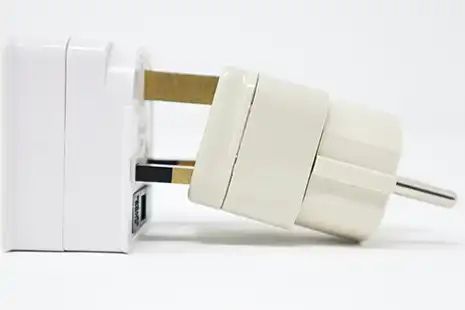
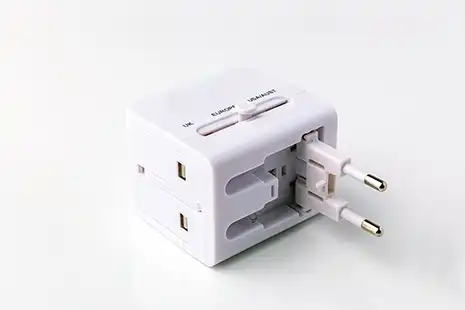
- Type C and Type F — two round pins
- Voltage
- 230V, 50 Hz
- Adapter needed?
- Yes
- Converter needed?
- Only for single-voltage devices
Adapter or converter?
An adapter lets an American plug fit a Greek socket. A converter changes the voltage. Nearly all converters are also adapters, but not all adapters are converters, so read the product description carefully before you buy.
Check the label on each device. If it reads INPUT: 100–240V, 50/60 Hz, it is dual-voltage and can be used in any country, including Greece, with only an adapter. That covers most phones, tablets, laptops, and electronics with a boxy charger. Most CPAP machines are dual-voltage as well, but please check with your manufacturer or doctor to make sure yours is compatible.
Single-voltage devices need a converter, or the higher voltage from Greek sockets will burn them out. Hair dryers, straighteners, and curling irons fall into this category, as do many electric toothbrushes and shavers. Most hotels have hair dryers, and you will be able to check your specific hotels once your pilgrim packet arrives. Adapters and converters are easy to find online or in the travel section of stores such as Target and Walmart.
One adapter covers Greece and Turkey. Both countries use the same two-round-pin sockets at 230 volts, so the adapter you pack for Athens works in Istanbul too.
Questions Pilgrims Ask
Do U.S. citizens need an ETIAS to travel to Greece?
Not yet. ETIAS, the European Travel Information and Authorisation System, is not in operation, no revised launch date has been published, and no applications are being accepted anywhere. U.S. citizens can visit Greece for up to 90 days in any 180 without a visa. Your passport must be valid for at least three months after you leave the Schengen Area and must have been issued within the last ten years. Airlines read these rules strictly, so travel with six months to spare. At the border you will give fingerprints and a photograph under the European Union's Entry/Exit System.
How long is passport control at Athens airport?
Longer than it used to be. Athens airport has registered the fingerprints and photograph of every non-EU traveler under the Entry/Exit System since March 30, 2026. Waits of thirty minutes to an hour have been common when several long-haul flights land together, and longer on the worst summer days. If you connect through another Schengen airport, you register there instead. For departures, Athens airport asks international travelers to arrive at least two and a half hours before their flight.
When is the best time to visit Greece?
April, May, and October are the most comfortable months for the walking a Greece pilgrimage involves: warm days, cooler evenings, and little rain in Athens. September is still hot early on. July and August are very hot, and the Acropolis has closed during the hottest hours of recent heat waves. Winter is mild in Athens but cold and damp in the north, with frost at night near Meteora. Orthodox Holy Week and August 15 are the busiest and most moving church seasons of the Greek year.
What is the dress code at the Meteora monasteries?
Women must wear a skirt or dress that covers the knee, and trousers are not accepted in place of one. Four of the six monasteries lend wrap-around skirts at the entrance, but supply can run short. Men must wear long trousers; shorts are not admitted and no trousers are lent. Everyone must cover their shoulders. Photography is not permitted inside the monastery churches. Pack a light pull-on skirt or sarong and long trousers for that day.
Can Catholics receive Communion in a Greek Orthodox church?
No. The Orthodox Church admits only its own faithful to Communion, and the Catholic Church asks Catholics to respect that discipline, so do not come forward at an Orthodox Divine Liturgy. You are welcome to attend, light a candle, and pray. At the end of the Liturgy the priest may offer blessed bread, the antidoron, to everyone present; it is not Communion, and you may receive it with thanks. On a Tekton pilgrimage your group celebrates Mass most days with its own priest.
Can you take stones from ancient sites in Greece?
No. Under Greece's antiquities law, taking any object from an archaeological site, even an ordinary pebble, can bring criminal charges, and site guards watch for it. Greece also fines visitors who take pebbles or shells from protected beaches. Do not climb on, sit on, or lean against the monuments. Take a photograph instead, and leave the place whole for the pilgrims who come after you.
Can you drink tap water in Greece?
In Athens and Thessaloniki, yes. The public water supply is treated to European Union standards and is safe to drink. In smaller towns and on the islands, taste and quality vary, and many Greeks drink bottled water there. Restaurants usually bring bottled water to the table. Carry a refillable bottle and fill it at your hotel before long coach days.
What plug adapter do I need for Greece?
Greece uses Type C and Type F sockets at 230 volts. You will need a plug adapter, and a voltage converter only for single-voltage devices such as hair dryers and curling irons. Phones, tablets, laptops, and most CPAP machines are dual-voltage and need only an adapter. Turkey uses the same sockets, so one adapter covers a Greece and Turkey pilgrimage.
Next Steps
Let the Road Finish What Study Began
For thirty years Tekton has walked with pilgrims through Greece, from the Bema at Corinth to the riverbank at Philippi. Everything on this page exists so that the practical things are settled before you land, and what you have read about St. Paul can become something you have prayed where he stood.