

Germany Travel Guide for Catholic Pilgrims
Preparing for a Pilgrimage to Germany
This Germany travel guide covers what to know before traveling to Germany on a Catholic pilgrimage, in the order you will need it. Check your passport the week you register, because Germany counts its validity rule from the day you leave rather than the day you land. Read the weather and the notes on the German Sunday a month before you fly. Save arrival, cash, and Cologne Cathedral for the week you pack.
The wise men did not work out the road home for themselves. Saint Matthew says they were warned in a dream, which means the word that changed their route reached them at night, asleep, with nothing left to do. Germany keeps a day like that every week. On Sunday the shops close by law, the delivery vans stay parked, and even a market town goes quiet enough to hear the bells from the next village. Most visitors treat it as an inconvenience to plan around. A pilgrim can treat it as room. Settle the practical things on this page at home, and the quiet will find you with nothing left on your list.
Already registered? Your pilgrim packet arrives two to three weeks before departure with hotel details, your final itinerary, and guidance from your Pilgrimage Manager. This guide is what you need before that packet reaches you. For the interior preparation, read how to prepare for a Catholic pilgrimage and begin our pre-pilgrimage spiritual retreat.
Germany Entry Requirements for U.S. Citizens
Germany asks nothing of a U.S. pilgrim in advance except the right passport. Americans enter for up to ninety days without a visa, and the European travel authorization called ETIAS, which many articles still describe as already required, is not yet in operation. What has changed is the border itself. Since 2025 the European Union has been replacing passport stamps with a digital record, and your first arrival now includes a photograph and fingerprints.
There is no ETIAS to buy yet. The official European Union site, travel-europe.europa.eu, states that ETIAS is not in operation and that no applications are being collected. When it does launch, it will cost 20 euros (roughly $23) and the EU has committed to announcing the start date several months in advance. Sites that offer to sell you an ETIAS for Germany today are not the European Union. We will tell registered pilgrims when it becomes necessary for their departure.
-
Check your passport against the day you leave
Germany applies the Schengen rule: your passport must be valid for at least three months beyond the day you plan to leave the Schengen Area, and it must have been issued within the last ten years. The count runs from your departure, not your arrival, so a passport that expires three months after you land is not enough. The U.S. State Department recommends six months and asks for two blank pages, and airlines apply the cautious figure at check-in. If you are anywhere near either limit, renew before you register.
-
Expect a photograph and fingerprints the first time
The European Union's Entry/Exit System, known as EES, has been fully operational at every Schengen border since April 10, 2026. The first time you enter, the officer scans your passport and records your face and fingerprints, and children under twelve give a photograph only. It replaces the entry stamp and keeps the ninety-day count electronically. The registration stays on file, so a pilgrim who returns within three years is simply checked against it.
-
Know where your border actually is
The border is wherever you first land inside the Schengen Area, and that is not always Germany. On a nonstop flight to Frankfurt or Munich, passport control happens there. If you connect through Amsterdam, Paris, Zurich, or Vienna, it happens at the connection, and you arrive in Germany as if on a domestic flight. Connecting through London or Dublin, which are outside the Schengen Area, puts the check back in Germany. Allow for it in the connection time either way.
-
Keep your passport on you on the coach
Germany has run spot checks at all of its land borders since September 2024 and has extended them through March 2027. A coach coming into Germany from Austria, the Czech Republic, Switzerland, or Belgium can be stopped and boarded by federal police, who ask for passports. It matters on itineraries that pair Bavaria with Salzburg or Prague. Keep your passport in your day bag, not in the luggage bay, and expect the coach to wait until everyone has been seen.
-
Carry the proof you are coming home
The State Department notes that Germany may ask for proof of sufficient funds and a return ticket. On a Tekton pilgrimage your group itinerary and your airline booking answer both questions. Keep a copy of each in your day bag or on your phone, and have your hotel's name ready if the officer asks where you are staying.
Carry copies, kept apart from the original. Photograph your passport page and email it to yourself, and keep a paper copy in a different bag. Send your Pilgrimage Manager a photograph of the page when you register, so the name on your airline ticket can be checked against it. Maiden names, middle initials, and suffixes are the usual trouble, and they are far easier to fix at home than at a gate in Frankfurt.
Germany Weather by Month
A Germany pilgrimage usually crosses two climates. The Rhineland around Cologne and Aachen is mild and damp, with soft winters and moderate summers. Bavaria is more continental, colder in winter and wetter in summer. And the Alpine foothills around Oberammergau, Ettal, and the Wieskirche make their own weather, with colder nights and far more summer rain than Munich only an hour and a half away.
| Month | Munich | Cologne | Garmisch, near Oberammergau | Rain, Munich (in) | Rain, Garmisch (in) | What it feels like |
|---|---|---|---|---|---|---|
| January | 39° / 29° | 43° / 32° | 38° / 21° | 2.0 | 3.0 | Cold and grey, with frost most nights and snow on the Alps. Epiphany, January 6, is a public holiday in Bavaria. |
| February | 42° / 30° | 45° / 32° | 42° / 23° | 1.8 | 2.6 | The driest month, and still wintry. Carnival fills Cologne's streets in the days before Ash Wednesday. |
| March | 50° / 35° | 53° / 36° | 50° / 29° | 2.4 | 3.6 | Lent in cool, raw weather. Mild afternoons arrive, but snow can still close the Alpine passes. |
| April | 59° / 42° | 61° / 40° | 58° / 35° | 2.2 | 3.4 | Changeable enough that German has a word for it, Aprilwetter. Easter, blossom, and sudden showers. |
| May | 67° / 49° | 67° / 46° | 65° / 43° | 4.2 | 5.6 | Green and mild, and the Marian month, with shrines decorated for May devotions. The rain begins to climb. |
| June | 73° / 55° | 73° / 52° | 71° / 49° | 4.8 | 7.0 | The longest days, with light in Munich until about 9:15 p.m. Corpus Christi processions, and afternoon thunderstorms. |
| July | 77° / 58° | 77° / 56° | 74° / 52° | 4.7 | 6.8 | The warmest month, and one of the wettest in the south, the rain falling mostly as short afternoon storms. |
| August | 76° / 58° | 76° / 55° | 73° / 52° | 4.6 | 7.5 | Warm, with the Alps at their wettest. The Assumption, August 15, is a holiday in much of Bavaria. |
| September | 67° / 51° | 69° / 50° | 66° / 46° | 3.1 | 4.5 | Settled and cooler, with the rain easing. Munich's hotels fill for Oktoberfest in the second half of the month. |
| October | 58° / 44° | 59° / 44° | 58° / 38° | 2.6 | 3.6 | Autumn color and morning fog in the Bavarian valleys. Evenings turn cold, and the clocks go back on the last Sunday. |
| November | 47° / 36° | 50° / 38° | 47° / 30° | 2.3 | 3.1 | Damp and grey. All Saints is a holiday in the south, and children carry lanterns for St. Martin on November 11. |
| December | 41° / 30° | 44° / 34° | 38° / 24° | 2.3 | 3.1 | Advent, and the Christmas markets. Short days, with dark falling in Munich soon after 4:20 p.m. |
- Warmest months, with afternoon storms
- Mild and changeable
- Cold and damp, with short days
Average daytime highs and overnight lows in Fahrenheit, and average monthly rainfall in inches, for 1991–2020, from the daily climate records of the Deutscher Wetterdienst, Germany's national weather service, for Munich, Cologne/Bonn, and Garmisch-Partenkirchen. Garmisch stands in for Oberammergau, about twelve miles away and slightly higher.
The Alps make their own weather
The difference between Munich and the mountains is larger than the short drive suggests. In August, Munich averages 4.6 inches of rain and Garmisch 7.5, most of it falling in late-afternoon storms that build over the peaks after a bright morning. Nights in the foothills run five to eight degrees colder than in the city year-round. A pilgrim who packs for Munich in July and then spends an evening in Oberammergau will want a warmer layer and a real rain jacket.
The Rhineland is gentler at both ends. Cologne's winter nights sit around freezing where Munich's fall a few degrees below it, and its summer rain is closer to three and a half inches a month than five. It is also greyer in winter, and a November day in Cologne can pass without the sun appearing at all.
Long evenings, and short ones
Germany sits well north of any American city a pilgrim is likely to fly from. Munich is farther north than Montreal, and Cologne is level with southern Saskatchewan. In June that means light until after nine in the evening, and time after dinner for a walk to a church or a beer garden. In December the sun is down before half past four, and a day at the Christmas markets is lived mostly by lamplight.
Arriving at Frankfurt or Munich Airport
Most Tekton pilgrimages to Germany land at one of two airports, and which one tells you a good deal about the week ahead. Frankfurt is the gateway to the Rhineland, with Cologne about two hours away by coach. Munich serves Bavaria, Altötting, the Alpine shrines, and Oberammergau. Your guide meets the group after customs and stays with the pilgrimage from there.
What to expect at passport control
A federal police officer checks your passport and, on your first visit since the new system began, takes your photograph and fingerprints. Some halls have self-service kiosks where you start the registration yourself before seeing the officer. None of it is slow for one traveler. The queues are longest in the early morning, when several flights from North America land within the same hour, and the first registration adds a few minutes to each person in front of you. Have your return ticket and hotel name to hand, answer the questions simply, and keep the group together on the far side.
Customs, and what not to pack
After baggage claim you choose the green channel if you have nothing to declare and the red channel if you do. Two rules catch Americans. The European Union does not allow travelers to bring in meat or dairy products from outside the EU, so the sandwich and the cheese from the flight stay on the plane. And cash of 10,000 euros or more, or the equivalent in dollars, has to be declared.
Bring prescription medicine in its original packaging with a copy of the prescription. If you take a controlled medication, such as a strong painkiller or an ADHD prescription, ask your doctor about the paperwork well before departure, because Germany treats some of these as narcotics.
Two very large airports
Frankfurt has two terminals joined by the SkyLine train, and the walk from the gate to passport control can be long. Munich is easier to find your way around, with most transatlantic flights on Lufthansa and its partners using Terminal 2. At both, the coach will be waiting outside arrivals, so there is no need to hurry through the building. Drink some water and stay with the group.
The first day, and going home
Flights from the United States reach Germany after a night in the air, usually in the morning. Stay outside in the daylight, eat something, and hold out until a normal German bedtime. Our advice on the first day of a pilgrimage covers the rest. On the way home the Entry/Exit System records your departure as well, so allow three hours at the airport for the international flight.
Holy water from the shrines, blessed oils, candles from Altötting, and anything glass belong in checked luggage, wrapped in clothing. Liquids over 3.4 ounces will not pass security in a carry-on.
General Information
- Capital city
- Berlin
- States
- 16, each setting its own public holidays
- Official language
- German
- Currency
- Euro (€)
- Time zone
- 6 hours ahead of U.S. Eastern
- Clock changes
- Last Sunday of March and of October
- Country code
- +49
- Emergency numbers
- 112 · police 110
Will people speak English?
In the places this pilgrimage goes, usually yes. Hotel staff, younger Germans, and nearly everyone at the major cathedrals and shrines speak good English, and your knowledgeable Catholic and other Christian guides speak it fluently. It thins out in Bavarian villages, among older Germans, and at the counter of a country bakery, where pointing and a smile do the work. Germans can sound brisk to American ears. It is directness, not rudeness, and it usually comes with real help.
Grüß Gott, and a few other words
In Bavaria and across the border in Austria, the everyday greeting is Grüß Gott (grooss GOTT), literally "may God greet you." You will hear it from shopkeepers, hotel staff, and strangers on a mountain path, and returning it is the easiest courtesy you can offer. Farther north, Guten Tag does the same job. Danke is thank you, bitte is please and also you're welcome, and Entschuldigung is excuse me. Say Auf Wiedersehen when you leave a shop, since Germans generally greet and take leave of the person behind the counter.
Emergency numbers
Germany does not use 911. Dial 112 for an ambulance or the fire service and 110 for the police. Both work from any phone, are free, and need no area code. For a doctor outside office hours when it is not an emergency, the number is 116 117. Pharmacies, marked with a red A for Apotheke, close on Sundays like other shops, but one in each area stays open on a rota, and every pharmacy posts the name of the duty pharmacy in its window. You will almost certainly never need any of this. Your Pilgrimage Manager is the first person to find if something goes wrong.
Jet lag and the clock
Germany runs six hours ahead of U.S. Eastern time for most of the year. Because Europe changes its clocks on different Sundays from the United States, the gap shrinks to five hours for a few weeks in March and for a week around the end of October, which is worth knowing if you are calling home. Drink more water than feels necessary, stay out in the daylight on the first afternoon, and resist the long nap.
The Euro, Cash, and Cards in Germany
Should I buy euros before I leave?
No. Your home bank and the airport exchange counter both set their own rate and add a fee. Withdraw euros from a bank ATM after you arrive, marked Geldautomat, at a Sparkasse, a Volksbank, or one of the large banks. Avoid the standalone machines in tourist areas that do not belong to a bank, which often charge far more. Withdraw once and withdraw enough, since most U.S. cards charge a flat fee per withdrawal on top of the exchange.
Always choose to be charged in euros. When an ATM or a card terminal offers to bill you in U.S. dollars, it is applying its own poor rate. This is dynamic currency conversion, and declining it costs nothing.
Cash or card?
Both, but Germany still likes cash more than most of Western Europe. Hotels, restaurants, and larger shops take Visa and Mastercard, and contactless payment is ordinary. The bakery counter, the beer garden, the market stall, the village gift shop, and the small café near the shrine may not. Some card terminals accept only the German debit card called girocard, and a sign reading Nur Barzahlung means cash only. Carry enough euros each day to pay for lunch without a card.
We recommend Visa and Mastercard. American Express and Discover are much less widely accepted in Germany. Before you leave:
- Tell your card issuer your travel dates, including any days in Austria, Switzerland, or the Czech Republic, so your purchases are not flagged.
- Check your foreign transaction fees, so you are not surprised by extra costs.
- Carry a second card, kept somewhere other than your wallet.
- Know your PIN. German terminals often ask for it.
The coins you will need
Keep a few one- and two-euro coins in a pocket. Public restrooms in train stations, town centers, and some churches charge a coin, and at motorway rest stops a turnstile takes your coins and hands back a voucher you can spend in the shop. You will want coins for votive candles and the collection as well. Plastic bottles and cans carry a deposit, the Pfand, of 25 cents, which you get back by feeding the empties into the machines at any supermarket.
Tipping in Germany
Gratuities for your guides and drivers are already on your final invoice, so there is nothing to calculate or hand out on the last day. Your pilgrim packet explains what that amount covers. At a meal you pay for yourself, Germans round up or add a little for good service, and they do it out loud. Tell the server the total you want to pay as you hand over the money, or say stimmt so to leave the change, rather than leaving coins on the table after you go.
Sunday Rest and the Catholic Holidays of the South
Germany still keeps Sunday. Shops and supermarkets close by law, noisy work stops, and whole towns move at the pace of a morning Mass and a long lunch. In the Catholic south the same thing happens on the great feasts, which are public holidays there and ordinary working days in the north. A pilgrim who knows the rhythm plans around it once and then gets to enjoy it.
What closes, and what stays open
On Sundays and public holidays, shops, supermarkets, and pharmacies close, apart from the duty pharmacy. Restaurants, cafés, beer gardens, museums, and of course churches stay open. Shops inside the main train stations and airports keep trading, many bakeries open for a few hours in the morning, and petrol stations sell the basics. On Saturday, village shops often close by the middle of the afternoon. If you need sunscreen, a phone charger, or something from the pharmacy, buy it on Saturday morning.
Quiet, by custom and by law
Sunday is a legal day of rest, and Germans take the quiet seriously. No one mows a lawn, drills a wall, or runs a loud machine, and the same courtesy applies every night from about ten o'clock. In a village hotel, keep voices down in the corridors after dinner. Good Friday is a protected stiller Feiertag, a silent holiday, in every state, with dances and loud public entertainment restricted, and a pilgrimage in Holy Week will find the whole country observing it.
Holidays that change at the state line
Germany's sixteen states set their own public holidays, and the Catholic ones follow the old religious map. Epiphany, January 6, is a holiday in Bavaria and Baden-Württemberg. Corpus Christi is a holiday across the Catholic south and west, including Bavaria and the Rhineland around Cologne, and the processions are worth planning a day around. The Assumption, August 15, is a holiday in the Saarland and in most of Bavaria's towns. All Saints, November 1, closes the south and the Rhineland. Travel north into Lutheran country and the same days are ordinary working days, while Reformation Day on October 31 closes the shops instead.
Chalk over the doors
Walk through any Bavarian village and you will see chalk above the doors: the year, split around three letters, as in 20 C+M+B 26. Around Epiphany, children dressed as the three kings go from house to house singing, collecting for children in need around the world, and blessing each home in chalk. The letters stand for Christus mansionem benedicat, "may Christ bless this house," and they are also read as Caspar, Melchior, and Balthasar. The chalk stays up all year, so you will see it whatever month you travel.
What the quiet is for
It is easy to spend a German Sunday noticing what is shut. Try noticing what is open instead: the church, the long table after Mass, the path out of town, the hours no one has claimed. The wise men heard what they most needed to hear when there was nothing left for them to do. A pilgrimage usually includes at least one Sunday like that. Leave it a little room.
Phone, Data, and Water
Will my phone work in Germany?
Yes. Every major U.S. carrier's international plan covers Germany. Coverage is strong in the cities, but Germany is known for dead spots, and you will lose signal for stretches on the coach through rural Bavaria, in the Alpine valleys, and on some trains. Your options:
- Carrier travel pass. The simplest choice. Add it before you leave, and check that it also covers any neighboring country on your itinerary.
- eSIM. Usually cheaper for heavy data use. Buy and install before departure. A European Union plan covers Germany, Austria, Belgium, and the Czech Republic, but often not Switzerland, which is not in the EU.
- Hotel Wi-Fi. Widely available, and enough if you are content to check in once a day.
Consider using it less. The Chapel of Grace at Altötting is small and dark, its walls hung with votive offerings and silver urns holding the hearts of Bavarian kings, and most people who step inside forget the phone is in their hand. Let the Wieskirche and the Shrine of the Three Kings do the same. Pray the place before you photograph it.
Can I drink the tap water?
Yes. German tap water is among the most closely tested in the world, and the water in the Alpine foothills is excellent. Fill a refillable bottle at the hotel each morning. Public fountains marked Trinkwasser are safe to drink from, and those marked Kein Trinkwasser are not.
Restaurants are another matter. Tap water is not normally offered and often not served. You order bottled water and pay for it, and plain Wasser or Mineralwasser usually arrives sparkling. Ask for stilles Wasser if you want still. Some places will bring a glass of tap water, Leitungswasser, if you ask, and some will politely decline.
Food, and Fridays
Bavarian food is hearty and built around pork: roast pork with dumplings, sausages, and the soft pretzel called a Breze. Friday abstinence takes a little attention here, but it is easy to keep. Look for trout from the mountain streams, fish grilled on sticks in the beer gardens, Käsespätzle baked with cheese and onions, and potato and vegetable dishes on every menu. In the Rhineland, ask for the fish of the day. Breakfast is a generous buffet of bread, rolls, cheese, cold cuts, eggs, and yogurt. If you have a serious allergy or a dietary requirement, tell your Pilgrimage Manager well before departure so arrangements can be made rather than improvised.
What to Wear in Germany and at Cologne Cathedral
German churches rarely post a dress code, and you can dress much as you would for Mass at home, unless your priest has told you differently. Women do not need skirts or head coverings unless that is your preferred style, and neat jeans are fine. What matters more is the weather in the table above. Pack layers you can add and remove through a changeable day, a real rain jacket, and one warm sweater even in summer for evenings in the mountains.
Cologne Cathedral. Since July 1, 2026, the cathedral has required a ticket for sightseeing visits, and the tower climb and the treasury each need their own. Mass is free, and anyone who comes to pray or light a candle can still enter the north transept, on the side facing the main train station, without a ticket. Your group's visit is arranged in advance through your Pilgrimage Manager. Men are asked to remove hats inside, women may keep theirs on, and eating, drinking, and phone or video calls are not allowed. Only small bags, up to about 16 by 14 by 6 inches, may be carried in, so leave the backpack on the coach. Stewards in red robes keep order, and sightseeing pauses while Mass is being said.
The shrines. The Chapel of Grace at Altötting is small, crowded, and in constant use for prayer. Go in quietly, and let those kneeling at the front keep their place. The Wieskirche is a working pilgrimage church rather than a museum, whatever the crowds suggest.
Shoes matter more than anything else you bring. Old town centers are cobbled, the shrines of the foothills are reached on sloping paths, and a cathedral tower is hundreds of steps. Pack something with grip that has already been broken in. Our post on packing like a true pilgrim covers the rest.
Electricity, Plugs, and Adapters
- Socket types
- Type C and Type F, two round pins
- Voltage
- 230V, 50 Hz
- Adapter needed?
- Yes
- Converter needed?
- Only for single-voltage devices
Adapter or converter?
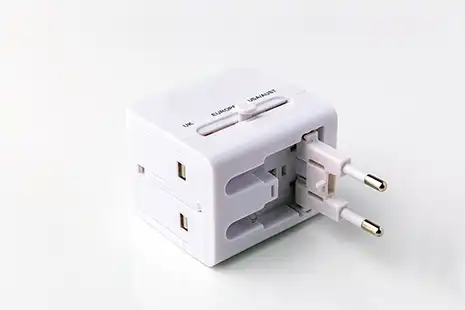
An adapter lets an American plug fit a German socket. A converter changes the voltage. Nearly all converters are also adapters, but not all adapters are converters, so read the product description carefully before you buy.
Check the label on each device. If it reads INPUT: 100–240V, 50/60 Hz, it is dual-voltage and can be used in any country, including Germany, with only an adapter. That covers most phones, tablets, laptops, and electronics with a boxy charger. Most CPAP machines are dual-voltage as well, but please check with your manufacturer or doctor to make sure yours is compatible.
Single-voltage devices need a converter, or the higher voltage from German sockets will burn them out. Hair dryers, straighteners, and curling irons fall into this category, as do many electric toothbrushes and shavers. Most hotels have hair dryers, and you will be able to check your specific hotels once your pilgrim packet arrives. Adapters and converters are easy to find online or in the travel section of stores such as Target and Walmart.
One adapter for the neighbors, with one exception. Austria, Belgium, and the Czech Republic use the same round-pin sockets, so the adapter you pack for Munich works in Salzburg, Brussels, and Prague. Switzerland uses its own recessed socket, which takes the slim two-pin Type C plug but not the thicker Type F. If your pilgrimage visits Einsiedeln, bring a slim adapter.

Questions Pilgrims Ask
Do U.S. citizens need a visa for Germany?
No. U.S. citizens can visit Germany without a visa for up to 90 days in any 180-day period, and that allowance is counted across the whole Schengen Area rather than per country. You need a passport valid for at least three months beyond the day you leave, two blank pages, and your return ticket. The first time you enter, the border officer will also take your photograph and fingerprints for the European Union's Entry/Exit System.
Do Americans need ETIAS for Germany?
Not yet. ETIAS, the European travel authorization for visa-exempt travelers, is not in operation, and the official European Union website says no applications are being collected. When it launches it will cost 20 euros (roughly $23) and the EU will announce the start date several months ahead. Any website that offers to sell you an ETIAS for Germany today is not the European Union. Tekton will tell registered pilgrims when it becomes necessary.
How long must my passport be valid to travel to Germany?
At least three months beyond the day you plan to leave the Schengen Area, and issued within the last ten years. The U.S. State Department recommends six months of validity and asks for two blank pages, and airlines apply the cautious figure at check-in, so travel with six months to spare. A passport that expires three months after you land is not enough. If you are close, renew before you register.
Are stores closed on Sunday in Germany?
Yes. German law closes shops and supermarkets on Sundays and on public holidays, and in the Catholic south that includes feasts such as Corpus Christi, the Assumption in much of Bavaria, and All Saints. Restaurants, cafés, museums, and churches stay open, as do shops inside major train stations and airports, and many bakeries open for a few hours in the morning. Buy anything you need on Saturday, when village shops also close earlier than you might expect.
Is Germany cash or card?
Both, but Germany uses more cash than most American visitors expect. Hotels, restaurants, and larger shops take Visa and Mastercard, and contactless payment is common. Bakeries, café counters, beer gardens, market stalls, small village shops, and public restrooms may take cash only, and some terminals accept only the German girocard. Withdraw euros from a bank ATM after you land and keep some coins and small notes with you every day.
Is tap water free in restaurants in Germany?
Usually not, and often it is not offered at all. German tap water is safe and closely tested, but restaurants normally serve bottled water and charge for it, and plain wasser usually arrives sparkling. Ask for stilles Wasser if you want still water. Some restaurants will bring a glass of tap water, Leitungswasser, if you ask, and some will decline. Fill a refillable bottle at the hotel instead.
Do you need a ticket to enter Cologne Cathedral?
For a sightseeing visit, yes. Since July 1, 2026, Cologne Cathedral has required a ticket for tourist visits to the interior, and the tower and the treasury each need their own. Attending Mass remains free, and anyone coming to pray or to light a candle can still enter the north transept without a ticket. Only small bags are allowed inside, men are asked to remove hats, and a Tekton group's visit is arranged in advance through your Pilgrimage Manager.
What plug adapter do I need for Germany?
Germany uses Type C and Type F sockets at 230 volts, the two round pins found across most of Europe. You need a plug adapter for American devices, and a voltage converter only for single-voltage appliances such as hair dryers and curling irons. Phones, tablets, laptops, and most CPAP machines are dual-voltage. The same adapter works in Austria, Belgium, and the Czech Republic, and a slim Type C adapter also fits Swiss sockets.
Next Steps
Arrive With Nothing Left on Your List
For thirty years Tekton has led pilgrims through the Catholic heart of Germany, from the Shrine of the Three Kings in Cologne to the Chapel of Grace at Altötting and the meadow church of the Wies. Everything on this page exists so that the practical things are settled before you land, and the quiet hours of the week are free for whatever God means to say in them.