
Where the Old Faith Never Died

Catholic Pilgrimage to England & Scotland

Walk the pilgrim roads of the English and Scottish saints — and come home carrying what they gave their lives to keep.
Durham Cathedral | County Durham, England
30+ Years Guiding Catholic Pilgrims
Daily Mass at Sacred Sites
Expert Local Guides
Walk the Holy Mile at Walsingham
The Invitation

The Faith That Was Kept in Hiding

A Catholic pilgrimage to England and Scotland is more than a religious tour. It is the slow discovery that the faith you practise openly was once kept alive in secret, at the cost of people’s lives. You walk the Holy Mile into Walsingham as pilgrims have since 1061, kneel at the tomb of St. Cuthbert in Durham, stand in the cell where St. Thomas More spent his last sixteen months, and pray in the small room on the Shambles in York where Margaret Clitherow hid her priests.

For over thirty years, Tekton Ministries has led pilgrims along these roads — not to tour the cathedrals, but to be changed by them. American Catholics who come here often find they are meeting their own ancestors: the men and women whose refusal to give up the Mass is the reason it ever crossed the Atlantic.
You go to England and Scotland to see where the faith survived. You come home knowing whose courage you inherited.
"When you seek truth, you seek God whether you know it or not."
- St. Edith Stein
Upcoming Pilgrimage Dates

Upcoming England & Scotland Pilgrimages

Most of our pilgrimages to these countries travel England and Scotland together, from Canterbury north to Edinburgh and the Highlands. Every pilgrimage includes daily Mass, a Pilgrimage Manager who travels with the group, and full logistics. England-only and Scotland-only itineraries are available for groups on request.
Date
Length
Price
(per person)
Departure City

No Matching Pilgrimages

Contact us to plan a custom pilgrimage for your group.

If none of these available dates work for you, please click the white button below to be notified when the next pilgrimage is open for registration. You will receive an email with all the pilgrimage details at that time.
Alternatively, you can plan a pilgrimage for your parish by clicking the gold button below. Someone from our office would be happy to speak with you about this.
Why This Pilgrimage Is Different

The Road That Was Broken

In 1536 the Crown condemned the practice of pilgrimage. Within two years the Priory at Walsingham had been pulled down, the shrine of St. Thomas Becket at Canterbury was broken up and carted away, and roads that English pilgrims had walked for five hundred years fell silent.

The Slipper Chapel — the last waystation before Walsingham, where pilgrims left their shoes and walked the final mile barefoot — became in turn a poorhouse, a forge, a barn, and a cowshed.
It is a national shrine again today.
That is the particular grace of this destination. What you follow in England and Scotland is not an unbroken tradition but a recovered one — kept alive in hiding, in priest holes and private chapels, at the cost of the men and women who would not give it up. You walk a road that was deliberately severed and has been deliberately re-walked.

Pilgrims tend to come home from England and Scotland with a sharper sense of what their own faith costs, and what it is worth. That is not something you can bring back in a suitcase. It is the reason to go.
The Dowry of Mary

England Pilgrimage Sites

Pray at the tomb of a martyred archbishop in Canterbury. Stand in the cell where St. Thomas More spent his last sixteen months. Cross the tidal causeway to Lindisfarne. Walk the last mile into Walsingham as pilgrims have for nearly a thousand years.
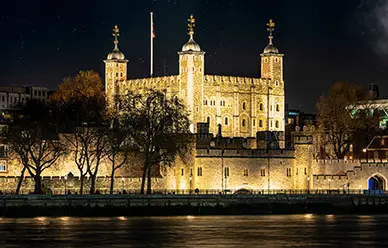
The Tower of London floodlit at night, where Sts. Thomas More and John Fisher were held before their execution

London

Tower of London · Westminster · St. Etheldreda’s · Tyburn
The Tower of London held Sts. Thomas More and John Fisher before their execution on Tower Hill in 1535; both are buried in the Chapel of St. Peter ad Vincula. Westminster Cathedral is the mother church of the Catholic Church in England and Wales and the seat of the Archbishop of Westminster. St. Etheldreda’s in Ely Place is the oldest Catholic church in England, a refuge during the penal years. At Tyburn Convent, the Benedictine sisters keep perpetual adoration at the site where more than a hundred martyrs died.
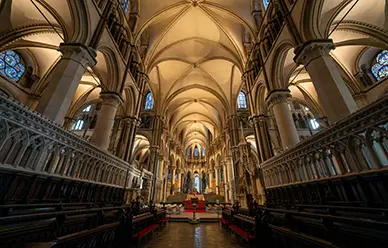
The vaulted interior of Canterbury Cathedral, where St. Thomas Becket was martyred in 1170

Canterbury

Canterbury Cathedral · St. Dunstan’s · Ramsgate · Rochester
St. Augustine arrived in 597, sent by Pope Gregory the Great to evangelize the Anglo-Saxons, and founded the monastery that became the burial place of kings and archbishops. In Canterbury Cathedral, St. Thomas Becket was killed by knights of Henry II in 1170 while praying vespers; he was canonized three years later, and it was to his tomb that Chaucer’s pilgrims were traveling. Nearby St. Dunstan’s holds the Roper family crypt, where the head of St. Thomas More is buried. Many itineraries pair Canterbury with Rochester, home of St. John Fisher.
Photo by Tomasz Zielonka on Unsplash, cropped
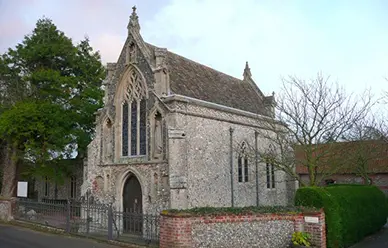
The Slipper Chapel at Walsingham, final waystation on the Holy Mile to England's national Marian shrine

Walsingham

National Shrine of Our Lady · Slipper Chapel · Priory ruins
In 1061 Richeldis de Faverches was shown, in a series of visions, the house in Nazareth where the angel Gabriel announced the birth of Christ, and Our Lady asked her to build its replica here. With the Holy Land closed to pilgrims during the Crusades, English Christians could visit ‘Nazareth’ in their own country, and Walsingham became the premier shrine to Our Lady in England — rivalling Canterbury and the great shrines of Europe. The Priory was dissolved in 1538. The Slipper Chapel, built around 1325 as the final waystation, was recovered in the nineteenth century and is now the Catholic National Shrine. See also our Marian shrines pilgrimages.
Photo: Humphrey Bolton / The Slipper Chapel, Houghton St Giles, cropped
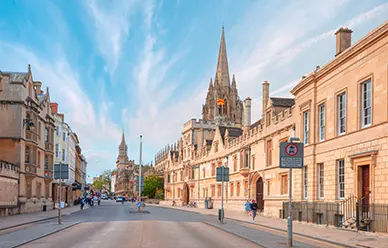
The spire of the University Church of St. Mary the Virgin above Oxford's High Street, where St. John Henry Newman preached

Oxford

Littlemore · Oriel & Trinity · University Church of St. Mary
St. John Henry Newman studied at Trinity College and held his fellowship at Oriel, preached at the University Church of St. Mary, and was received into full communion with the Church at Littlemore in 1845. St. Thomas More studied here two centuries earlier. Oxford is also the city of G.K. Chesterton’s circle and of C.S. Lewis and J.R.R. Tolkien, whose conversations at the Eagle and Child shaped a century of Christian writing.
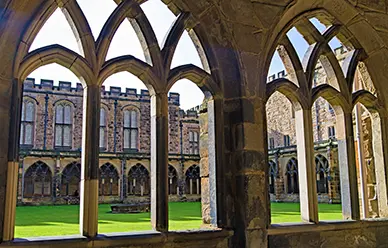
Gothic arches of the Durham Cathedral cloister looking across the green garth to the Norman stonework beyond

Durham

Durham Cathedral · Tomb of St. Cuthbert · Venerable Bede
Durham Cathedral is the great Norman church of northern England, built to house the body of St. Cuthbert after the monks of Lindisfarne carried it inland to escape the Viking raids. Pilgrims venerate Cuthbert at the east end and the Venerable Bede — the first historian of the English Church and a Doctor of the Church — in the Galilee Chapel at the west.
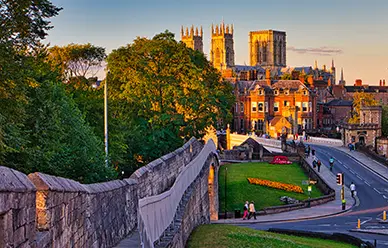
York Minster's towers rising above the rooftops at sunset, seen from York's medieval city walls

York

York Minster · Shrine of St. Margaret Clitherow · The Shambles
York Minster dominates this medieval walled city with its towers and its priceless stained glass. In the Shambles stands the shrine of St. Margaret Clitherow, the butcher’s wife who hid priests in her home and was pressed to death in 1586 rather than enter a plea that would have forced her children to testify. She is among the most affecting of the English martyrs, and her house is a working chapel.
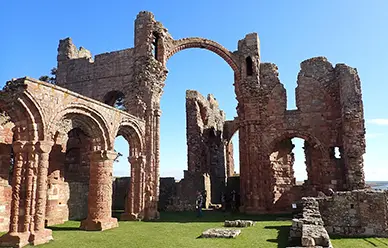
The rainbow arch and ruined nave of Lindisfarne Priory on Holy Island, where St. Aidan founded a monastery in 635

Lindisfarne

Holy Island · Priory ruins · St. Cuthbert’s original grave
St. Aidan came from Iona in 635 and founded the monastery that evangelized the north of England. St. Cuthbert later served as its abbot and was first buried here. The island is reachable only across a tidal causeway, and only when the tides allow — which is part of why it remains one of the quietest and most prayerful places on any English itinerary. The priory stands in ruins, and the Lindisfarne Gospels were written here.
Photo: Lindisfarne Priory - Inside the nave by Rob Farrow, CC BY-SA 2.0, via Wikimedia Commons, cropped
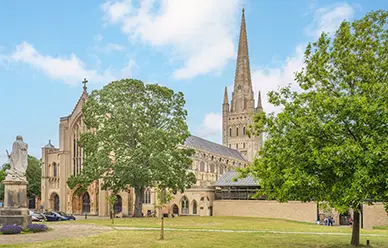
Norwich Cathedral and its spire, the second tallest in England, seen across the green of the Cathedral Close

Norwich

Norwich Cathedral · Cell of Julian of Norwich
Norwich Cathedral is a largely Norman church with the largest monastic cloister in England. Pilgrims come chiefly for the cell of Julian of Norwich, the fourteenth-century anchoress and mystic whose Revelations of Divine Love is the earliest surviving book in English written by a woman. Nearby Bury St. Edmunds holds the abbey where King Edmund, martyred by the Danes in 869, was buried.
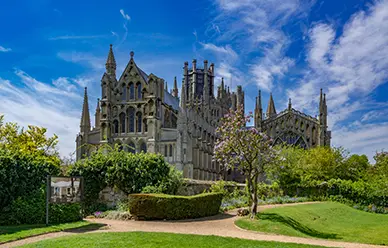
Ely Cathedral rising above its gardens in Cambridgeshire, built over the monastery St. Etheldreda founded in 673

Also on Our Itineraries

Aylesford · Ely · Cambridge · Lincoln · Fountains Abbey
Aylesford Priory in Kent, restored to the Carmelites in 1949, is associated with St. Simon Stock and the Brown Scapular. Ely Cathedral stands where St. Etheldreda founded her monastery in 673 — the same saint honoured at St. Etheldreda's in London — and is visible for miles across the flat country of eastern England. Lincoln Cathedral crowns the ridge above the River Witham. Fountains Abbey is among the largest and best-preserved ruined Cistercian monasteries in England, and Cambridge offers King’s College Chapel. Custom itineraries are built around the saints your group wishes to follow.
The Apostle and the Queen

Scotland Pilgrimage Sites

Venerate the relics of St. Andrew in Edinburgh. Pray at the tomb of St. Margaret of Scotland at Dunfermline. Stand in the ruins of a cathedral that once drew more pilgrims than anywhere in Europe outside Santiago.
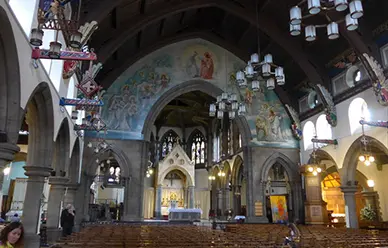
The painted sanctuary of St Mary's Metropolitan Cathedral in Edinburgh, home to the National Shrine of St Andrew

Edinburgh

St. Mary’s Cathedral · National Shrine of St. Andrew · Royal Mile
St. Mary’s Cathedral houses the National Shrine of St. Andrew, where relics of the Apostle are venerated — the reason Scotland claims him as patron. The Royal Mile runs from Edinburgh Castle to Holyroodhouse past St. Giles’ Cathedral and its Thistle Chapel, and the castle itself preserves St. Margaret’s Chapel, the oldest surviving building in the city.
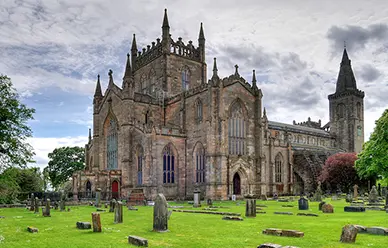
Dunfermline Abbey and its graveyard in Fife, burial place of St. Margaret of Scotland and Robert the Bruce

Dunfermline Abbey

Tomb of St. Margaret of Scotland · Robert the Bruce
Founded as a priory on the site where St. Margaret of Scotland married Malcolm III, Dunfermline became the home of the first Benedictine community in Scotland. Her son King David I raised it to an abbey. Damaged under Edward I and rebuilt in the fourteenth century by Robert the Bruce, it now holds the tombs of all three. Margaret — queen, mother of eight, and reformer of the Scottish Church — remains the country’s best-loved saint.
Photo: Dunfermline Abbey by David Dixon, CC BY-SA 2.0, via Wikimedia Commons, cropped
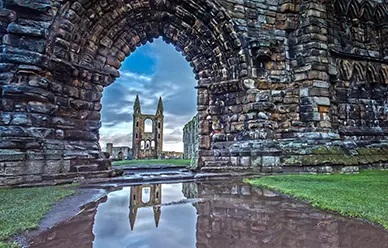
Ruins of St Andrews Cathedral, once the greatest pilgrimage destination in Europe outside Santiago

St. Andrews

Cathedral ruins · Medieval pilgrim routes
Before the Reformation, the cathedral of St. Andrew was among the most visited pilgrimage destinations in Europe — second only to Santiago de Compostela in the estimation of many medieval travelers. The cathedral now stands in ruins above the North Sea, and the walking routes that carried pilgrims to it are being restored, much as the Camino was.
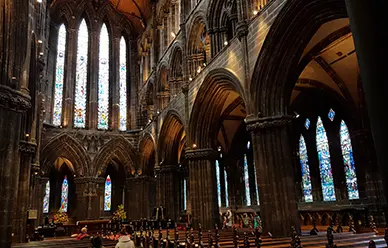
The nave and stained glass of Glasgow Cathedral, built above the tomb of St. Mungo, founder of the city

Glasgow & Carfin

Glasgow Cathedral · Carfin Grotto · St. John Ogilvie
Scotland’s largest city grew up around the shrine of St. Mungo, its founder, whose tomb lies in the crypt of Glasgow Cathedral. Glasgow is also the city of St. John Ogilvie, the Jesuit hanged here in 1615 and canonized in 1976 — Scotland’s martyr of the penal era. A short distance away at Carfin, near Motherwell, is Scotland’s national shrine to Our Lady of Lourdes, built by miners in the 1920s.
Photo: Stinglehammer, CC BY-SA 4.0, via Wikimedia Commons, cropped
A Highland cow in the open grassland of the Scottish Highlands

The Scottish Highlands

Stirling · Trossachs · Loch Lomond
The route north from Edinburgh passes Stirling Castle and the Wallace Monument before opening into the Trossachs and the banks of Loch Lomond. This is a day of landscape rather than shrines — and on a pilgrimage where so much has been about loss and endurance, the Highlands give the group room to breathe and to talk about what they have seen.
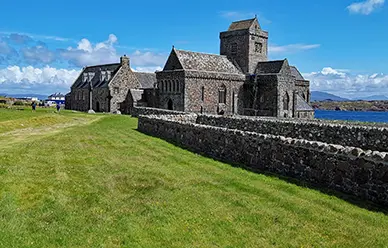
Iona Abbey above the Sound of Iona, on the island where St. Columba founded his monastery in 563

Iona

Abbey · St. Columba · Cradle of Scottish Christianity
St. Columba landed on this small Hebridean island from Ireland in 563 and founded the monastery from which Christianity spread through Scotland and, by way of St. Aidan, into northern England. Iona is remote and requires a ferry crossing, so it appears on longer custom itineraries rather than every departure — but for groups tracing the Celtic roots of the faith it is the beginning of the whole story.
Photo: PaulT (Gunther Tschuch), CC BY-SA 4.0, via Wikimedia Commons, cropped
Those Who Would Not Give It Up

The English and Scottish Martyrs

Between 1535 and 1681, hundreds of Catholics in England, Wales and Scotland were executed for their faith — bishops and scholars, priests smuggled in from seminaries abroad, and lay men and women who sheltered them. Forty were canonized together by Pope Paul VI in 1970. A pilgrimage here visits the places where they lived, hid, and died.
c. 300
Roman Britain
Saint Alban
St Albans, Hertfordshire · First martyr of these islands

Alban was a pagan Roman Briton who gave shelter to a priest fleeing the persecution. Watching the man pray through the night, he asked to be instructed and baptised. When the soldiers came, Alban put on the priest’s cloak and gave himself up in his place. He was beheaded on the hill above the town, and the abbey and the city of St Albans grew up around the spot. Everything that follows on this pilgrimage — the whole long English habit of hiding priests and dying instead of them — begins here, twelve centuries before the Reformation.

1535
22 June
Saint John Fisher
Rochester · Tower Hill · Canonized 1935

Bishop of Rochester for thirty years and the only bishop in England to oppose Henry VIII’s claim aloud. He was already in the Tower, old and ill, when Pope Paul III named him a cardinal — a gesture that enraged the King and hastened his death. He was beheaded on Tower Hill two weeks before his friend Thomas More, and both were buried in the Chapel of St. Peter ad Vincula inside the Tower walls. Pilgrims visit his chapel at Rochester Cathedral, built in memory of a bishop who would not be moved.

1535
6 July
Saint Thomas More
Chelsea · The Tower · Tower Hill · Canonized 1935

Lord Chancellor of England, author of Utopia, friend of Erasmus, and the most eminent layman in the kingdom. He resigned rather than assent, kept his silence for as long as the law allowed him to, and spent his last sixteen months in a cold cell above the Thames writing the Dialogue of Comfort Against Tribulation. His itinerary is a pilgrimage in itself: the mulberry tree he planted at Chelsea, the family tomb at Chelsea Old Church, Lincoln’s Inn where he read law, Westminster Hall where he was tried, the cell, and the scaffold.

“I die the King’s good servant, and God’s first.”

On the scaffold, Tower Hill

His head, rescued by his daughter Margaret Roper, is buried in the Roper vault at St. Dunstan’s in Canterbury — which is why a pilgrimage that begins in London so often ends up on the road to Canterbury.

1581
1 December
Saint Edmund Campion
Oxford · Lyford · Tyburn · Canonized 1970

The most brilliant young scholar in Oxford, singled out by Elizabeth I herself, with every worldly path open to him. He left it all, went to the Continent, became a Jesuit, and came back into England in disguise to minister to Catholics who had not seen a priest in years. Before he landed he wrote out a statement to be published if he were taken — the document known ever since as Campion’s Brag. He was betrayed at Lyford Grange, racked in the Tower, and hanged at Tyburn.

“The expense is reckoned, the enterprise is begun; it is of God, it cannot be withstood.”

Campion’s Brag, 1580
1586
25 March
Saint Margaret Clitherow
York · The Shambles · The Pearl of York · Canonized 1970

A butcher’s wife on the Shambles in York, a convert, and a mother. She kept a hidden Mass room in her house and sheltered the priests who used it, knowing exactly what the penalty was. At her trial she refused to enter any plea at all — because a trial required witnesses, and the witnesses would have had to be her own children. She was pressed to death instead. Her house on the Shambles is a working chapel today, and it is small enough that a group has to go in a few at a time, which is part of why it stays with people.

1615
10 March
Saint John Ogilvie
Banffshire · Glasgow Cross · Canonized 1976

Born into a Calvinist gentry family in the north-east of Scotland and sent abroad to be educated, he was received into the Church at seventeen and later ordained a Jesuit. He returned to Scotland disguised as a horse trader, ministering in secret in a country where the Mass had been outlawed for half a century. Arrested in Glasgow, he was kept from sleep for over a week to make him name other Catholics, and he named no one. He was hanged at Glasgow Cross, and as he went he threw his rosary into the crowd. He is Scotland’s only canonized martyr of the penal era.

Forty of the martyrs of England and Wales were canonized together by Pope Paul VI in 1970, and a further eighty-five were beatified by Pope John Paul II in 1987. On a Tekton pilgrimage they are not a footnote in a guidebook. You stand at Tower Hill, in the Shambles, at Tyburn and at Glasgow Cross — the actual ground — and your guide tells you what happened there.
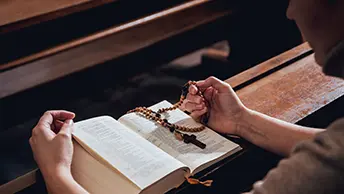
Pilgrim Voices

Pilgrim Reflections

"I have a whole new perspective on Sts. Thomas More and John Fisher and what it means to live (and die) one's faith."
Paul P.
Pilgrim from Willoughby, OH
"The experience has changed me in a way that is difficult to explain. I have told my friends and family that taking a pilgrimage is something everyone should do if they want to experience an increase in faith and understanding of what God wants from us.”
Emma P.
Pilgrim from Leeds, AL
"The Tekton staff are good, organized, experienced, thorough, friendly, caring Christians.”
Maria E.
Pilgrim from Annandale, VA
The Tekton Difference

Why Pilgrims Travel to England & Scotland with Tekton

Over 30 Years in Ministry
More than 20,000 pilgrims served across over 1,000 groups since 1996 — leading the way to the lands of St. Paul and the early Church.
Daily Mass
Mass is scheduled into the day rather than fitted around it, and a priest chaplain travels with the group. Itineraries are paced to leave room for prayer, confession and reflection.
Knowledgeable Local Guides
Expert local guides bring the Acts of the Apostles and the Book of Revelation to life on the ground, while your priest celebrates daily Mass and leads the group spiritually throughout.
Everything Handled for Group Leaders
Inclusive pricing, free promotional materials, easy online registration, and local offices and support worldwide — so a busy parish staff is not doing the administration.
Custom-Crafted Itineraries
England and Scotland reward a personal route. Groups have followed St. Thomas More through London, traced the English martyrs, or walked the Anglican patrimony from Oxford to Walsingham.
Prayerful Pre-Pilgrimage Prep
Spiritual resources to ready your heart before departure, so you arrive a pilgrim and return changed — seeds of grace, not souvenirs.
Pilgrim Questions

Questions About an England & Scotland Pilgrimage

Practical questions about visiting these countries — visas, currency, electricity, etiquette — are answered in our England Travel Guide and Scotland Travel Guide. Below: the shrines, the pace, the Anglican sites, and how a custom group pilgrimage comes together.
Begin the Pilgrimage

The Road Is Open Again

For four hundred years these shrines were empty by law. Walsingham has been restored, Lindisfarne is crossed again at low tide, and the martyrs are honoured in the places where they died. Come and see what that does to a person — then go home and live differently.