

Italy Travel Guide for Catholic Pilgrims
The Road Is Part of the Pilgrimage
This Italy travel guide is written for Catholic pilgrims, and it gathers what pilgrims most often need to settle before departure: entry requirements, what the new European border check actually involves, the weather month by month, money, church dress, and the small logistics that otherwise occupy the mind at the very moments you would rather be praying.
Italy has been receiving pilgrims for nineteen centuries, and it was never the arrival alone that mattered. Rome sits at the end of roads that people walked for months to reach. The wise men, too, were a long time on the way. Scripture spends more words on their travelling than on the moment they knelt down, which should tell us something about where the work of a pilgrimage actually happens.
You will feel this in Italy more than almost anywhere. The distance between the tomb of Saint Peter and the tomb of Saint Paul is walked, not skipped. Assisi is reached by climbing. The stone underfoot between one basilica and the next is not the gap between holy places. It is part of them.
Already registered? Your pilgrim packet arrives two to three weeks before departure with hotel details, your final itinerary, and specific guidance from your Pilgrimage Manager. This guide is what you need before that packet reaches you. Our pre-pilgrimage spiritual retreat is where the interior preparation happens.
Entry Requirements for Italy
Two European border systems have been in the news for years, and pilgrims arrive confused about which one applies to them. As of September 2026 the answer is simple: a United States passport is all you need to board, and the only new thing waiting for you is a biometric check on arrival.
First, a word you will keep meeting. The Schengen area is a group of twenty-nine European countries, Italy among them, that have taken down the borders between themselves and share one external border instead. Land in Rome and you could travel on to France, Austria, or Spain without another passport check. Two things follow from that, and both matter below: the rules on this page are European rules rather than Italian ones, and your days abroad are counted across the whole area rather than country by country.
ETIAS is not in operation. The European Travel Information and Authorisation System has been delayed to 2027, and no applications are being accepted anywhere. The European Union has committed to announcing a start date several months before the portal opens. Any site offering to sell you an ETIAS today is a scam. When it does begin, it will not be a visa, and Tekton will tell registered pilgrims what to do.
-
Check your passport before anything else
It must be valid for at least three months beyond the day you leave Europe, and it must have been issued within the previous ten years. Aim for six months of validity anyway, because airlines apply their own stricter rules at the check-in desk, and that is where trips are actually lost. Keep two blank pages free. If you are anywhere near expiry, renew before you register, not after.
-
Confirm the name matches
The name on your airline ticket must match your passport exactly. Maiden names, middle initials, and suffixes are the usual culprits. Send your Pilgrimage Manager a photograph of the passport page when you register and this resolves itself.
-
Understand the ninety-day rule
A U.S. passport allows ninety days in the Schengen area within any rolling one hundred eighty days, and Italy is part of that shared count. A pilgrimage is nowhere near the limit, but if you are extending a stay or linking two trips in Europe, the days add together across every Schengen country.
-
Carry copies, kept separately
Photograph your passport page and email it to yourself. Keep a paper copy in a different bag from the original. Replacing a lost passport in Rome is possible; doing it without a copy is slower.
Travelling on beyond the Schengen countries? Some Italy pilgrimages connect with Medjugorje or other destinations outside the Schengen area, and those have separate rules. Your itinerary will make this clear, and your Pilgrimage Manager will confirm it well before departure.
Italy Weather Month by Month
Italy runs eight hundred miles from the Alps to Sicily, and a single itinerary can cross a good deal of it. Rome is warmer than most pilgrims expect in October and hotter than almost anyone expects in July. Assisi sits high enough to be noticeably cooler, and the Gargano above San Giovanni Rotondo is cooler still.
| Month | Rome high | Rome low | Rain | What it feels like |
|---|---|---|---|---|
| January | 53°F | 38°F | Frequent | Cool, damp, and quiet. A real coat, and the basilicas nearly empty. |
| February | 55°F | 38°F | Frequent | Still cool. Churches are colder inside than out. |
| March | 60°F | 41°F | Occasional | Turning. Bright mornings, changeable afternoons, layers. |
| April | 65°F | 46°F | Occasional | Excellent walking. Umbria is green. Holy Week fills Rome. |
| May | 74°F | 54°F | Rare | Warm, long, and bright. Many pilgrims call it the best month. |
| June | 82°F | 61°F | Rare | Hot by midday. Start early, rest through the afternoon. |
| July | 88°F | 66°F | Very rare | The driest month and a demanding one. Water constantly. |
| August | 88°F | 66°F | Very rare | Hot, and much of Italy is on holiday. See Ferragosto below. |
| September | 81°F | 61°F | Occasional | Warm and settled, with the August crowds gone home. |
| October | 72°F | 54°F | Frequent | Mild and golden, with real rain arriving. Pack a shell. |
| November | 62°F | 46°F | Wettest month | Cool and often grey. All Saints and All Souls fill the churches. |
| December | 55°F | 40°F | Frequent | Cold, bright between rains, and Rome at Christmas is its own reason. |
- Warm to hot, dry, full sun
- Mild and changeable
- Cool, damp, often overcast
- Mildest walking weather
Historical averages for Rome. Assisi and the Umbrian hill towns run roughly five degrees cooler than these figures through the summer and colder at night; the Gargano above San Giovanni Rotondo is cooler again. Nights everywhere drop further than the daytime number suggests, and Italian churches hold the cold well into spring. Layers matter more than any single garment.
Comfort is not the only measure. Holy Week in Rome, the Feast of Saint Francis in Assisi on October 4, the feast of Saint Pio on September 23 — pilgrims who choose those dates are not choosing them for the forecast, and they rarely regret it. If you are weighing which season suits which itinerary, that question is answered on our Italy pilgrimage page.
Arrival at Fiumicino and the New Border Check
Most Italy pilgrimages arrive at Leonardo da Vinci airport at Fiumicino, west of Rome, and some at Milan Malpensa. Both now run the European Union's Entry/Exit System, and the first thing you will notice is that nobody stamps your passport any more.
What the biometric check involves
The Entry/Exit System began at Fiumicino and Malpensa on October 12, 2025 and has covered every Schengen border since April 10, 2026. On your first entry you are directed to a booth or self-service kiosk before the passport officer, where the system records your fingerprints and a facial image along with your passport details and the date. It takes a couple of minutes.
There is nothing to register beforehand and no fee. The record is held for three years, so a second pilgrimage inside that window moves considerably faster. The system exists to replace ink stamps with a digital count of your days in Europe.
How long to allow
Queues at Italian airports have been longer than usual since the system went live, particularly on summer mornings when several long-haul flights land together. Your group is met after baggage claim regardless of how long the hall takes, so there is no flight to miss — but tell anyone waiting at home not to worry about silence for an hour or two.
On the way home, plan on arriving three hours before an international departure. Your Pilgrimage Manager confirms the timing on the ground.
Holy water, oils, and anything liquid. Blessed oils, water from Lourdes or Loreto, and bottles brought home from a shrine must travel in checked luggage rather than your carry-on. If you buy them on the final day, say so to your Pilgrimage Manager before you pack. Olive wood, rosaries, and medals travel fine either way.
General Information

- Capital city
- Rome
- Largest city
- Rome
- Official language
- Italian
- Time zone
- 6 hours ahead of U.S. Eastern Time
- Flight time
- Roughly 9 hours nonstop from the U.S. East Coast
- Country code
- +39
- Emergency number
- 112
- Main airports
- Rome Fiumicino (FCO) · Milan Malpensa (MXP)
Will people speak English?
In the places your pilgrimage takes you, mostly yes. English is widely spoken in Roman hotels, at the Vatican, and in the shops around the basilicas, and less so in smaller towns and with older Italians. Your knowledgeable Catholic and other Christian guides speak fluent English. Where a word does not land, a smile and a little patience still do. Buongiorno on the way in and grazie on the way out will carry you a surprising distance.
The emergency number
Italy does not use 911. Dial 112 for any emergency anywhere in the country — police, ambulance, or fire. It is free, it works from any phone including one with no SIM card and no credit, and the call centre locates you automatically and brings in an interpreter if needed. Operators in Rome, Florence, Milan, and the other major cities speak English.
Three older numbers still work if you know exactly who you need: 113 for the state police, 115 for the fire service, 118 for an ambulance. You are unlikely ever to need any of them. Your Pilgrimage Manager is with the group throughout and is the first person to find if something goes wrong. Save 112 and your hotel address to your phone before you leave home anyway.
Calling home, and being called
Italy does one thing no other country does. When you give family an Italian landline number — a hotel, say — the leading zero in the area code stays in place, even from abroad. Rome is +39 06, not +39 6. Drop that zero out of habit, as you would for London or Paris, and the call simply fails. Italian mobile numbers begin with 3 and have no leading zero at all.
Jet lag
The six-hour shift is real, and most pilgrims find the second and third days harder than the first. Stay awake until a normal local bedtime on arrival day, drink more water than feels necessary, and get outside into the morning light. Our advice on the first day of a pilgrimage covers the rest.
Money, Cards, and Tipping
Should I buy euros before I leave?
No. Buying foreign currency from an American bank, or worse from an airport exchange counter, is the most expensive way to get it. Those counters set their own rate well away from the market and then add a fee on top, so a meaningful share of the value is gone before you have left the country.
Withdraw euros from a bank ATM after you arrive, where the rate is close to the real one. Two things worth knowing:
- Use a machine attached to a bank rather than a standalone one in a tourist street. Independent ATMs near the Trevi Fountain and the Vatican charge conspicuously more.
- Always choose to be charged in euros, never in dollars. When a machine or a card terminal offers to convert for you, it is applying its own poor rate. This is called dynamic currency conversion, and declining it costs nothing.
Withdraw once and withdraw enough, since most cards charge a flat fee per withdrawal.
How much cash will I actually need?
Less than most pilgrims bring. Italian merchants are required to accept cards, and in practice nearly all of them do, down to small cafés. Cash is still useful for candles and offerings in churches, small shops in the hill towns, market stalls, and the occasional parking or restroom charge. A modest amount in small notes covers a full pilgrimage.
Which cards work?
Visa and Mastercard are accepted everywhere. Discover is uncommon overseas. American Express is more widely taken in Italy than it once was, but still not universally. Before you leave:
- Tell your card issuer your travel dates so purchases are not flagged and frozen.
- Check your foreign transaction fees, which vary considerably from card to card.
- Carry a second card, kept somewhere other than your wallet.
- Know your PIN. Some Italian terminals and automated machines will ask for it.
What is the coperto on my bill?
Italian restaurants commonly add a small per-person coperto, a cover charge for bread and table service. It is not a tip and it is not optional. Some places add a servizio charge as well, in which case nothing further is expected. Rounding up for genuinely good service is welcome but never assumed — Italy does not run on tipping the way the United States does.
What about gratuities for the guide and driver?
Gratuities for your guides and drivers are customary. Tekton provides specific guidance in your pilgrim packet so the whole group works from the same expectation, and your Pilgrimage Manager confirms the arrangements before the final day. There is nothing to work out on your own.
Riposo, Ferragosto, and the Italian Clock
Italy keeps a different day from the one American pilgrims are used to, and the difference is not laziness. It is a structure, and once you see it the country makes a great deal more sense.
The midday pause
Riposo is the long break in the middle of the day. In Assisi, Siena, Orvieto, San Giovanni Rotondo and most towns outside the big cities, shops shutter from roughly one o'clock until four and then reopen into the evening. Many churches close for the same hours. A town that was full at noon is silent at two and busy again at five.
Central Rome, Florence, and Milan largely keep straight hours now, so you may go a whole pilgrimage without meeting riposo in the cities. In the hill towns you will meet it every day. Your itinerary is built around it — it matters mainly when you were planning to slip out for a errand after lunch.
Sundays and feast days
Sunday in Italy is still Sunday. Shops outside the tourist centres close, families eat together for hours, and the pace drops noticeably. Churches, of course, are at their fullest and most alive.
The largest of these is Ferragosto, August 15. For Italians it is the peak of the summer holiday and the day the country visibly empties — shops shut, cities thin out, whole neighbourhoods go to the coast. It is also the Solemnity of the Assumption, a Holy Day of Obligation, and the reason the holiday exists at all. If your pilgrimage falls across it, you will find closed shutters and full churches on the same street, which is the whole of Italy in one afternoon.
Meals run late
Lunch begins around one. Dinner rarely starts before half past seven and often later, and a restaurant that looks empty at seven will be full by nine. Nobody will hurry you out. In Italy the table is where the day is spent, not an interruption to it, and a long meal with your group is not time taken from the pilgrimage.
Phone, Data, and Water
Will my phone work in Italy?
Yes. Coverage is strong, including at almost every shrine. Your options:
- Carrier travel pass. Simplest. Most U.S. carriers sell a daily or monthly international plan covering Italy. Add it before you leave, not on arrival.
- eSIM. Usually cheaper if you expect heavy data use. Buy and install it before departure while you still have home Wi-Fi.
- Hotel Wi-Fi. Widely available and generally fine. Enough if you are content to check in once a day.
Many pilgrims use WhatsApp for calls and messages home, since it works over Wi-Fi and is what most of Europe uses by default.
Consider using it less. The phone is useful for photographs and a nightly word home. It is also the quickest way to be somewhere other than where you are standing. Many pilgrims decide in advance to keep it pocketed inside the basilicas, and come home glad they did.
Can I drink the tap water?
Yes, everywhere in Italy. Rome goes further than most cities: the nasoni, the cast-iron street fountains with the curved spout, run continuously with cold, clean drinking water and have done for well over a century. They are free, they are all over the city, and in July they are a mercy. Cover the end of the spout with a finger and the water arches up through a small hole on top, which is how Romans drink from them without a bottle.
Assisi and the hill towns have their own fountains. Carry a refillable bottle regardless: you will walk further on stone than you expect.
Food and dietary needs
Hotel breakfasts in Italy are lighter than American ones — coffee, bread, pastry, sometimes eggs and cured meat. Eat enough; lunch is a long way off. Coeliac disease is well understood in Italy and senza glutine options are common. If you have a serious allergy or a dietary requirement, tell your Pilgrimage Manager well before departure so arrangements are made rather than improvised at the table.
What to Wear in Italian Churches
Dress as you would at home, with one consistent exception: the churches expect modesty, and unlike almost everywhere else in Europe, they enforce it at the door.
Knees and shoulders must be covered to enter Saint Peter's Basilica and the other major churches, for men and women alike. Bare midriffs are not permitted. This is checked at the entrance, and pilgrims are turned away every day of the summer. It is a poor way to spend a morning you may have waited years for.
You will not need a head covering, and women are not expected to wear skirts or dresses unless that is your preference. Jeans are fine, unless your priest has told you differently. A light scarf packs to nothing and solves almost every situation you will meet, including a cold basilica in April.
The one thing worth spending money on is your shoes. Rome is paved with sampietrini, the small basalt cobbles that have been underfoot since the sixteenth century, and Assisi and Siena are built on hills. You will walk several miles a day on uneven stone. Break them in well before you go.
Rome and the motorcoach. Coaches are restricted in where they may travel within Rome. On some days you will be set down and walk to the site, and you may not be able to leave belongings on the coach during the day, since a different one may collect you in the evening. Carry what you need for the day and leave the rest at the hotel. Your Pilgrimage Manager will tell you which days these are.
Electricity, Plugs, and Adapters
- Socket types
- Type C, E, F, and L
- Voltage
- 220–240V
- Adapter needed?
- Yes
- Converter needed?
- Only for single-voltage devices
Adapter or converter?
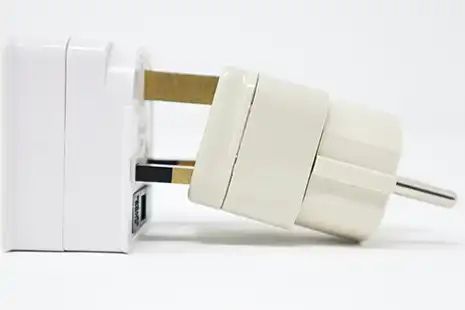
An adapter lets an American plug fit an Italian socket. A converter changes the voltage. Nearly all converters are also adapters; not all adapters are converters, so read the product description rather than the title.
Check the label on each device. If it reads INPUT: 100–240V, 50/60 Hz, it is dual-voltage and needs only an adapter. That covers most phones, tablets, laptops, and cameras. Most CPAP machines are dual-voltage as well, but confirm with your manufacturer or physician before you rely on it.
Single-voltage devices need a converter, or the higher Italian voltage will destroy them. Hair dryers, straighteners, curling irons, and many electric shavers and toothbrushes fall into this category. Most hotels provide hair dryers, and your pilgrim packet confirms the specific hotels on your departure.
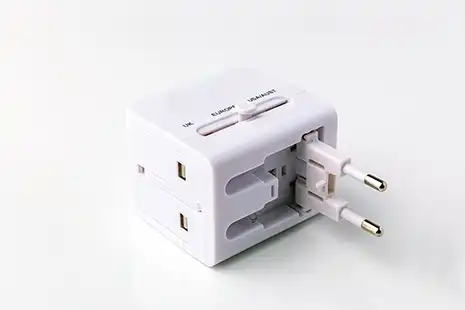
Italy's Type L socket is the one that catches people out: it is the three-in-a-row Italian plug, and a cheap two-pin adapter will not always seat properly in it. A universal adapter that covers Europe handles all four types.
Questions Pilgrims Ask
Is ETIAS required for Italy yet?
No. As of September 2026 the European Travel Information and Authorisation System is not in operation and no applications are being accepted anywhere. The launch has moved to 2027, and the European Union has committed to announcing a specific date several months in advance. U.S. citizens travel to Italy on a valid passport alone. Any website offering to process an ETIAS application for you today is a scam.
How long does my passport need to be valid to travel to Italy?
Your passport must be valid for at least three months beyond the day you fly home from Europe, and it must have been issued within the previous ten years. Six months of validity is the safer target, because airlines apply their own rules at check-in. Carry two blank pages. Travelers are turned away at the airline counter over this far more often than at the border.
What happens at the airport now that the EU Entry/Exit System is live?
Since April 10, 2026 the Entry/Exit System has operated at Europe's external borders, including Rome Fiumicino and Milan Malpensa. On your first entry you register fingerprints and a facial image at a booth or kiosk before reaching the officer, which takes a couple of minutes. Your passport is no longer stamped. There is nothing to arrange in advance and no fee, and the record is kept for three years, so a later pilgrimage moves faster.
What is the dress code for Italian churches?
Knees and shoulders must be covered, for men and women alike, and bare midriffs are not permitted. This is checked at the entrance to the major basilicas and it is enforced. You will not need a head covering, and women are not expected to wear skirts unless that is your preference. Jeans are acceptable, unless your priest has told you differently. A light scarf packs small and solves nearly every situation you will meet.
What is riposo and will shops be closed in the afternoon?
Riposo is the long midday pause. In smaller towns such as Assisi, Siena, and San Giovanni Rotondo, many shops and some churches close from roughly one o'clock until four, then reopen into the evening. Central Rome keeps longer hours. Your itinerary is built around it, but it is worth knowing before you plan an afternoon errand.
Should I buy euros before I leave the United States?
No. Your home bank and the airport exchange counters set their own rate and add a fee on top, so you lose value before you have left the country. Withdraw euros from a bank ATM after you arrive, and always choose to be charged in euros rather than dollars when a machine or a card terminal offers to convert for you. Cards are accepted almost everywhere in Italy, so carry only modest cash for small shops, offerings, and candles.
Can I drink the tap water in Italy?
Yes. Tap water is safe throughout Italy. Rome also keeps its public drinking fountains, the cast-iron nasoni, which run continuously with cold, clean water, and Assisi and the hill towns have fountains of their own. Carry a refillable bottle anyway, because you will walk further than you expect on stone.
What kind of electrical adapter do I need for Italy?
Italy uses Type C, E, F, and L sockets at 220-240 volts, so you will need a plug adapter. You will only need a voltage converter if a device is single-voltage. Phones, tablets, laptops, and most CPAP machines are dual-voltage and need only an adapter. Hair dryers, curling irons, and some electric shavers often are not.
Next Steps
Return Home by a Different Way
For thirty years Tekton has walked with pilgrims through Italy — to the tombs of the Apostles, the hills of Assisi, and the altars where the saints still draw us. Everything on this page exists so that when you arrive, the logistics are already settled and you are free to be present.