
Poland Travel Guide for Catholic Pilgrims
Preparing for Poland
This Poland travel guide is written for Catholic pilgrims, and it gathers what Tekton pilgrims most often need settled before departure: entry requirements, the weather in the months our groups travel, arriving in Warsaw or Kraków, money, the closed Polish Sunday, and how to prepare for a day at Auschwitz-Birkenau.
Very little of it is complicated. U.S. citizens need no visa, cards work almost everywhere, and one European adapter covers every Tekton itinerary in the country. What catches pilgrims out are the smaller things: a currency that is not the euro, shops that close on Sunday, a bag-size rule at the Auschwitz Memorial, and October evenings that run colder than the daytime forecast suggests.
The wise men's long journey ended in a house, where they saw the Child with Mary his mother, and they knelt down. Pilgrims in Poland find the same scene at Jasna Góra, where Our Lady still holds her Son out to everyone who comes. Settle the practical things at home, and you arrive with your attention free for that moment.
Already registered? Your pilgrim packet arrives two to three weeks before departure with hotel details, your final itinerary, and guidance from your Pilgrimage Manager. This guide is what you need before that packet reaches you. Our pre-pilgrimage spiritual retreat is where the interior preparation happens.
Entry Requirements for Poland
Poland asks nothing of a U.S. pilgrim in advance beyond a valid passport. It belongs to the European Union and the Schengen Area, and Americans visit for up to ninety days without a visa. What deserves attention is the passport itself, and one Polish border rule that happens to work in a pilgrim's favor.
ETIAS is not in operation. The European Travel Information and Authorisation System has been delayed again, the European Union has removed its 2026 target, and no applications are being accepted anywhere. Poland is in the Schengen Area, so ETIAS will apply here when it launches. Until then, any website offering to sell you one is not the official portal. Tekton will tell registered pilgrims what to do when a real date is announced.
-
Check your passport against two dates
It must be valid for at least three months after the day you leave the Schengen Area, and it must have been issued within the last ten years. On a pilgrimage that ends in Prague or Split, the date that counts is the day you fly home from there, not the day you leave Poland. Airlines apply their own stricter reading at check-in, so travel with six months to spare. If you are close to either limit, renew before you register.
-
Know the one question the border can ask
Polish law sets the money a visitor from outside the European Union should be able to show for a stay: 300 zloty (roughly $80) for up to four days, or 75 zloty (roughly $20) for each day of a longer stay. Poland also makes an exception that fits a pilgrimage exactly. When your accommodation and meals are already paid for, the figure falls to 20 zloty a day (about $5), with a minimum of 100 zloty (about $27).
Most pilgrims are never asked. If you are, your pilgrimage confirmation shows the stay is paid for, and your return ticket covers the journey home. The regulation also accepts a statement from your bank, or a letter from your card issuer showing your credit limit, dated within the month before you travel.
-
Keep your return ticket and confirmation reachable
An officer may ask how you are leaving and where you are staying. Keep your return flight and your pilgrimage confirmation on your phone and on paper, in your day bag rather than the bottom of a checked suitcase.
-
Count your days across all of Schengen
A U.S. passport allows ninety days in the Schengen Area in any rolling one hundred eighty, and Poland shares that count with Lithuania, the Czech Republic, and Croatia. A pilgrimage is nowhere near the limit, but the days add together if you stay on to visit family elsewhere in Europe. The one itinerary that briefly leaves Schengen is Poland and Medjugorje, which crosses into Bosnia and Herzegovina. Our Bosnia travel guide covers that border.
Carry copies, kept apart from the original. Photograph your passport page and email it to yourself, and keep a paper copy in a different bag. Send your Pilgrimage Manager a photograph of the page when you register, so the name on your airline ticket can be checked against it. Maiden names, middle initials, and suffixes are the usual trouble.
Poland Weather Month by Month
Poland has a continental climate, and it catches pilgrims who know the Mediterranean shrines off guard twice over. The winters are genuinely cold, and the rain falls mostly in summer, not winter. Late spring and early autumn are when the country is at its kindest, which is why nearly every Tekton group travels in May, September, or October.
| Month | Warsaw | Kraków | Prague | Vilnius | Rain, Kraków (in) | What it feels like |
|---|---|---|---|---|---|---|
| January | 34° / 25° | 35° / 24° | 39° | 29° | 1.5 | Deep winter. Short grey days, snow some years, frozen ground at Birkenau. |
| February | 37° / 26° | 39° / 25° | 42° | 31° | 1.3 | Still hard cold. Kraków's old town under frost most mornings. |
| March | 45° / 31° | 47° / 31° | 50° | 40° | 1.5 | Thawing, raw, and changeable. Winter coats still needed. |
| April | 58° / 39° | 59° / 39° | 61° | 55° | 1.8 | Spring arrives unevenly. Warm afternoons, near-freezing nights. |
| May | 68° / 48° | 68° / 47° | 70° | 65° | 3.1 | Green, bright, and long-lit. Showers and the first thunderstorms. |
| June | 74° / 54° | 74° / 54° | 76° | 71° | 3.0 | Warm, with the longest days of the year and afternoon storms. |
| July | 77° / 58° | 78° / 57° | 80° | 75° | 3.9 | The warmest and wettest month, rain in short heavy bursts. |
| August | 76° / 57° | 77° / 56° | 79° | 74° | 2.9 | Warm. The walking pilgrims reach Jasna Góra for August 15. |
| September | 66° / 49° | 67° / 49° | 69° | 63° | 2.6 | The best walking weather of the year. Clear, mild days. |
| October | 55° / 41° | 57° / 40° | 58° | 51° | 2.0 | Crisp and golden early, cold and damp by the end. |
| November | 44° / 34° | 46° / 33° | 47° | 39° | 1.6 | Grey, damp, and dark by four. Candles on every grave on November 1. |
| December | 36° / 28° | 37° / 26° | 41° | 32° | 1.3 | Cold, with Advent markets in Kraków's Main Square. |
- Warmest months, and also the wettest
- Mild and changeable, cold at night
- Cold and grey, with short days
- Most comfortable months for walking
Average daytime highs in Fahrenheit, with overnight lows for Warsaw and Kraków. Rainfall is the monthly average at Kraków Airport. Figures are 1991–2020 climate normals published by IMGW, Poland's national meteorological and hydrological institute, for Warsaw Chopin Airport and Kraków Airport; for the Clementinum station in Prague; and by the Lithuanian Hydrometeorological Service for Vilnius.
Summer is the rainy season
Kraków gets nearly four inches of rain in July and about an inch and a quarter in February. That is the reverse of Italy, Portugal, or the Holy Land. Polish summer rain tends to arrive as short, heavy afternoon thunderstorms that clear within the hour, so a compact umbrella in the day bag does more good than a heavy raincoat left at the hotel.
The months Tekton groups travel
In May, Kraków's afternoons average 68°F and the evenings drop to the upper 40s. September is nearly identical by day and the steadiest month of the year for walking. October starts golden and ends cold: the average low in Kraków is 40°F, frost is possible in the last week, and Birkenau, on open ground, feels colder than the city. For an autumn departure, pack a warm jacket, a hat you can pull on at Auschwitz, and gloves you may never need.
Prague runs warmer, Vilnius colder
If your pilgrimage continues to Prague, expect it to feel a couple of degrees milder than Kraków. The figures above come from the old Clementinum observatory in the heart of the city, which also keeps the nights warmer. If it begins in Vilnius, expect the reverse: Lithuania runs several degrees colder than southern Poland in every month of the year.
Underground, the season does not change
The Wieliczka Salt Mine holds at 17–18°C, about 63°F, all year round. In July that is a relief. In October it is warmer than the street above. Either way, bring a light layer you can carry.
Arriving in Warsaw, Kraków, or Vilnius
Most Tekton pilgrimages to Poland land in Warsaw and travel south toward Czestochowa and Kraków. Others land in Kraków, or begin in Vilnius and cross into Poland by coach. Many go home from Prague, and one flies on from Kraków to Croatia for Medjugorje. Where your flight first touches Europe decides where your passport is checked.
Landing at Warsaw Chopin
Since April 10, 2026, every Schengen airport has used the European Union's Entry/Exit System. The first time you enter, your passport is scanned and your fingerprints and a photograph are recorded, often at a self-service kiosk before you reach an officer. It takes a few minutes per person, and at peak hours the queues can be long. It is not difficult, only slow, so keep the group together and be patient.
If your flight connects through Frankfurt, Munich, Amsterdam, or another Schengen hub, that registration happens there instead, and you walk off the plane in Warsaw as if from a domestic flight. Your Pilgrimage Manager meets the group on arrival and stays with you for the whole pilgrimage.
Kraków's airport carries a saint's name
Kraków John Paul II International Airport sits at Balice, west of the city. It is smaller and quicker than Warsaw, and it is the airport for pilgrimages that begin in Kraków or fly on from it. The flight from Kraków to Split, on the Poland and Medjugorje pilgrimage, stays inside the Schengen Area, so there is no passport control at either end. The border comes later, on the road from Split into Bosnia and Herzegovina.
Crossing by coach
Poland, Lithuania, and the Czech Republic share the Schengen Area, so there is normally no passport control between them, and the drive from Kraków to Prague crosses the Czech border with little more than a change of road signs. The border with Lithuania is the exception for now. Since July 2025 Poland has run selective checks there, and on the Vilnius itinerary the coach may be stopped. Keep your passport on you, not in the luggage hold, on the day you cross.
One thing changes at the Lithuanian border: the clock. Lithuania is an hour ahead of Poland, so on the drive south from Vilnius your watch goes back an hour.
Going home
Your exit from the Schengen Area is recorded the same way at your departure airport, whether that is Warsaw, Kraków, Prague, or Split. Plan on arriving three hours before an international flight. Bottles of holy water and blessed oils belong in checked luggage. A rosary from Jasna Góra or a Divine Mercy image from Lagiewniki travels anywhere.
General Information

- Capital city
- Warsaw
- Largest city
- Warsaw
- Official language
- Polish
- Time zone
- 6 hours ahead of U.S. Eastern; 1 hour behind Lithuania
- Country code
- +48
- Emergency number
- 112
- Driving
- On the right
Will people speak English?
In the areas where you will be traveling, you are likely to meet people who speak English, especially younger Poles, hotel staff, and the people who look after the shrines. Your knowledgeable Catholic and other Christian guides speak it fluently. English thins out among older Poles and in small towns, and if you have a hard time communicating with someone, a smile and a little body language go a long way. Three words are worth learning on the plane: dzien dobry (JEN DOH-bri), good day; dziekuje (jen-KOO-yeh), thank you; and prosze (PRO-sheh), which means both please and here you are.
Reading Polish place names
Polish spelling looks forbidding and is more regular than English. Signs use several letters English does not, among them an L with a stroke through it, which sounds like an English w. That is why Lagiewniki, home of the Divine Mercy Shrine, is said wah-gyev-NEE-kee. The pair cz is our ch, so Czestochowa is chen-sto-HO-va, and w is our v, which makes Wadowice vah-do-VEE-tseh. Itineraries and maps, including ours, often leave the accent marks off, so the names on your itinerary will look a little plainer than the signs. Kraków, Krakow, and Cracow are the same city, and Oswiecim is the Polish name of the town the world knows as Auschwitz.
Emergency numbers
Poland does not use 911. Dial 112 for police, ambulance, or fire. It needs no area code, works from any phone in the country including a mobile without a Polish SIM, and operators can take calls in English. You will almost certainly never need it. Your Pilgrimage Manager is with the group throughout and is the first person to find if something goes wrong. Save the number anyway, alongside your hotel addresses, before you leave home.
Jet lag
Six hours is a real shift, and most flights land in Poland in the morning after a night in the air. Stay outside in the daylight, drink more water than feels necessary, and hold out until a normal Polish bedtime. The first day is usually gentle for exactly this reason. Our advice on the first day of a pilgrimage covers the rest.
The Zloty, Cards, and Tipping
Poland is in the EU, but not on the euro
Poland uses its own currency, the zloty, written zl or PLN and divided into 100 groszy. Euros are not legal tender. A few hotels and larger shops will take them, at a rate that favors the shop, and most places will not. U.S. dollars are not accepted at all. In practice you will need very little cash, because Poland is among the most card-friendly countries in Europe. Contactless payment is standard in shrine gift shops, pharmacies, cafés, and even many market stalls.
Keep some zloty in small notes and coins for candles, offering boxes, a coffee, and public restrooms, which in Poland usually charge a few zloty at the door.
Should I buy zloty before I leave?
No. Your home bank and the airport exchange counter both set their own rate and add a fee on top. Withdraw zloty from an ATM after you arrive, and choose a machine that belongs to a Polish bank such as PKO Bank Polski, Pekao, or Santander Bank Polska. The standalone machines clustered around tourist squares charge noticeably more.
- Always choose to be charged in zloty. When an ATM or a card terminal offers to bill you in U.S. dollars, it is applying its own poor rate. This is dynamic currency conversion, and saying no costs nothing.
- Withdraw once and withdraw enough, since most U.S. cards charge a flat fee per withdrawal.
If you are carrying cash dollars anyway, a kantor, one of the small exchange offices found on most city streets, usually gives a far better rate than the airport. Compare the posted buying rate at two before you hand anything over.
Which cards work
Visa and Mastercard are accepted everywhere. Discover is not as common overseas. American Express is becoming more popular but is still not as widely accepted as Visa or Mastercard. Before you leave:
- Tell your card issuer your travel dates, so your purchases are not flagged.
- Check your foreign transaction fees, so you are not surprised by extra costs.
- Carry a second card, kept somewhere other than your wallet.
- Know your PIN. Polish terminals ask for it on larger purchases.
Tipping in Poland
Gratuities for your guides and drivers are already on your final invoice, so there is nothing to calculate or hand out on the last day. Your pilgrim packet explains what that amount covers.
At a meal you pay for yourself, around ten percent is customary for good service. One Polish habit is worth knowing before you learn it the expensive way. Saying dziekuje, thank you, as you hand over your payment tells the server to keep the change. Say it once the change is back in your hand.
If your pilgrimage crosses a border
Every country on a Tekton Poland itinerary handles money differently. The Czech Republic uses the koruna, and euros are not generally accepted in Prague, so withdraw a small amount there. Lithuania and Croatia use the euro. Medjugorje uses the convertible mark, though euros are widely taken in the village.
A Country That Still Keeps Sunday
Since 2018, Polish law has closed most shops on most Sundays. Pilgrims from countries where Sunday is simply a second Saturday tend to discover this at about eleven in the morning, standing outside a locked supermarket. It is worth knowing in advance, and worth seeing for what it is.
What closes, and what does not
Supermarkets, shopping malls, and most shops stay shut on all but a handful of designated trading Sundays. In 2026 there are eight, and none of them falls in May, September, or October, so every Sunday of a Tekton pilgrimage to Poland will be a closed one. Pharmacies, bakeries, petrol-station shops, small shops staffed by their owners, restaurants, cafés, and museums can all open. Public holidays close shops too, among them May 1, May 3, Corpus Christi, August 15, November 1, and November 11.
The practical answer is simple. Buy snacks, toiletries, batteries, and anything else you might want on Saturday, and a Sunday will cost you nothing.
What Sunday gives back
A closed shop is the smallest part of a Polish Sunday. Churches fill for Mass after Mass, families walk together afterward, and whole towns slow to a pace that most of the Western world gave up long ago. Poles genuflect deeply, kneel on stone floors, and many kneel to receive Communion. Many still cross themselves as they pass a church door on the street.
That faith was kept at a price. On Warsaw itineraries, pilgrims pray at the Church of Saint Stanislaw Kostka, where Blessed Jerzy Popieluszko preached to packed crowds under Communism, and where he is buried after his murder by the secret police in 1984. A full church in Poland is not a habit that survived by accident. It is worth joining rather than merely observing.
Candles, flowers, and November
On All Saints' Day, November 1, and All Souls' Day that follows, nearly the whole country goes to the cemeteries. Graves are cleaned, covered in flowers, and lit with thousands of candles in colored glass, and by nightfall a Polish cemetery glows. If a late-autumn pilgrimage puts you there, go and see it.
Preparing for Auschwitz-Birkenau
Most Tekton pilgrimages to Poland spend a day at the Auschwitz-Birkenau Memorial, west of Kraków in the town of Oswiecim. It is a museum, a memorial, and a cemetery without graves. More than a million people were murdered here, most of them Jews. It asks for a different kind of preparation from every other day of the pilgrimage.
Two saints of the Church died here
Among the dead are two saints of the Church. In August 1941, the Franciscan friar Maximilian Kolbe stepped forward and offered his own life in place of a condemned man, Franciszek Gajowniczek, who had a wife and children. Kolbe died in a starvation cell in the basement of Block 11. A year later, the Carmelite Teresa Benedicta of the Cross, born Edith Stein, a Jewish philosopher who had become a Catholic nun, was murdered at Birkenau. Saint John Paul II canonized them both.
What the day involves
Groups visit with a guide licensed by the Memorial, on entry passes reserved in advance. None can be bought at the gate, and Tekton arranges them for you. The visit covers two sites: the brick blocks of the original camp at Auschwitz I, and a short drive away, the enormous open expanse of Birkenau. Expect several hours on your feet, much of it outdoors on gravel and uneven ground, in whatever weather the day brings.
- Bring a small bag or none. Bags larger than 30 × 20 × 10 centimeters, about 12 × 8 × 4 inches, will not pass security. Leave everything bigger on the coach.
- Dress for a memorial. Modest clothing, no slogans, and the most comfortable shoes you own.
- Dress for the ground. Birkenau has almost no shelter. Bring a rain layer in any season and a warm coat from October.
- Leave banners on the coach. Flags on poles and banners are not permitted on the grounds, and that includes parish banners.
- Silence your phone. Phones are not to be used inside the exhibition buildings or in the silence zone of the Block 11 courtyard.
- Know where not to photograph. Photography is forbidden in the room of Block 4 that holds the victims' hair and in the cellars of Block 11.
Praying there
Pilgrims pray quietly throughout the day, and many stop at Kolbe's cell and at the wall in the Block 11 courtyard. Any organized ceremony on the grounds needs the Museum's permission in advance, so leave anything planned to your Pilgrimage Manager and your priest. For most pilgrims, the prayer that matters most comes later, in the quiet of the coach or the hotel chapel that evening. Do not feel you need words for it.
Phone, Data, and Water
Will my phone work in Poland?
Yes. Mobile coverage in Poland is strong in the cities and along the main roads, and generally good at the shrines. Your options:
- Carrier travel pass. The simplest choice. Most U.S. carriers offer a daily or monthly international plan that covers Poland. Add it before you leave.
- eSIM. Usually cheaper if you expect heavy data use. Buy and install it before departure. A European Union eSIM also covers the Czech Republic, Lithuania, and Croatia, but not always Bosnia and Herzegovina, so check before the Medjugorje leg.
- Hotel Wi-Fi. Widely available and generally reliable, and enough if you are content to check in once a day.
Consider using it less. Signal will not be your problem underground in the Wieliczka Salt Mine or in the silence at Birkenau. Distraction might be. Many pilgrims decide in advance to keep the phone in a pocket at the holy sites, and come home glad they did.
Can I drink the tap water?
Yes. Tap water in Polish cities and hotels is treated to European Union drinking-water standards and is safe to drink. Many Poles still prefer bottled or filtered water, partly from habit and partly for the taste, and hotels often leave bottles in the room. In a restaurant, water usually comes bottled rather than from the tap, and the server will ask whether you want it still, niegazowana, or sparkling, gazowana. If you do not answer, it may well arrive sparkling.
Food and dietary needs
Polish food is hearty, built on soups, potatoes, cabbage, pork, and dumplings. Pierogi come filled with potato and cheese as often as with meat, and zurek, a sour rye soup, is worth trying once. Soups are often made on meat stock even when they look vegetarian, so ask. If you have a serious allergy or a dietary requirement, tell your Pilgrimage Manager well before departure so arrangements can be made rather than improvised.
What to Wear in Polish Churches
Unless your pilgrimage has a very specific formal occasion, you can dress much as you would at home. Poland asks for three adjustments: modesty at the church door, layers for a climate that changes by the hour, and shoes for stone.
You may be turned away, or asked to cover up, before entering churches and other holy sites if your knees and shoulders are not covered. This applies to men and women alike, and bare midriffs are frowned upon. Jasna Góra, Wawel Cathedral, and the Divine Mercy Shrine are active places of prayer before they are anything else, and Polish congregations dress for Mass. Modesty and respectfulness are key.
You will not need a head covering, and women do not need to wear skirts or dresses unless that is your preferred style. Jeans are acceptable, unless your priest has told you differently.
Shoes matter more than anything else you bring. Kraków's Old Town is cobbled, Kalwaria Zebrzydowska's paths climb through woodland, and the Wieliczka Salt Mine's route has about 800 stairs, 380 of them in the first descent, before a lift brings you back to the surface. Our post on packing like a true pilgrim covers the rest.
Electricity, Plugs, and Adapters
- Socket type
- Type E — two round pins; Type C plugs fit
- Voltage
- 230V, 50 Hz
- Adapter needed?
- Yes
- Converter needed?
- Only for single-voltage devices
Adapter or converter?
An adapter lets an American plug fit a Polish socket. A converter changes the voltage. Nearly all converters are also adapters, but not all adapters are converters, so read the product description carefully before you buy.
Check the label on each device. If it reads INPUT: 100–240V, 50/60 Hz, it is dual-voltage and can be used in any country, including Poland, with only an adapter. That covers most phones, tablets, laptops, and electronics with a boxy charger. Most CPAP machines are dual-voltage as well, but please check with your manufacturer or doctor to make sure yours is compatible.
Single-voltage devices need a converter, or the higher voltage from Polish sockets will burn them out. Hair dryers, straighteners, and curling irons fall into this category, as do many electric toothbrushes and shavers. Most hotels have hair dryers, and you will be able to check your specific hotels once your pilgrim packet arrives. Adapters and converters are easy to find online or in the travel section of stores such as Target and Walmart.
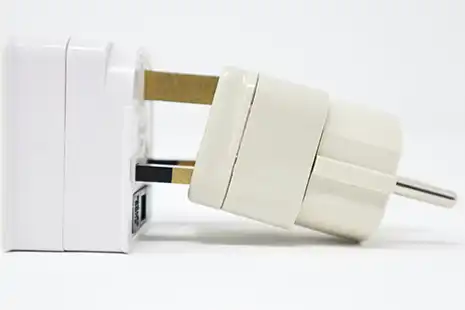
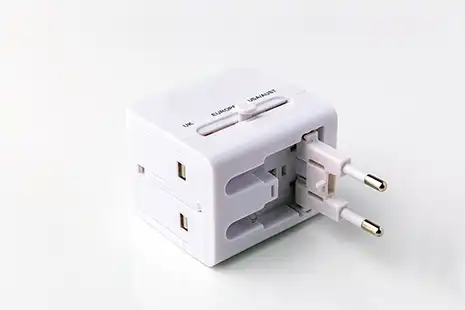
One adapter covers every Poland itinerary. Polish Type E sockets have a small grounding pin, and a simple two-round-pin European adapter fits around it. That same adapter works in Prague, Vilnius, Split, and Medjugorje, so no combination pilgrimage needs a second one.
Questions Pilgrims Ask
Do U.S. citizens need a visa or an ETIAS to travel to Poland?
No. U.S. citizens can visit Poland for up to 90 days in any 180 without a visa. ETIAS, the European Travel Information and Authorisation System, is not yet in operation and no applications are being accepted anywhere, so there is nothing to apply for today. Your passport must be valid for at least three months after the day you leave the Schengen Area and must have been issued within the last ten years. If a Polish border officer asks about funds, a pilgrim whose accommodation and meals are already paid for needs only 20 zloty a day, about $5, with a minimum of 100 zloty.
What is the weather like in Poland in September and October?
Mild, then cool. In Kraków, September averages a daytime high of 67°F and an overnight low of 49°F. By October the high falls to 57°F and the low to 40°F, and frosty mornings are possible late in the month. Warsaw runs a degree or two cooler. Autumn rain usually comes as showers rather than long wet spells. Pack layers, a warm jacket for October evenings, and a light waterproof. The Wieliczka Salt Mine stays at about 63°F underground all year.
Can I use euros in Poland?
Not as a rule. Poland is in the European Union but uses its own currency, the zloty. A few hotels and larger shops will take euros at a poor rate, most places will not, and U.S. dollars are not accepted. Cards are the easiest way to pay, since contactless payment is standard almost everywhere, and a Polish bank ATM after you arrive is the best source of cash. If your pilgrimage continues to Prague you will need Czech koruna. Lithuania and Croatia use the euro.
Are shops closed on Sundays in Poland?
Most of them, yes. Since 2018, Polish law has closed supermarkets, shopping malls, and most other shops on all but a handful of trading Sundays each year. In 2026 there are eight, and none falls in May, September, or October, the months Tekton groups usually travel. Pharmacies, petrol-station shops, bakeries, small owner-run shops, restaurants, and cafés can still open. Buy snacks, toiletries, and anything else you need on Saturday.
What should I wear and bring to Auschwitz-Birkenau?
Dress as you would for a memorial and a cemetery, modestly and without slogans, and wear shoes you can walk in for several hours, because Birkenau is vast and open to the weather. Bags larger than 30 by 20 by 10 centimeters, about 12 by 8 by 4 inches, are not allowed past security, so leave anything bigger on the coach. Bring a rain layer in any season. Flags on poles and banners are not permitted, and photography is forbidden in a few places, including the cellars of Block 11, where Saint Maximilian Kolbe died.
Will my cell phone work in Poland?
Yes. Mobile coverage in Poland is strong in the cities and along the main roads, and most U.S. carriers offer a daily or monthly international plan that covers it. An eSIM bought before departure is usually cheaper if you expect to use a lot of data. A European Union eSIM will also cover the Czech Republic, Lithuania, and Croatia, but check before relying on it in Bosnia and Herzegovina, which is not in the EU. Hotel Wi-Fi is widely available.
Is the tap water safe to drink in Poland?
Yes. Tap water in Polish cities and hotels is treated to European Union drinking-water standards, although many Poles prefer bottled or filtered water out of habit and for the taste. Restaurants serve bottled water rather than tap, and you will be asked whether you want it still, niegazowana, or sparkling, gazowana. Carry a refillable bottle on walking days.
What kind of electrical adapter do I need for Poland?
Poland uses Type E sockets at 230 volts, and two-pin Type C plugs fit them too. You will need a plug adapter, and a voltage converter only for single-voltage devices. Phones, tablets, laptops, and most CPAP machines are dual-voltage and need only an adapter. The same simple two-round-pin European adapter also works in Prague, Vilnius, Split, and Medjugorje.
Next Steps
Arrive Free to Kneel
For thirty years Tekton has walked with pilgrims through Poland, from the Black Madonna at Jasna Góra to the tomb of Saint Faustina at Lagiewniki. Everything on this page exists so that when you arrive, the practical things are already settled, and you are free to kneel where so many have knelt before you.