
England & Scotland Travel Guide for Catholic Pilgrims
What to Know Before Traveling to England and Scotland
This England and Scotland travel guide gathers what a Catholic pilgrim needs to settle before leaving for the United Kingdom. Apply for your travel authorization the week you register. Read the weather and the notes on what to wear a month before you fly. Keep the sections on money, the border, and the cathedrals for the week you pack.
The wise men had followed a star for a long way, and they still had to stop in Jerusalem and ask where the Child was to be born. Americans rarely think to ask in England or Scotland. We speak the language and recognize the names on the map, so it is easy to assume there is not much to learn, but Scotland has its own church, its own laws, and its own banknotes, and even the word for an elevator changes when you land. Pilgrims who come willing to ask get a great deal more out of the trip.
Already registered? Your pilgrim packet arrives two to three weeks before departure with hotel details, your final itinerary, and guidance from your Pilgrimage Manager. This guide is what you need before that packet reaches you. For the interior preparation, begin our pre-pilgrimage spiritual retreat.
UK Entry Requirements for U.S. Citizens
Americans still visit the United Kingdom without a visa, but no longer without paperwork. Every U.S. pilgrim now needs an approved Electronic Travel Authorisation, the ETA, before boarding a flight to London or Edinburgh. Airlines check it at check-in, and since February 25, 2026 they have refused to board anyone without one.
One authorization covers the whole pilgrimage. England and Scotland are both part of the United Kingdom, so a single ETA covers London, Canterbury, Walsingham, York, Durham, Edinburgh, and everywhere between. There is no second application for Scotland and no passport check when the coach crosses the border.
-
Apply only through the official app or GOV.UK
The application runs through the free UK ETA app or the GOV.UK website and takes most people a few minutes. You scan your passport, take a photograph of your face, answer a short set of questions, and pay 20 pounds (roughly $27) by card, Apple Pay, or Google Pay. Lookalike websites charge far more for the same authorization, and paying them does not speed anything up.
-
Apply once for every traveler, including children
Each person needs their own ETA, babies and children included. You can apply for a spouse or a child from your own phone if they are with you when you do it. Most decisions arrive by email within minutes, but the Home Office asks travelers to allow three working days, so do not leave it for the week you fly.
-
Check your passport before you apply
The ETA is tied electronically to the passport you apply with. If you renew your passport afterward, the old ETA does not transfer and you must apply again. The UK asks that your passport be valid for your whole stay, but airlines read every rule strictly, so travel with six months to spare. If you are close, renew first, then apply for the ETA with the new book.
-
Know that approval is not entry
An ETA gives you permission to travel. At the airport, a Border Force officer or an automated eGate still decides whether you enter. For a Tekton pilgrim this is a formality, but keep your return flight details and your pilgrimage confirmation on your phone and on paper in your day bag, in case you are asked.
Dual citizens, read this twice. If you hold British or Irish citizenship as well as American, you cannot get an ETA. Since February 2026 the UK expects you to travel on your British or Irish passport. Tell your Pilgrimage Manager which passport you will use, so the name on your airline ticket can be matched to it.
England and Scotland Weather Month by Month
The weather in England and Scotland is rarely extreme and almost never settled. Summer afternoons are mild rather than hot, winter is cold and grey rather than frozen, and rain can arrive in any month. What changes most as you travel north is not the temperature. It is the length of the day.
| Month | London | Durham | Edinburgh | Rain days, Edinburgh | Daylight, Edinburgh | What it feels like |
|---|---|---|---|---|---|---|
| January | 47° / 37° | 44° / 34° | 45° / 35° | 12 | 7 hr 34 min | Cold and grey, with frost on many northern nights and barely seven and a half hours of light in Edinburgh. |
| February | 48° / 37° | 46° / 34° | 46° / 35° | 10 | 9 hr 29 min | Still cold, a little drier, and the days lengthen quickly. |
| March | 53° / 39° | 50° / 36° | 49° / 37° | 10 | 11 hr 39 min | Changeable spring weather. Daffodils in the cathedral closes, and a sharp wind on the coast. |
| April | 59° / 43° | 54° / 39° | 54° / 40° | 9 | 14 hr 06 min | Brighter, and one of the driest months in Edinburgh. Cool evenings and the first long afternoons. |
| May | 65° / 48° | 60° / 44° | 59° / 45° | 10 | 16 hr 16 min | Mild, bright, and among the sunniest months, with more than sixteen hours of daylight in Edinburgh. |
| June | 71° / 54° | 64° / 49° | 63° / 50° | 10 | 17 hr 34 min | The longest days of the year. Mild rather than warm, with light in the Scottish sky until ten at night. |
| July | 75° / 58° | 68° / 52° | 67° / 53° | 11 | 17 hr 01 min | The warmest month, still mild by American standards, with passing showers and busy sites. |
| August | 74° / 57° | 68° / 52° | 66° / 53° | 10 | 15 hr 03 min | As mild as July. Edinburgh's festivals fill the city and its hotels. |
| September | 68° / 53° | 63° / 49° | 62° / 49° | 10 | 12 hr 38 min | Settled, mild days, quieter roads after the summer, and the first autumn color. |
| October | 60° / 48° | 56° / 44° | 56° / 44° | 12 | 10 hr 17 min | Cooler and wetter, and the clocks go back at the end of the month. |
| November | 53° / 41° | 49° / 38° | 50° / 39° | 12 | 8 hr 07 min | Damp, and dark by mid-afternoon, with frost returning in the north. |
| December | 48° / 38° | 45° / 35° | 45° / 35° | 12 | 6 hr 59 min | The shortest days, with under seven hours of light in Edinburgh and cold, grey afternoons. |
- Mild and changeable
- Cool, damp, and short days
- Most comfortable months for walking
Average daytime highs and overnight lows in Fahrenheit, from Met Office 1991–2020 climate averages for the Heathrow, Durham, and Edinburgh Royal Botanic Garden stations. Rain days count days with at least a millimeter of rain. Daylight is sunrise to sunset in Edinburgh at the middle of the month.
Every step north is a little cooler
A pilgrimage that begins in Canterbury and ends in Edinburgh travels about four hundred miles north, and the difference shows. In June, London averages a high of 71°F and Edinburgh 63°F. Durham, halfway between, already feels like Scotland. The coast is cooler again than the cities, and the wind off the North Sea at Holy Island can make a bright May morning feel like March.
The long light of a Scottish summer
Edinburgh sits farther north than any city in the lower 48 states, and in June the sun is up for more than seventeen and a half hours. Evening prayer can end in full daylight, and dawn can wake you before five. In December the same city has less than seven hours of daylight, and the sun sets before four in the afternoon. Pack an eye mask for a summer departure and plan for early dark in winter.
Rain that is frequent, and rarely heavy
Edinburgh counts ten to twelve rainy days in most months, but London receives only about two feet of rain a year, roughly half of what New York City does. Most British rain is light and passing. Plan for it daily, and it will seldom spoil anything.
Arriving at Heathrow, and the Road North to Scotland
Most pilgrimages that travel both countries land in London and work north by coach, through Canterbury, Walsingham, York, and Durham, to Edinburgh. Many then fly home from Scotland rather than returning to London. Your itinerary confirms both airports.
Passport control at Heathrow
Overnight flights from the United States usually reach London early in the morning. Heathrow is large, and the walk from the gate to passport control can take fifteen minutes or more, so wear comfortable shoes on the plane. U.S. passport holders with an approved ETA can use the automated eGates: take your passport out of its cover, stand still, and look at the camera. Adults qualify, and so do children eight and older traveling with an adult. Eight- and nine-year-olds must be at least 3 feet 11 inches tall. If a gate will not open, a Border Force officer will see you at a desk.
After baggage claim, walk through the green “Nothing to Declare” channel unless you are carrying something that must be declared. Your guide meets the group once everyone is through.
The first day
Flights from the United States reach London after a short night in the air, and the body clock takes a day or two to follow. Stay outside in the daylight, eat something light, and hold out until a normal British bedtime. A nap longer than an hour tends to cost you the night. Our advice on the first day of a pilgrimage covers the rest.
On the coach, everything is on the other side
British coaches open on the left, so you step out onto the sidewalk rather than into the road. Wear the seat belt, since British law requires it on coaches where belts are fitted. The northern days are long ones. Keep water, a snack, and a rain layer in your day bag, and use the miles for the Rosary, a nap, or the Scripture readings for the next day's Mass.
Crossing into Scotland
There is no checkpoint, no stamp, and often no more than a roadside sign to tell you the coach has left England. Two things change quickly afterward. The banknotes in your change start to look different, and some road and railway station signs add a second language, Scottish Gaelic, beneath the English.
Going home
The United Kingdom has no passport control on the way out. Your airline checks your passport at the desk, and the next officer you meet is American. When you land in the United States, the free Mobile Passport Control app can shorten the line. Pack bottles of holy water from Walsingham in checked luggage, well wrapped, since liquid rules at British airport security vary from one airport to the next.
General Information
- Country
- United Kingdom
- Capitals
- London (England) · Edinburgh (Scotland)
- Largest cities
- London · Glasgow
- Languages
- English; Scots and Gaelic are official in Scotland
- Time zone
- 5 hours ahead of U.S. Eastern
- Country code
- +44
- Emergency number
- 999 or 112
- Urgent medical advice
- 111
Will people speak English?
Yes, though not always the English you know. Regional accents and dialects in the north of England and across Scotland can sound very different and be hard to follow at first. It is perfectly fine to ask someone to repeat themselves, and people are used to being asked. A few everyday words differ as well. The lift is the elevator, the toilets are the restrooms, and Way Out marks the exit. In a hotel, the ground floor is the street level and the first floor is one flight up, so a room on the second floor is two flights up.
What is the official language of Scotland?
Scotland now has two official languages, Scottish Gaelic and Scots. Both gained official status on St. Andrew's Day, November 30, 2025, under the Scottish Languages Act. English has no formal designation, but it is spoken by nearly everyone and is the language of daily life, government, and the Church. British Sign Language is also recognized in Scottish law.
You will see Gaelic mostly on signs: at railway stations, on some roads, and throughout the Highlands and islands, where Edinburgh appears as Dùn Èideann. Scots you will hear rather than read. A wee thing is small, aye is yes, and the kirk is the church.
Emergency numbers
The United Kingdom does not use 911. Dial 999 or 112 for police, ambulance, fire, or coastguard. Both work from any phone, need no area code, and connect to English-speaking operators. For an illness that is urgent but not an emergency, call 111, which reaches the National Health Service in England and NHS 24 in Scotland. For a police matter that is not urgent, such as a stolen wallet, call 101. Visitors are billed for most NHS hospital treatment, which is one reason we recommend travel insurance. Your Pilgrimage Manager is always the first person to find.
Jet lag, and the week the clocks disagree
Britain is five hours ahead of U.S. Eastern time for most of the year. It changes its clocks on the last Sunday of March and October, a week or two before the United States does, so for those short stretches the gap is only four hours. In 2026 that week runs from October 25 to November 1. If you are calling home, check the difference on the day.
The Pound, Scottish Banknotes, and Tipping
How much cash will I need?
Very little. England and Scotland both use the pound sterling, and U.S. dollars are not accepted. Britain is close to cashless. Contactless cards and phone payments work in shops, cafes, pubs, and many church gift shops, and London's buses do not take cash at all. Carry a small amount anyway, in coins and small notes, for votive candles, church donation boxes, the shrine shop at Walsingham, and a cup of tea at a motorway service stop.
Should I buy pounds before I leave?
No. Your home bank and the airport exchange counter both set their own rate and add a fee on top. Withdraw pounds from an ATM, which the British call a cashpoint, after you arrive. Machines at or inside a bank are the best choice. Many machines in convenience stores display a fee on the screen before you withdraw, so read it and walk away if it charges.
- Always choose to be charged in pounds. When a cashpoint or card terminal offers to bill you in U.S. dollars, it is using its own poor rate. This is dynamic currency conversion, and declining it costs nothing.
- Withdraw once and withdraw enough, since most U.S. cards add a flat fee per withdrawal.
Scottish banknotes
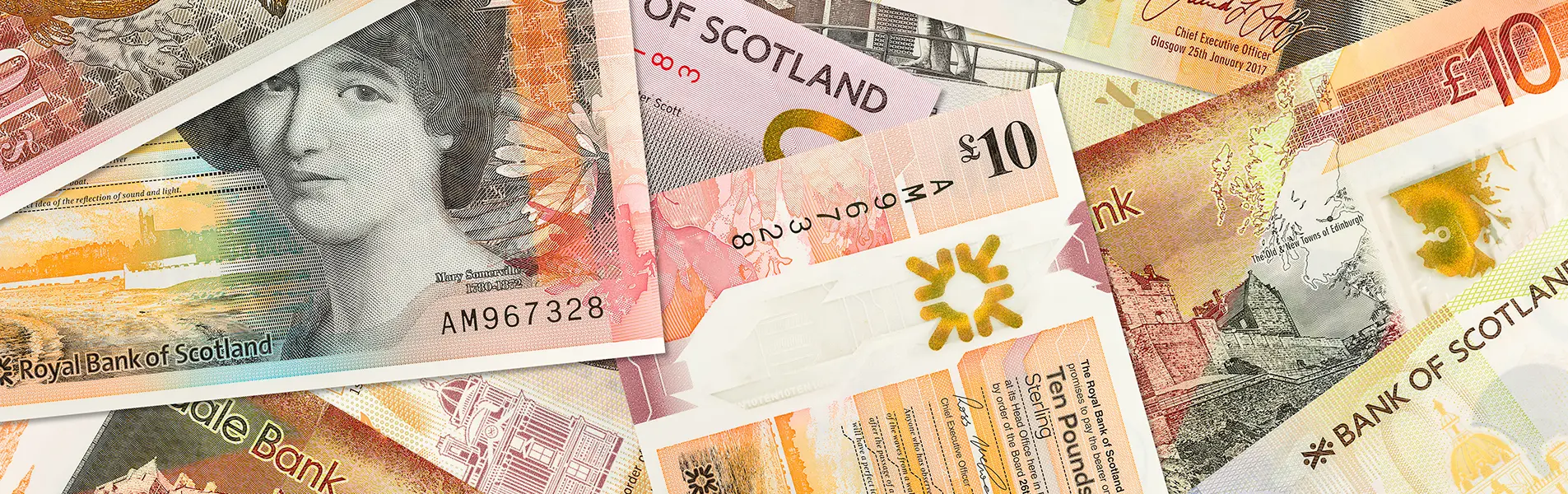
Scotland uses the same pound, but three Scottish banks, the Bank of Scotland, the Royal Bank of Scotland, and Clydesdale Bank, print their own notes. They are fully backed and worth exactly the same as a Bank of England note, and virtually every shop in Scotland takes them. In England most businesses do too, but some smaller shops decline notes they do not recognize. That is legal, because a Scottish note is recognized currency without being “legal tender” in the narrow legal sense.
The practical answer is simple. If your pilgrimage travels from Scotland into England, avoid carrying much Scottish cash across the border. Spend it in Scotland, or exchange it for Bank of England notes at a large bank. Do the same before you fly home, because Scottish notes are hard to change back into dollars once you are in the United States.
Visa, Mastercard, and the rest
We recommend Visa and Mastercard. Discover is not as common overseas. American Express is becoming more popular in Britain, but it is still not as widely accepted. Contactless payments are capped at 100 pounds a tap on a card, so a larger purchase will ask for your PIN. Before you leave:
- Tell your card issuer your travel dates, so your purchases are not flagged.
- Check your foreign transaction fees, so you are not surprised by extra costs.
- Carry a second card, kept somewhere other than your wallet.
- Know your PIN. British terminals ask for it more often than American ones.
Tipping in England and Scotland
A gratuity for your guides and coach driver is customary. Your pilgrim packet explains how Tekton handles it, so the whole group works from the same expectation and nobody is left guessing on the last day.
At a meal you pay for yourself, look at the bill before adding anything. Many restaurants add a “discretionary service charge,” often 12.5 percent, and when it is there no further tip is expected. Where it is not, around 10 percent for good table service is usual. Nobody tips for a drink ordered at the bar of a pub.
Two Countries, One Kingdom
To an American, England and Scotland can look like one place with two accents. To the people who live there, they are separate nations with their own flags, laws, banknotes, churches, and saints. Knowing the difference is a courtesy people notice, and it makes the second half of the pilgrimage make sense.
Is Scotland part of England?
No. England and Scotland are two of the four nations of the United Kingdom, with Wales and Northern Ireland. They have shared a monarch since 1603 and a parliament in London since 1707, but Scotland keeps its own legal system, its own schools, and, since 1999, its own parliament in Edinburgh. Great Britain is the island that holds England, Scotland, and Wales.
The practical point is small but real. Calling a Scot “English” is the quickest way to cause offense on this pilgrimage. British is correct for everyone, Scottish is correct for the people of Scotland, and Scotch is the whisky.
Two national churches, and one Catholic Church in both
England's established church is the Church of England, which has bishops and cathedrals. Scotland's national church is the Church of Scotland, the Kirk, which is Presbyterian and has no bishops. That is why St. Giles' in Edinburgh is often called a cathedral though no bishop has a seat there today. The Catholic Church in each country has its own bishops' conference, and small differences follow. In England and Wales, for example, the bishops restored meatless Fridays in 2011, so a Friday supper of fish and chips is a Catholic custom as well as a British one.
Sunday in England, and Sunday in Scotland
In England, the law limits large shops to six hours of trading on a Sunday, usually from ten or eleven in the morning, and supermarkets close earlier than on weekdays. Scotland has no such law, so its big stores keep longer Sunday hours. In parts of the Highlands and islands, however, some businesses still close on the Lord's Day by long habit. If you need something on a Sunday, buy it on Saturday.
Look right before you cross
Traffic keeps to the left in both countries, so the car you need to watch is coming from your right. Many London crossings have LOOK RIGHT painted on the curb for exactly this reason. Take an extra second at every corner for the first few days, especially when you are tired, since the instinct you grew up with is the wrong one here. British people also line up, which they call queueing, with real seriousness. Join the end of the line and wait your turn.
Cathedral Tickets, Evensong, and the Holy Island Tide
Two things set the pace of an England and Scotland pilgrimage in ways no other destination does. The great medieval cathedrals keep their own hours and rules, and two of the holiest islands on the route can only be reached when the sea allows.
Tickets, and the prayer that is always free
Many of England's historic cathedrals, Canterbury and York Minster among them, now charge admission to visitors. Your group's scheduled visits are arranged ahead of time. What is worth knowing is the rule underneath: these cathedrals never charge anyone to attend a service or to come in and pray. If you have a free evening near one, you can walk in for prayer at no cost.
Choral Evensong
Evensong is evening prayer sung by a cathedral choir, drawn largely from the Psalms and the canticles of Mary and Simeon. At Canterbury it begins at 5:30 on most days and lasts about three quarters of an hour. Many Catholic pilgrims count it among the most prayerful hours of the trip. Arrive fifteen minutes early, silence your phone, stay until the end, and take no photographs. It is a service of the Church of England rather than Mass, so it does not fulfill a Sunday obligation, and there is no Communion at Evensong.
The Holy Island tide
Lindisfarne is joined to the mainland by a causeway road that the North Sea covers twice a day. Northumberland County Council publishes safe crossing times for every date, and the day your group visits is planned around them. On the island, that means one firm rule. When your Pilgrimage Manager names a time to be back at the coach, be there, since the tide will not wait for a last visit to the priory.
Beside the road, a line of tall poles marks the Pilgrims' Way, the old three-mile walking route across the sands. The council's crossing times do not apply to it, and it should never be attempted on a rising tide or without local knowledge. If your group walks it, the walk is planned and led. Otherwise, pray it from the coach window.
The ferries to Iona
Iona, where St. Columba landed in 563, sits off the far end of the Isle of Mull. Reaching it means a ferry from Oban to Mull, a drive across the island, and a second short ferry, and ordinary visitors' cars are not allowed on Iona itself. Atlantic weather can delay or cancel crossings, so an Iona day is always held a little loosely. Bring a warm, windproof layer even in summer.
Phone, Data, and Water
Will my phone work in the UK?
Yes. Coverage is strong in London, the cities, and along the main roads north. It weakens in the Scottish Highlands, on Holy Island, and on Iona, which is part of their peace. Your options:
- Carrier travel pass. The simplest choice. Most U.S. carriers offer a daily or monthly international plan that covers the United Kingdom. Add it before you leave.
- eSIM. Usually cheaper for heavy data use. Buy and install it before departure. The UK is no longer in the European Union, so check that a plan sold for “Europe” names the United Kingdom.
- Hotel Wi-Fi. Widely available, and enough if you are content to check in once a day.
Let the signal drop. Some of the quietest hours of this pilgrimage fall where the phone stops working, on a tidal island or a Hebridean shore. Treat the lost bars as an invitation rather than a problem.
Can I drink the tap water?
Yes. Tap water is treated and safe to drink throughout England and Scotland. Pubs and restaurants that serve alcohol must give you tap water free if you ask for it, so ask for “tap water” unless you want to be offered a bottle. In a few older buildings a tap is fed from a storage tank rather than the main supply. If a tap is marked as not for drinking, believe it.
Food, and dietary needs
A full British breakfast of eggs, bacon, sausage, beans, and toast will carry you well into the afternoon, and in Scotland it may come with a tattie scone. Restaurants must be able to tell you which major allergens a dish contains. If you have a serious allergy or a dietary requirement, tell your Pilgrimage Manager well before departure so arrangements can be made rather than improvised.
What to Wear in England and Scotland
Unless your pilgrimage has a very specific formal occasion, you can dress much as you would at home. The adjustments Britain asks for are about the sky and the stone rather than a dress code.
Dress in layers you can add and remove all day. A cool morning at Walsingham, a sunny noon in York, and a windy afternoon on Holy Island can all fall within the same week, and a cathedral interior is cooler than the street outside it. A light sweater or fleece under a hooded, packable rain jacket covers nearly every day from May to September. Add a warmer layer, a hat, and gloves for spring, autumn, or anywhere in the Highlands.
Shoes matter more than anything else you pack. Expect cobbled lanes in York and Durham, worn stone steps in the cathedrals, wet grass at ruined priories, and sand at Holy Island. Choose comfortable, broken-in shoes with a grip that can take rain, and bring a second pair so one can dry overnight.
For churches and other holy sites, it is expected that your knees and shoulders be covered. This applies to both men and women, and bare midriffs are frowned upon. Modesty and respect are the key. You will not need a head covering, and women do not need to wear skirts or dresses unless that is your preferred style. Jeans are acceptable, unless your priest has told you differently. Our post on packing like a true pilgrim covers the rest.
Electricity, Plugs, and Adapters
- Socket type
- Type G — three rectangular pins
- Voltage
- 230V, 50 Hz
- Adapter needed?
- Yes
- Converter needed?
- Only for single-voltage devices
Adapter or converter?
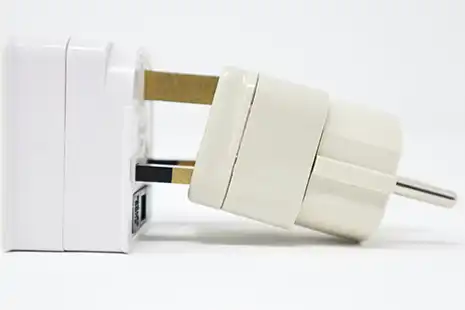
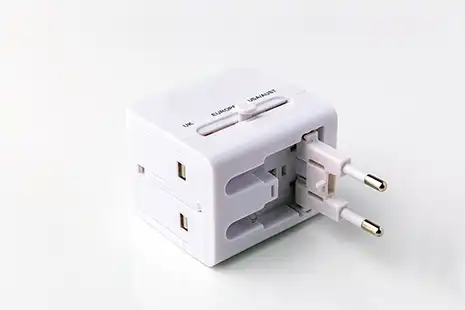
An adapter lets an American plug fit a British socket. A converter changes the voltage. Nearly all converters are also adapters, but not all adapters are converters, so read the product description carefully before you buy.
Check the label on each device. If it reads INPUT: 100–240V, 50/60 Hz, it is dual-voltage and can be used in England and Scotland with only an adapter. That covers most phones, tablets, laptops, and electronics with a boxy charger. Most CPAP machines are dual-voltage as well, but please check with your manufacturer or doctor to make sure yours is compatible. Single-voltage devices need a converter, or the higher voltage from British sockets will burn them out. Hair dryers, straighteners, and curling irons fall into this category, as do many electric toothbrushes and shavers. Most hotels have hair dryers, and you will be able to check your specific hotels once your pilgrim packet arrives.
Two British surprises
Most British sockets have their own small on-off switch. If your phone is plugged in but not charging, flip the switch beside the socket. In hotel bathrooms you may also find a narrow two-pin outlet marked for shavers only. It supplies very little power, so use it for an electric razor or toothbrush and nothing else.
One adapter covers Britain and Ireland. The Republic of Ireland uses the same Type G socket, so if your pilgrimage continues there, the adapter you pack for London still works. See our Ireland travel guide. For France, Italy, or anywhere on the Continent, you will need a round-pin setting instead.
Questions Pilgrims Ask
Do U.S. citizens need an ETA to visit the UK?
Yes. U.S. citizens need an approved Electronic Travel Authorisation to visit the United Kingdom, and since February 25, 2026 airlines have refused to board travelers without one. It costs 20 pounds and is applied for only through the official UK ETA app or GOV.UK. Most decisions arrive within minutes, but the Home Office advises allowing three working days. Every traveler needs their own, including children. An ETA lasts two years or until your passport expires, and a new passport needs a new ETA.
Do I need a passport to go from England to Scotland?
Not to cross the border. England and Scotland are both part of the United Kingdom, and there are no passport checks between them by coach, train, or plane. A U.S. pilgrim still needs a passport and an approved ETA to enter the UK in the first place, and airlines and hotels may ask for photo identification along the way, so keep your passport with you for the whole pilgrimage. One ETA covers England, Scotland, Wales, and Northern Ireland.
What is the official language of Scotland?
Scotland has two official languages, Scottish Gaelic and Scots, which gained official status on November 30, 2025, under the Scottish Languages Act 2025. English has no formal designation, but it is spoken by nearly everyone and is the everyday language of shops, hotels, government, and the Church. British Sign Language is also recognized. Visitors mostly meet Gaelic on railway station and road signs, especially in the Highlands and islands.
Can I use Scottish money in England?
Usually, but not always. Banknotes from the Bank of Scotland, the Royal Bank of Scotland, and Clydesdale Bank are pound sterling and worth the same as Bank of England notes, and most English businesses accept them. They are not legal tender in England, however, so a shop may lawfully refuse them. Spend Scottish notes before leaving Scotland, or exchange them for Bank of England notes at a large bank. They are hard to change into dollars once you are home.
Does it rain a lot in Scotland?
Often, but rarely heavily. Met Office averages for Edinburgh show ten to twelve days with measurable rain in most months, yet the yearly total is modest, about 29 inches. The west coast and the Highlands are wetter than Edinburgh. Showers usually pass quickly, so pack a hooded rain jacket and shoes that can take the wet rather than planning around the forecast, and bring a warm layer for the wind on the coast and islands.
Will my phone work in the UK?
Yes. U.S. phones work in England and Scotland. Coverage is strong in the cities and along main roads, and weaker in the Highlands and on islands such as Holy Island and Iona. Add an international plan from your carrier before you leave, or buy an eSIM. The UK is no longer in the European Union, so check that a plan sold for Europe names the United Kingdom. Hotel Wi-Fi is widely available.
Can you drink tap water in the UK?
Yes. Tap water is treated and safe to drink throughout England and Scotland. Pubs and restaurants that serve alcohol must give you free tap water if you ask, so ask for tap water by name if you do not want to buy a bottle. In a few older buildings a tap may be fed from a storage tank, so if a tap is marked as not for drinking, use another.
What plug adapter do I need for the UK?
England and Scotland use Type G sockets, with three rectangular pins, at 230 volts and 50 hertz. You need a Type G adapter for American plugs, and a voltage converter only for single-voltage devices such as hair dryers and curling irons. Phones, tablets, laptops, and most CPAP machines are dual-voltage and need only the adapter. Many British sockets have their own switch, so make sure it is on. Ireland uses the same plug.
Next Steps
Come Ready to Ask the Way
For thirty years Tekton has walked with pilgrims from the martyr's shrine at Canterbury to the relics of St. Andrew in Edinburgh. Everything on this page exists to settle the practical questions early, so the questions you carry across the Atlantic are the ones worth asking.