


Tekton Ministries
Publish Date: September 23, 2026
There is a kind of visitor who arrives in Assisi with a camera and a checklist, photographs the frescoes, buys a small wooden Tau cross, and leaves by dinnertime having seen everything and encountered nothing. And there is another kind who climbs this Umbrian hill town looking for something a photograph cannot hold. The difference between them is the whole point. A St. Francis Assisi pilgrimage is not a sightseeing stop to admire medieval art or tick a saint off a list; it is a deliberate walk into the life of a man who gave everything away and, in doing so, became one of the most joyful figures in the history of the Church.
That joy is the thing pilgrims come here to touch. Assisi is not a somber place, though its patron embraced poverty most of us would find frightening. It is a town soaked in the peculiar gladness of a man who discovered that letting go of what the world clutches is the beginning, not the end, of happiness. To walk these streets well, we have to understand who Francis was before grace found him.
A City Shaped by a Single Yes
Francis was born around 1181 to Pietro di Bernardone, a prosperous cloth merchant, and grew up with money, fine clothes, and the easy confidence of a young man who expected life to give him whatever he asked. He dreamed of knighthood and glory. Then came war between Assisi and neighboring Perugia, capture, and a year in a Perugian prison — the first crack in a life built on comfort. Illness followed. Slowly, the pleasures that had once thrilled him began to taste of ash.
The turning point came in the small, half-ruined church of San Damiano, just below the city walls. Kneeling before a Byzantine crucifix, Francis heard a voice: “Go and repair my church, which you see is falling into ruin.” He took it literally at first, selling his father’s cloth to buy stones for the crumbling chapel. The deeper meaning — that Christ meant the Church herself, and meant to rebuild her through this one poor man — would take the rest of his life to unfold.
What happened next is the heart of Assisi’s witness. Hauled before the bishop by a furious father demanding his money back, Francis stripped off his clothes in the public square, handed them over, and renounced his inheritance and even his identity as his father’s son. The Scriptures had once told another rich young man, “Sell what you possess and give to the poor” (Matthew 19:21); Francis is the one who actually did it. From that morning he owned nothing — and by every account had never been more free. This is the paradox every pilgrim comes to Assisi to feel in person: the man who released his grip on everything is remembered not as grim or severe, but as radiantly, almost recklessly, joyful.
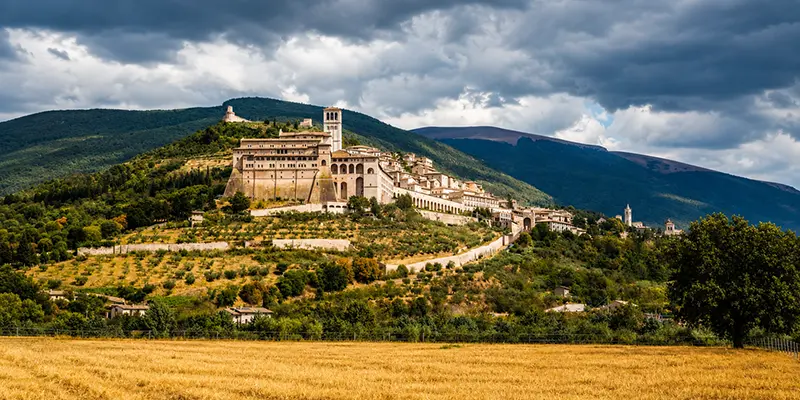
Assisi rises in tiers up Mount Subasio, its holy places scattered from the valley floor to the mountain woods — so that to visit them is quite literally to climb.
Walking Where Francis Walked
The geography of a St. Francis Assisi pilgrimage is itself a kind of catechesis. The holy sites run from the valley floor to the forested heights of Mount Subasio, so that to move among them is to ascend and descend, to feel the pilgrimage in your legs.
The Basilica of St. Francis anchors everything. Begun in 1228, only two years after his death, it is really two churches stacked one atop the other: a dim, low Romanesque lower church and a soaring Gothic upper church lined with Giotto’s celebrated fresco cycle of Francis’s life. Beneath them both lies the crypt and the saint’s stone tomb, hidden for six centuries and only rediscovered in 1818. Pilgrims descend to it in silence. No one needs to be told what to do there.
Across town, the Basilica of Santa Chiara holds the tomb of St. Clare, the young noblewoman who heard Francis preach and gave up her own comfortable future to follow the same road. Here, in a side chapel, hangs the original San Damiano crucifix — the very cross that spoke to Francis. At San Damiano itself, a short walk beyond the walls, Clare would later live for four decades, and Francis, nearly blind in his final years, would compose the Canticle of the Creatures, his great hymn of praise to God through “Brother Sun” and “Sister Moon.”
Down in the valley stands the enormous Basilica of Santa Maria degli Angeli, built to shelter something tiny: the Porziuncola, the little chapel Francis restored with his own hands and where, in 1209, the Franciscan movement was born. It was here, too, that he died on the evening of October 3, 1226, in the humble structure now called the Chapel of the Transitus. And high above the town, reached by a steep and quiet road into the holm-oak forest, is the Eremo delle Carceri, the hermitage where Francis and his brothers withdrew to pray in caves cut from the mountainside. Every pilgrim should also step into the Cathedral of San Rufino, whose ancient font gave both Francis and Clare their baptism — the quiet beginning of two lives that would reshape the Church.
Not all of these places are easy to reach, and that is part of the gift. The climb to the Carceri will leave you winded; the crowds at the basilica will test your patience; the summer sun on the valley pavement is unforgiving. A tourist experiences such things as friction to be minimized. A pilgrim can receive them another way — the aching legs, the long line, the wait in the heat quietly offered up, joined to the far greater poverty Francis embraced on purpose. The discomfort is not a flaw in the pilgrimage. It is part of what makes it true.
Planning a Catholic Tour of Assisi, Italy
Because the sites are spread across a vertical mile — from the Porziuncola in the valley to the hermitage in the trees — Assisi rewards those who slow down. Two days here are far better than one. Hurrying from church to church with a camera raised is the surest way to see Assisi and somehow miss it. We encourage the pilgrims we accompany to build in unhurried time: an hour of quiet at the tomb of St. Francis, an unrushed Mass, a slow walk up the Via San Francesco that pilgrims have climbed for eight hundred years.
What you are after in Assisi is not a folder of photographs but a handful of seeds — small graces that may not bloom until long after you are home. Approach the town that way and even the practical rhythm of the days, the early Masses and the shared meals and the footsore evenings, becomes part of the prayer.
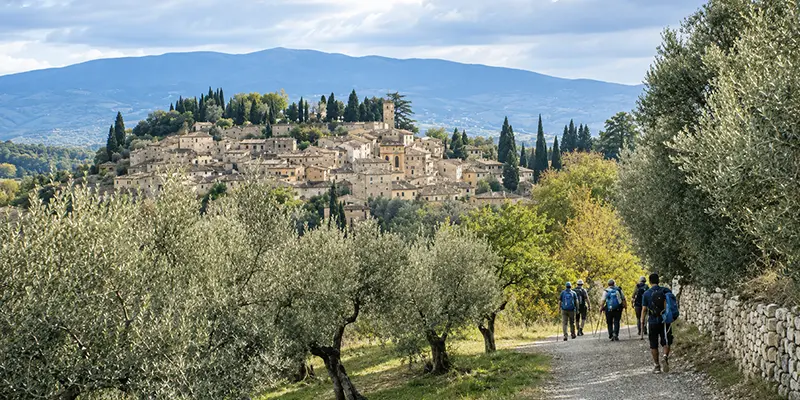
The Via San Francesco has carried pilgrims toward the saint’s tomb for eight centuries. The unhurried walk is part of the prayer.
Saint Carlo Acutis and Holiness in Our Own Time
For centuries the story of Assisi was the story of Francis and Clare. In recent years a new chapter has been added, and it speaks directly to our own age. In 2006, a fifteen-year-old from Milan named Carlo Acutis died of leukemia. An ordinary teenager in most respects — he loved computers, video games, and soccer — Carlo had an extraordinary love for the Eucharist, and he used his gift for technology to build a website cataloguing Eucharistic miracles around the world. At his own request, he was buried in Assisi, the city of the saint he most admired.
On September 7, 2025, Pope Leo XIV canonized him alongside Saint Pier Giorgio Frassati, making Carlo the first saint of the millennial generation. His tomb rests in the Sanctuary of the Renunciation — the Church of Santa Maria Maggiore — which is, fittingly, the very place where Francis once stripped away his inheritance to belong entirely to God. Eight centuries apart, two young men let go of what the world prized in order to grasp something greater. Many who come to venerate Francis now leave just as moved by Carlo: proof, in sneakers and a windbreaker, that sanctity is not a relic of the Middle Ages but a living possibility in an age of screens.
What a St. Francis Assisi Pilgrimage Leaves Behind
The measure of a pilgrimage to Assisi is never how many sites you saw. It is what came home with you. Francis’s whole life was a single, sustained answer to a question every pilgrim eventually faces: what am I willing to let go of? You do not need to strip off your possessions in the town square. But you may find, walking these streets, that certain things you have been clutching begin to loosen their grip — a resentment, an anxiety, a way of measuring your worth that has never once brought you peace.
That is the true work of Assisi, and it does not end at the airport. It begins there. Arriving as a pilgrim rather than a sightseer takes some interior groundwork long before you pack a bag, and we’ve explored what that preparation looks like in our reflection on how to prepare for a Catholic pilgrimage. Francis went to the poorest, humblest places in Assisi and found joy waiting there. If we let it, this small Umbrian town still sends pilgrims home by a different road than the one they arrived on — and the difference, quietly, is everything.
Ready to walk in the footsteps of St. Francis? Whether you long to make this pilgrimage yourself or feel called to bring others with you, we would be honored to help. Explore our upcoming pilgrimages to find a journey to Assisi and beyond, or discover how to lead your own group and shepherd fellow pilgrims to the heart of Umbria.