

Portugal Travel Guide for Fatima Pilgrims
Getting Ready for Lisbon and Fatima
This Portugal travel guide is written for Fatima pilgrims, and most of it can be settled in one evening at home. Check your passport, expect a slow border line at Lisbon airport, pack for cool, wet evenings in Fatima, and know what the 13th of the month means at the Shrine.
The wise men reached Jerusalem with a question, and Fatima began with one: on May 13, 1917, Lúcia asked the Lady where she came from and what she wanted. Settle the practical questions here, and the one you are bringing to the Chapel of the Apparitions will have room.
Already registered? Your pilgrim packet arrives two to three weeks before departure with hotel details, your final itinerary, and guidance from your Pilgrimage Manager. This guide is what you need before that packet reaches you. For the interior preparation, begin with how to prepare for Fatima through its message and our pre-pilgrimage spiritual retreat.
Portugal Entry Requirements for U.S. Citizens
Portugal asks nothing of a U.S. pilgrim in advance beyond a valid passport. It belongs to the European Union and the Schengen Area, and Americans visit for up to ninety days without a visa. The paperwork is easy. What Portugal has made harder, over the last year, is the line at the border itself.
ETIAS is not in operation. The European Travel Information and Authorisation System has been delayed again, the European Union has removed its 2026 target, and no applications are being accepted anywhere. Portugal is in the Schengen Area, so ETIAS will apply here when it launches. Until then, any website offering to sell you one is not the official portal. Tekton will tell registered pilgrims what to do when a real date is announced.
-
Check your passport against two dates
It must be valid for at least three months after the day you leave the Schengen Area, and it must have been issued within the last ten years. On a Marian Shrines pilgrimage that begins in Lisbon and ends in Paris, Madrid, or Barcelona, the date that counts is the day you fly home from there, not the day you leave Portugal. Airlines apply their own stricter reading at check-in, so travel with six months to spare. If you are close to either limit, renew before you register.
-
Pre-register for the border, if you like
Portugal was among the first countries to offer Travel to Europe, the European Union's free app for the new Entry/Exit System. Up to 72 hours before you land, it lets you scan your passport and answer the entry questions on your phone, then present a QR code at the self-service kiosks in the arrivals hall. It is optional, it does not replace the border check, and it needs a recent phone that can read the chip in your passport. If that sounds like more trouble than it is worth, skip it. Your Pilgrimage Manager will not expect it.
-
Keep your return ticket and confirmation reachable
Like every Schengen country, Portugal lets a border officer ask where you are staying, how you are leaving, and whether you have the means to pay for your stay. For a Tekton pilgrim all three are answered by the same two documents: your return flight and your pilgrimage confirmation, which shows an organized journey with its hotels already arranged. Keep both on your phone and on paper, in your day bag rather than a checked suitcase.
-
Count your days across all of Schengen
A U.S. passport allows ninety days in the Schengen Area in any rolling one hundred eighty. Portugal shares that count with Spain, France, and the rest, so a pilgrimage that continues from Fatima to Lourdes or Santiago is one stay, not three. Only a long stay with family elsewhere in Europe comes anywhere near the limit.
Carry copies, kept apart from the original. Photograph your passport page and email it to yourself, and keep a paper copy in a different bag. Send your Pilgrimage Manager a photograph of the page when you register, so the name on your airline ticket can be checked against it. Maiden names, middle initials, and suffixes are the usual trouble.
Lisbon and Fatima Weather Month by Month
Portugal's weather follows the Mediterranean pattern: dry, hot summers and mild, rainy winters. What surprises pilgrims is Fatima itself. The Shrine stands on a limestone plateau roughly a thousand feet above sea level, two hours north of Lisbon, and it is wetter than the capital in every month and cooler after dark.
| Month | Lisbon | Coimbra | Rain, Lisbon (in) | Rain, Fatima (in) | What it feels like |
|---|---|---|---|---|---|
| January | 59° / 47° | 59° / 41° | 4.1 | 6.8 | The wettest stretch of the year in Fatima. Cool, grey, and green, with frost some nights inland. |
| February | 62° / 48° | 62° / 42° | 3.1 | 4.9 | Still wet and cool. Almond blossom in the south; heavy coats in Fatima after dark. |
| March | 66° / 52° | 66° / 46° | 2.7 | 3.4 | Rain eases and days lengthen. Changeable, with bright spells between showers. |
| April | 69° / 54° | 69° / 49° | 2.8 | 4.2 | Spring, but showery. Warm in the afternoon sun, cold on the esplanade at night. |
| May | 74° / 58° | 74° / 53° | 2.3 | 3.5 | Green, bright, and settling. The first great anniversary pilgrimage fills Fatima on the 12th and 13th. |
| June | 79° / 62° | 79° / 58° | 0.6 | 1.2 | Warm and mostly dry, with long evenings. Saint Anthony's feast fills Lisbon on the 13th. |
| July | 83° / 65° | 82° / 60° | 0.1 | 0.3 | Hot and almost rainless. Shade and water matter on the esplanade at midday. |
| August | 84° / 66° | 83° / 61° | 0.2 | 0.3 | The hottest month. Assumption Day on the 15th; inland afternoons run hotter than Lisbon. |
| September | 80° / 64° | 81° / 57° | 1.5 | 2.5 | Still warm, the heat fading and the crowds thinning. Rain returns late in the month. |
| October | 73° / 60° | 74° / 53° | 4.4 | 5.1 | Mild and golden, and markedly wetter. The last anniversary pilgrimage on the 12th and 13th. |
| November | 65° / 53° | 64° / 47° | 5.3 | 6.3 | The wettest month in Lisbon. Short days, frequent rain, cool nights. |
| December | 60° / 49° | 60° / 43° | 4.3 | 6.9 | Cool and wet. The Immaculate Conception on the 8th is a national holiday. |
- Warm to hot and mostly dry
- Mild and changeable, with showers
- Cool and wet, with short days
- Most comfortable months for walking
Average daytime highs and overnight lows in Fahrenheit. Lisbon and Coimbra figures are 1991–2020 climate normals from IPMA, Portugal's national meteorological institute. Fatima rainfall is the long-term average recorded at Boleiros, beside the Shrine, by the Portuguese Environment Agency.
Fatima is not Lisbon
No official temperature record is kept at Fatima, but its altitude puts it closer to inland Coimbra than to the coast. Read the Coimbra column for the nights. In October, Lisbon's average low is 60°F and Coimbra's is 53°F, and the esplanade at Fatima, open to the sky, can feel colder than either. The candlelight procession is held outdoors after dark, so the evening layer belongs in your day bag even when the afternoon was warm.
The rain is the larger difference. Fatima receives about 45 inches a year against Lisbon's 31, and nearly all of it falls between October and April. A compact umbrella and a hooded rain jacket are worth their weight on any pilgrimage outside the summer.
The months Tekton groups travel
Our Portugal itineraries arrive in April, July, or October. April is green and showery, with warm afternoons and cool evenings. July is hot and almost rainless; carry water and use the shade. October begins mild and turns wet, and the first autumn storms usually arrive during the month.
Lisbon's hills in the rain
Lisbon's pavements are laid in small polished limestone cobbles, the calçada portuguesa, and they are beautiful and treacherous when wet. The Alfama, where Saint Anthony was born, is steep. On a rainy day, shoes with real grip matter more there than anywhere else on the pilgrimage.
Passport Control at Lisbon Airport
Nearly every Tekton pilgrimage to Portugal lands at Lisbon's Humberto Delgado Airport and drives north to Fatima the same day. Of all the airports on our itineraries, Lisbon has had the hardest time with Europe's new biometric border check. It is worth knowing what to expect so that a long line does not become the first thing you remember about Portugal.
What happened, and where things stand
The European Union's Entry/Exit System records a fingerprint scan and a photograph of every traveler from outside the EU, in place of the old passport stamp. When Lisbon began using it, waits at passport control stretched to several hours. At the end of December 2025 Portugal paused the system at Lisbon for three months, added staff, and expanded the border equipment. Since April 10, 2026, the check has been mandatory at every Schengen airport, Lisbon included, and at busy times this spring police paused the biometric step for departing passengers so that people would not miss flights. By late summer the European Commission reported that Portugal's lines had eased significantly.
On arrival
If your flight comes nonstop from the United States, you register in Lisbon. If it connects through Frankfurt, Madrid, or another Schengen airport, registration happens there, and Lisbon feels like a domestic arrival. Either way, the process is simple, only slow. Have your passport open to the photo page. U.S. citizens may use the automated e-gates, unless they are traveling with children, who must go through the staffed line with them. Keep the group together, and be patient. Your Pilgrimage Manager meets you once you are through and stays with the group for the whole pilgrimage.
The road north
From the airport, the coach takes the A1 motorway north. Fatima is about an hour and a half away, and many itineraries stop on the way at Santarém, where the Church of the Holy Miracle keeps the Eucharistic miracle of the thirteenth century. After a night flight, this is a day to stay awake in the daylight and let the evening Rosary at the Chapel of the Apparitions be the first real prayer of the pilgrimage.
Going home, or going on
Some pilgrimages fly home from Lisbon. Others fly on to Paris or Bilbao, which stays inside the Schengen Area and involves no passport control, or continue by coach into Spain. If you cross by road, your watch goes forward an hour at the border, because Portugal keeps the same clock as London and Spain keeps the same clock as Paris. Our Spain travel guide and France travel guide pick up the journey from there.
At Lisbon, departing passport control comes after the airport's shopping area, and it is easy to lose track of time among the shops. Go through first. Plan on arriving three hours before an international flight. Bottles of holy water and blessed oils belong in checked luggage. A rosary from Fatima travels anywhere.
General Information
- Capital city
- Lisbon
- Largest city
- Lisbon
- Official language
- Portuguese
- Time zone
- 5 hours ahead of U.S. Eastern; 1 hour behind Spain
- Country code
- +351
- Emergency number
- 112
- Health advice line
- SNS 24, 808 24 24 24
- Driving
- On the right
Will people speak English?
In the places where you will be traveling, you are likely to meet people who speak English, especially younger Portuguese, hotel staff, and the people who serve pilgrims at the Shrine, where Masses and confessions are offered in several languages. Your knowledgeable Catholic and other Christian guides speak it fluently. English thins out among older people and in small towns, and if you have a hard time communicating with someone, a smile and a little body language go a long way.
One courtesy is worth knowing. Portuguese is not Spanish, and the Portuguese notice when a visitor assumes it is. Speak English rather than Spanish, and learn two words on the plane. Bom dia (bohn DEE-ah) is good morning. Obrigado (oh-bree-GAH-doo) is thank you, but it agrees with the person speaking, so a man says obrigado and a woman says obrigada, whoever she is thanking.
Reading the place names
Portuguese signs keep their accents, and your itinerary may not. Fátima and Fatima are the same town, and the stress falls on the first syllable, FAH-tee-mah. The Cova da Iria, the hollow where the apparitions took place, is KOH-vah dah ee-REE-ah. Aljustrel, the village where the three shepherd children lived, lies just outside Fatima, and Valinhos, the hillside of the fourth apparition, is close beside it.
Emergency numbers
Portugal does not use 911. Dial 112 for police, ambulance, or fire. It needs no area code and works from any phone in the country, including a mobile without a Portuguese SIM. For a health question that is not an emergency, Portugal's national health service runs a telephone advice line, SNS 24, at 808 24 24 24. You will almost certainly never need either. Your Pilgrimage Manager is with the group throughout and is the first person to find if something goes wrong.
Jet lag
Five hours is a real shift, and flights from the United States land in Lisbon in the morning after a night in the air. Stay outside in the daylight, drink more water than feels necessary, and hold out until a normal Portuguese bedtime. Our advice on the first day of a pilgrimage covers the rest.
The Euro, the Couvert, and Tipping
How much cash will I use?
Portugal uses the euro, and U.S. dollars are not accepted. Cards are taken in hotels, restaurants, and most shops, and contactless payment is common. Keep some euros in small notes and coins anyway. The small cafés and religious goods shops around the Shrine often prefer cash for small amounts, and you will want coins for candles and offering boxes.
Should I buy euros before I leave?
No. Your home bank and the airport exchange counter both set their own rate and add a fee on top. Withdraw euros from an ATM after you arrive. Portuguese bank machines carry the Multibanco sign and are the best choice. The standalone machines in airports and tourist streets charge noticeably more.
- Always choose to be charged in euros. When an ATM or a card terminal offers to bill you in U.S. dollars, it is applying its own poor rate. This is dynamic currency conversion, and saying no costs nothing.
- Withdraw once and withdraw enough, since most U.S. cards charge a flat fee per withdrawal.
Visa, Mastercard, and the rest
We recommend Visa and Mastercard. Discover is not as common overseas. American Express is becoming more popular, but it is still not widely accepted in Portugal. Before you leave:
- Tell your card issuer your travel dates, so your purchases are not flagged.
- Check your foreign transaction fees, so you are not surprised by extra costs.
- Carry a second card, kept somewhere other than your wallet.
- Know your PIN. Portuguese terminals often ask for it.
The couvert at Portuguese restaurants
Sit down in a Portuguese restaurant and bread, butter, olives, and sometimes a small cheese or pâté may arrive before you order. This is the couvert, and it is not a gift. Eat it and it appears on the bill, usually a few euros a person. If you do not want it, say so, or leave it untouched and ask for it to be taken away, and you should not be charged. Group meals on your pilgrimage are arranged in advance, so this matters most on a free evening in Lisbon or Fatima.
Tipping in Portugal
Gratuities for your guides and drivers are already on your final invoice, so there is nothing to calculate or hand out on the last day. Your pilgrim packet explains what that amount covers.
At a meal you pay for yourself, tipping in Portugal is modest. Rounding up the bill or leaving five to ten percent for good service is customary, and many Portuguese leave only the coins from their change at a café.
The 13th of the Month in Fatima
Most shrines keep the Church's calendar. Fatima keeps its own as well. Our Lady asked the children to return on the 13th of each month, and the Shrine still gathers on that date. Whether your pilgrimage falls on it or not changes what Fatima will feel like when you arrive.
The anniversary pilgrimages
From May to October, the Shrine holds its International Anniversary Pilgrimages on the 12th and 13th of the month. The evening of the 12th brings the Rosary and the candlelight procession, followed by a night of prayer. The morning of the 13th brings the international Mass on the esplanade, and at its end the image of Our Lady is carried back to the Chapel of the Apparitions while the crowd waves white handkerchiefs in farewell.
May 13 and October 13 are the largest days of the Fatima year. In the days before May 13, pilgrims walk to Fatima from all over Portugal, many of them along the highway shoulders in reflective vests. The streets fill, private celebrations become hard to schedule, and a walk that takes five minutes on another day can take thirty.
If your dates fall on the 13th
Expect crowds and plan for them. Keep your group's meeting point clear, carry water and a layer through a long evening, and give yourself more time than seems necessary to move anywhere. Your Pilgrimage Manager will arrange the group's Mass and adjust the schedule around the Shrine's own. What you receive in return is something few pilgrims forget: candles by the thousand moving across the dark, and the Rosary prayed in a dozen languages at once.
If they do not
On an ordinary weekday outside those dates, Fatima is a quiet town. The Rosary is prayed in the Chapel of the Apparitions every evening, you can find a place close to the image of Our Lady, and the candlelit procession is an intimate one. Pilgrims who come in the quieter weeks often say they prayed better for it. Neither Fatima is the wrong one.
Candles and the penitential path
Candles are sold at the Shrine and burned together in the open-air candle area beside the Chapel of the Apparitions, so there is no need to bring any from home. Across the esplanade runs a smooth path toward the Chapel, where pilgrims make their way on their knees in petition or thanksgiving. It is longer than it looks. Anyone who means to walk part of it that way should bring or buy simple knee pads, and nobody should feel obliged to.
A calendar still marked by feasts
Portugal's national holidays include Corpus Christi, the Assumption on August 15, All Saints on November 1, and the Immaculate Conception on December 8. Our Lady of the Conception has been the patroness of Portugal since 1646, when King John IV placed his crown at her feet, and Portuguese kings did not wear it again. Lisbon also keeps June 13, the feast of the saint the rest of the world calls Anthony of Padua and Lisbon calls Santo António, since he was born there. The night before, the city fills with processions, music, and grilled sardines.
Phone, Data, and Water
Will my phone work in Portugal?
Yes. Coverage is strong in Lisbon, along the motorway north, and in Fatima itself. Your options:
- Carrier travel pass. The simplest choice. Most U.S. carriers offer a daily or monthly international plan that covers Portugal. Add it before you leave.
- eSIM. Usually cheaper if you expect heavy data use. Buy and install it before departure. A European Union eSIM also covers Spain and France on a combined Marian Shrines pilgrimage.
- Hotel Wi-Fi. Widely available and generally reliable, and enough if you are content to check in once a day.
Consider using it less. The candlelight procession does not photograph well, and it is easy to watch it through a screen instead of praying it. Many pilgrims decide in advance to keep the phone in a pocket at the Chapel of the Apparitions, and come home glad they did.
Can I drink the tap water?
Yes. Tap water across mainland Portugal is treated to European Union drinking-water standards and is safe to drink, in Lisbon and in Fatima. Restaurants usually serve bottled water, and the server will ask whether you want it still, sem gás, or sparkling, com gás. If you would prefer tap water, ask for água da torneira.
Food and dietary needs
Portuguese food is simple and generous: grilled fish, soups, bacalhau (salt cod) prepared in more ways than there are days in the year, and pastéis de nata, the custard tarts that began in the monastery kitchens at Belém. Caldo verde, a green kale and potato soup, often carries a slice of sausage, and many soups are made on meat stock, so ask. If you have a serious allergy or a dietary requirement, tell your Pilgrimage Manager well before departure so arrangements can be made rather than improvised.
What to Wear in Fatima
Unless your pilgrimage has a very specific formal occasion, you can dress much as you would at home. Fatima asks for three adjustments: modesty across the whole Sanctuary, a warm layer for the evening, and shoes for stone, cobbles, and rough paths.
You may be turned away, or asked to cover up, before entering churches and other holy sites if your knees and shoulders are not covered. This applies to men and women alike, and bare midriffs are frowned upon. At Fatima the esplanade itself is holy ground, and the Chapel of the Apparitions stands open to it, so dress as you would for Mass from the moment you walk in. Modesty and respectfulness are key.
You will not need a head covering, and women do not need to wear skirts or dresses unless that is your preferred style. Jeans are acceptable, unless your priest has told you differently.
Shoes matter more than anything else you bring. The esplanade is vast and paved in stone. The Way of the Cross from the Shrine toward Valinhos and Aljustrel follows the children's own path, partly unpaved and uneven underfoot. Lisbon's cobbles turn slick in the rain, and the monastery at Alcobaça is all stone floors. Our post on packing like a true pilgrim covers the rest.
Electricity, Plugs, and Adapters
- Socket types
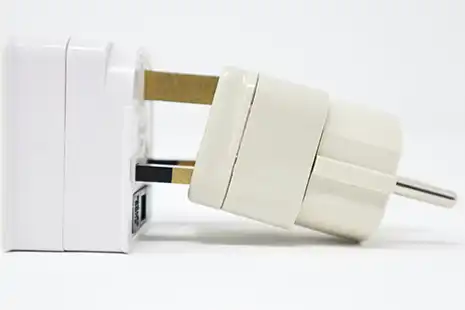
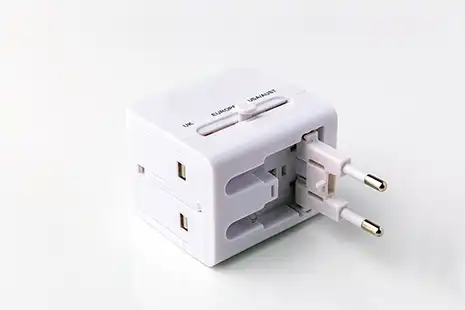
- Type C and Type F — two round pins
- Voltage
- 230V, 50 Hz
- Adapter needed?
- Yes
- Converter needed?
- Only for single-voltage devices
Adapter or converter?
An adapter lets an American plug fit a Portuguese socket. A converter changes the voltage. Nearly all converters are also adapters, but not all adapters are converters, so read the product description carefully before you buy.
Check the label on each device. If it reads INPUT: 100–240V, 50/60 Hz, it is dual-voltage and can be used in any country, including Portugal, with only an adapter. That covers most phones, tablets, laptops, and electronics with a boxy charger. Most CPAP machines are dual-voltage as well, but please check with your manufacturer or doctor to make sure yours is compatible.
Single-voltage devices need a converter, or the higher voltage from Portuguese sockets will burn them out. Hair dryers, straighteners, and curling irons fall into this category, as do many electric toothbrushes and shavers. Most hotels have hair dryers, and you will be able to check your specific hotels once your pilgrim packet arrives. Adapters and converters are easy to find online or in the travel section of stores such as Target and Walmart.
One adapter covers the whole Marian Shrines route. Portugal, Spain, and France all take the same simple two-round-pin European adapter, so a pilgrimage from Fatima to Lourdes needs only one.
Questions Pilgrims Ask
Do U.S. citizens need a visa or an ETIAS to travel to Portugal?
No. U.S. citizens can visit Portugal for up to 90 days in any 180 without a visa. ETIAS, the European Travel Information and Authorisation System, is not yet in operation and no applications are being accepted anywhere, so there is nothing to apply for today. Your passport must be valid for at least three months after the day you leave the Schengen Area and must have been issued within the last ten years. Airlines apply a stricter reading at check-in, so travel with six months to spare.
How long are the passport control lines at Lisbon airport?
They have been among the longest in Europe since the European Union's Entry/Exit System began recording fingerprints and a photograph of every non-EU traveler. Waits of several hours were reported during the rollout, and Portugal paused the system at Lisbon for three months before it became mandatory everywhere on April 10, 2026. Lines have eased since extra officers and equipment were added, but an hour or more is still possible at peak times. Pre-registering in the free Travel to Europe app up to 72 hours before landing can shorten the process.
What is the best time of year to visit Fatima?
May, June, and September give the most comfortable weather for the walking a Fatima pilgrimage involves: warm days, little rain, and long evenings. October is mild but noticeably wetter, and from November through February Fatima is cool and often rainy. The Shrine is busiest on the 12th and 13th of each month from May to October, above all in May and October, when the anniversary pilgrimages draw very large crowds. Fatima sits well above sea level and its nights run cooler than Lisbon's in every season.
What happens in Fatima on the 12th and 13th of the month?
From May to October the Shrine holds its International Anniversary Pilgrimages on the 12th and 13th, remembering the apparitions of 1917, which took place on the 13th of each month. The evening of the 12th brings the candlelight Rosary procession and a night of prayer, and the morning of the 13th brings a large international Mass. The May and October anniversaries are the largest of the year. If your dates include them, expect crowds, fuller streets, and a Shrine that is extraordinary to witness.
What is the couvert in Portuguese restaurants?
The couvert is the bread, butter, olives, or small starters a Portuguese restaurant places on the table before you order. It is not free. If you eat it, it appears on the bill. If you do not want it, you can decline it or leave it untouched and ask for it to be taken away, and you should not be charged. Group meals on a Tekton pilgrimage are arranged in advance, so this matters most at meals you order yourself.
What should I wear in Fatima?
Dress modestly, with knees and shoulders covered, as you would for any church. Fatima's Shrine is an active place of prayer, and silence and respect are expected across the whole esplanade. Bring a warm layer for the evening candlelight procession, which is outdoors after dark, and a rain jacket outside the summer months. Comfortable shoes matter more than anything else, for the wide stone esplanade and the partly unpaved Way of the Cross toward Valinhos.
Is tap water safe to drink in Portugal?
Yes. Tap water across mainland Portugal is treated to European Union standards and is safe to drink, including in Lisbon and Fatima. Restaurants usually serve bottled water, and you will be asked whether you want it still, sem gás, or sparkling, com gás. Carry a refillable bottle on walking days, particularly from June through September.
What kind of electrical adapter do I need for Portugal?
Portugal uses Type C and Type F sockets at 230 volts. You will need a plug adapter, and a voltage converter only for single-voltage devices. Phones, tablets, laptops, and most CPAP machines are dual-voltage and need only an adapter. The same simple two-round-pin European adapter also works in Spain and France, so one adapter covers an entire Marian Shrines pilgrimage.
Next Steps
Bring Your Question to Fatima
For thirty years Tekton has walked with pilgrims through Portugal, from the Eucharistic miracle at Santarém to the Chapel of the Apparitions in the Cova da Iria. Everything on this page exists so that when you arrive, the practical things are already settled, and the question you came with has room to be heard.