

Tekton Ministries
Publish Date: May 13, 2026
On May 13, 1917, three shepherd children ran home from the Cova da Iria with a story their families could not believe. A Lady "brighter than the sun" had appeared above a small holm oak and asked them to return on the thirteenth of each month. Six visits later, on October 13, some seventy thousand people stood in a rain-soaked field and watched the sun dance. Today, more than a century on, millions travel to Fatima every year. Some come with cameras and itineraries. Others come because the secrets of Fatima have gripped them, and they want to stand where the Blessed Mother stood. The difference between those two postures is the difference between visiting a famous shrine and undertaking a pilgrimage.
This post is written for the second group. Before you book a flight to Lisbon, before you pack a single bag, the most important preparation for any Catholic pilgrimage is interior. Understanding what the secrets of Fatima actually say — and what Our Lady asked of those who heard them — is where that preparation begins.
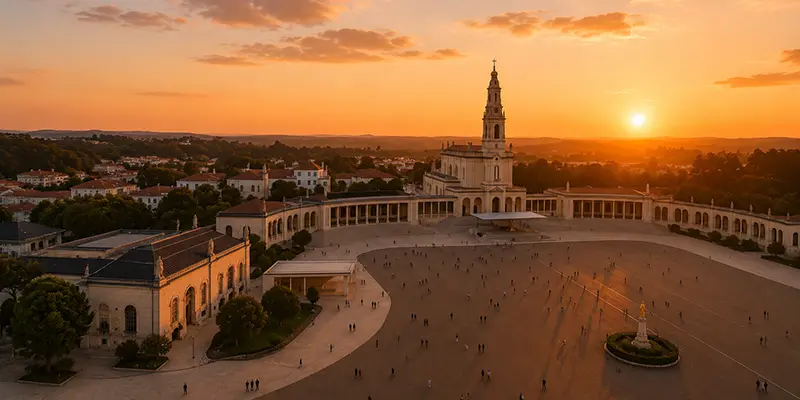
The Capelinha marks the exact spot above the Cova da Iria where Our Lady appeared to the three children on May 13, 1917.
The Children, the Cova, and the Three Secrets
On July 13, 1917 — during the third apparition — Mary entrusted three messages to the seers: Lúcia dos Santos and her younger cousins, Francisco and Jacinta Marto. These would come to be called the Three Secrets of Fatima. Francisco and Jacinta were canonized by Pope Francis on May 13, 2017, exactly one hundred years after the first apparition. Sister Lúcia, who lived to record her memoirs and explain Our Lady's requests in detail, died in 2005; her cause for canonization is open, and she is presently a Servant of God.
The first two secrets were written down by Sister Lúcia in 1941 and gradually made public. The third remained sealed in the Vatican until June 26, 2000, when Pope John Paul II released it through a document of the Congregation for the Doctrine of the Faith, accompanied by a theological commentary from Cardinal Joseph Ratzinger.
The Fatima Secrets Explained: What Mary Actually Revealed
The first secret was a vision of hell. The children saw what Lúcia later described as a sea of fire and the souls of sinners plunged into it. Mary did not show them this to terrify them, but to move them to pray and sacrifice for the conversion of sinners. "You have seen hell," she said, "where the souls of poor sinners go."
The second secret had three parts. First, a request that the world — and Russia in particular — be consecrated to her Immaculate Heart. Second, a warning that if humanity did not stop offending God, a war worse than the one then raging would break out during the pontificate of Pius XI. Third, the promise: "In the end, my Immaculate Heart will triumph." World War II began in 1939, late in Pius XI's reign. Pope John Paul II consecrated the world to Mary's Immaculate Heart in 1984, an act Sister Lúcia later confirmed fulfilled Our Lady's request. Pope Francis renewed the consecration in March 2022, expressly naming Russia and Ukraine.
The third secret, withheld for decades and the subject of endless speculation, proved to be a prophetic vision rather than a coded prediction. Lúcia described "a Bishop dressed in White" climbing a steep mountain crowned with a cross, falling under gunfire amid the bodies of other martyrs. The Vatican's interpretation, reflected in Cardinal Ratzinger's commentary, reads the vision against the broader twentieth-century persecution of the Church and connects it to the May 13, 1981, assassination attempt on Pope John Paul II — a date that fell on the Feast of Our Lady of Fatima, and one to which the wounded pope explicitly attributed his survival.
Read together, the three secrets are not a tabloid. They are a call. Hell is real. Conversion is urgent. Prayer and reparation matter. The Immaculate Heart is the refuge God has provided. Everything Mary asked for at Fatima — the daily Rosary, sacrifice, the Five First Saturdays, the consecration — flows from this single message.
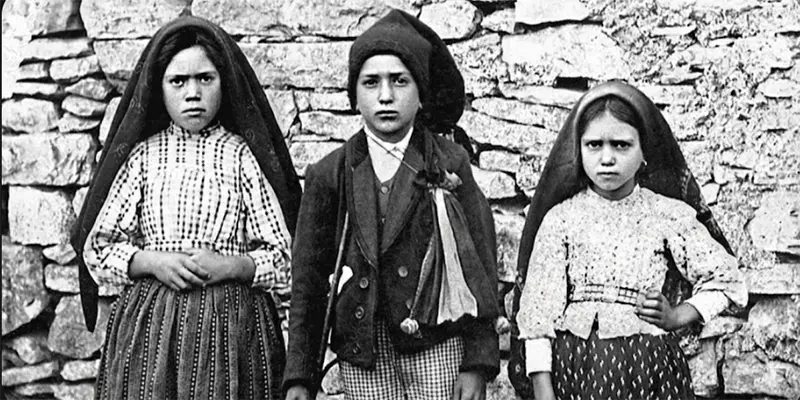
Saints Francisco and Jacinta Marto, with their cousin Lúcia dos Santos, in the months following the apparitions.
Why Fatima Pilgrimage Preparation Has to Start with the Message
Many travelers arrive at the Cova having read the dates and the famous Miracle of the Sun but not the request that prompted everything. They take photos at the Capelinha, walk the esplanade, and leave moved but unchanged. They have visited Fatima. They have not been pilgrims to it.
A pilgrim, by contrast, hears the message before booking the flight. A pilgrim arrives already living some part of what Mary asked — not perfectly, but really. That is what makes standing on the site of the apparitions different in kind from the standing of a tourist on the same square meter of stone. Approached this way, Fatima pilgrimage preparation is not a packing list. It is a small but real reordering of life that begins weeks or months before you fly.
Concrete Practices Before You Go
Begin with the daily Rosary. Mary asked for this at every single Fatima apparition. If the Rosary is not yet part of your daily life, start now and keep it as the foundation of your trip. A pilgrim who has prayed the Rosary every day for two months before arrival will pray differently at the Capelinha than one who has not.
Take up the Five First Saturdays devotion. This was the specific reparatory devotion Our Lady requested through Sister Lúcia at Pontevedra in 1925: confession, Holy Communion, the Rosary, and fifteen minutes of meditation on its mysteries, on the first Saturday of five consecutive months, in reparation for offenses against the Immaculate Heart. If you can complete the five Saturdays before your pilgrimage, do it. If not, begin them and let them carry you through your travel dates.
Make a good confession before you leave. Pilgrimage is uniquely fruitful for souls who arrive in a state of grace, free to receive what the place is offering. A few weeks out is the right window — far enough that you can prepare prayerfully, close enough that the graces are still warm when you board the plane.
Read the actual sources. The Memoirs of Sister Lúcia and the Vatican's The Message of Fatima (2000) will do more for your pilgrimage than any travel guide. Both are short and inexpensive, and both will help you separate authentic Fatima from the layers of sensationalism that have grown up around the apparitions.
Carry intentions. Write them down before you leave — names, situations, conversions you long to see. The Cova is a place where intentions are entrusted, not collected. You are going there to lay something down.
What You Will Encounter at Fatima
The Sanctuary is built around a vast esplanade — larger, when you first see it, than photographs prepare you for. At its heart stands the Capelinha das Aparições, the small chapel marking the exact spot of the apparitions. To one side is the Basilica of Our Lady of the Rosary, where the bodies of Saints Francisco and Jacinta are interred. Opposite stands the modern Basilica of the Most Holy Trinity, which seats nearly nine thousand and hosts daily Masses in many languages.
You will likely walk the esplanade more than once. Some pilgrims walk part of it on their knees, in petition or thanksgiving. At night, the candlelight procession winds across the square — tens of thousands of small flames, the Rosary in many tongues, an image of Our Lady carried slowly past you. It is the kind of moment that does not photograph well. Try not to photograph it.
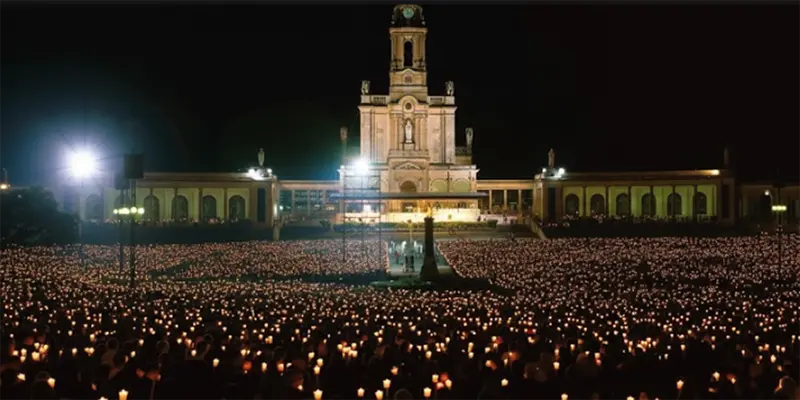
The candlelight procession draws tens of thousands of pilgrims each evening during the major feast days at Fatima.
Pack Intentions, Not Just Luggage
Fatima will press on you in the ways pilgrimage always presses: long days, midday heat, jet lag, queues, unfamiliar food, a body more tired than your devotional appetite. None of this is a glitch. The small discomforts are part of the offering — minor reparations made on the very ground where Mary asked for reparation. Received as such, they become seeds of grace rather than complaints.
The deepest preparation, then, is not logistical. It is the inward decision, made before you ever leave home, to receive whatever comes — consoling or difficult — as part of what God means to do in you at Fatima.
Returning by a Different Way
The fruit of a Fatima pilgrimage is not the photographs or the souvenir Rosary blessed at the Capelinha. The fruit is what continues at home: the Rosary still prayed in the kitchen on a Tuesday in October, the First Saturday kept faithfully through the next winter, the conversion of life that began in the Cova and refused to be left behind there.
If you are weighing a Fatima pilgrimage and want it to be something more than a trip, start with the message and let it shape the months before you go. The Lady who appeared to three children on May 13, 1917, has not changed her requests. She is still asking for the same things. A pilgrim is simply someone who has begun to do them.
Ready to walk where Our Lady walked?
Tekton Ministries leads small-group pilgrimages to Fatima and the Marian shrines of Europe with knowledgeable Catholic and Christian guides, daily Mass, and itineraries built for prayer rather than sightseeing.