
Spain Travel Guide for Catholic Pilgrims
Preparing for Spain, and for the Road Home
This Spain travel guide is written for Catholic pilgrims, and it gathers what Tekton pilgrims most often need settled before departure: what the Spanish border can ask of you, the weather across three very different climates, what happens when you land or cross in by coach, money, the late rhythm of the Spanish day, and what the 2027 Holy Year changes in Santiago de Compostela.
Saint Matthew ends the story of the wise men with a change of route. Having found the Child, and warned in a dream, they went back another way into their country. The road home was not the road they had planned, and the reason was what they had seen at the end of the first one.
Spain keeps one of the Church's clearest pictures of that. In March 1522 a wounded Basque soldier named Íñigo de Loyola climbed to the monastery of Montserrat, kept watch through the night before Our Lady, and left his sword at her altar. He gave his fine clothes to a poor man and went down the mountain toward Manresa by another road, on his way to becoming Saint Ignatius. Several Tekton itineraries stop at Montserrat, before the same image of Our Lady. Nobody will ask you to leave a sword there. But a pilgrim should expect the way home to run differently from the way out, and should arrive with room for it.
That is the real reason to settle the practical things now. The passport, the paperwork the border may ask to see, the right plug, and the late dinner hour deserve one evening of attention at home, so that none of them is on your mind at Montserrat.
Already registered? Your pilgrim packet arrives two to three weeks before departure with hotel details, your final itinerary, and guidance from your Pilgrimage Manager. This guide is what you need before that packet reaches you. Our pre-pilgrimage spiritual retreat is where the interior preparation happens.
Entry Requirements for Spain
A U.S. passport is still all you need to board a flight to Spain. What catches pilgrims out is not a new form to file in advance but a rule Spain has had for years and now enforces more visibly: at the border, an officer may ask you to prove that your stay is arranged and paid for.
ETIAS is not in operation. The European Travel Information and Authorisation System has been delayed again, the European Union has removed its 2026 target, and no applications are being accepted anywhere. Spain belongs to the Schengen Area, so ETIAS will apply here when it launches. Until then, any website offering to sell you one is not the official portal. Tekton will tell registered pilgrims what to do when a real date is announced.
-
Check your passport against two dates
It must be valid for at least three months after the day you leave the Schengen Area, and it must have been issued within the last ten years. Airlines enforce their own stricter reading at the check-in desk, so travel with six months to spare. If you are close to either limit, renew before you register.
-
Know what Spain may ask you to show
Spanish border officers can ask visitors from outside the European Union to show they have enough money for their stay. The 2026 reference figure is 122.10 euros per person per day (roughly $140), with a minimum of 1,089.90 euros (roughly $1,260) however short the visit. The rule is old; what is new is how visibly it is applied. Over Easter 2026, travelers who could not show it were refused entry at Málaga.
Most pilgrims are never asked. If you are, a credit card with a recent bank statement is accepted, and so is cash. A statement printed or saved as a PDF from your bank is better than a screenshot of an app.
-
Keep your return ticket and pilgrimage confirmation reachable
The same officer may ask how you are leaving Spain and where you are staying. For a Tekton pilgrim both answers are simple: your return flight and your pilgrimage confirmation, which shows an organized trip with its accommodation arranged. Keep both on your phone and on paper, somewhere other than the bottom of a checked bag.
-
Count your days across all of Schengen
A U.S. passport allows ninety days in the Schengen Area in any rolling one hundred eighty. Spain shares that count with Portugal, France, and the rest. A pilgrimage is nowhere near the limit, but if you are adding a week in Rome or visiting family elsewhere in Europe, the days add together.
Carry copies, kept apart from the original. Photograph your passport page and email it to yourself, and keep a paper copy in a different bag. Send your Pilgrimage Manager a photograph of the page when you register, so the name on your airline ticket can be checked against it. Maiden names, middle initials, and suffixes are the usual trouble.
Spain Weather Month by Month
Spain is not one climate. It is at least three, and most pilgrimages cross all of them: the high central plateau around Madrid and Ávila, the Mediterranean coast at Barcelona and Montserrat, and the green, rain-soaked northwest where the Camino ends. A single week can ask you to pack for all three.
| Month | Madrid | Ávila | Barcelona | Santiago | Rain days, Santiago | What it feels like |
|---|---|---|---|---|---|---|
| January | 50° / 37° | 46° / 29° | 56° | 52° | 15 | Crisp and bright in Madrid, frost in Ávila, wet in Galicia. |
| February | 54° / 39° | 49° / 31° | 58° | 54° | 13 | Still cold on the plateau. Almond blossom along the coast. |
| March | 61° / 43° | 55° / 33° | 61° | 59° | 13 | Spring reaches Madrid weeks before the walled towns. |
| April | 65° / 46° | 58° / 37° | 64° | 61° | 14 | Mild and changeable, with showers in the north. |
| May | 72° / 52° | 65° / 44° | 70° | 65° | 13 | Warm, green, and long-lit. Cool evenings in Castile. |
| June | 83° / 61° | 76° / 50° | 77° | 72° | 8 | Settled and bright. Hot by mid-afternoon in Madrid. |
| July | 90° / 66° | 83° / 55° | 82° | 76° | 6 | Hot inland, humid on the coast. Santiago at its busiest. |
| August | 88° / 66° | 82° / 54° | 83° | 76° | 6 | The hottest stretch. Many city businesses close for holidays. |
| September | 80° / 60° | 74° / 49° | 79° | 73° | 8 | The heat breaks and the light stays. Superb for walking. |
| October | 67° / 51° | 62° / 43° | 72° | 65° | 14 | Golden days inland. Galician rain returns mid-month. |
| November | 56° / 43° | 52° / 35° | 63° | 57° | 15 | Grey and cool in the north. Barcelona stays mild. |
| December | 50° / 38° | 47° / 31° | 58° | 53° | 16 | Cold on the plateau. Santiago's wettest month. |
- Hot, dry, and bright across most of the route
- Mild and changeable, with showers in the north
- Cold inland and wet in Galicia
- Most comfortable months for walking
Average daytime highs in Fahrenheit, with overnight lows shown for Madrid and Ávila. “Rain days” is the average number of days per month with at least 1 mm of rain at Santiago de Compostela. Figures from the climate normals published by AEMET, Spain's national meteorological agency, for Madrid Retiro, Ávila, Barcelona Airport, and Santiago de Compostela Airport.
The plateau is higher and colder than it looks
Madrid sits more than 2,000 feet above sea level, and Ávila, where Saint Teresa was born, is the highest provincial capital in Spain at about 3,700 feet. Burgos, on several itineraries, runs almost exactly as cold as Ávila. The result surprises pilgrims every spring and autumn: a warm afternoon in Madrid can be followed by a genuinely cold evening inside Ávila's walls, and in May the overnight low there still averages 44°F. Bring a warm layer even when the forecast says summer.
Galicia gets four times Madrid's rain
Santiago de Compostela averages about 70 inches of rain a year. Madrid averages about 17. Most of Santiago's falls between October and April, and in October, when many Camino pilgrimages walk, it rains on about fourteen days of the month. Galician rain tends to come as long soft spells rather than storms. The walking goes on regardless, so a real rain jacket and quick-drying layers matter more on the Camino than on any other Tekton itinerary in Spain.
Barcelona is the easy one
The Mediterranean coast is the mildest part of the route. Barcelona rarely drops much below the mid-50s by day even in January, and its summer heat comes with humidity rather than the dry blast of the interior. Montserrat, a short drive inland and high on its mountain, runs noticeably cooler and windier than the city below.
Arriving in Spain by Air or Overland
Spain is the country on Tekton itineraries that pilgrims are as likely to enter by coach as by plane. Some pilgrimages land in Madrid. Others begin in Lisbon or Paris and cross into Spain partway through, and several fly home from Barcelona or Bilbao. Where your journey first enters Europe decides where the border actually happens.
Landing at Madrid-Barajas
Since April 10, 2026, every Schengen airport has used the European Union's Entry/Exit System. The first time you enter, your passport is scanned and your fingerprints and a photograph are recorded, usually at a self-service kiosk before you reach an officer. It takes a few minutes per person. When the system went fully live, non-EU passengers at Madrid and Barcelona waited in lines of up to three hours, and peak-hour queues are still unpredictable. Nothing about it is difficult. It is simply slow, so be patient and keep the group together.
Your Pilgrimage Manager meets the group after arrival and stays with you for the whole pilgrimage. On several itineraries the coach drives straight on to Ávila or begins in Madrid the same day, so wear shoes you can walk in off the plane.
Crossing overland from Portugal or France
Spain, Portugal, and France share the Schengen Area, so the land borders between them have no passport control. Coming from Fatima, you will notice little more than a blue road sign. Coming from Lourdes, you cross the Pyrenees. If your pilgrimage began in Lisbon or Paris, or connected through another European airport, your Entry/Exit registration already happened there.
One thing does change at the Portuguese border: the clock. Spain is one hour ahead of Portugal, so a coach that leaves Fatima after breakfast arrives in Salamanca an hour later than the driving time suggests. Set your watch at the border and check your phone has followed.
At the hotel desk
Do not be surprised by how much a Spanish hotel wants to know. Since December 2, 2024, Spanish law has required every hotel to record each guest's passport number, nationality, date of birth, home address, phone number, and email, and to send them to the Ministry of the Interior within twenty-four hours. It applies to Spaniards as much as to visitors, and it is why check-in can feel like a form. Group check-in usually moves quickly, but you may still be asked to confirm your own details at the desk.
Hotels are allowed to record your passport details. Spain's data protection authority has said they are not allowed to keep a photocopy of the passport itself.
Going home
Your exit from the Schengen Area is recorded the same way at your departure airport, whether that is Madrid, Barcelona, Bilbao, Lisbon, or Paris. Plan on arriving three hours before an international flight. Bottles of holy water and blessed oils belong in checked luggage. A scallop shell from Santiago travels anywhere.
General Information
- Capital city
- Madrid
- Largest city
- Madrid
- Official language
- Spanish, with Catalan, Galician, and Basque co-official in their regions
- Time zone
- 6 hours ahead of U.S. Eastern; 1 hour ahead of Portugal
- Flight time
- Roughly 7–8 hours nonstop from the U.S. East Coast to Madrid
- Country code
- +34
- Emergency number
- 112
- Driving
- On the right
Will people speak English?
In the places your pilgrimage visits, you are likely to meet people who speak English, particularly at hotels, shrines, and larger restaurants. Your knowledgeable Catholic and other Christian guides speak it fluently. English thins out in smaller towns and among older Spaniards, and if you have a hard time communicating with someone, a smile and a little body language go a long way. Por favor, gracias, and a buenos días on walking into a shop are appreciated out of all proportion to the effort.
Spanish is not the only language on the signs
Spain has four official languages, and a Tekton itinerary can pass through three of them in a week. At Montserrat and in Barcelona, signs and many Masses are in Catalan. In Santiago de Compostela they are in Galician, which is why the great square in front of the cathedral is the Praza do Obradoiro rather than the Plaza. At Loyola, in the Basque Country, place names are written in Basque, a language unrelated to any other in Europe. Your guides translate as you go. It is one of the first signs of how old and how varied the Church in Spain is.
Emergency numbers
Spain does not use 911. Dial 112 for police, ambulance, or fire. It needs no area code, works from any phone in the country including a mobile without a Spanish SIM, and the service takes calls in English. You will almost certainly never need it. Your Pilgrimage Manager is with the group throughout and is the first person to find if something goes wrong. Save the number anyway, alongside your hotel addresses, before you leave home.
Jet lag
Six hours is a real shift, and Spain adds a twist: because the whole country eats and sleeps late, your body is asked to move further than the clock suggests. Most flights land in the Spanish morning. Stay outside in the daylight, drink more water than feels necessary, and hold out until a normal Spanish bedtime, which will be later than you are used to. Our advice on the first day of a pilgrimage covers the rest.
Money, Cards, and Tipping
Spain runs on cards
Spain uses the euro, and U.S. dollars are not accepted. In practice you will need far fewer euros than you might expect, because Spain has become one of the most card-friendly countries in Europe. Contactless payment works in cathedral gift shops, pharmacies, cafes, and village bakeries alike. Keep some cash in small notes and coins for candles, offering boxes, a coffee in a small bar, and the occasional restroom attendant, and put the rest on a card.
Where to get euros
Not at home, and not at the airport exchange counter, both of which set their own rate and add a fee on top. Withdraw euros from an ATM after you arrive, and choose a machine that belongs to a Spanish bank such as Santander, BBVA, or CaixaBank. The brightly branded standalone machines on busy sightseeing streets charge noticeably more.
- Always choose to be charged in euros. When an ATM or a card terminal offers to bill you in U.S. dollars, it is applying its own poor rate. This is dynamic currency conversion, and saying no costs nothing.
- Withdraw once and withdraw enough, since most U.S. cards charge a flat fee per withdrawal.
Which cards work
Visa and Mastercard are accepted everywhere. Discover is not as common overseas. American Express is widely taken in hotels and larger restaurants and less reliably in small shops. Before you leave:
- Tell your card issuer your travel dates, so your purchases are not flagged.
- Check your foreign transaction fees, so you are not surprised by extra costs.
- Carry a second card, kept somewhere other than your wallet.
- Know your PIN. Spanish terminals and ticket machines often ask for it.
Tipping in Spain
Gratuities for your guides and drivers are already on your final invoice, so there is nothing to calculate or hand out on the last day. Your pilgrim packet explains what that amount covers.
In restaurants and cafes, Spain is not a tipping culture in the American sense. Service is not usually added to the bill, and waiting staff do not expect a percentage. Leaving the small change, or rounding up a euro or two for good service at a meal you have paid for yourself, is the local habit. The Spanish word is propina, and leaving nothing is not rude.
The Late Spanish Day
Nothing about Spain takes Americans by surprise quite like the clock. Lunch at three, dinner at half past nine, children in the plaza at eleven, and a town that seems to close altogether in the middle of the afternoon. None of it is disorder. The day has a different shape here, and a pilgrim who expects it will find it gracious rather than inconvenient.
Why everything runs late
Look at a map and most of Spain lies level with Portugal and Great Britain, yet since 1940 it has kept the same clock as Germany. The sun rises late and sets late. In June it is still light in Santiago de Compostela close to ten at night. Spanish meal times simply follow the sun rather than the watch, which is why a nine o'clock dinner feels early evening once you are there.
Meals
Breakfast is light, often coffee and toast with tomato and olive oil. Lunch is the main meal of the day, eaten between about two and four, and many restaurants offer a fixed-price menú del día at midday that is the best value in the country. Dinner rarely begins before nine, and many restaurants do not open their kitchens until half past eight. Your Pilgrimage Manager sets the rhythm for group meals. On a free evening, if you are hungry at six, do what Spaniards do and have a few tapas.
The midday closure
The siesta as an afternoon nap is mostly a memory, but the long midday break is not. In smaller towns, many shops close from roughly two until five and open again into the evening. Parish churches outside the big cities are often locked in the middle of the day except for Mass. Many of Spain's great cathedrals charge admission for visits outside Mass times. Your group's visits are arranged in advance; on your own time, the doors are always open to you for Mass.
In many cathedrals, sightseeing pauses when Mass begins. Visitors are asked to take a seat or step aside, and it is the right moment to put the phone away and join in.
Sundays, and August
Outside the busiest city centers, most shops close on Sunday, and the day belongs to Mass, family, and a long lunch. August is Spain's holiday month. Family-run restaurants and shops in Madrid and other inland cities often close for weeks, and the Feast of the Assumption on August 15 is a public holiday across the country.
The evening walk
As the heat goes out of the day, Spanish towns come outside. The paseo is an unhurried walk through the old streets and plazas, with grandparents, couples, and children still out long after American bedtimes. After a day of shrines, an hour spent in it is not time away from the pilgrimage. It is the country you came to pray in, living its ordinary Catholic life in front of you.
Visiting Santiago in the 2027 Holy Year
If your pilgrimage reaches Santiago de Compostela in 2027, you will arrive in a Holy Year. It comes only when the Feast of Saint James, July 25, falls on a Sunday. The last was 2021, extended into 2022, and after 2027 the next is not until 2032. It changes what you can receive at the tomb of the Apostle, and it changes how busy the city will be.
The Holy Door
In ordinary years the Holy Door of the cathedral, which opens onto the Praza da Quintana, stays sealed. The Archbishop of Santiago opens it on the evening of December 31, 2026. It stays open through the whole of 2027 and is closed again on December 31, 2027. Entering the cathedral through that door is one of the oldest gestures of the pilgrimage to Santiago, and during the Holy Year every pilgrim who reaches the city can make it.
Receiving the Jubilee indulgence
The Church grants a plenary indulgence to pilgrims who visit the cathedral in a Holy Year. The customary conditions are to visit the tomb of Saint James and pray there, including for the intentions of the Holy Father; to receive Holy Communion; and to make a sacramental Confession within fifteen days before or after the visit. That Confession can be made in Santiago or elsewhere, including at home in the two weeks before you fly. The indulgence may also be offered for the faithful departed.
If you are traveling with a chaplain, ask early in the pilgrimage about opportunities for Confession, rather than on the morning you reach Santiago.
The Compostela is something different
The Compostela is the certificate the Pilgrim Office issues to those who walk at least the last 100 kilometers to Santiago, which is why Tekton's Camino pilgrimages begin at Sarria on the French Way or at Vigo on the Portuguese Way. It is a record of the road. The Jubilee indulgence is a grace. You can receive either one without the other, and a pilgrim who arrives by coach in 2027 can receive the indulgence just as fully as one who walked.
Expect crowds, and register early
The Camino set a record in 2025 without a Holy Year behind it, and 2027 is expected to be busier still, above all in July around the Feast of Saint James. Hotels in and around Santiago fill far in advance, and the lines at the Holy Door and the tomb lengthen through the summer. If you are considering a pilgrimage to Spain in 2027, register as early as you can, and expect the cathedral to be full.
For the story behind the pilgrimage, read about Saint James and the Camino de Santiago and the great censer of the cathedral, the Botafumeiro.
Phone, Data, and Water
Will my phone work in Spain?
Yes. Mobile coverage in Spain is strong in the cities and along the main roads, and generally good on the final stretch of the Camino Francés, with the occasional dead spot in the wooded valleys of Galicia. Your options:
- Carrier travel pass. The simplest choice. Most U.S. carriers offer a daily or monthly international plan covering Spain. Add it before you leave.
- eSIM. Usually cheaper if you expect heavy data use. Buy and install it before departure.
- Hotel Wi-Fi. Widely available and generally reliable, and enough if you are content to check in once a day.
WhatsApp is how nearly everyone in Spain messages, from hotels to family-run restaurants, and it works over Wi-Fi.
Consider using it less. The phone is useful for photographs and for a nightly word home. It is also the quickest way to be somewhere other than where you are standing. Many pilgrims decide in advance to keep it in a pocket at the holy sites, and come home glad they did.
Can I drink the tap water?
Yes. Tap water in Spanish cities, towns, and hotels is treated and safe to drink. It varies in taste: Madrid's, drawn from the mountains north of the city, is excellent, while Barcelona's tastes clearly of minerals and chlorine, which is why many locals there buy bottled water by choice rather than necessity. Carry a refillable bottle, especially on the plateau in summer.
On the Camino, drink from a public fountain only when it is marked as drinking water. A sign reading auga non potable in Galician, or agua no potable in Spanish, means the water is not safe.
Food and dietary needs
Spanish food is less spicy than many Americans expect and built on olive oil, bread, ham, seafood, and eggs. Ham turns up in a great many dishes, including some that look vegetarian, so ask. Gluten-free options are increasingly common, and allergens are listed on menus. If you have a serious allergy or a dietary requirement, tell your Pilgrimage Manager well before departure so arrangements can be made rather than improvised.
What to Wear in Spanish Churches
Unless your pilgrimage includes a very specific formal occasion, you can dress much as you would at home. Spain asks for two adjustments: modesty at the church door, and layers for the altitude and the rain.
You may be turned away, or asked to cover up, before entering churches and other holy sites if your knees and shoulders are not covered. This applies to men and women alike, and bare midriffs are frowned upon. Spain's most visited basilicas, La Sagrada Familia among them, check at the entrance. Modesty and respectfulness are key. A light scarf or wrap in your daypack solves most problems on a hot day.
You will not need a head covering, and women do not need to wear skirts or dresses unless that is your preferred style. Jeans are acceptable, unless your priest has told you differently.
Pack for the climate your itinerary actually crosses. A warm layer for Ávila, Burgos, and Montserrat even in late spring; breathable clothing for Madrid in summer; and a proper rain jacket for Santiago in any month. Shoes matter more than anything else you bring: Spanish old towns are stone, often steep, and polished smooth by centuries of feet. If you are walking the Camino, our Camino de Santiago packing list covers boots, socks, and daypacks in detail.
Electricity, Plugs, and Adapters
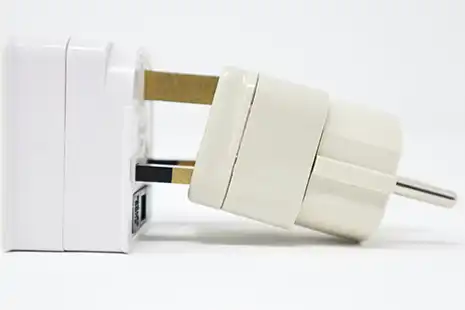
- Socket types
- Type C and Type F — two round pins
- Voltage
- 230V, 50 Hz
- Adapter needed?
- Yes
- Converter needed?
- Only for single-voltage devices
Adapter or converter?
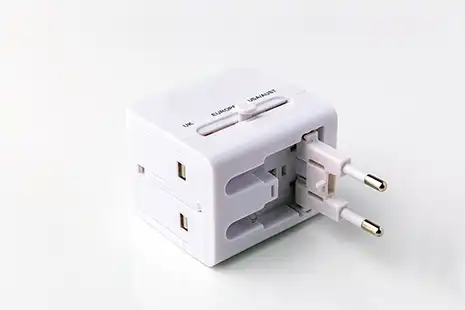
An adapter lets an American plug fit a Spanish socket. A converter changes the voltage. Nearly all converters are also adapters, but not all adapters are converters, so read the product description carefully before you buy.
Check the label on each device. If it reads INPUT: 100–240V, 50/60 Hz, it is dual-voltage and can be used in any country, including Spain, with only an adapter. That covers most phones, tablets, laptops, and electronics with a boxy charger. Most CPAP machines are dual-voltage as well, but please check with your manufacturer or doctor to make sure yours is compatible.
Single-voltage devices need a converter, or the higher voltage from Spanish sockets will burn them out. Hair dryers, straighteners, and curling irons fall into this category, as do many electric toothbrushes and shavers. Most hotels have hair dryers, and you will be able to check your specific hotels once your pilgrim packet arrives. Adapters and converters are easy to find online or in the travel section of stores such as Target and Walmart.
One adapter covers the whole Marian Shrines route. Portugal and France use the same Type C and F sockets as Spain, so a pilgrimage that runs from Fatima through Spain to Lourdes needs only one kind of plug. It will not fit sockets in Ireland or Britain, which use Type G. If your journey continues there, bring a universal adapter instead.
Questions Pilgrims Ask
Do I need a visa or an ETIAS to travel to Spain?
No. U.S. citizens do not need a visa to visit Spain for up to 90 days. ETIAS, the European Travel Information and Authorisation System, is not yet in operation and no applications are being accepted anywhere, so there is nothing to apply for today. Any website offering to sell you an ETIAS now is not the official portal. When the system does launch, Tekton will tell registered pilgrims exactly what to do.
How much money do I need to show to enter Spain?
Spanish border officers may ask visitors from outside the European Union to show they can support themselves for their stay. For 2026 the reference figure is 122.10 euros per person per day, roughly $140, with a minimum of 1,089.90 euros, roughly $1,260, however short the stay. Most pilgrims are never asked. If you are, a credit card together with a recent bank statement is accepted, as is cash, and it helps to have your return ticket and your pilgrimage confirmation ready as well.
Why do Spanish hotels ask for my passport details?
Since December 2024, Spanish law has required every hotel to record each guest's identity details, including passport number, nationality, date of birth, home address, and contact information, and to report them to the Ministry of the Interior within twenty-four hours. It applies to every guest at every hotel, not only to foreign visitors. Hotels may record the details, but Spain's data protection authority has said they may not keep a photocopy of your passport to do it.
What happens at passport control at Madrid airport?
Madrid-Barajas uses the European Union's Entry/Exit System, which records your fingerprints and a photograph the first time you enter the Schengen Area. First-time registration takes a few minutes per person, and queues at peak times can be long. Have your passport ready and use the self-service kiosks when directed. If your pilgrimage enters Europe through Lisbon, Paris, or a connecting airport instead, this happens there, and there is no passport check when your coach later crosses into Spain.
When is the best time of year for a pilgrimage to Spain?
May, June, September, and October are the most comfortable months for most Spanish itineraries. Summer is hot on the central plateau, where Madrid averages highs near 90°F in July, and winter is cold there and wet in Galicia. Santiago de Compostela averages about 70 inches of rain a year, so bring rain gear for the Camino in any season. In 2027, the Holy Year will also draw unusually large crowds to Santiago, especially in the weeks around the Feast of Saint James on July 25.
What time do people eat dinner in Spain?
Late by American standards. Lunch is the main meal of the day and is usually eaten between two and four in the afternoon, and dinner rarely begins before nine at night. Many restaurants do not open for dinner until half past eight. Your Pilgrimage Manager will set the rhythm for group meals, but on a free evening, plan for a later dinner or a plate of tapas in the early evening.
Can I drink the tap water in Spain?
Yes. Tap water in Spanish cities, towns, and hotels is treated and safe to drink. In Barcelona it tastes noticeably of minerals and chlorine; in Madrid, which draws its water from the mountains north of the city, it is very good. On the Camino, drink from public fountains only when they are marked as drinking water. A sign reading auga non potable, in Galician, means the water is not safe to drink.
What kind of electrical adapter do I need for Spain?
Spain uses Type C and Type F sockets at 230 volts. You will need a plug adapter, and a voltage converter only for single-voltage devices. Phones, tablets, laptops, and most CPAP machines are dual-voltage and need only an adapter. Portugal and France use the same sockets, so a single adapter covers an entire Marian Shrines itinerary.
Next Steps
Come Home by Another Road
For thirty years Tekton has walked with pilgrims through Spain, from the pillar at Zaragoza to the tomb of the Apostle at Santiago. Everything on this page exists so that when you arrive, the practical things are already settled, and you are free to be changed by what you find.