


Tekton Ministries
Publish Date: September 22, 2026
There are few places in the Catholic world where the call to conversion feels as close to the surface as it does in Assisi. To lead a pilgrimage to Assisi is to walk your parishioners into the story of a wealthy young man who stripped himself of everything he owned in the town square and stepped out of his old life for good. In 2026—the eight-hundredth anniversary of Saint Francis's death—that invitation to be changed carries a particular weight, and the priest who shepherds a group into these hills steps into one of the most fruitful roles his ministry will ever ask of him.
Leading a group here, though, is not the same as visiting. A traveler comes to Assisi for the frescoes of Giotto and the sweeping views over the Umbrian valley, and leaves with photographs. A pilgrim comes to stand where Francis knelt and asks to be undone by the same grace—and leaves different. Your task, as shepherd, is to help the people entrusted to you make that second journey rather than the first. What follows is meant to help you do exactly that.
Why Lead a Pilgrimage to Assisi in the Jubilee Year
Saint Francis died on the evening of October 3, 1226, at the little chapel of the Porziuncola—a passing his friars have always called not his death but his Transitus. The year 2026 marks the eight hundredth anniversary of that night, and the Church has answered it with a Franciscan Jubilee Year running from January 10, 2026, to January 10, 2027, proclaimed by Pope Leo XIV and carrying a plenary indulgence for pilgrims under the usual conditions.
For a priest weighing whether to organize a group pilgrimage to Assisi, this is a rare convergence. A parish that arrives in the autumn of the centenary walks into a town living its founder's memory at full intensity, and your pilgrims can receive the Jubilee indulgence at the very churches where Francis prayed, preached, and died. Centenary years do not repeat in a lifetime. If you have felt the pull to bring your people here, this is the year that pull is worth heeding.
Forming Pilgrims Before You Depart
The fruit of any pilgrimage is decided long before the plane leaves the ground. Assisi rewards the prepared heart and quietly passes over the distracted one, and the priest is the person best placed to make sure his parishioners arrive as pilgrims rather than sightseers. Consider gathering your registered pilgrims several times in the months beforehand to lay that groundwork.
Tell the conversion story. Francis was the son of a prosperous cloth merchant, a young man with money and ambition, until a voice from the San Damiano crucifix asked him to rebuild a falling church. His answer, in the end, was to stand before the bishop and his own father in the public square and hand back even the clothes on his back. Your pilgrims will understand every stone in Assisi differently once they know that this town is, above all, the place where a man let go of everything.
Reframe the packing list. Remind your people that we travel not as tourists collecting souvenirs but as pilgrims looking for seeds of grace—and that the most important thing they will carry is their intentions, not their luggage. The interior preparation that turns a traveler into a pilgrim is the single greatest predictor of whether the graces of Assisi take root or evaporate on the flight home.
Name the discomfort in advance. Assisi is a medieval hill town of steep lanes and uneven stone. There will be climbs, crowds, and tired feet, and in a centenary year the crowds will be considerable. Pilgrims who understand beforehand that the hardship is part of the offering—that a blistered afternoon can be laid down as a small penance—will meet it with peace rather than complaint.
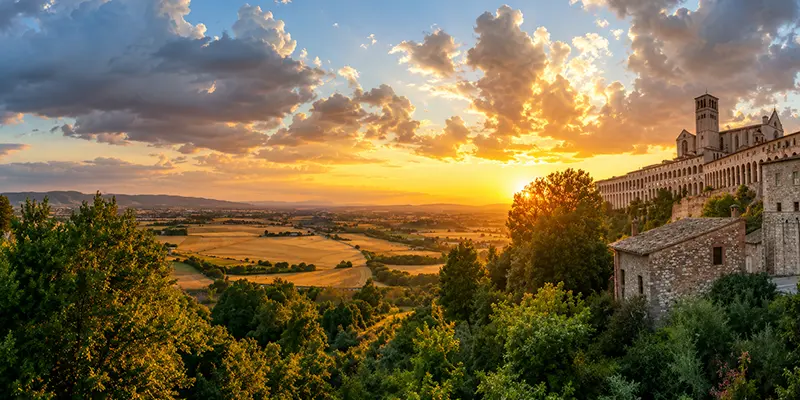
Assisi rises against the slopes of Monte Subasio, the same hills Francis walked eight centuries ago.
The Essential Sites and the Grace Within Them
Assisi is compact enough to pray through unhurriedly in two full days. The temptation, as always, is to treat the itinerary as a checklist; resist it, and let each place do its own work on your people.
The Basilica of Saint Francis. The great double church—Upper and Lower—shelters the crypt where the saint is entombed. Filing down the stone stairway to the plain tomb, ringed by the graves of his first companions, is often the quietest and most affecting moment of the whole pilgrimage. This is the heart of Assisi, and it will be the heart of your days here.
The Basilica of Saint Clare. A short walk across town brings you to the resting place of Clare, the noblewoman who followed Francis into radical poverty. Here, in a side chapel, hangs the original San Damiano crucifix—the very cross from which Christ spoke the words that began everything. For the pilgrims you formed before departure, this cross needs no commentary; they will recognize what it asked of Francis and what it asks of them.
San Damiano and the Porziuncola. Below the walls, San Damiano preserves the humble church Francis rebuilt with his own hands and the garden where he composed the Canticle of the Creatures. In the valley floor, the vast Basilica of Santa Maria degli Angeli was raised to shelter the tiny Porziuncola, cradle of the Franciscan movement, and the adjoining Chapel of the Transitus, where Francis died singing. Few sites in Christendom hold so much in so small a space.
The Sanctuary of the Spoliation. At the former cathedral of Santa Maria Maggiore—the square where Francis stripped away his inheritance—your pilgrims will also find the tomb of Saint Carlo Acutis, the fifteen-year-old canonized in 2025 and now resting in the city of the saint he loved. For younger pilgrims especially, the sight of a modern boy in sneakers, holy and whole, can speak as loudly as anything medieval. It is a gift to have both witnesses in one town.
If your schedule allows, the hermitage of the Eremo delle Carceri, tucked into the wooded slopes above town, offers the silence where Francis and his brothers withdrew to pray—a fitting place to give your group a stretch of unstructured quiet.
Celebrating the Sacraments: Your Gift as a Priest
No local guide, however knowledgeable, can offer your people what you can. The sacraments are the reason a priest-led pilgrimage bears fruit a well-run excursion never will.
Mass at the tomb. Groups may arrange to celebrate Mass in the Crypt Church at the tombs, typically in the early morning, and in the Chapel of Saint Catherine later in the day. To offer the Eucharist a few feet from the remains of Saint Francis, before your own parishioners, is a grace you will not soon forget—and one worth confirming well in advance, as the centenary year has drawn heavy demand. We handle those reservations and the daily Mass schedule so that your attention can stay where it belongs, on your people.
Confession and the Jubilee indulgence. Assisi stirs conversion, and hearts opened before a crucifix that once spoke often long to be reconciled. Make yourself generously available for the Sacrament of Reconciliation, and help your pilgrims fulfill the conditions attached to the Jubilee indulgence—sacramental confession, Holy Communion, prayer for the Holy Father's intentions, and detachment from sin. Few pastoral gestures this year will mean more.
Homilies shaped by Francis. Let the poverty, peace, and utter conformity to Christ that mark this place preach through you. A homily at the Porziuncola on letting go, or at the Spoliation on what we are each asked to hand back, will reach your parishioners in a way no classroom lesson at home ever could.
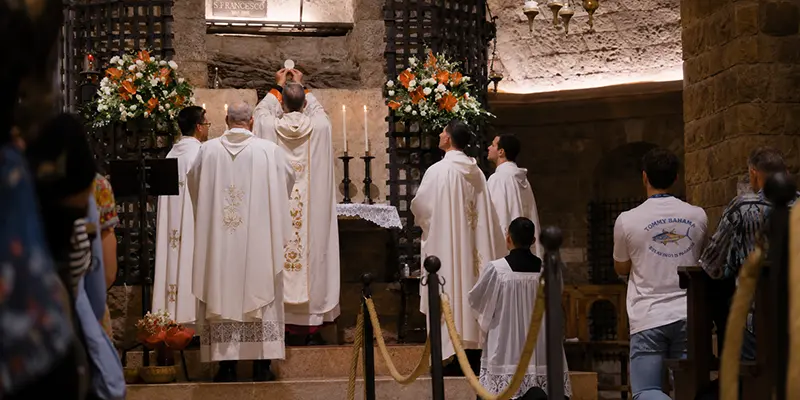
Celebrating Mass near the tomb of Saint Francis is the grace at the center of a priest-led pilgrimage.
Pacing and Pastoral Care in the Hills of Assisi
The same steep lanes that make Assisi beautiful make it demanding. Plan a gentle rhythm—a few sites each day with real pauses between them—and remember that an exhausted pilgrim cannot pray. Some of your group will find the climbs difficult; the crypt at the Basilica of Saint Francis can be reached by elevator, and a good coordinator can arrange rest and alternatives so that no one feels left behind.
Watch, too, for the pilgrim who goes quiet. A place this saturated with holiness can overwhelm, and the most pastoral thing you can do is sometimes to give someone permission to sit out an optional climb and simply rest in a pew. In a centenary year, when lines are long and the town is full, your steady, unhurried presence will do more to keep the group prayerful than any perfect schedule.
The Return: Bringing Assisi Home
The Magi, having found the Child, went home by a different way. That is the measure of a pilgrimage well made: not the sites checked off, but the life that cannot resume unchanged. Assisi is almost designed to teach this, because its whole meaning is a man who came home from a war and a prison and a crucifix's voice utterly unable to live as he had before.
Plan for the re-entry. Gather your pilgrims a few weeks after your return to share what has continued to work in them, and point them toward ways to keep the encounter alive—Franciscan spirituality, care for the poor and for creation, a renewed simplicity. Remind them that the real pilgrimage begins at home, in the ordinary weeks when the graces of Assisi either take root or are quietly forgotten. And do not neglect your own soul in the rush; leading a group is spiritually intense, and you will need time to let what God did in you settle. The pilgrims returned with seeds of grace, not souvenirs—and so, please God, will you.
Considering leading your parish to Assisi in the Jubilee Year? We would be honored to help you shepherd your people through the town of Saint Francis—handling Mass reservations, pacing, and every logistical detail so you can give yourself to the pilgrims in your care. Learn how to Lead Your Own Group with our dedicated support for clergy, or See All Upcoming Pilgrimages to explore available dates.