

The Seven Pilgrim Churches
Plan a Rome and Vatican pilgrimage around St. Philip Neri's seven churches, from Peter's tomb to the Holy Stairs, and let the city send you home changed.
Rome tends to surprise people who come expecting mostly grandeur. The grandeur is there, but what stays with pilgrims is how personal the city becomes once they realize that nearly every great church is built over someone's grave, and that many of those graves belong to names they've heard at Mass for years. Peter and Paul, Lawrence and Cecilia, popes like Sixtus and Cornelius: they're named in the First Eucharistic Prayer, and in Rome you can kneel where they were buried. A Rome and Vatican pilgrimage is a chance to meet the people the Church has been praying alongside for centuries.
That's one reason we'd encourage anyone planning a visit, whether alone or with a parish, to see fewer places and stay longer at each. The list of possible sites is always too long. The groups that come home most changed are usually the ones that gave themselves time to pray where they stood.
In the last week of the Church's year, the weekday readings at Mass come from Revelation and the end of Luke's Gospel, full of falling cities and Jerusalem surrounded by armies. It's an odd backdrop for a visit to Rome, though the saints buried there would have understood it well.
A Saint's Guide to a Rome and Vatican Pilgrimage
St. Philip Neri came to Rome from Florence in 1533 and gave the rest of his life to the city. As a young layman he walked out to its great churches by himself, sometimes at night, with a loaf of bread and a few books, and he often prayed in the catacombs of St. Sebastian. The visit to the seven pilgrim churches was older than he was, but in the 1550s he made it something Romans loved: a long day on foot with friends, with prayers and hymns along the road and a short sermon at each stop. The city still calls him its Second Apostle.
The seven are St. Peter's, St. Paul Outside the Walls, St. Sebastian on the Appian Way, St. John Lateran, Santa Croce in Gerusalemme, St. Lawrence Outside the Walls, and St. Mary Major. Philip's companions covered about twelve miles, and hundreds of people still walk the whole route in a single night. Vatican News has a good series on the route if you'd like the history church by church.
For most pilgrims, and especially parish groups, we'd spread the seven across three or four days, with Mass in the morning and some open time in the afternoon. Rome is hard on a crowded schedule. Priests who lead groups often notice it in the Vatican Museums, where a long morning of galleries can leave even eager pilgrims dizzy, while a day of walking between churches tends to leave the same people tired and happy. Philip meant the walk to be convivial, with stops along the way to pray and to rest.
St. Peter's Basilica: A Pilgrimage, Not a Catholic Tour
Around the inside of Michelangelo's dome, right above the high altar, runs the line from Matthew's Gospel in letters about six feet tall: “you are Peter, and upon this rock I will build my church” (Mt 16:18). Far below the altar is the Roman cemetery archaeologists excavated between 1939 and 1950, and at its center is the grave the first Christians honored as Peter's.
It's worth remembering, standing over that grave, who Peter was: the fisherman who began to sink when he took his eyes off Christ and who denied him three times in a courtyard. The Church was built on him anyway. Pilgrims who come to Rome carrying their own failures often find that more consoling than anything else in the basilica.
If you'd like to see the grave itself, plan early. The Vatican Excavations Office arranges visits to the Scavi in small groups, only for pilgrims fifteen and older, and requests should go in months ahead. Shoulders and knees need to be covered in the basilica, and our Italy travel guide has the rest of the practical details. If you're in Rome on a Wednesday, the general audience is worth the early start; tickets are free but must be requested. The Holy Door, open for the 2025 Jubilee, has been walled up again until the next Holy Year.
One reaction appears regularly at Peter's tomb, and it's kinder to mention it before anyone gets there. Many pilgrims expect to be overwhelmed, and some are. Others feel very little and quietly wonder what's wrong with them, and it's common for that same person to be moved a few days later in a side chapel nobody had put on the schedule.
Praying at the Tombs of St. Paul and the Martyrs
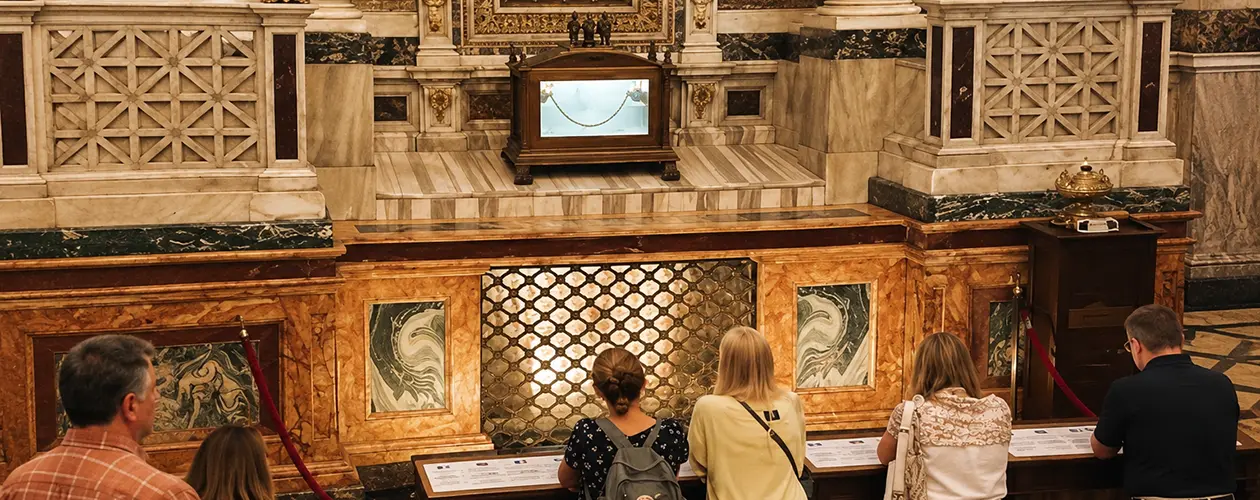
Paul's grave asks less of a group than Peter's. He was beheaded outside the city and buried along the road to Ostia, and a basilica has stood over his grave since the time of Constantine. In 2006 excavators beneath the papal altar uncovered the marble sarcophagus venerated as his. One side of it can now be seen through an opening below the altar, and the chain tradition says bound him in Rome is kept just above.
The catacombs are where the early Church becomes easiest to imagine. At the Catacombs of St. Callixtus, the official cemetery of the Church of Rome in the third century, nine popes were buried in a single crypt, Sixtus II among them, and Pope Cornelius lies in another part of the same catacomb. Five of the popes' Greek inscriptions survive, and the passages around them are narrow and dim. It's cold down there, even in summer. Anyone who struggles in tight spaces is welcome to stay above ground, and if you're leading, it helps to say so before anyone has to ask.
St. Lawrence Outside the Walls is the church most groups skip, and it's worth making time for. It's out of the way, beside the Verano, Rome's great cemetery, with none of the crowds or famous art of the major basilicas. Lawrence was a deacon of Rome, martyred in 258; tradition says he died on a gridiron, and the relics of St. Stephen, the first martyr, share his tomb. Those who keep Philip's walk today say he put Lawrence on the route as a reminder of mortality.
That sounds heavier than it turns out to be. November is the month the Church prays for the dead, and a good number of pilgrims arrive carrying someone, a parent or a spouse or a friend. Lawrence's church gives them a place to bring that person to God without being hurried, in the company of a man who has already finished the road.
It also raises the question of their own death, and how far to take that question is a real judgment call, whether you're a priest leading the group or a friend walking alongside. Some pilgrims want it put to them and are grateful. Others are grieving and only want to pray for the person they've lost, and pressing them further before they're ready can do real harm.
The Holy Stairs and the Question of Pace
Pilgrims climb the Holy Stairs on their knees, all twenty-eight of them. The staircase stands just across the square from St. John Lateran, the cathedral of Rome, dedicated in 324 and still described by its inscription as the mother and head of all the churches of the city and the world. Tradition holds that these are the steps Christ climbed in Pilate's praetorium and that St. Helena brought them to Rome. The marble has been covered in wood since the eighteenth century to protect it.
It's slow and harder on the knees than it looks, and for many pilgrims that turns out to be the gift of it. Each step can carry something you name: a person you love, an intention you've brought from home, a sin you'd like to leave behind on the way up. Anyone who can't kneel the whole way can kneel at the first step and take a side staircase, and if you're traveling with older pilgrims, it's a kindness to tell them so before they reach the line.
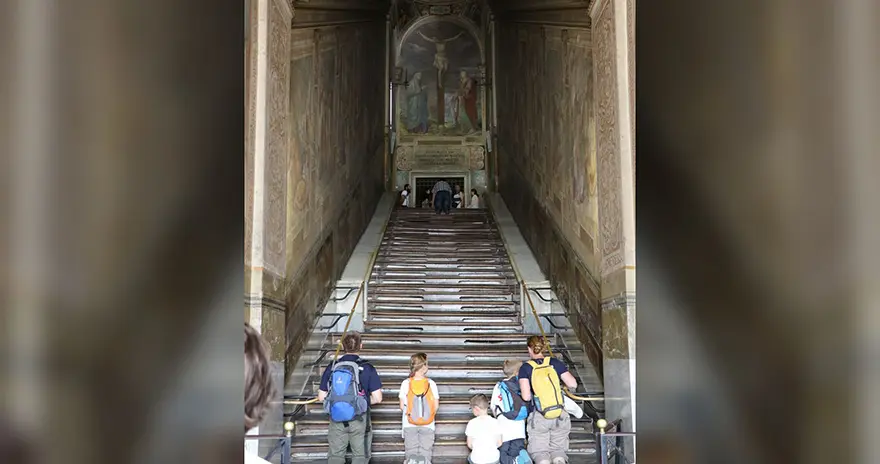
This is where pace matters most. We'd give a group an unhurried hour at the Holy Stairs before adding another church to the afternoon, because people need time afterward to pray about what happened on them. Pilgrims who rush from the Lateran to the stairs to the bus tend to remember mostly their knees.
A short walk east, Santa Croce in Gerusalemme keeps the relics Helena brought back from the Holy Land: fragments of the True Cross, thorns from the crown, a nail. The church is usually quiet, and you can stand within inches of them. Pilgrims who've prayed at Calvary, which we wrote about in The True Cross: Visiting the Holy Sepulchre and Calvary, often recognize what they're looking at. For centuries the popes walked here barefoot from the Lateran on Good Friday.
St. Mary Major and the End of the Year
The traditional route ends at St. Mary Major. The basilica took its present shape under Pope Sixtus III in 432, the year after the Council of Ephesus proclaimed Mary the Mother of God, and its mosaics were made to teach that. In the Pauline Chapel hangs the icon Romans call Salus Populi Romani, Protectress of the Roman People, which tradition credits to St. Luke and scholars date later. Pope St. Gregory the Great is said to have carried it through the streets during a plague, and Rome has turned to it in hard times ever since.
After six churches built over martyrs and relics of the Passion, a good many pilgrims find this is where they want to leave everything they've carried. Rome calls itself the Eternal City, and the readings at Mass this week keep pointing somewhere else. The Letter to the Hebrews says it plainly.
SCRIPTURE“For here we have no lasting city, but we seek the one that is to come.”HEBREWS 13:14
Most of the seven churches stand over someone who believed that line enough to stake a life on it. The old phrase for the Christian is homo viator, a person on the way, and a Rome and Vatican pilgrimage lets you spend a few days among people who reached the end of it. Most of them started out with as much unfinished business as any of us.
The real test of a Rome and Vatican pilgrimage comes after the flight home. It tends to show up in ordinary places, like whether the faith you professed at Peter's grave reaches the kitchen table in December, or whether knees that climbed the Holy Stairs bend a little more easily back in your own parish. We wrote about those first weeks home in How Pilgrimage Changes You, and about the groundwork before departure in how to prepare for a Catholic pilgrimage. Priests thinking about bringing a parish will find the planning side in Leading Your Parish to Rome and the Vatican, and our Italy pilgrimage page lists upcoming dates.
Ready to walk Philip's road? Explore our upcoming pilgrimages to find a journey to Rome, or, if you're a priest or parish leader, learn how to lead your own group to the tombs of the apostles.
Know someone who is discerning a pilgrimage? Pass this along.