
St. Martin's Lessons for Pilgrims
Planning your first Catholic pilgrimage? Learn what to expect through the life of St. Martin of Tours, and how to travel as a pilgrim and return home changed.

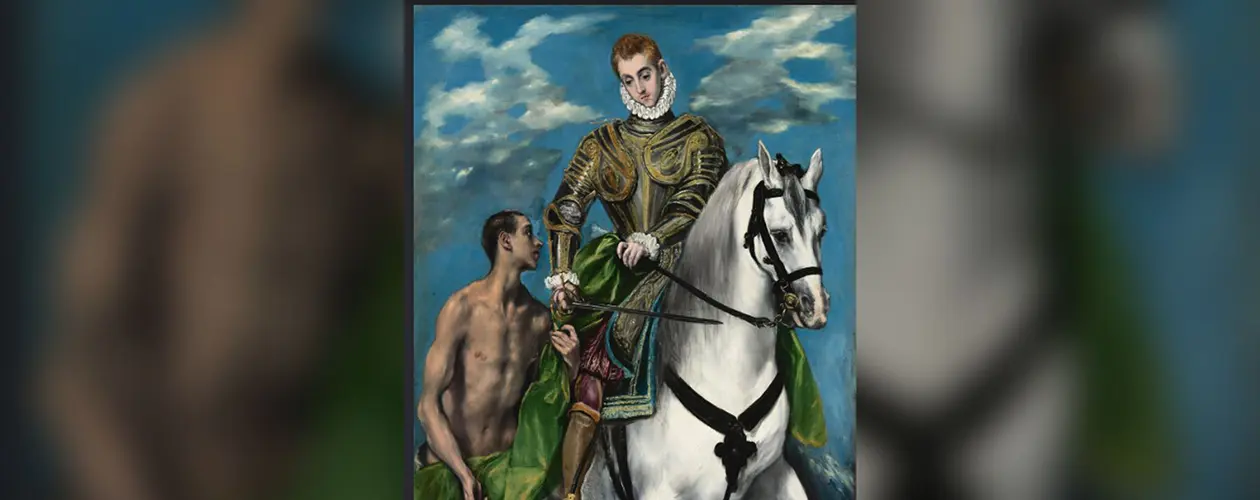
The Church keeps November 11 as the feast of St. Martin of Tours, and we can think of no better first Catholic pilgrimage guide than his life. Martin was a young Roman cavalryman, not yet baptized, riding through the gate of Amiens on a winter night so cold that people were dying of it. A beggar stood there nearly naked. Other soldiers had already passed him by. Martin had given away everything else, so he drew his sword, cut his military cloak in two, and wrapped the stranger in half of it. If you are wondering what to expect on your first pilgrimage, start there, at that gate, with a man who had only half a cloak to give.
That night, as his friend and biographer Sulpicius Severus tells it, Martin dreamed of Christ surrounded by angels and wearing the half-cloak he had given away. He heard the Lord say, "Martin, who is still but a catechumen, clothed me with this robe." Martin hurried to be baptized. He eventually told the emperor he was now Christ's soldier and could no longer fight. He became a disciple of St. Hilary of Poitiers, founded the first monastery in Gaul at Ligugé, and in 371 was carried off to Tours by a crowd that would not take no for an answer and made him their bishop.
What to Expect on Pilgrimage, According to a Fourth-Century Soldier
Notice the shape of Martin's story. A man sets out on one road for one purpose, meets Christ along the way, and comes home on a road he never planned to take. That is the whole difference between a tourist and a pilgrim. A tourist travels to see something and then returns to the life he left. A pilgrim travels to seek God and cannot return to that life at all.
One priest who has led many pilgrimages puts it this way: "A tour means a circuitous journey. You return to the place you began, maybe a little more polished, but basically the same. A pilgrimage is not around, but through. Not a circle, but an arrow!" Martin's life was an arrow. Yours can be too, and the first step is simply deciding which of the two you intend to be.
First Catholic Pilgrimage Guide: What a Day Actually Looks Like
First-time pilgrims ask practical questions, and they deserve plain answers. Here is the rhythm of an ordinary pilgrimage day. Mass anchors it, often celebrated in the very churches and chapels where the saints prayed. A priest travels with the group and offers the sacraments throughout the journey, Confession included. Knowledgeable Catholic or Christian guides walk beside you at each site, connecting what you see to what it means. You share meals with your fellow pilgrims, ride the coach together, pray the Rosary together, and most evenings you fall into bed tired and full.
But do not mistake the schedule for the pilgrimage. A priest who has walked these roads with his own parishioners is blunt about it: "Pilgrimage is not travel with prayer glued on top. It is itself a spiritual act; the journey itself is holy." The early mornings, the long coach rides, the waiting in line at a basilica door are not interruptions between the holy moments. They are the holy moments, if you let them be. The pilgrim who learns to step aside in a crowded church, put the camera down, and simply say, "Lord, I am here where You are," has understood more than any itinerary can teach.
That interior work begins before departure. "Preparation is also part of the pilgrimage itself," the same priest writes. "The graces begin to flow even before you leave." Our reflection on how to prepare for a Catholic pilgrimage walks through it: writing down a few specific intentions, studying the sites and their saints, and going to Confession before you go.
Expect to Travel Light
Martin met Christ with half a cloak, and every first-time pilgrim standing over an open suitcase should remember it. The medieval pilgrim carried a tunic, a cape, a purse, a hat and a staff. One pilgrim priest once fit everything for a nine-day pilgrimage overseas, including what he needed to celebrate daily Mass, into a single backpack. "Over-packing is almost always a symptom of anxiety," he observes. "Pilgrimage is a journey of trust."
Pack sensibly: shoes you can walk in for hours, modest clothing for churches, a layer for weather that changes. Then stop. The lighter you travel, the freer your hands are to receive what God wants to give and to hand on what someone beside you needs.
Expect to Be Tired, and Expect It to Count
Half a cloak meant a cold ride home for Martin. Holiness usually costs something, and pilgrimage is no exception. You will be tired. The jet lag is real, the lines are long, and a site you dreamed about for years may leave you strangely unmoved. A tourist files these as complaints. A pilgrim offers them.
"Martyrs offer blood. Penitents offer tears. Pilgrims offer sweat," one priest writes, and he adds a line worth memorizing before your first coach breaks down: "Disappointments are not disasters." Offer the sore feet for one of the intentions you packed. Hold your tongue when the grumbling starts around you. The Israelites in the desert fell into murmuring more than any other sin, and the pilgrim who resists it is doing a quiet charity to everyone on the bus. These small renunciations are not the price of the pilgrimage. They are part of its fruit.
Expect Hope, Not Expectation
It may seem odd, in a post about what to expect, to tell you to come without expectations. But this is the most important thing we can say to anyone preparing for a first Catholic pilgrimage. "We should have hearts full of hope, but empty of expectation," writes a priest who has led pilgrims for years. Hope asks and trusts. Expectation demands, and when the demand goes unmet, it resents. He tells of standing before a relic he had longed to see for years and feeling nothing at all, and of realizing afterward that the dryness had more to do with his entitlement than with God's absence. "Humility and hope are the two feet on which the pilgrim walks," he concludes. "Expectation and entitlement are a ditch into which we fall."
Martin did not ride to Amiens expecting a vision. He answered the need in front of him, and God did the rest. Some pilgrims are flooded with consolation at the holy places. Others feel little in the moment and discover the grace weeks later, at home, in the middle of a Tuesday. Both are pilgrims. Both are being led.
Expect Christ in the Stranger Beside You
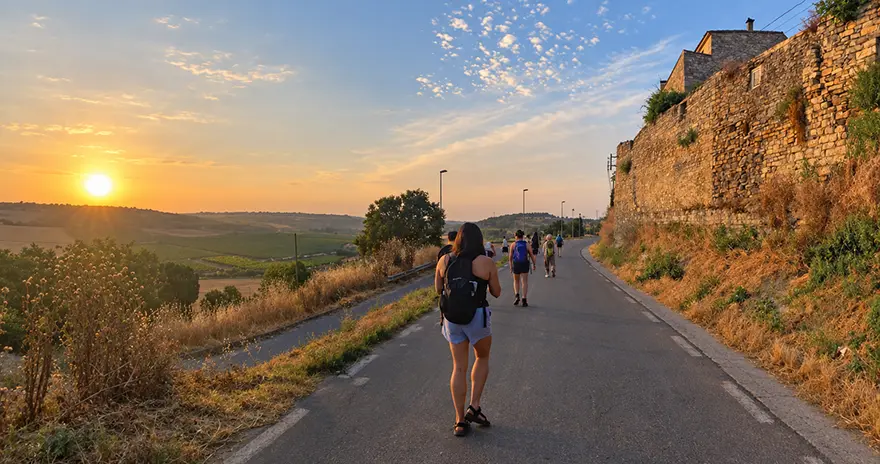
Martin did not find Christ in a cathedral. He found Him in a freezing man at a city gate. Preaching on this feast in 2007, Pope Benedict XVI observed that for all the miracles attributed to Martin, he "is known most of all for an act of fraternal charity." The vision that followed simply confirmed what the Lord had already promised. The holy sites are real gifts. Some places truly are sacred, and you will feel it. But our pilgrims tell us, again and again, that the moment that changed them happened somewhere they never planned: a conversation on the coach, a stranger praying beside them at the grotto, a fellow pilgrim who needed an arm on a steep path.
SCRIPTURE“Amen, I say to you, whatever you did for one of these least brothers of mine, you did for me.”MATTHEW 25:40
You will travel with people you do not yet know. Some will become friends for life. One or two will test your patience, and that is part of the pilgrimage too. The Church herself is a pilgrim people, and nobody walks this road alone.
There is a fitting coda to Martin's story. He died on November 8, 397, at Candes, on a pastoral visit, and was buried in Tours on November 11, the day we now keep as his feast. He was among the first saints venerated who had not died a martyr, and so many pilgrims came to his tomb that the small chapel over it gave way to a great basilica. For centuries Tours was one of the great shrines of Europe, and the northernmost of the historic French routes of the Camino de Santiago, the Via Turonensis, still carries the city's name. The man who met Christ on the road became a place where others would meet Him. That is what happens to pilgrims who are truly changed. Our France pilgrimages walk in the footsteps of saints like Martin, Thérèse and Bernadette.
Expect to Come Home by Another Way
After the Magi found the Christ Child, Scripture says, "having been warned in a dream not to return to Herod, they departed for their country by another way" (Mt 2:12). Martin's life traces the same arc. He laid down the soldier's sword and took up the shepherd's staff. The encounter at the gate did not stay at the gate. It reordered everything after it.
This is the true measure of a first Catholic pilgrimage: not how many sites you saw, but who you are when you unpack. Are you more patient? Quicker to pray? More likely to notice the person shivering at the gate? "No matter how impressive or powerful pilgrimage was," one experienced pilgrim priest cautions, "returning well requires work," and we wrote about those first weeks at home in How Pilgrimage Changes You. He sums it up in a sentence worth hanging over the door of every returning pilgrim: "We have chosen to be pilgrims. Now we must resolve to be saints."
On this feast of St. Martin, ask him to pray for you as you discern your first pilgrimage. He knows the road. He knows what it is to give away something warm and come home with something far better.
Ready to take the first step? A Tekton pilgrimage is built for encounter, with daily Mass, a priest beside you, and the spiritual preparation that helps you travel as a pilgrim, not a tourist. See All Upcoming Pilgrimages, or if you are a priest or parish leader, learn how to Lead Your Own Group.
Know someone who is discerning a pilgrimage? Pass this along.