
France Travel Guide for Catholic Pilgrims
Settle the Details Before You Set Out
This France travel guide is written for Catholic pilgrims, and it gathers what pilgrims most often need settled before departure: entry requirements, what the European border check now involves, the weather month by month in Paris and in Lourdes, how to carry spring water home, money, and the ordinary French courtesies that decide how the country meets you.
Nearly all of it can be handled in a single evening, months ahead. Check your passport tonight rather than in the spring. Buy the right adapter once and put it in the bag you will actually travel with. Decide how you are carrying spring water home before you are standing at the taps with nothing to put it in. Tell your Pilgrimage Manager about a dietary need while there is still time to arrange something. None of this is difficult. It only becomes a problem when it is left until the week before.
There is a reason to do it early that goes beyond convenience. The wise men followed a light a long way before they had any account of what it was for; the understanding came at the end of the road, not the start of it. A pilgrim who has settled the practical things in advance is free to travel that way. A pilgrim still working out phone plans and plug types on the coach is not.
Already registered? Your pilgrim packet arrives two to three weeks before departure with hotel details, your final itinerary, and specific guidance from your Pilgrimage Manager. This guide is what you need before that packet reaches you. Our pre-pilgrimage spiritual retreat is where the interior preparation happens.
Entry Requirements for France
Two European border systems have been in the news for years and pilgrims arrive confused about which one applies to them. As of September 2026 the answer is straightforward: a United States passport is all you need to board, and the only new thing waiting for you is a biometric check on arrival.
First, a word you will keep meeting. The Schengen area is a group of European countries, France among them, that have taken down the borders between themselves and share one external border instead. Land in Paris and you could travel on to Spain, Italy, or Germany without another passport check. Two things follow from that, and both matter below: the rules on this page are European rules rather than French ones, and your days abroad are counted across the whole area rather than country by country.
ETIAS is not in operation. The European Travel Information and Authorisation System has still not launched. The European Union removed its own 2026 target from the official ETIAS page in July 2026 and has not published a replacement date; 2027 is the widely reported expectation. No applications are being accepted anywhere. Any site offering to sell you an ETIAS today is a scam. When it does begin it will cost 20 euros, it will not be a visa, and Tekton will tell registered pilgrims exactly what to do.
-
Check your passport before anything else
It must be valid for at least three months beyond the day you leave Europe, and it must have been issued within the previous ten years. Aim for six months of validity anyway, because airlines apply their own stricter rules at the check-in desk, and that is where trips are actually lost. Keep two blank pages free. If you are anywhere near expiry, renew before you register, not after.
-
Confirm the name matches
The name on your airline ticket must match your passport exactly. Maiden names, middle initials, and suffixes are the usual culprits. Send your Pilgrimage Manager a photograph of the passport page when you register and this resolves itself.
-
Understand the ninety-day rule
A U.S. passport allows ninety days in the Schengen area within any rolling one hundred eighty days, and France is part of that shared count. A pilgrimage is nowhere near the limit, but if you are extending a stay or linking two trips in Europe, the days add together across every Schengen country.
-
Carry copies, kept separately
Photograph your passport page and email it to yourself. Keep a paper copy in a different bag from the original. Replacing a lost passport in Paris is possible; doing it without a copy is slower, and doing it from Lourdes means a day of travel you had not planned.
Traveling on beyond the Schengen countries? Some France pilgrimages connect with Portugal or Spain, which are inside the area, and some link to destinations that are not. Your itinerary will make this clear, and your Pilgrimage Manager will confirm it well before departure.
France Weather Month by Month
A France pilgrimage usually crosses two different climates in one week. Paris sits in the north and behaves like northern Europe. Lourdes sits six hundred miles south in the foothills of the Pyrenees, runs several degrees warmer in summer, and takes roughly twice as much rain as Paris in every month of the year. Pilgrims routinely pack for one and are surprised by the other.
| Month | Paris high / low | Lourdes high / low | Rain at Lourdes | What it feels like |
|---|---|---|---|---|
| January | 45°F / 35°F | 49°F / 35°F | 13 wet days | Cold, grey, and quiet. The sanctuary is at its emptiest. |
| February | 48°F / 36°F | 51°F / 35°F | 13 wet days | Cold, and the anniversary of the apparitions falls on the 11th. |
| March | 53°F / 38°F | 56°F / 39°F | 13 wet days | Turning. Bright mornings, cold churches, changeable afternoons. |
| April | 59°F / 43°F | 60°F / 43°F | 15 wet days | The sanctuary season opens. Pleasant, and genuinely wet. |
| May | 66°F / 49°F | 65°F / 49°F | 16 wet days | Beautiful, busy, and the wettest month of the year in Lourdes. |
| June | 72°F / 56°F | 72°F / 56°F | 14 wet days | Long evenings. Light until nearly ten for the torchlight procession. |
| July | 76°F / 59°F | 75°F / 59°F | 12 wet days | Warm and crowded. Paris empties of Parisians, not of visitors. |
| August | 76°F / 59°F | 75°F / 59°F | 12 wet days | Hot, and much of working France is away. See below. |
| September | 70°F / 54°F | 71°F / 54°F | 11 wet days | Warm, settled, and the driest month in Lourdes. Many pilgrims' favorite. |
| October | 62°F / 49°F | 65°F / 50°F | 12 wet days | Mild and golden. The sanctuary season closes at the end of the month. |
| November | 52°F / 41°F | 55°F / 41°F | 14 wet days | Cool and often grey. All Saints fills the churches on the 1st. |
| December | 46°F / 37°F | 51°F / 37°F | 13 wet days | Cold and dark early. Paris keeps Advent beautifully. |
- Warm, long days, full sun
- Mild and changeable
- Cool, damp, often overcast
- Daytime highs of 60°F to 72°F in both cities
Historical averages. Normandy and Mont-Saint-Michel run cooler and windier than Paris, and the tide there sets the schedule as much as the forecast does. Lisieux and Rouen behave like Paris. Nevers and Paray-le-Monial sit inland and get colder nights. The single most useful fact in this table is the last column of rain figures: Lourdes has no dry season, and a packable rain shell earns its place in the bag in July as much as in March.
Comfort is not the only measure. February 11, the feast of Our Lady of Lourdes and the anniversary of the first apparition, falls in the coldest and quietest part of the year, and pilgrims choose it anyway. So do those who come for the Assumption on August 15 in the heat. If you are weighing which season suits which itinerary, that question is answered on our France pilgrimage page.
Arrival at Charles de Gaulle
Most France pilgrimages arrive at Paris Charles de Gaulle, and a good many of those land in Terminal 2E, which handles the long-haul flights from the United States. The first thing you will notice is that nobody stamps your passport any more.
What the biometric check involves
France switched over to the European Union's Entry/Exit System on April 10, 2026. On your first crossing you are directed to a kiosk or a booth before the passport officer, where the system records four fingerprints and a facial image along with your passport details and the date. It takes a couple of minutes once you are at the machine.
There is nothing to register beforehand and no fee. The record is held for three years, so a second pilgrimage inside that window moves considerably faster. The system exists to replace ink stamps with a digital count of your days in Europe.
How long to allow
Longer than you would have needed two years ago. Since the changeover, French airports have reported waits of an hour or more at passport control during the busy afternoon arrival banks, and Terminal 2E has been the slowest hall in the country. Paris Aéroport has added pre-enrolment pods at 2E, and border police have occasionally paused biometric capture outright when the queue became unmanageable. None of that is anything you arrange or control.
What it means for you is simple. Your group is met after baggage claim regardless of how long the hall takes, so there is no connection to miss and nothing to hurry for. Tell anyone waiting at home not to worry about an hour or two of silence after you land. Eat on the plane, keep your passport in your hand rather than your bag, and take the delay as the last stretch of the road.
On the way home, plan on arriving three hours before an international departure — the exit side of the Entry/Exit System scans you again. Your Pilgrimage Manager confirms the timing on the ground.
Onward from Paris. Lourdes is a long way south. Depending on the itinerary you may take a domestic flight to Tarbes or Toulouse, or a high-speed train from Paris. Trains are boarded from a platform with no porter and a short window to get everyone and everything aboard, which is one more reason to pack a bag you can lift yourself. Your itinerary specifies which, and your Pilgrimage Manager handles the logistics.
General Information
- Capital city
- Paris
- Largest city
- Paris
- Official language
- French
- Time zone
- 6 hours ahead of U.S. Eastern Time
- Flight time
- Roughly 7 to 8 hours nonstop from the U.S. East Coast
- Country code
- +33
- Emergency number
- 112
- Main airports
- Paris Charles de Gaulle (CDG) · Paris Orly (ORY)
Will people speak English?
In the places your pilgrimage takes you, usually yes. English is widely spoken in Paris hotels and around the major sites, and in Lourdes the whole town is built to receive pilgrims from everywhere, so English is ordinary there. It thins out in the smaller towns and with older generations. Your knowledgeable Catholic and other Christian guides speak fluent English throughout.
One habit is worth forming before you go. Open with Bonjour, parlez-vous anglais? rather than launching straight into English. Asking permission to switch languages is a courtesy, and in France courtesies are not decoration. More on that below.
The emergency number
France does not use 911. Dial 112 for any emergency anywhere in the country. It is free, it works from any phone including one with no SIM card and no credit, and the operators can bring in an interpreter. Three French numbers also work if you know precisely who you need: 15 for medical emergencies and ambulances, 17 for the police, 18 for the fire service, who in France are also the first responders to most medical calls. There is also 114, which takes text messages, for anyone who cannot make a voice call.
You are unlikely ever to need any of them. Your Pilgrimage Manager is with the group throughout and is the first person to find if something goes wrong. Save 112 and your hotel address to your phone before you leave home anyway.
Calling home, and being called
French numbers have ten digits and begin with a zero. When you give family a French number to call from the United States, that first zero comes off: a Paris number written 01 42 xx xx xx is dialled from home as +33 1 42 xx xx xx. Leave the zero in and the call will not connect. Within France, dial all ten digits exactly as written, including the zero, wherever you are.
Jet lag
France runs six hours ahead of U.S. Eastern Time, and most pilgrims find the second and third days harder than the first. Three things help, and all of them are easier decided now than at the time: stay awake until a normal local bedtime on arrival day rather than napping at four in the afternoon, drink more water than feels necessary on the plane and after it, and get outside into the morning light on your first full day. Our advice on the first day of a pilgrimage covers the rest.
Money, Cards, and Service Compris
Should I buy euros before I leave?
No. Buying foreign currency from an American bank, or worse from an airport exchange counter, is the most expensive way to get it. Those counters set their own rate well away from the market and then add a fee on top, so a meaningful share of the value is gone before you have left the country.
Withdraw euros from a bank ATM after you arrive, where the rate is close to the real one. Two things worth knowing:
- Use a machine attached to a bank. The standalone machines in tourist streets, often branded for travellers, charge conspicuously more. A French bank cash machine is a distributeur.
- Always choose to be charged in euros, never in dollars. When a machine or a card terminal offers to convert for you, it is applying its own poor rate. This is called dynamic currency conversion, and declining it costs nothing.
Withdraw once and withdraw enough, since most cards charge a flat fee per withdrawal.
How much cash will I actually need?
Less than most pilgrims bring. France is close to cashless and contactless payment is accepted almost everywhere, down to a single coffee. Cash is still worth having for candles and offerings, small shops in the villages, market stalls, and the occasional restroom turnstile. A modest amount in small notes covers a full pilgrimage.
Which cards work?
Visa and Mastercard are accepted everywhere. Discover is uncommon overseas. American Express is taken in the larger hotels and less reliably elsewhere. Before you leave:
- Tell your card issuer your travel dates so purchases are not flagged and frozen.
- Check your foreign transaction fees, which vary considerably from card to card.
- Carry a second card, kept somewhere other than your wallet.
- Know your PIN. French terminals and the automated machines at train stations and toll booths will ask for it, and a signature is not an option.
What does service compris mean on my bill?
It means the service charge is already included, and in France it always is. French law requires restaurant and café prices to be quoted with service included, so the number printed on the menu is the number you pay. Waiting staff are salaried rather than tipped, and no gratuity is expected on top.
Americans routinely add twenty percent out of habit and are startled afterwards. If the service was genuinely good, French custom is to leave the small change or round up a euro or two — le pourboire, literally the drink money. That is the whole of it. Leaving nothing is not rude.
What about gratuities for the guide and driver?
Gratuities for your guides and drivers are a separate matter from restaurant service and are customary. Tekton provides specific guidance in your pilgrim packet so the whole group works from the same expectation, and your Pilgrimage Manager confirms the arrangements before the final day. There is nothing to work out on your own.
Bonjour, and the Shape of the French Day
Americans come home from France with one of two stories. Either the French were warm, patient, and delighted to help, or the French were cold. The difference between the two is almost always a single word, said or not said in the first two seconds.
The word
In France a shop is not a public space. It is someone's room, and you are entering it. So you greet the person before you ask for anything: Bonjour madame or Bonjour monsieur on the way in, and Au revoir, merci on the way out. Every bakery, every pharmacy, every ticket window, every time. After about six in the evening it becomes bonsoir.
Walk in and open with "Do you have this in a larger size?" and you have, in French terms, addressed a person as though they were a vending machine. The coolness that follows is not anti-American feeling. It is the same coolness an American shopkeeper would feel if a stranger reached across the counter and took something without a word.
This one habit will change your week. It costs nothing, it requires no French beyond the word itself, and pilgrims who form it in the first two days report a completely different country from the one they had been warned about.
Noon to two
Outside the big cities, France closes in the middle of the day. Shops in Lourdes, Lisieux, Nevers, Ars, and the villages shutter from around noon until two, and smaller churches often do the same. Paris largely keeps straight hours and you may go a whole day there without meeting it. Your itinerary is built around the closure — it matters mainly when you were planning to slip out for an errand after lunch.
Sundays, and the month of August
Sunday in France still empties the commercial streets. Most shops close, bakeries open only in the morning, and families eat together for hours. Churches, of course, are at their fullest.
August is the larger version of the same thing. Les grandes vacances take much of working France away for weeks, and in Paris you will find handwritten fermeture annuelle notices taped in the windows of the neighborhood shops while the great sites stay busy with visitors from elsewhere. The one date that stops the country outright is August 15, the Solemnity of the Assumption and a public holiday. In Lourdes that day the town is at its fullest of the year, which is the whole paradox of France in a single afternoon: closed shutters on one street and a packed basilica on the next.
Meals keep their own clock
Lunch is served from about noon to two and then the kitchen stops. Dinner rarely begins before half past seven. A restaurant that looks empty at seven will be full by nine, and nobody will hurry you out of it once you are seated. In France the table is where the day is spent, not an interruption to it, and a long meal with your group is not time taken from the pilgrimage.
Bringing Lourdes Water Home
Almost every pilgrim intends to carry water home for someone who could not come. Almost none of them know how it is actually done, and a few learn at the airport that they have packed it in the wrong bag. It takes ten minutes of planning and it is worth doing properly.
Filling a bottle at the taps
The spring water runs from a row of taps set into a low wall a short walk from the Grotto, and from fountains nearby. It is free. It has always been free and it is never sold — the sanctuary sells the empty containers, not what goes in them, and anyone charging you for the water itself is not the sanctuary.
Bring your own bottles or buy them in the town, where the shops carry everything from small flasks to five-litre jugs. Two practical points: choose containers with a screw cap rather than a cork or a plug stopper, and fill them early in your time in Lourdes rather than on the last evening, when the taps are busiest and you are trying to pack.
Getting it home through security
Water is a liquid, and the liquids rule does not make an exception for holy water. Anything over 3.4 ounces goes in your checked bag, on the flight home as much as on any other. There is no religious exemption at a United States checkpoint and none at a French one.
- Seal each bottle, then put it inside a zip-top bag of its own. Cabin pressure and rough handling do what you would expect.
- Pack it in the middle of the case with clothing around it, not against the shell.
- Spread it across bags if your group is traveling together and someone has room.
- The same rule covers blessed oils, and anything liquid bought at a shrine shop.
If you are buying on the final day, tell your Pilgrimage Manager before you pack. It is a two-minute conversation that saves a bottle.
What the water is for
It is not a medicine and the Church has never treated it as one. Pilgrims drink it, wash with it, and take it to the sick at home. There is no prescribed way to use it and no ritual you are failing to perform. The water gesture at the Baths, which replaced the immersion most pilgrims have heard about, is explained in our guide to the healing waters.
The evening, and why the timing matters
Through the main season, from April to the end of October, the sanctuary keeps two processions daily: the Blessed Sacrament procession in the late afternoon, and the torchlight Marian procession after dark, which has been walked every night since 1872. Your itinerary will give the exact times for your dates.
Two things to know in advance. The evening procession is outdoors and Lourdes is in the mountains — it is cooler after dark than the daytime figure in the table above suggests, in August as much as in April, so carry a layer even on a warm day. And you will want both hands reasonably free, because you will be holding a candle in its paper shield with the Lourdes Ave printed on it, which is the point of the whole thing and not a souvenir.
Phone, Data, and Drinking Water
Will my phone work in France?
Yes. Coverage is strong, including at the shrines. Your options:
- Carrier travel pass. Simplest. Most U.S. carriers sell a daily or monthly international plan covering France. Add it before you leave, not on arrival.
- eSIM. Usually cheaper if you expect heavy data use. Buy and install it before departure while you still have home Wi-Fi.
- Hotel Wi-Fi. Widely available and generally fine. Enough if you are content to check in once a day.
Many pilgrims use WhatsApp for calls and messages home, since it works over Wi-Fi and is what most of Europe uses by default.
Consider using it less. The phone is useful for photographs and a nightly word home. It is also the quickest way to be somewhere other than where you are standing. Many pilgrims decide in advance to keep it pocketed at the Grotto, and come home glad they did.
Can I drink the tap water?
Yes, everywhere in France. There is also a rule worth knowing at the table: a restaurant must bring you tap water free of charge with a meal if you ask for it. Say une carafe d'eau, s'il vous plaît and you will get a jug rather than a bill for bottled water. Across a week and a group, that adds up.
Carry a refillable bottle regardless. You will walk further on stone than you expect, and the water at the Lourdes taps is drinking water too.
Food and dietary needs
Hotel breakfasts in France are lighter than American ones — coffee, bread, pastry, sometimes fruit and yogurt. Eat enough; lunch is a long way off. Coeliac disease is reasonably well understood and sans gluten is a phrase staff recognize, though France is a harder country for it than most. If you have a serious allergy or a dietary requirement, tell your Pilgrimage Manager well before departure so arrangements are made rather than improvised at the table.
What to Wear When Nobody Checks
Dress as you would at home. France differs from Italy in one way that surprises pilgrims who have made both journeys: almost nowhere will anyone stop you at the door of a church and look at your hemline.
That is partly history. Since 1905 the great French churches have been public buildings in the care of the state, open to all comers, and there is no attendant checking shoulders at Notre-Dame the way there is at Saint Peter's. Which leaves the modesty entirely to you, and a thing freely given is worth more than a thing enforced.
The standard is the same either way. Cover shoulders and knees, for men and women alike, and leave the bare midriffs at home. You will not need a head covering, and women are not expected to wear skirts or dresses unless that is your preference. Jeans are fine, unless your priest has told you differently. A light scarf packs to nothing and solves almost every situation you will meet, including a cold stone church in April.
Two things are worth spending money on. The first is your shoes: you will walk several miles a day, much of it on cobbles, on the long ramps of the Rosary Basilica, and at Mont-Saint-Michel up a great many stairs. Break them in well before you go. The second is a rain shell that packs small. Look again at the rain figures above before you decide you can do without one.
Evenings run colder than the forecast. Lourdes sits in the foothills and the torchlight procession is outdoors and after dark. Pilgrims in August are regularly caught out by it. One warm layer, in the bag you carry that day rather than the one at the hotel.
Electricity, Plugs, and Adapters
- Socket types
- Type C and Type E
- Voltage
- 230V, 50 Hz
- Adapter needed?
- Yes
- Converter needed?
- Only for single-voltage devices
Adapter or converter?
An adapter lets an American plug fit a French socket. A converter changes the voltage. Nearly all converters are also adapters; not all adapters are converters, so read the product description rather than the title.
Check the label on each device. If it reads INPUT: 100–240V, 50/60 Hz, it is dual-voltage and needs only an adapter. That covers most phones, tablets, laptops, and cameras. Most CPAP machines are dual-voltage as well, but confirm with your manufacturer or physician before you rely on it.
Single-voltage devices need a converter, or the higher French voltage will destroy them. Hair dryers, straighteners, curling irons, and many electric shavers and toothbrushes fall into this category. Most hotels provide hair dryers, and your pilgrim packet confirms the specific hotels on your departure.
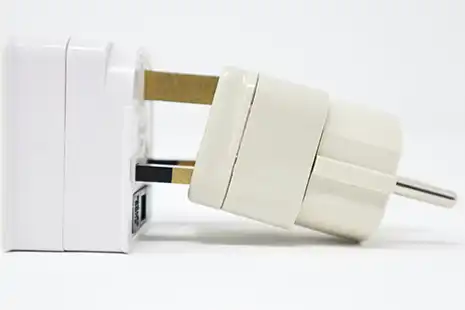
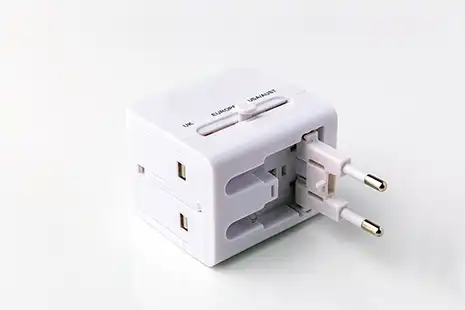
One detail catches people out. The French Type E socket has a small earth pin standing out of the wall, and the plug needs a matching hole to seat on it. A plain two-pin adapter fits fine. A grounded German Schuko adapter, which is what a lot of generic "Europe" adapters actually are, may not. Buy one described as Type C/E, or sold for France specifically.
Questions Pilgrims Ask
Do I need a visa or an ETIAS to travel to France?
No. United States citizens travel to France on a valid passport alone, with no visa required for a stay of up to ninety days. ETIAS, the European Travel Information and Authorisation System, is still not in operation and no applications are being accepted anywhere. The European Union removed its own 2026 target in July 2026 and has not published a new date. When it does begin it will cost 20 euros and it will not be a visa. Any website selling you an ETIAS today is a scam.
How long does my passport need to be valid to travel to France?
Your passport must be valid for at least three months beyond the day you leave Europe, and it must have been issued within the previous ten years. Aim for six months of validity anyway, because airlines apply their own stricter rules at the check-in desk, and that is where pilgrims are actually turned back. Keep two blank pages free.
What happens at passport control at Charles de Gaulle?
Since April 10, 2026 France has run the European Union's Entry/Exit System, so your passport is no longer stamped. On your first crossing you give four fingerprints and a facial image at a kiosk or a booth before you reach the officer. There is nothing to arrange in advance and no fee, and the record is kept for three years. Terminal 2E at Charles de Gaulle takes the long-haul arrivals and has been the slowest hall in France since the changeover, so expect the walk from the aircraft to the meeting point to take longer than it used to.
When is the best time of year to go to Lourdes?
The sanctuary keeps its full daily programme from April to the end of October, and September and October are the mildest months for walking, with fewer wet days than the spring. May and June are beautiful and busy. Lourdes sits in the foothills of the Pyrenees and takes rain in every month of the year, so a light rain shell belongs in your bag whenever you go. February 11, the feast of Our Lady of Lourdes, falls outside the main season and is kept there all the same.
Can I bring Lourdes water home on the plane?
Yes, in your checked luggage. Water from the Lourdes taps is free and you may take as much as you can carry, but any container larger than 3.4 ounces has to travel in the hold under the same liquids rule that applies at United States and European airports alike. Buy a bottle with a sealing cap at the sanctuary shops, wrap it in a plastic bag, and pack it in the middle of your case. The same applies to blessed oils and anything else liquid you are bringing home.
Do I really need to say bonjour when I walk into a shop?
Yes, and it matters more than any other phrase you will learn. In France a shop, a bakery, or a pharmacy is treated as someone's space, and you greet the person before you ask for anything. Bonjour madame or bonjour monsieur on the way in, au revoir on the way out. Skipping it is read as rudeness, and almost every story an American brings home about cold French service begins with a missing bonjour.
Can I drink the tap water in France?
Yes, everywhere in France. Restaurants are also required to bring you a free carafe of tap water with a meal if you ask for one, which saves both money and plastic across a pilgrimage. Ask for une carafe d'eau. The spring water at the Lourdes taps is a separate matter and is likewise free.
What kind of electrical adapter do I need for France?
France uses Type C and Type E sockets at 230 volts, so you will need a plug adapter. Buy one described as Type C/E or sold for France specifically. A German Schuko adapter will not always seat properly, because the French socket has a small earth pin standing out of it that the plug must have a hole for. You will only need a voltage converter if a device is single-voltage. Phones, tablets, laptops, and most CPAP machines are dual-voltage and need only an adapter.
Next Steps
Come Home Carrying More Than Water
For thirty years Tekton has walked with pilgrims through France — to the Grotto at Massabielle, to Thérèse in Lisieux, to the Crown of Thorns in Paris. Everything on this page exists so that when you arrive, the logistics are already settled and you are free to be present for the part that cannot be planned.