
Marian shrine homilies ask something different of a priest. What Lourdes and Fatima preach, and how to send your parishioners home changed by the grace.
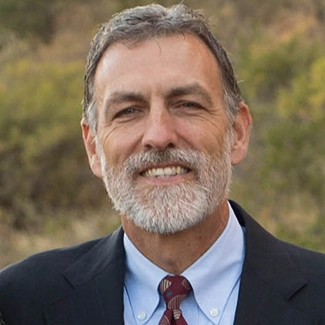
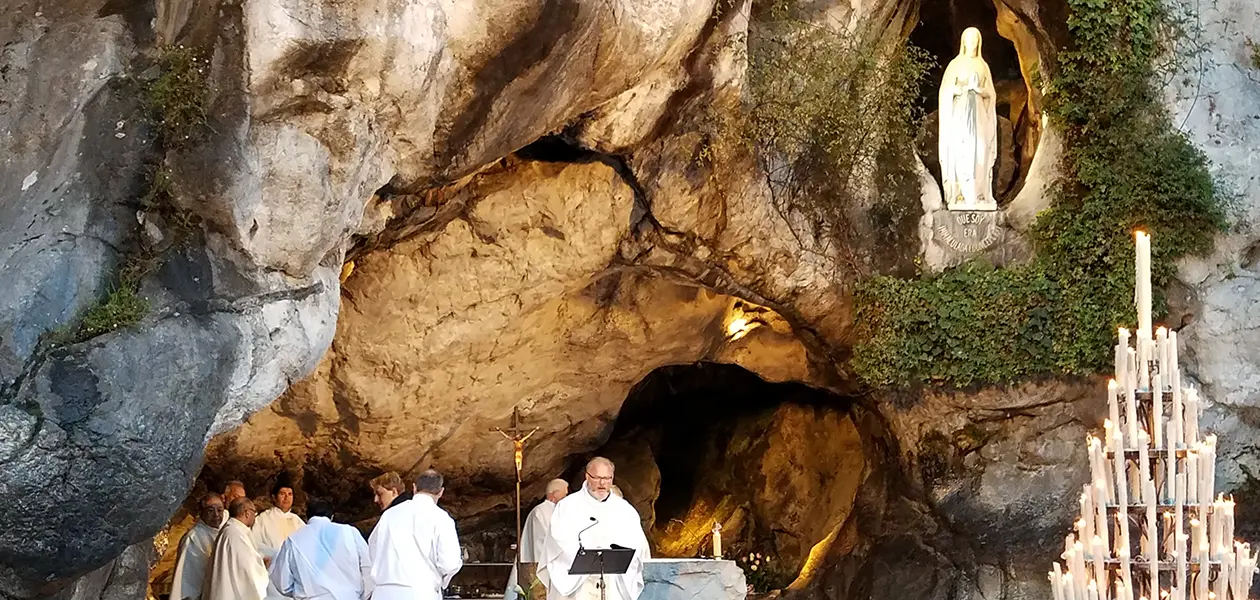
You are vested in a side chapel at Lourdes at seven in the morning. Forty of your parishioners are in front of you, most of them still cold, a few of them weeping already, and you have eight minutes. Marian shrine homilies ask something of a priest that Sunday preaching does not. Your people are already moved. What they need from you is help understanding what God may be asking of them.
After decades of accompanying pilgrimage groups, one pattern becomes clear. The homilies that land are rarely the ones with the most history in them. They are the ones that take what Our Lady said at that particular place and hand it to people who will be back at work in Indiana or Ohio ten days from now.
You already know how to build a homily. What follows is about what these places preach on their own: poverty, penance and baptismal grace at Lourdes, conversion and sacrifice and the Rosary at Fatima. The grace of a pilgrimage is proved at home rather than at the grotto. Everything below is aimed at that.
What Makes Marian Shrine Homilies Different
At home, your task is often to make an ancient text feel immediate. At a shrine the opposite problem confronts you. Your pilgrims have been awake since five, they are standing where a young girl knelt in the mud, and their emotions are running well ahead of their understanding. The homily has to catch up the understanding.
This is why the old Marian principle matters so much at the great Marian shrines: everything Mary says points away from herself. Paul VI set out four marks of sound Marian devotion in Marialis Cultus, and the first is that devotion to Our Lady must bear a biblical imprint. The Council had already put it plainly in Lumen Gentium: Mary's dignity flows from her Son, and devotion to her leads to Him. A homily that leaves your people admiring Mary has half-finished its job.
Two temptations wait for the preacher here. The first is the travelogue, which summarizes what the local guide said an hour earlier and attaches a prayer. The second is the marvel, where the apparition becomes the subject and the miraculous details do the emotional work. Both leave a congregation moved and unfed. Private revelation adds nothing to the deposit of faith; it helps us live the Gospel more fully in a particular hour. Preach the Gospel the shrine is illuminating, and the shrine takes care of itself.
Lourdes: Poverty, Penance, and the Water of Baptism
Lourdes hands you a homily whether you want one or not, and it is the Magnificat. Bernadette Soubirous was fourteen, asthmatic, desperately poor, and spoke a dialect rather than proper French. She saw the Lady eighteen times at the grotto of Massabielle in 1858, and on March 25 the Lady gave her name, in Occitan. Bernadette carried the phrase back to her pastor without understanding it: I am the Immaculate Conception. The doctrine had been defined four years earlier.
The through-line is God's preference for the small. He entrusted a dogma of the universal Church to a girl who could not have spelled it. Your pilgrims, who have spent months quietly wondering whether they are spiritual enough to deserve this pilgrimage, need to hear that. Set Luke 1:46–55 alongside Bernadette and let the parallel do its own work.
SCRIPTURE“For he has looked upon his handmaid’s lowliness; behold, from now on will all ages call me blessed. The Mighty One has done great things for me, and holy is his name.”LUKE 1:48–49
The second Lourdes theme is harder and worth the trouble. What Our Lady asked for there was prayer and penance, conversion of heart, prayer for sinners. She did not ask for a cure. The healings are real and they are signs, but a homily built around the approved cures will quietly teach your people that anyone who goes home unhealed was passed over. Preach the spring as what it signifies instead. Water, poured out and washing, is a language your congregation learned at the font, and it lets you preach healing without promising it. There may well be a pilgrim in front of you facing serious illness, wondering whether God sees her. Lourdes answers her through Baptism rather than through statistics.
What they should take home from Lourdes is that sentence from the Magnificat applied to themselves: God works through people who do not feel qualified, which is everyone on your bus.
Fatima: Conversion, Sacrifice, and the Rosary
Preaching at Lourdes and Fatima calls for different registers. Lourdes speaks to the pilgrim who feels too small to be noticed; Fatima speaks to the one who has not yet decided to change, which on most pilgrimages is the larger group.
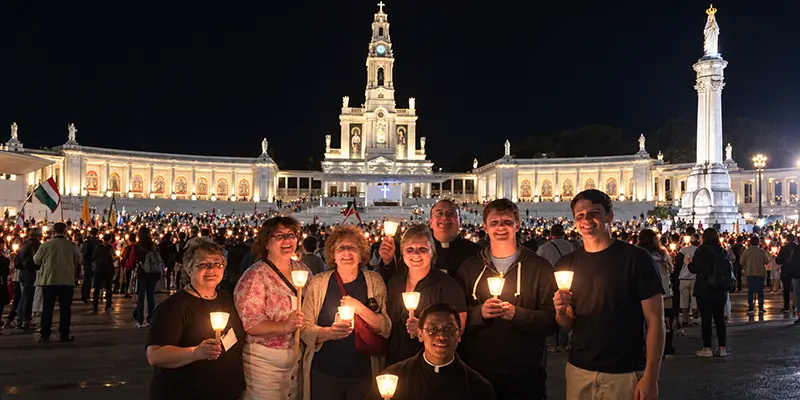
The Fatima message is conversion first. The Lady appeared to Lúcia, Francisco and Jacinta on the thirteenth of each month from May through October of 1917, and what she asked for was repentance, daily prayer and penance offered for sinners. That is a demanding word to preach on the fifth day of a pilgrimage, when the mood is warm and everyone is getting along. Preach it anyway. Conversion is the reason they came, even if they would have described it differently at the parish sign-up table.
Then the Rosary, which at the final apparition is how the Lady named herself: Our Lady of the Rosary. Most of your pilgrims will arrive with the secrets on their minds, because that is what the internet has told them Fatima is about. Redirect gently rather than scolding. John Paul II called the Rosary a compendium of the Gospel and described praying it as contemplating the face of Christ in the school of His Mother. Preach that, and the woman who has said the Rosary in her car for forty years without much thought about it may hear for the first time what she has been holding.
The children are the third gift Fatima gives a preacher. Francisco and Jacinta were seven and nine, and they gave up their lunches and their small comforts for sinners they never met. Their sacrifice gives you a concrete way to ask what conversion costs.
The history is worth a sentence, and it lands best at the end. The October 7 memorial of Our Lady of the Rosary goes back to Lepanto in 1571, when Pius V credited the victory to the Rosary; Gregory XIII gave the feast the Rosary's name two years later. A group traveling in October will feel that connection without your needing to labor it. What they should take home from Fatima is smaller and harder than anything they will buy in the shops: one concrete thing given up, for someone who will never know about it.
What They Carry Through the Front Door
Every shrine homily has a second audience: the parishioner in her kitchen on a Tuesday in November, trying to remember why any of it mattered. The fruits are a habit of prayer kept once the group has scattered, and a temper that has genuinely shortened its fuse. They ripen at home.
So preach toward the return. Give your people one line at each shrine they can carry in a pocket; Mary's instruction at Cana works everywhere. Your parishioners did not spend a year's savings for a better photo album, and most of them know it. Say what they did come for, early enough in the pilgrimage that they can still act on it. That is the difference between a pilgrim and a sightseer, and it shows itself at home rather than at the shrine.
It helps to preach as one of them rather than over them. You are a man on a journey too, tired, far from your own bed, carrying intentions you have not told anyone about. Pilgrims forgive a plain homily from a priest who is clearly making the same pilgrimage they are.
Five Things to Prepare Before You Preach at Lourdes or Fatima
1. Tell us early where you want to celebrate. Mass reservations run through each sanctuary's own booking office, and we make those requests for you, along with the documentation the shrines require from a visiting celebrant. What we need from you is which sites matter most for Mass and preaching. Ask early, because the quiet hours go first.
2. Choose your Mass texts before you go. Lourdes and Fatima both have proper Masses, and a group traveling in early October will meet the memorial of Our Lady of the Rosary on the seventh. Settling the texts at home shapes the homily and spares you a sacristy conversation in a language you do not speak.
3. Preach shorter than you think. Shrine chapels are often booked back to back, stone acoustics swallow a quiet voice, and outdoor altars compete with wind and crowds. Six to eight minutes, spoken slowly, will reach people better than fifteen.
4. Draft at your own desk. The evening before a shrine Mass you will be exhausted, and someone will need confession. Write your Lourdes and Fatima homilies at home, then adjust on site once you know who you are preaching to.
5. Leave room for confession. The homily often opens something, and the Sacrament of Reconciliation is where it gets resolved. Lourdes keeps resident chaplains available daily, but your own people will usually want you.
A priest who preaches Mary at Lourdes or Fatima usually finds he has been preached to first. That is the Magnificat working on the man holding the microphone. Your parishioners will notice, and some of them will be changed by that alone.
Considering Lourdes or Fatima with your parish? We build the itinerary around the pastoral work that matters most: daily Mass, time for confession, prayer, and enough margin for your people to encounter the shrines rather than pass through them. See All Upcoming Pilgrimages for available dates, or learn how to Lead Your Own Group.
Know someone who is discerning a pilgrimage? Pass this along.