


Tekton Ministries
Publish Date: July 7, 2026
Somewhere around the fourth or fifth day, it happens. A pilgrim who arrived radiant with anticipation grows quiet. Another stands before the empty tomb and feels nothing at all, then feels ashamed for feeling nothing. A third weeps without warning at Gethsemane over a grief she thought she had buried years ago. These moments are not interruptions to the pilgrimage. Very often, they are the pilgrimage—the place where grace finally finds an opening. And the person standing closest when they happen is you.
Pastoral care on the road is unlike anything in ordinary parish life. For eight, ten, or twelve days, a priest is present to his people in a way the regular calendar never permits—at meals, on long bus rides, in the hush before Mass, in the unguarded moment after a holy site has cracked something open. The privilege is enormous. So is the demand. When a pilgrim struggles, there is no rectory to retreat to and reflect before responding. The words are needed now, in the moment, with tenderness and truth.
This is, in a real sense, the difference between a tourist and a pilgrim. A tourist expects a smooth, satisfying experience and feels cheated when it falters. A pilgrim understands that the difficulty is not a flaw in the journey but part of the offering. Helping your people hold onto that truth—especially when their own hearts are telling them otherwise—is among the most consequential things you will do. What follows is not a script, but a set of pastoral instincts and, where it helps, some words that have served other shepherds well.
Struggle Is Not a Sign the Pilgrimage Has Failed
Many pilgrims arrive carrying an unspoken expectation: that standing on holy ground will produce an unmistakable surge of feeling. When it doesn't, they quietly conclude something is wrong with them. The first and most important pastoral move is to dismantle that assumption before it hardens into discouragement.
It helps to name the expectation gap openly, even from the first day. Something as simple as, "Some of you will be moved to tears at these sites, and some of you will feel nothing at all—and both of you are praying well," gives permission in advance. Pilgrims who hear this are far less likely to spiral into self-blame when the dryness comes. They have been told, by someone they trust, that the absence of feeling is not the absence of grace.
The deeper truth worth returning to again and again is that discomfort is not an obstacle to the pilgrimage but material for it. The aching feet, the crowded basilica, the prayer that feels like it bounces off the ceiling—these can all be folded into the offering. When a pilgrim grasps that the hard parts are not deductions from the experience but a genuine part of what they are giving to God, the whole journey reorients. This is the quiet logic of pilgrimage that we try to seed in every traveler: not the collection of consolations, but the gift of self.
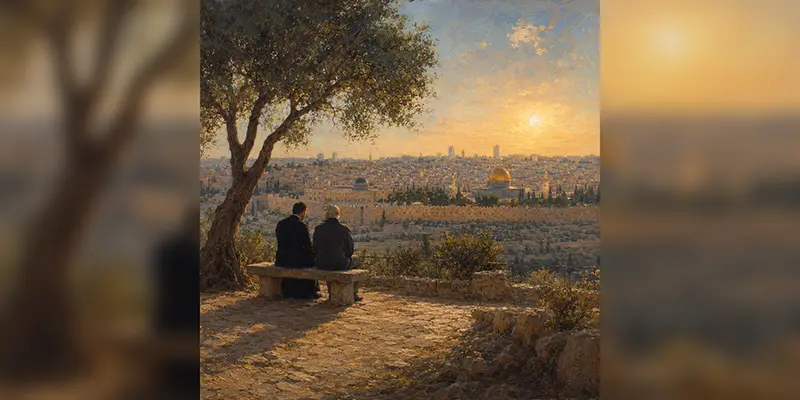
A priest pauses to listen as a pilgrim sits in quiet reflection at a holy site—the moments between the scheduled stops are often where the deepest accompaniment happens.
When a Pilgrim Feels Nothing at the Holy Places
Spiritual dryness on a pilgrimage can be especially bewildering, precisely because the surroundings seem to promise so much. A pilgrim kneels where Christ was laid in the tomb and waits for a flood that never comes. The temptation is to read that emptiness as failure—their own, or the pilgrimage's.
Here the Church's spiritual tradition is a gift to draw on. The masters of prayer are unanimous that consolation is not the measure of an authentic encounter with God. St. John of the Cross taught that the Lord often withdraws felt sweetness precisely in order to deepen faith, drawing the soul beyond its dependence on emotion. A pilgrim does not need a lecture on the dark night, but a few words rooted in that wisdom can be steadying: "Feelings are a gift, not a wage. God is not absent because He is quiet. Sometimes the most generous thing you can offer Him is to keep praying when you feel nothing—that is faith, not failure."
It can also help to reframe the dryness as its own kind of invitation. The pilgrim who feels nothing at the tomb may be precisely the one being asked to love God for His own sake rather than for the consolations He gives. Offered gently, that perspective can transform a moment of perceived emptiness into one of surprising freedom.
When Old Wounds Surface
The holy places have a way of loosening what people have held tightly for years. Calvary, the Jordan, the foot of a Marian shrine—these can become the unexpected site of a grief, a regret, or a wound that suddenly demands to be felt. A pilgrim may be caught completely off guard, and so may you.
In these moments, resist the instinct to resolve the pain quickly. The most pastoral response is usually presence before words: a hand on the shoulder, a willingness to simply stay. When words come, let them be small and true. "You don't have to carry this alone, and you don't have to have it figured out today," says more than any attempt to explain the mystery of suffering. What surfaces here is often material for the confessional, and the priest's unique gift is that he can offer not only a sympathetic ear but absolution and the Eucharist. Make it easy for the pilgrim to take the next step—"Would it help to talk more, or to make a good confession while we're here?"—without pressure, and let grace set the pace.
It is worth remembering that you do not have to be the entire answer. Your role is to accompany the pilgrim to the One who heals, not to do the healing yourself. That distinction protects both you and them.
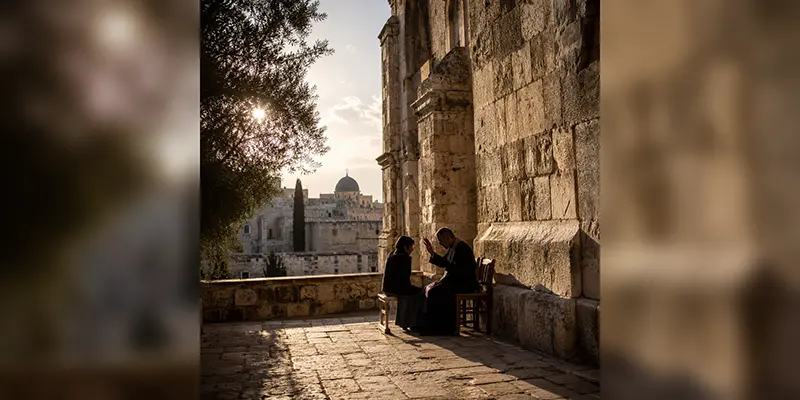
The Sacrament of Reconciliation, offered near a holy site, becomes one of the most powerful moments of a pilgrimage—where a wound that surfaced on the road is finally laid down.
When the Body Fails the Spirit
Pilgrimage is physically demanding, and summer travel intensifies the strain. Heat, uneven terrain, early mornings, and long days will eventually outpace some pilgrims—often the very ones most determined not to be a burden. A pilgrim who can no longer keep up may feel not just tired but humiliated, as though the failure of the body were a failure of devotion.
The pastoral task here is to restore dignity. Remind such a pilgrim that the offering of physical limitation is itself a profound form of prayer—that the saints understood weakness as a privileged place to meet Christ, not an exclusion from Him. "Sitting here and offering your tiredness to the Lord is every bit as much a part of this pilgrimage as climbing the hill," can lift a real weight. Encourage rest without a hint of disappointment, and the pilgrim hears that their worth on this journey is not measured in steps.
Practical accommodations are part of this, but those are ours to arrange. Our role at Tekton is to ensure that alternatives, accessible routes, and rest are quietly built into the day so that no pilgrim is ever left choosing between participation and exhaustion. That frees you to attend to the heart of the matter rather than the logistics of it.
When Disappointment Turns to Frustration
Not every struggle is sorrowful. Sometimes a pilgrim grows irritable—frustrated by crowds at a basilica, a long wait to enter the tomb, a site that fell short of the picture in their imagination. The grievance is real, and dismissing it only deepens it. But it is also, quietly, an opportunity.
The gentlest redirection acknowledges the frustration before reframing it. "The line is genuinely hard—and I wonder if the waiting might be part of what we're being given here. Pilgrims have stood in lines like this one for centuries to reach this place." The aim is never to scold the tourist impulse out of someone, but to invite the pilgrim within them to surface. Many of the most cherished memories pilgrims carry home are born not in spite of the inconveniences but through them, once the difficulty was received as an offering rather than resented as an intrusion.
The Ministry of Presence: When Few Words Are Best
For all the emphasis on what to say, much of pastoral care on the road is about what not to say. The instinct to fill silence, to explain, to fix, can crowd out the very work God is doing in a pilgrim's heart. Often the most powerful thing a priest offers is simply to be there—unhurried, unalarmed, willing to sit with discomfort that has no immediate resolution.
Trust that grace does not require your commentary. A pilgrim weeping at a shrine may need nothing more than your quiet presence and, later, the assurance that what they experienced was holy. Knowing when to speak and when to simply accompany is the mark of a shepherd who has learned that the Holy Spirit, not the priest, is the principal actor in every soul.
Tending Your Own Reserves
A shepherd cannot give from an empty well. The intensity of being constantly available will deplete even the most generous priest, and a depleted priest has less patience, less attentiveness, and fewer words of life to offer. Guard small pockets of solitude. Pray the Office. Find a brother priest on the journey, or a few minutes of silence before the others wake, to be ministered to rather than always ministering.
This is one of the quiet reasons we exist. When the ticketing, the reservations, the bus schedules, and the hundred daily contingencies are carried by someone else, the priest is freed to do the one thing only he can do—shepherd souls. We consider it our privilege to hold the logistics so that you can hold your people.
The Struggle Becomes the Seed
When pilgrims return home and you ask them, weeks later, what moment changed them, they rarely name the smooth and easy hours. They name the morning they wept, the night they finally made that confession, the day their body gave out and they learned to receive instead of achieve. The struggle, it turns out, was where the seed of grace was planted. The Magi did not return home by the road they came; they were changed by the encounter, and their journey home reflected it. So it is with your pilgrims. The aim was never a comfortable pilgrimage—it was a heart that comes back different.
Your willingness to stay close in the hard moments is what allows that transformation to take root. You will not have perfect words for every situation, and you don't need them. You need only to be present, to point steadily toward Christ, and to trust that the same Lord who walked these roads is walking them still—through you, in the people He has given you to lead.
Considering leading your own parish pilgrimage? We walk alongside priests at every step, carrying the logistics so you are free to shepherd. Learn how to Lead Your Own Group with our dedicated support for clergy, or See All Upcoming Pilgrimages to explore where you might lead your people next.