


Tekton Ministries
Publish Date: April 22, 2026
There is a moment, just before the Holy Father arrives in St. Peter's Square on a Wednesday morning, when the crowd goes quiet. Twenty thousand pilgrims from every continent have spent the last hour under Bernini's colonnade—praying, chatting across language barriers, watching the Swiss Guards take their positions. Then a ripple of applause begins somewhere near the basilica and travels outward, and the square remembers what it came for. The Holy Father is about to appear.
For a parish group that has prepared well, the papal audience is one of the most quietly transformative hours of a Rome pilgrimage. But it is often the least understood piece of the itinerary—treated as a Wednesday morning appearance by a famous man, or worse, a photo opportunity sandwiched between the Colosseum and a lunch reservation. Helping parishioners encounter the audience as pilgrims rather than tourists is pastoral work, and it begins long before the bus pulls up to the Vatican.
This reflection is offered for priests considering what the papal audience actually gives to a parish group, and how to help parishioners receive it. Logistics we handle at Tekton; what follows is what no company can provide.
Not a Performance, Not a Mass
The first thing a parish group needs to understand is what the audience actually is. The General Audience, held most Wednesdays at 9:00 a.m. in St. Peter's Square (or the Paul VI Audience Hall in extreme weather), is not a Mass. It is not a press conference. It is not, in any meaningful sense, a show. It is the Holy Father's weekly catechesis to the universal Church—a teaching offered to the faithful who have made the journey to Rome, delivered in the tradition of his predecessors stretching back generations.
The structure is simple and ancient. A Scripture passage is read aloud in several languages. The Holy Father delivers a catechesis, usually as part of a longer teaching series on a theme—the sacraments, the virtues, a saint, a letter of St. Paul. Greetings are offered to pilgrim groups by nation and language. The Our Father is prayed together. The apostolic blessing is given.
What makes this extraordinary is not its spectacle but its ordinariness. This is, more or less, what has happened on Wednesday mornings in Rome for decades. A parishioner who sits in St. Peter's Square on a Wednesday in October is participating in the ordinary teaching office of the Church, in the presence of the man charged with that office. That is not a tourist attraction. That is the Catholic faith lived in one of its most concrete forms.
Communion with the Church, Made Visible
Most Catholics in the pews have a thin understanding of what we mean when we speak of communion with the successor of Peter. We profess belief in "one, holy, catholic, and apostolic Church" in the Creed, but the apostolic dimension—the continuity of teaching and authority passed from the apostles to the bishops, with Peter's successor at the head—can feel abstract. A papal audience makes that abstraction tangible.
When a parishioner stands shoulder to shoulder with Catholics from Kenya, Korea, Brazil, Poland, and the Philippines, and all of them pray the Our Father together in their own languages at the direction of the Holy Father, something clicks that no catechesis can quite produce. The Church is not an American institution, or a parish, or even a diocese. It is vast. It is multilingual. It is bound together visibly in the person of the man now teaching from the platform. The parishioner who has spent decades in a single pew suddenly sees the Body of Christ in a dimension the pew alone could not reveal.
This experience of universality often surprises pilgrims more than any other moment of the trip. The Holy Sepulchre is awe-inspiring but intimate. The Mount of Beatitudes is peaceful but familiar. St. Peter's Square on Wednesday morning is the Church's catholicity made palpable—and for many parishioners, it permanently changes the way they think about "our Church" back home.
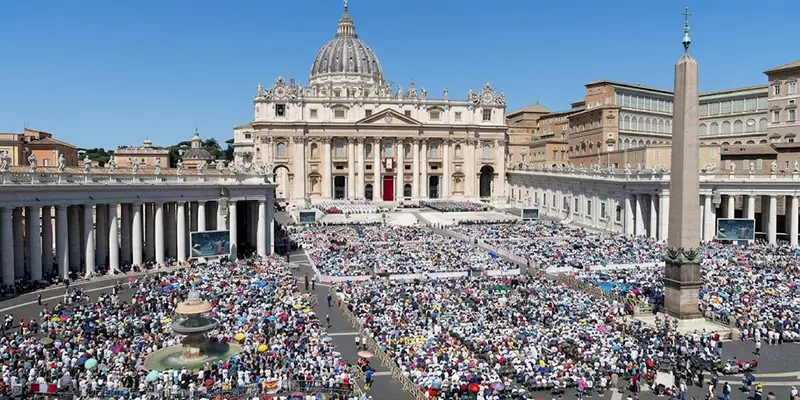
Pilgrims from across the world gather in St. Peter's Square for the Wednesday General Audience.
Receiving, Not Watching
The most common failure mode of a papal audience is spectatorship. A pilgrim who treats the audience as a performance—something to watch, record, and remember—will leave St. Peter's Square with a phone full of video and very little interior fruit. A pilgrim who treats the audience as an act of the Church, in which they are participating rather than observing, will leave changed.
This is the reframe worth offering parishioners before they ever arrive in Rome. The papal audience is not something to be witnessed. It is something to be received. The catechesis is for them. The Scripture is read to them. The Our Father is prayed with them. The blessing is given to them—and through them, to everyone they are carrying in their hearts.
Encourage parishioners to bring specific intentions into the square. Who are they praying for as they gather with the universal Church? A sick friend? A son who has left the faith? A marriage straining under long burdens? A parish back home? The audience becomes radically personal when each pilgrim arrives with someone named in their heart and receives the apostolic blessing on their behalf. The blessing, by the Holy Father's own intention, extends to family members and to those who could not make the journey. A parishioner who understands this carries home something real—not a souvenir, but a blessing actively pronounced over the people they love most.
The same is true of religious articles. Rosaries, medals, crucifixes, and holy cards carried into the square are included in the apostolic blessing. This detail, briefly mentioned, transforms the audience into a concrete gift pilgrims can bring home to children, grandparents, neighbors, and parishioners who did not travel. The rosary blessed on that Wednesday will be prayed at a kitchen table for years afterward. The medal will be pinned to a crib. The pilgrim has become a carrier of grace back to the ordinary places of their life.
The Priest's Particular Contribution
A professional guide can explain the architecture of St. Peter's Square. A tour company can coordinate the bus and the security timing. But only the priest leading the group can do the work that determines whether the audience is received as pilgrimage or observed as tourism.
That work begins in formation before departure. A brief teaching on the Petrine office goes a remarkably long way. Many Catholics have never heard a homily on what Christ entrusted to Peter, why the Holy Father is called the "Vicar of Christ," or why the teaching office of the Pope matters for the life of faith. Even ten minutes of formation on this, offered in a pre-pilgrimage gathering, transforms how a parishioner hears the Holy Father's catechesis on Wednesday morning. They will not merely see a man speaking from a platform. They will recognize the office, the continuity, the weight of what is happening.
The work continues on the ground. The night before the audience is an ideal moment for a short briefing—not about logistics (we handle those), but about disposition. What is about to happen? What should a pilgrim bring to the square, in their hands and in their heart? What is worth praying for in the days leading up to Wednesday morning? A priest who gathers his group for fifteen minutes of reflection the evening before sets a spiritual tone that no guide can provide.
And it continues after. In the hours and days following the audience, parishioners often struggle to articulate what they experienced. The square was so crowded. The Pope felt so far away. They could not hear every word of the catechesis. A priest who helps them name what happened—the communion they stood in, the blessing they received, the intentions they carried—gives them language for the grace they already received but did not yet recognize. This is the work of spiritual direction in miniature, and it is the reason parish groups led by a priest bear fruit that secular tour groups cannot.
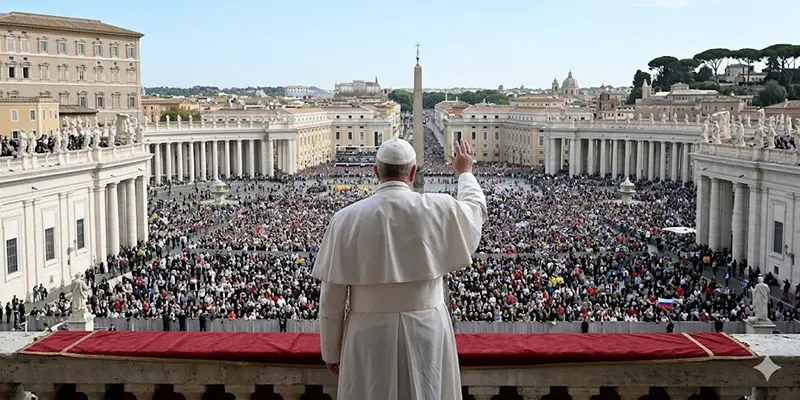
The apostolic blessing extends beyond the square to those the pilgrim carries in their heart.
What the Audience Can Offer a Parish Back Home
Pilgrimage is not measured by what happens in Rome. It is measured by what changes when pilgrims come home. For parish groups, the papal audience often produces three kinds of lasting fruit, and a priest who knows to watch for them can help his parishioners recognize and nurture each one.
A deeper sense of the Church. Parishioners who have stood in St. Peter's Square often return with a new appreciation for the parish itself. The universal Church, once an abstraction, is now concrete—and their own parish is experienced as a visible outpost of that vast, multilingual, catholic reality. Complaints about parish life do not disappear, but they soften. The pilgrim has seen the Church from a higher angle.
A personal connection to the Holy Father. Many Catholics pray vaguely for "the Pope" in the intercessions each Sunday, but after a papal audience, the prayer sharpens. They have stood in his presence. They have received his blessing. When the Holy Father appears in the news, they are no longer watching a distant figure—they are watching someone they have met, in the sense that pilgrims meet. This connection often deepens their engagement with papal teaching for years afterward.
A witness to carry. Pilgrims who have received the apostolic blessing for their families and friends often come home with a quiet sense of mission. They want to tell someone what happened. They want to share the blessing, in their own way, with the people they love. This impulse, properly encouraged, spills into ordinary parish life—conversations after Mass, casual witness to neighbors, a renewed sense that the faith is worth speaking about. Parish groups that return from Rome with pilgrims who have genuinely received the audience become seedbeds of quiet evangelization.
Leaving the Logistics to Us
One of the most common concerns from priests considering a Rome pilgrimage is the mechanics of the papal audience itself. The ticketing process, the Wednesday schedule, the collection of passes, the group seating—all of it can feel daunting to handle alongside the work of pastoral care. It does not need to be.
At Tekton, papal audience arrangements are simply part of how we build a Rome pilgrimage. We coordinate with the Prefecture of the Papal Household or the Pontifical North American College Visitors Office, we confirm the Wednesday schedule and flag conflicts with papal travel or major solemnities well in advance, we manage ticket collection, and we build the arrival timing into the itinerary so the group walks into St. Peter's Square unhurried and ready to pray. Priests leading groups with us do not submit requests, collect tickets, or navigate Vatican offices. They arrive on Wednesday morning free to do what no one else in the group can do—shepherd their parishioners into the encounter.
That division of labor is not a convenience. It is the pastoral shape of a well-led pilgrimage. The priest tends to souls. The pilgrimage company tends to the scaffolding that lets souls be tended. When both are done well, parishioners arrive in St. Peter's Square on a Wednesday morning ready to receive what the Holy Father has come to give them.
And they return by a different way. Quietly, perhaps without being able to name it, they carry Rome home with them—the voice of the Holy Father still in their ears, the blessing still resting on the people they love, the Church suddenly larger than they ever imagined. The papal audience, received rather than watched, does exactly what pilgrimage is meant to do. It sends a parishioner back to ordinary life, changed.
Considering a Rome pilgrimage for your parish? We would be honored to walk alongside you in the planning, handling every logistical detail—including papal audience arrangements—so you can focus on shepherding your people. Learn more about how to Lead Your Own Group, or explore our Upcoming Pilgrimages to see available dates.