

Poland
Where the faith survived everything history could throw at it.
Rynek Główny Main Market Square | Krakow, Poland
Poland / Prague Pilgrimage
Jasna Gora & the Black Madonna | Divine Mercy Shrine, Lagiewniki | St. John Paul II's Wadowice | Auschwitz-Birkenau | Infant Jesus of Prague
This 10-day pilgrimage carries you through Poland and the Czech Republic, two nations whose history is written in the lives of their saints. You will walk the streets of St. John Paul II’s boyhood, kneel where St. Faustina received the message of Divine Mercy, and stand in solemn silence at Auschwitz-Birkenau, where St. Maximilian Kolbe gave his life. Along the way, the Black Madonna of Czestochowa, the salt-carved chapels of Wieliczka, and the Infant Jesus of Prague each draw the heart deeper into prayer—so that you return home not merely traveled, but transformed, by a different way.
A Truly Catholic Pilgrimage
departure date
September 8, 2027
Duration
10 Days
Departure City
Land Only
Activity Level
Level 2
Day 1 · September 8
Arrive in Warsaw
Our pilgrimage begins today as we gather for the first time at our hotel in Warsaw (the address will be provided prior to departure); you may check in any time after 3:00 p.m. This evening, join your fellow pilgrims and your Pilgrimage Manager for a welcome dinner in the hotel dining room — the first gathering of our community as we set our hearts on the journey ahead.
Day 2 · September 9
Warsaw & Niepokalanow
We begin our day with Mass at St. Stanisław Kostka Church, where the martyred Solidarity priest Father Jerzy Popiełuszko worked and is buried. Father Popiełuszko’s courage in speaking truth to communist power — and his murder by the secret police in 1984 — made him one of the most powerful symbols of faith, freedom, and the power of the Gospel in modern Poland.
Enjoy a guided tour of Warsaw including visits to the Cathedral of St. John, the Royal Castle, the Old Town Square, the Barbican and City Walls, and Zygmunt’s Column. Follow the Royal Route to Łazienki Park where we will see the Palace on the Water.
We end our day with a visit to Niepokalanow — the “City of the Immaculata” founded by St. Maximilian Kolbe as a center of Marian devotion and the apostolate of print media. Here we visit the Shrine of Our Lady Immaculate and St. Maximilian Kolbe, offering our prayers in the place where he built his great work of faith before his arrest and deportation to Auschwitz.
Day 3 · September 10
Częstochowa & the Black Madonna
We depart Warsaw this morning and drive to Częstochowa, the most visited pilgrimage site in Poland, where Our Lady has been called the “Queen of Poland” for centuries. Here we visit the Jasna Góra Monastery — a spiritual fortress that has stood as the heart of Polish Catholic identity through invasions, partitions, and communist oppression. We visit the Treasury, Knight’s Hall, Refectory, and the Basilica of the Holy Cross and Nativity of the Virgin Mary.
The highlight of our visit is viewing the miraculous icon of Our Lady of Częstochowa — the Black Madonna — to which countless miracles have been attributed over seven centuries. We celebrate Mass before this beloved image. After Mass we proceed south to Kraków, our home base for the next four nights.
Day 4 · September 11
Auschwitz-Birkenau
Following breakfast, we travel to Auschwitz-Birkenau to pay our respects at the remains of this Nazi concentration camp, where over a million people were killed during the Second World War. Both St. Edith Stein and St. Maximilian Kolbe were sent here, along with millions of innocent Jews, Christians, and Poles. St. Maximilian was condemned to death by starvation after he stepped forward to take the place of a fellow prisoner — an act of self-giving love that shines through the darkness of this place.
Our time here is not a museum tour but an act of witness and prayer. We return to Kraków in the late afternoon for dinner and a quiet evening of reflection, carrying in our hearts all whom we have remembered today.
Day 5 · September 12
Wieliczka & Divine Mercy Shrine
This morning we travel to Wieliczka to visit one of the oldest working salt mines in Europe and a UNESCO World Heritage Site. Descend 135 meters underground into a breathtaking world of chambers, corridors, and chapels carved over centuries by Polish miners. The crown jewel is the magnificent Chapel of St. Kinga — a full cathedral carved entirely from rock salt, complete with chandeliers, elaborate bas-reliefs depicting scenes from the New Testament, and altarpieces fashioned from the same salt.
In the afternoon we journey to the Divine Mercy Shrine in Łagiewniki, where Saint Faustina Kowalska — Apostle of Divine Mercy — lived and died. Enjoy a guided tour of the shrine including the convent chapel and St. Faustina’s tomb. Venerate the original image of Divine Mercy and the relics of St. Faustina. Listen to a talk from one of the sisters of her Order. Pray before a relic of St. John Paul II in the center “Have No Fear,” named for his words at the beginning of his pontificate.
Day 6 · September 13
In the Footsteps of St. John Paul II
Today we walk in St. John Paul II’s footsteps as we retrace much of his early life, beginning with Wadowice where Karol Wojtyla was born in 1920. We celebrate Mass at the Gothic Basilica of the Presentation of the Virgin Mary, the very church where the future pope was baptized, received his first Holy Communion, and was confirmed. Admire the Baroque nave and pray before the miraculous picture of Our Lady of Perpetual Help, before which the young Karol prayed every day. Explore the Wojtyla family home museum, with personal relics and belongings from his youth.
Our next stop is Kalwaria Zebrzydowska — a place JPII called one of his great loves from youth. This UNESCO World Heritage site began in the 17th century when a Polish nobleman built a replica of the Chapel of the Holy Cross in Jerusalem. Over the centuries it grew to encompass replicas of the Tomb of Christ, the Mount of Olives, the Home of Caiaphas, and other Holy Land sites. Today 43 chapels and shrines are scattered across four kilometers of hills, honoring the Way of the Cross, the Mysteries of the Rosary, and the Seven Sorrows of Mary.
Day 7 · September 14
Journey to Prague
We depart this morning for the Czech capital of Prague, one of Europe’s most stunningly beautiful and well-preserved cities. En route, we stop in Brno to visit the Old Town and celebrate Mass at the Cathedral of Sts. Peter and Paul — a national cultural monument and a masterpiece of South Moravian Gothic architecture. A curiosity: the cathedral bells ring the noon hour one hour early, to commemorate a historic victory over Swedish forces during the Thirty Years’ War. Upon arrival in Prague, we check in at our hotel.
Day 8 · September 15
Prague — Loreto, Prague Castle & the Infant Jesus
We begin with a visit to the Loreto Shrine, one of the most important pilgrimage sites in the Czech Republic, housing a faithful replica of the Holy House of the Virgin Mary from Nazareth. Then we proceed to Prague Castle to visit the magnificent St. Vitus Cathedral, St. George’s Basilica, the picturesque Golden Lane, the Royal Palace, and St. George’s Convent.
We continue to Malá Strana — “The Little Quarter” — with its wealth of Baroque architecture. Here we visit the Church of St. Nicholas and the Church of Our Lady Victorious, where we venerate the famous Infant Jesus of Prague — the miraculous wax statue venerated by the faithful for over four centuries — and celebrate Mass.
Day 9 · September 16
Stará Boleslav & Prague Old Town
This morning we make an excursion to Stará Boleslav, where we celebrate Mass and visit the Basilica of St. Wenceslas — the site of the martyrdom of Bohemia’s patron saint — and venerate the Palladium of Bohemia, a sacred medieval relief of the Madonna and Child kept in the Basilica of the Assumption of the Virgin Mary.
In the afternoon we return to Prague and cross the Charles Bridge, lined with thirty magnificent Baroque statues of saints, to visit the Old Town — considered one of the finest historical city centers in Europe. We explore the Old Town Square, the Town Hall with its famous Astronomical Clock (which comes alive each hour as the twelve Apostles appear to bless the crowd), the Church of Our Lady before Týn, and the Church of St. Nicholas.
This evening we gather for a farewell dinner at a local restaurant, celebrating the many graces of this pilgrimage together.
Day 10 · September 17
Prague → U.S.A.
Following breakfast, we transfer to the airport for our return journey home (independently arranged), carrying with us all the blessings and graces of this pilgrimage through the land of saints. Like the Magi who “returned to their country by a different way,” we go home transformed — not merely as tourists with photographs, but as pilgrims carrying seeds of grace that will continue to bear fruit in our lives, our families, and our communities for years to come. Jesus, I trust in You.
Day 1 · September 8
Arrive in Warsaw
Our pilgrimage begins today as we gather for the first time at our hotel in Warsaw (the address will be provided prior to departure); you may check in any time after 3:00 p.m. This evening, join your fellow pilgrims and your Pilgrimage Manager for a welcome dinner in the hotel dining room — the first gathering of our community as we set our hearts on the journey ahead.
Meals: Breakfast, Dinner, Mass
Day 2 · September 9
Warsaw & Niepokalanow
We begin our day with Mass at St. Stanisław Kostka Church, where the martyred Solidarity priest Father Jerzy Popiełuszko worked and is buried. Father Popiełuszko’s courage in speaking truth to communist power — and his murder by the secret police in 1984 — made him one of the most powerful symbols of faith, freedom, and the power of the Gospel in modern Poland.
Enjoy a guided tour of Warsaw including visits to the Cathedral of St. John, the Royal Castle, the Old Town Square, the Barbican and City Walls, and Zygmunt’s Column. Follow the Royal Route to Łazienki Park where we will see the Palace on the Water.
We end our day with a visit to Niepokalanow — the “City of the Immaculata” founded by St. Maximilian Kolbe as a center of Marian devotion and the apostolate of print media. Here we visit the Shrine of Our Lady Immaculate and St. Maximilian Kolbe, offering our prayers in the place where he built his great work of faith before his arrest and deportation to Auschwitz.
Meals: Breakfast, Dinner, Mass
Day 3 · September 10
Częstochowa & the Black Madonna
We depart Warsaw this morning and drive to Częstochowa, the most visited pilgrimage site in Poland, where Our Lady has been called the “Queen of Poland” for centuries. Here we visit the Jasna Góra Monastery — a spiritual fortress that has stood as the heart of Polish Catholic identity through invasions, partitions, and communist oppression. We visit the Treasury, Knight’s Hall, Refectory, and the Basilica of the Holy Cross and Nativity of the Virgin Mary.
The highlight of our visit is viewing the miraculous icon of Our Lady of Częstochowa — the Black Madonna — to which countless miracles have been attributed over seven centuries. We celebrate Mass before this beloved image. After Mass we proceed south to Kraków, our home base for the next four nights.
Meals: Breakfast, Dinner, Mass
Day 4 · September 11
Auschwitz-Birkenau
Following breakfast, we travel to Auschwitz-Birkenau to pay our respects at the remains of this Nazi concentration camp, where over a million people were killed during the Second World War. Both St. Edith Stein and St. Maximilian Kolbe were sent here, along with millions of innocent Jews, Christians, and Poles. St. Maximilian was condemned to death by starvation after he stepped forward to take the place of a fellow prisoner — an act of self-giving love that shines through the darkness of this place.
Our time here is not a museum tour but an act of witness and prayer. We return to Kraków in the late afternoon for dinner and a quiet evening of reflection, carrying in our hearts all whom we have remembered today.
Meals: Breakfast, Dinner, Mass
Day 5 · September 12
Wieliczka & Divine Mercy Shrine
This morning we travel to Wieliczka to visit one of the oldest working salt mines in Europe and a UNESCO World Heritage Site. Descend 135 meters underground into a breathtaking world of chambers, corridors, and chapels carved over centuries by Polish miners. The crown jewel is the magnificent Chapel of St. Kinga — a full cathedral carved entirely from rock salt, complete with chandeliers, elaborate bas-reliefs depicting scenes from the New Testament, and altarpieces fashioned from the same salt.
In the afternoon we journey to the Divine Mercy Shrine in Łagiewniki, where Saint Faustina Kowalska — Apostle of Divine Mercy — lived and died. Enjoy a guided tour of the shrine including the convent chapel and St. Faustina’s tomb. Venerate the original image of Divine Mercy and the relics of St. Faustina. Listen to a talk from one of the sisters of her Order. Pray before a relic of St. John Paul II in the center “Have No Fear,” named for his words at the beginning of his pontificate.
Meals: Breakfast, Dinner, Mass
Day 6 · September 13
In the Footsteps of St. John Paul II
Today we walk in St. John Paul II’s footsteps as we retrace much of his early life, beginning with Wadowice where Karol Wojtyla was born in 1920. We celebrate Mass at the Gothic Basilica of the Presentation of the Virgin Mary, the very church where the future pope was baptized, received his first Holy Communion, and was confirmed. Admire the Baroque nave and pray before the miraculous picture of Our Lady of Perpetual Help, before which the young Karol prayed every day. Explore the Wojtyla family home museum, with personal relics and belongings from his youth.
Our next stop is Kalwaria Zebrzydowska — a place JPII called one of his great loves from youth. This UNESCO World Heritage site began in the 17th century when a Polish nobleman built a replica of the Chapel of the Holy Cross in Jerusalem. Over the centuries it grew to encompass replicas of the Tomb of Christ, the Mount of Olives, the Home of Caiaphas, and other Holy Land sites. Today 43 chapels and shrines are scattered across four kilometers of hills, honoring the Way of the Cross, the Mysteries of the Rosary, and the Seven Sorrows of Mary.
Meals: Breakfast, Dinner, Mass
Day 7 · September 14
Journey to Prague
We depart this morning for the Czech capital of Prague, one of Europe’s most stunningly beautiful and well-preserved cities. En route, we stop in Brno to visit the Old Town and celebrate Mass at the Cathedral of Sts. Peter and Paul — a national cultural monument and a masterpiece of South Moravian Gothic architecture. A curiosity: the cathedral bells ring the noon hour one hour early, to commemorate a historic victory over Swedish forces during the Thirty Years’ War. Upon arrival in Prague, we check in at our hotel.
Meals: Breakfast, Dinner, Mass
Day 8 · September 15
Prague — Loreto, Prague Castle & the Infant Jesus
We begin with a visit to the Loreto Shrine, one of the most important pilgrimage sites in the Czech Republic, housing a faithful replica of the Holy House of the Virgin Mary from Nazareth. Then we proceed to Prague Castle to visit the magnificent St. Vitus Cathedral, St. George’s Basilica, the picturesque Golden Lane, the Royal Palace, and St. George’s Convent.
We continue to Malá Strana — “The Little Quarter” — with its wealth of Baroque architecture. Here we visit the Church of St. Nicholas and the Church of Our Lady Victorious, where we venerate the famous Infant Jesus of Prague — the miraculous wax statue venerated by the faithful for over four centuries — and celebrate Mass.
Meals: Breakfast, Dinner, Mass
Day 9 · September 16
Stará Boleslav & Prague Old Town
This morning we make an excursion to Stará Boleslav, where we celebrate Mass and visit the Basilica of St. Wenceslas — the site of the martyrdom of Bohemia’s patron saint — and venerate the Palladium of Bohemia, a sacred medieval relief of the Madonna and Child kept in the Basilica of the Assumption of the Virgin Mary.
In the afternoon we return to Prague and cross the Charles Bridge, lined with thirty magnificent Baroque statues of saints, to visit the Old Town — considered one of the finest historical city centers in Europe. We explore the Old Town Square, the Town Hall with its famous Astronomical Clock (which comes alive each hour as the twelve Apostles appear to bless the crowd), the Church of Our Lady before Týn, and the Church of St. Nicholas.
This evening we gather for a farewell dinner at a local restaurant, celebrating the many graces of this pilgrimage together.
Meals: Breakfast, Dinner, Mass
Day 10 · September 17
Prague → U.S.A.
Following breakfast, we transfer to the airport for our return journey home (independently arranged), carrying with us all the blessings and graces of this pilgrimage through the land of saints. Like the Magi who “returned to their country by a different way,” we go home transformed — not merely as tourists with photographs, but as pilgrims carrying seeds of grace that will continue to bear fruit in our lives, our families, and our communities for years to come. Jesus, I trust in You.
Meals: Breakfast, Dinner, Mass
Departure
September 8, 2027
Pilgrimage Price
$3,900
per person
Questions? Call Us
(317) 574-4191
"I am not Catholic, but have been on a number of pilgrimages with my Catholic wife. I can say it was another awesome experience for her and her faith."
Edward S.
Pilgrim from Kapaa, HI
Pilgrimage Route
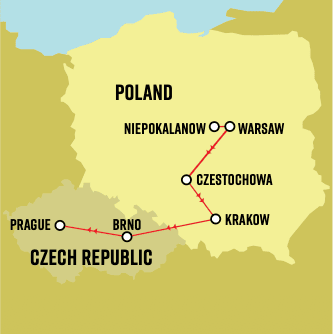
Jasna Gora & the Black Madonna | Divine Mercy Shrine, Lagiewniki | St. John Paul II's Wadowice | Auschwitz-Birkenau | Infant Jesus of Prague
Ready to Walk These Sacred Sites?
Your place on this pilgrimage awaits.
Anticipated Weather · September
Warsaw, Poland
50–68°F
Mild & Partly Sunny · September
Early-autumn days are mild, with sunshine breaking through drifting cloud and the chance of a passing shower. Mornings carry a gentle chill. The pilgrim, unlike the hurried traveler, lets each day arrive at its own pace.
Krakow, Poland
48–66°F
Mild & Variable · September
Comfortable afternoons give way to noticeably cooler evenings as the season turns. Expect a mix of sun and cloud across these four days. A bit of bracing air is part of the journey, not an obstacle to it.
Prague, Czech Republic
46–64°F
Cool & Variable · September
Autumn settles more firmly here—softer light, more cloud, and crisp evenings near the Vltava, with rain possible. The road home will look different than the road out; so, often, does the one who walks it.
Dress in layers for mild days and cool mornings and evenings. September can bring rain across Central Europe—pack a lightweight waterproof jacket. Sturdy walking shoes are essential for cobbled Old Towns, the Wieliczka salt mine, and the hillside chapels of Kalwaria Zebrzydowska. Modest attire required at all sacred sites (shoulders and knees covered).
Pricing Information
The total pricing is based on the following components:
Base price
$3,900
Air taxes & fuel surcharges
$NA
Gratuities (added to final invoice)
$180
This is a land-only pilgrimage. No group flights are provided. See brochure for information about single rooms.
Please note: The final invoice will be emailed to you approximately 3 months prior to departure.
Please note: The final invoice will be emailed to you approximately 3 months prior to departure.
What Pilgrims Are Saying
The tour guides did a super job, were very personable and patient, had a great education which they shared well and also had a sense of humor.
Fr. Matthew V.
Pilgrim from Lincoln, NE
We were pleasantly surprised by the excellent hotels, food arrangements and tours. Everything went without a hitch. Very well coordinated.
Patricia M.
Pilgrim from West Lafayette, IN
There were many wonderful moments. I was especially touched by the time spent in the childhood home of Pope John Paul 11. His personal objects were alive with memory.
Krista was patient, prompt and thorough in responding to my questions and confusion. Our guide was thorough and knowledgeable. She asked for our input when there were options. She was tireless and did an incredible job of keeping us together and on time. Our bus driver was cheerful, prompt and efficient. He was amazing at negotiating through busy traffic.
Krista was patient, prompt and thorough in responding to my questions and confusion. Our guide was thorough and knowledgeable. She asked for our input when there were options. She was tireless and did an incredible job of keeping us together and on time. Our bus driver was cheerful, prompt and efficient. He was amazing at negotiating through busy traffic.
Linda M.
Pilgrim from The Villages, FL