

Tekton Ministries
Publish Date: October 28, 2026
On the morning of September 20, 1918, a young Capuchin friar knelt in the choir loft of a small stone church in the Gargano hills, making his thanksgiving after Mass. When he rose, his hands, feet, and side bore open wounds that would not close for fifty years. The choir loft is still there. So is the crucifix he knelt before. That is the particular gift of a Padre Pio pilgrimage in Italy: the things you have read about did not happen in the abstract. They happened in a room you can stand in.
San Giovanni Rotondo sits on a spur of Monte Gargano in Puglia, several hours southeast of Rome and well off the route most visitors to Italy ever take. Nobody passes through on the way to somewhere else. You go because you mean to — and that decision, made before you ever pack, is already the beginning of the pilgrimage.
Who Padre Pio Was, and Why the Wounds Matter
Francesco Forgione was born in 1887 in Pietrelcina, a farming village in the hills of Benevento, and entered the Capuchins as a boy, taking the name Pio. In 1916 he was sent to the friary of Our Lady of Grace at San Giovanni Rotondo, a poor and remote house thought to suit his fragile health. He stayed fifty-two years and never left.
Two years after his arrival came the stigmata. He bore the visible wounds for half a century — under medical examination, under Vatican investigation, and through long stretches when he was forbidden to celebrate Mass publicly or hear confessions. He died in his cell in the small hours of September 23, 1968, at eighty-one. In the days before his death the wounds had closed, leaving no scar. Saint John Paul II beatified him in 1999 and canonized him on June 16, 2002. His feast is kept on September 23, the day he died.
Saint Paul told the Galatians, "From now on, let no one make troubles for me; for I bear the marks of Jesus on my body" (Galatians 6:17), and wrote to the Colossians of filling up in his flesh "what is lacking in the afflictions of Christ" (Colossians 1:24). The Church has never taught that Christ's Passion was insufficient; it teaches that He permits us to be joined to it. Padre Pio's wounds are not a curiosity to be explained. They are that doctrine made visible in one man's flesh for fifty years.
This is where the first fork in the road appears. It is entirely possible to arrive at San Giovanni Rotondo interested in the wounds and leave having missed the man. The stigmata are the headline; the fifty years are the story. A visitor comes to see something remarkable and photograph it. A pilgrim comes to be recruited into it — to ask what a life looks like when it is handed over to Christ without conditions and without a reserve clause, and whether his own could bear a fraction of that.
What You Will See at San Giovanni Rotondo
The old church of Santa Maria delle Grazie. Small, plain, sixteenth-century, attached to the friary — the church Padre Pio knew for most of his life. Upstairs is the choir loft where he received the stigmata, and the crucifix before which he was praying. Downstairs is the confessional where he sat for decades. Most pilgrims are surprised by how modest it is: grace did not require a grand setting.
The friary and his cell. The corridor where he lived and died is preserved, along with his habit, his letters, and the ordinary objects of a life that owned almost nothing. Standing at that door does more than any explanation of the mystical phenomena ever will.
The two newer churches. A larger church went up beside the old one in 1959, in his lifetime, because the crowds coming to him had outgrown the original. Then, between 1998 and 2004, Renzo Piano built the Church of Saint Pio — seating roughly 6,500, with room for tens of thousands more on the plaza outside. Twenty-two arches of pale Apricena stone fan outward from the altar in two radial rows, beneath a roof that follows the same turning. It divides opinion, and the objection is sharper than "it looks modern": the plan is a spiral, not a cross. Critics have asked why, of all men, the stigmatist did not get a cruciform church. Withhold judgment until you have been inside during a Mass with six thousand people singing in five languages. Since 2010 Padre Pio's body has rested here, behind glass in the lower church, where pilgrims file past from morning until evening.
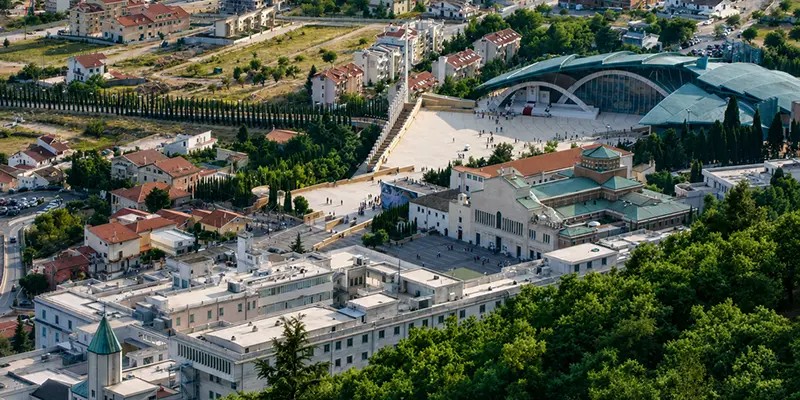
San Giovanni Rotondo from above. The friary and its churches sit at the center of the hillside, with the plaza and the newer church added as the crowds grew — the shrine expanding outward, ring by ring, around one Capuchin's cell.
The Way of the Cross. A monumental Via Crucis climbs the hillside above the shrine, meant to be walked rather than viewed. Take it slowly, and in the morning.
Casa Sollievo della Sofferenza. Do not skip the hospital. Padre Pio broke ground in 1946 and opened it in 1956 with 350 beds, refusing to let it be called a hospital: he named it the Home for the Relief of Suffering. It remains one of the largest in southern Italy. The man who carried the wounds of Christ in his own body spent his fundraising energy on beds for other people's pain.
The Confessional That Never Emptied
For years Padre Pio heard confessions ten hours a day and more. Demand grew so great that penitents took a number and waited, sometimes for days. What they got was not comfort. In 1950 a nineteen-year-old knelt down unprepared and sorry for nothing, and Padre Pio gave him two words: Go away. That was not a lapse of temper. He had a formula for it — Out! Go away! I don't want to see you before such and such a day — and used it deliberately, as a shock meant to produce repentance. He withheld absolution from penitents who would not form a firm intention to change, and made some of them wait months before he gave it.
He was also difficult to deceive. A wealthy woman named Luisa came to him out of curiosity, confessed a great deal, and held back the one sin she could not bring herself to say. He did not argue with her and he did not absolve her. He waited, while she trembled, until she said it. Then he absolved her.
That is the reason to go to confession at San Giovanni Rotondo. Not that the absolution is different there — it is the same sacrament as in your own parish on a Saturday afternoon. It is that for fifty years the confessional in that church ran on the assumption that a penitent could be told the truth, and that the sacrament mattered more than the penitent's comfort. It is hard to kneel in a room with that history and still shade the account.
How to Prepare for a Padre Pio Pilgrimage in Italy
The work that determines whether this pilgrimage bears fruit happens weeks before departure, and it is not logistical.
Name your intentions and write them down. Three to five, specific enough to be uncomfortable. Not "my family" but the particular estrangement, the particular fear. Carry the list in your pocket and pray it at the tomb. Vague intentions produce vague pilgrimages.
Read his life before you see his cell. An hour with a solid biography, or with his letters, turns a corridor of preserved furniture into the record of a man you have come to know. Sit with Galatians 6 and Colossians 1 before you go.
Plan to put the camera down. Choose one place — we suggest the old church — and give it ten minutes with nothing in your hands. The photograph you do not take is the memory most likely to survive. We have written more about this discipline, and the groundwork that makes any pilgrimage fruitful, in our reflection on preparing for a Catholic pilgrimage.
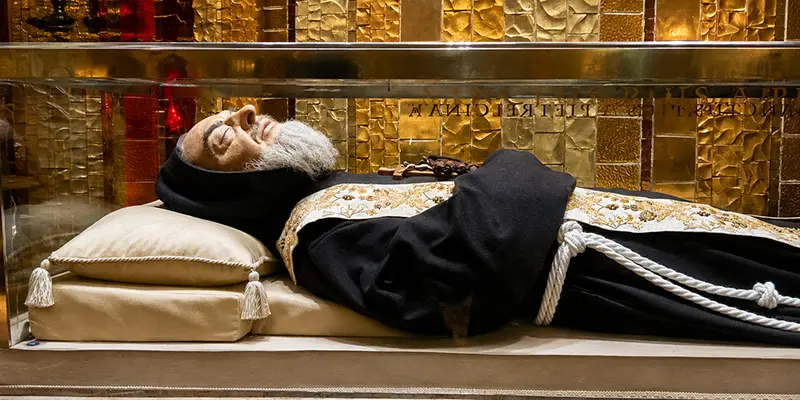
Padre Pio's tomb in the lower church, where his body has rested since 2010. The line to pass it forms early and rarely thins.
The Crowds, the Lines, and What They Are For
San Giovanni Rotondo is among the most heavily visited shrines in the Catholic world, and you will feel it. Mass is celebrated many times daily in both churches, in several languages, and the schedule shifts with the season. There will be a line at the tomb and a wait for confession. The plaza is hot in summer, and the hillside is steep for anyone whose knees are no longer young.
None of this is a defect in the pilgrimage. It is the pilgrimage. There is a real difference between the man who suffers a ninety-minute queue as a failure of logistics and the man who receives it as ninety minutes of prayer handed to him unasked. The first is a consumer, poorly served. The second is a pilgrim.
Offer the discomfort. Attach it to one of the intentions in your pocket. We are travelers by nature and exiles by circumstance, and a body that aches on a hillside in Puglia is being reminded it has not yet arrived home.
Returning by a Different Way
A Padre Pio pilgrimage in Italy pairs naturally with Rome and Assisi, and our pilgrimages to Italy that include San Giovanni Rotondo walk with other saints of the peninsula — among them Fr. Dolindo Ruotolo of Naples, whom Padre Pio sent his own visitors to see, telling them plainly that Dolindo was the saint. He spent his life pointing away from himself.
That is where this shrine finally points you as well — away from the spectacle and back toward your own ordinary life, which is where the fruit either appears or does not. Padre Pio's holiness was not built in the choir loft on one September morning. It was built across fifty years of rising before dawn in an unremarkable friary, saying Mass, hearing confessions, answering letters, offering the pain. The wounds were given. The sanctity was chosen, every day, for half a century.
So the honest measure of your pilgrimage will not be taken on the plaza at San Giovanni Rotondo. It will be taken six months later, at home, by the people who live with you. Are you more patient? Do you go to confession more often? Did the intention in your pocket become something you still pray for? A visitor comes home with photographs and a rosary from the shop. A pilgrim comes home unable to resume his old life on the old terms — and returns, as the Magi did, by another road.
Ready to pray where Padre Pio prayed? We have accompanied Catholic pilgrims for thirty years, and we build every itinerary so the sacraments — not the sightseeing — set the pace. See All Upcoming Pilgrimages to find a departure that fits your calendar, or, if you are a priest or parish leader wondering whether your people belong on that hillside, Lead Your Own Group and we will handle the rest.