


Tekton Ministries
Publish Date: June 24, 2026
On the evening of June 24, 1981, six young people on a rocky hillside in what was then communist Yugoslavia saw a woman holding a child, and ran. The next day they climbed back up. That second day—June 25—is the one Medjugorje keeps as its anniversary, and the choice of date says something. A spectator sees something remarkable and talks about it for years. A pilgrim goes back. That returning is what each June reenacts. The Medjugorje June anniversary draws tens of thousands of pilgrims to the same hillside, and every one of them meets the question the visionaries met on the morning of the twenty-fifth: having glimpsed something, will you return for more—or will you only talk about it?
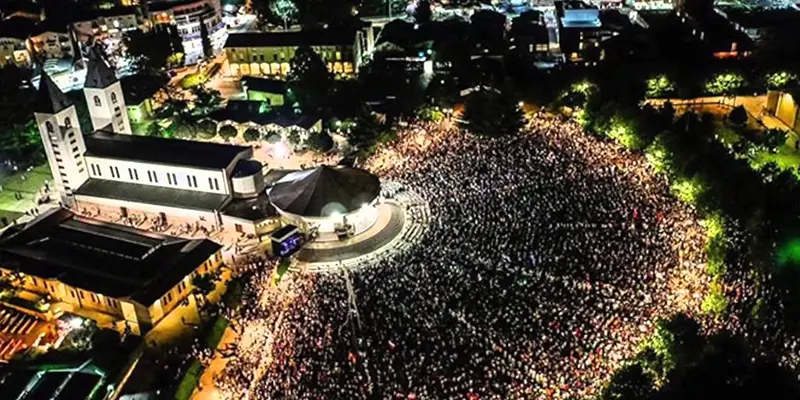
Pilgrims gather outside St. James Church in Medjugorje, the parish at the heart of the daily prayer that has continued for more than four decades. (Alt text: pilgrims praying outside St. James Church, Medjugorje)
A Hillside in 1981
The six were ordinary parish kids—Ivanka, Mirjana, Vicka, Marija, Ivan, and Jakov. They were not looking for a vision. What they reported, then and ever since, is the appearance of a woman who eventually identified herself as the Queen of Peace, the Gospa, and whose message has never strayed far from five plain words the Church has preached for two thousand years: peace, prayer, fasting, conversion, and the Eucharist. There is nothing exotic in that summons. It is the Gospel, handed back to a violent century in a Marian accent. The questions that naturally follow—who the visionaries are, what the messages actually say, and how the Church has weighed them—are taken up honestly in our resource on common questions about Medjugorje.
More than forty million people have made their way to this remote corner of Bosnia and Herzegovina in the decades since. They have not come for scenery—Medjugorje is a small village with a large church and two hills. They have come because the ordinary disciplines of the faith are practiced there with an intensity that is hard to find anywhere else: hours of confession in the open air, Adoration that stretches deep into the night, the Rosary prayed by crowds climbing rock in bare feet. Whatever one concludes about the events of 1981, the village has become a place where lukewarm Catholics go and come back changed.
Why June Still Calls Pilgrims Home
The Medjugorje June anniversary is not a festival of nostalgia. It is a homecoming. Each year the parish of St. James marks the date with extra Masses, all-night vigils, and a swell of pilgrims that turns the small square into a sea of candles. The anniversary draws people back to the spot where the story began—Podbrdo, now called Apparition Hill—and that physical return is itself a kind of catechesis. You walk the same stony path the visionaries walked. You feel the heat and the loose rock under your feet. You arrive at the white statue of the Queen of Peace a little breathless, which is, perhaps, the right way to arrive anywhere holy.
June in Medjugorje is hot, crowded, and demanding. None of those are problems to be solved. They are part of what makes the days fruitful. The long line for confession is where grace is waiting. The climb that leaves your calves burning is an offering you can place at the foot of the cross. Pilgrims who come expecting comfort are usually disappointed; pilgrims who come expecting to be stretched are rarely sent home empty.
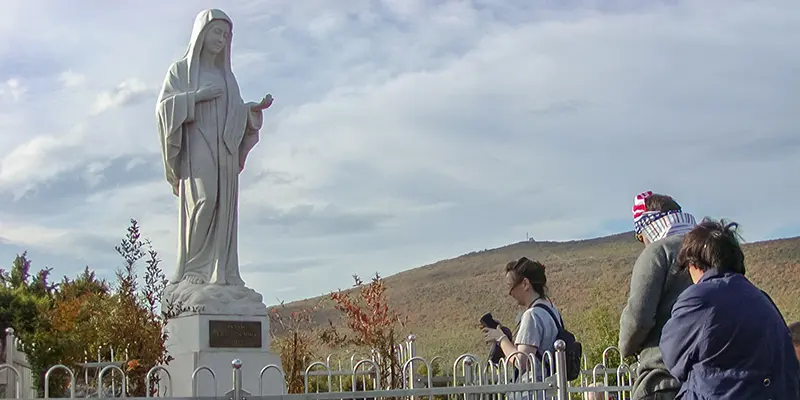
The statue of the Queen of Peace on Apparition Hill (Podbrdo), the rocky path pilgrims climb to pray where the events of June 1981 are said to have begun. (Alt text: statue of Our Lady, Queen of Peace, on Apparition Hill in Medjugorje)
Come as a Pilgrim, Not a Spectator
It matters how you go. Medjugorje attracts the curious—people who want to stand near the visionaries, photograph the hill, and collect a story to tell. That is the posture of a tourist, and a tourist leaves with souvenirs. A pilgrim goes looking for something he cannot pack: seeds of grace, planted quietly, that keep growing long after the flight home. The difference is not where you stand but what you intend. Pack your intentions before you pack your suitcase, and decide before you arrive that you are coming to be converted, not entertained.
This distinction is also where the Church's own guidance points. In September 2024, the Vatican's Dicastery for the Doctrine of the Faith issued a note titled The Queen of Peace, granting a nihil obstat—“nothing stands in the way”—to the devotion connected with Medjugorje. The decision authorizes public acts of devotion and recognizes the abundant spiritual fruits of the place, while deliberately stopping short of declaring the apparitions themselves to be supernatural in origin. The faithful are not obliged to believe in the visions. What the Church does ask us to notice is the fruit: confessions made after decades away, marriages healed, vocations born, hardened hearts softened. (Tekton has written more fully on what this ruling means in our post on the Vatican decision on Medjugorje.)
That emphasis on fruit is a gift to the pilgrim, because fruit is exactly what a pilgrimage is meant to produce. You do not have to settle the question of the apparitions to let the place do its work on your soul. You only have to go the way the Magi went—seeking, kneeling, and willing to be sent home by a different road than the one you came on. The groundwork for that begins long before departure; if you want a framework for the interior preparation that makes any pilgrimage fruitful, start with our guide on how to prepare for a Catholic pilgrimage.
The Rhythm of a Summer Pilgrimage
A few days in Medjugorje fall into a rhythm that the village has kept for forty years. Mornings often begin with the climb up Apparition Hill. Afternoons make room for the long, unhurried examination of conscience that precedes confession—here the sacrament is treated not as an errand but as the center of the day. Evenings belong to St. James: the Rosary, Mass, and Adoration that draws thousands into a silence you can almost lean against. For the strong of leg and the strong of will, there is Cross Mountain, Križevac, where a great concrete cross crowns a steep ascent past the Stations. Pilgrims climb it slowly, often barefoot, carrying intentions for the people they love. The body aches; the soul, somehow, breathes easier at the top.
If the June anniversary is the year's first great gathering, the Medjugorje Youth Festival—Mladifest—is the second. Held each year in early August, the Medjugorje Youth Festival brings tens of thousands of young Catholics from around the world for days of catechesis, music, testimony, and Adoration. It is a striking sight in an age that keeps announcing the death of faith among the young: a hillside packed with twentysomethings on their knees. For families weighing when to go, summer offers two distinct seasons of grace, the quieter intensity of late June and the youthful surge of August.
Returning by a Different Way
The real test of any pilgrimage is not what happens on the hill. It is what happens in the months after you come down—in your marriage, your parish, your prayer, your patience with the people who exhaust you. Medjugorje has never asked anyone to do anything novel. It asks for the Rosary you already know, the confession you have been avoiding, the fasting you keep meaning to begin. The grace of the place is that it makes those ordinary things feel possible again. Pilgrims who go to Medjugorje for the anniversary and treat it as a spectacle will return home essentially the same. Those who go as pilgrims—who climb, confess, and kneel—tend to come back unable to resume their old lives unchanged. That, and not a photograph of the hill, is the souvenir worth bringing home.
If the anniversary is stirring something in you, the next step is simple: see where the journey could lead.