


Tekton Ministries
Publish Date: August 12, 2026
Mary walked this ground before it was anyone's pilgrimage route—a girl in Nazareth, a young mother on the road to Bethlehem, a grieving woman at the foot of the Cross in Jerusalem. To follow the Marian sites in the Holy Land is to trace the whole arc of her life—from the Annunciation to the Assumption—and to discover that a pilgrim who walks this path is never merely sightseeing. A tourist comes to photograph a famous church; a pilgrim comes to kneel where a young woman once said yes to God and changed the course of human history.
That distinction matters more than it may first appear. It is entirely possible to visit every Marian shrine in Israel and come home with nothing but a camera roll. It is also possible to stand in a single grotto and be undone—to feel the floor of your own life shift. The difference is not the place. It is the posture you bring to it. And no one teaches that posture better than Mary herself.
Mary, the First Pilgrim
Before we set foot in Nazareth, it helps to recognize what kind of woman we are following. Mary was not a tourist in her own life. From the moment of the Annunciation, she became a woman on the move—Homo Viator, the human being on a journey—carrying Christ within her toward an unknown future. She traveled "with haste" to the hill country (Luke 1:39). She traveled to Bethlehem heavy with child. She fled to Egypt by night and returned again. She followed her Son to Jerusalem and stood at the foot of the Cross. Her whole life was a pilgrimage of trust, lived one unfamiliar mile at a time.
This is why the Marian sites in the Holy Land are not a collection of disconnected stops. They are the stations of a single life given completely to God. When you visit them as a pilgrim—asking not "what is there to see?" but "what is God asking of me here?"—you begin to walk Mary's interior road as well as her physical one. You begin, like her, to gather seeds of grace rather than souvenirs.
Nazareth: Where Mary Said Yes
Every Marian pilgrimage in the Holy Land begins, fittingly, where Mary's own story began. In Nazareth, the Basilica of the Annunciation rises over the Grotto of the Annunciation—the cave-home where, according to ancient tradition, the angel Gabriel appeared to Mary and she gave her consent: "Let it be done to me according to your word." The present basilica, designed by the Italian architect Giovanni Muzio and completed in 1969, was for decades the largest Christian church in the Middle East, and it remains the largest in the Holy Land. Its modern upper church draws the eye upward, but the heart of the place lies below, in the quiet of the grotto itself.
Pilgrims often expect grandeur here. What they find instead is smallness—a humble dwelling carved into rock, where the eternal God chose to enter human history through the consent of a teenage girl. That smallness is the lesson. Excavations beneath the basilica uncovered the remains of the ancient village, and on one column fragment archaeologists found scratched in Greek the words Chaire Maria—"Hail Mary"—left by some early Christian pilgrim who knelt here long before us. To pray the Angelus in this grotto is to stand inside the moment the Word became flesh, and to ask what God might be asking you to say yes to.
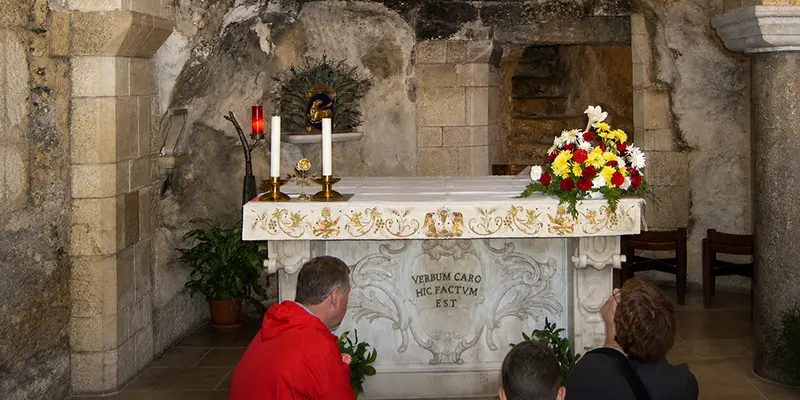
The Grotto of the Annunciation in Nazareth, where tradition holds Mary received the angel Gabriel and gave her consent to become the Mother of God.
Ein Karem and Bethlehem: The Visitation and the Nativity
From Nazareth, Mary's first act as the Mother of God was to set out on a journey of charity. She went "with haste" to the hill country to serve her cousin Elizabeth, and in the village of Ein Karem, just outside Jerusalem, the Church of the Visitation marks the place of that meeting. Here Elizabeth cried out, "Blessed are you among women," and Mary answered with the Magnificat—the great song of praise that the Church still prays every evening. A wall in the courtyard displays the Magnificat in dozens of languages, a reminder that Mary's joy has overflowed every border on earth.
In Bethlehem, the journey continues to the Grotto of the Nativity beneath the Basilica of the Nativity, where a silver star on the floor marks the traditional site of Christ's birth—the place where Mary first laid her newborn Son. A short walk away, the Milk Grotto chapel commemorates the tradition of the Holy Family's flight, a site where pilgrims, especially couples longing for children, come to pray under Mary's care. These are not stops to be hurried through. A pilgrim lingers, because Mary lingered here, treasuring all these things and pondering them in her heart (Luke 2:19).
From Cana to Calvary
Mary's presence threads quietly through her Son's public life, and the Holy Land preserves its key moments. At Cana in Galilee, where Jesus worked his first miracle at his mother's prompting, her counsel still echoes for every pilgrim: "Do whatever he tells you" (John 2:5). It is, in a single line, the entire spirituality of pilgrimage—and the entire spirituality of the Christian life.
And in Jerusalem, along the Via Dolorosa, pilgrims trace the path where Mary met her Son carrying the Cross, until they reach Calvary within the Church of the Holy Sepulchre—where she stood at the foot of the Cross and received the dying words that made her mother of us all: "Behold, your son" (John 19:26). To walk this stretch is to embrace, however faintly, the discomfort and sorrow that were part of Mary's own pilgrimage. Hardship, for the pilgrim, is not a complaint to be lodged but an offering to be made. Mary teaches us how.
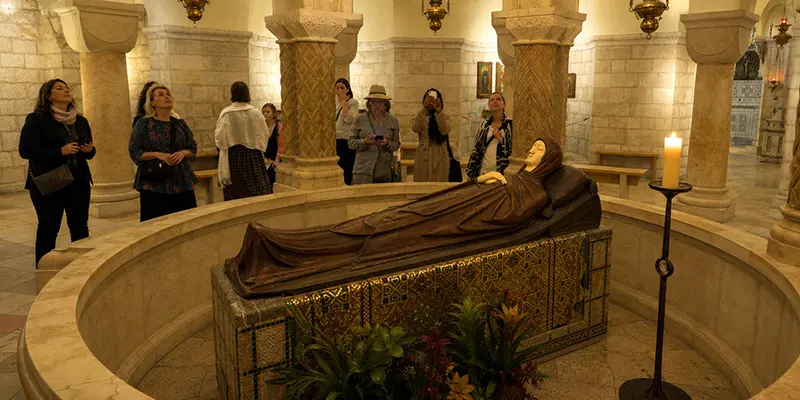
The crypt of the Dormition Abbey on Mount Zion, where an effigy of the sleeping Virgin commemorates the end of Mary's earthly life.
Mount Zion: The Dormition and the Mystery of the Assumption
Mary's earthly journey ends where the Church was born. On Mount Zion, steps from the Upper Room where the Holy Spirit descended at Pentecost, the German Benedictine Dormition Abbey commemorates the tradition that here Mary "fell asleep"—the Dormition, in the language of the Eastern Church. In the crypt below, an effigy of the sleeping Virgin rests beneath a dome in which Christ is shown calling his mother home. Nearby, in the Kidron Valley at the foot of the Mount of Olives, the Tomb of the Virgin marks the place tradition venerates as her burial—an empty tomb, fittingly, for the woman taken up body and soul into heaven.
A word of careful theology belongs here. When Pope Pius XII solemnly defined the Assumption in 1950, the Church deliberately did not settle whether Mary died before being assumed or was taken up without passing through death. What the dogma affirms is the heart of the matter: that "the Immaculate Mother of God, the ever Virgin Mary, having completed the course of her earthly life, was assumed body and soul into heavenly glory." The Dormition Abbey and the Tomb of the Virgin hold these mysteries in tension rather than resolving them—and the pilgrim is invited to do the same, standing before the threshold of a glory we do not yet fully comprehend. This is the destination of every Marian site in the Holy Land, and it is timely to remember: the Church celebrates the Solemnity of the Assumption each year on August 15.
Returning by a Different Way
Mary's life moved from the Annunciation to the Assumption—from her first yes to her final glory. The Marian sites of the Holy Land let us walk that arc with her, and in walking it, we are quietly asked to make her journey our own. For Mary is not only the Mother of God; she is the first and best disciple, the model of what a pilgrim becomes when grace is allowed to do its work. She received the Word, treasured it, pondered it, and let it transform everything.
That is the true measure of any pilgrimage. Not the sites you saw, but the person you became by standing among them. If you spend a single afternoon in the Grotto of the Annunciation and leave still asking what God might be asking of you—if you carry the Magnificat home and find yourself praying it in the ordinary evenings of your own life—then the holy places have taken root within you. You will have done what the Magi did after they found the Child: you will have returned home by a different way. To prepare your heart for that kind of journey through the Holy Land is to ensure that you come home not merely traveled, but changed.
Ready to walk in Mary's footsteps? Whether you are drawn to honor Our Lady at the places she once walked or feel called to lead others there, the journey begins with a single step. See All Upcoming Pilgrimages to find a Holy Land pilgrimage that fits your heart and calendar, or learn how to Lead Your Own Group and shepherd fellow pilgrims to the heart of the faith.