

Tekton Ministries
Publish Date: July 27, 2026
Every July 25, the great square before the cathedral in Santiago de Compostela fills with pilgrims who have walked for days, weeks, or even months to reach the tomb of the Apostle James. Some arrive limping. Many arrive weeping. None arrive unchanged. The Feast of Saint James the Greater is the beating heart of a pilgrimage tradition that has drawn the faithful across mountains and meseta for more than a thousand years—and it remains one of the most formative journeys a shepherd can offer his flock.
The Camino is unlike most pilgrimages, because here the path itself is the prayer. There is no bus to carry your people from site to site, no air-conditioned reprieve between churches. There is only the next step, the weight of the pack, and the slow conversion that happens when a soul is given nothing to do but walk toward God. This is precisely what makes the Way of Saint James such fertile ground for grace—and such a particular kind of responsibility for the priest who leads it.
If you are discerning whether to lead a Camino pilgrimage for your parish, what follows is meant to help you see the journey clearly: what it asks of you, what it offers your people, and how to ensure they return not merely well-traveled, but transformed.
Why the Camino Forms Pilgrims Unlike Any Other Journey
We are, each of us, homo viator—man on a journey, an exile traveling toward a homeland we have not yet seen. Most pilgrimages preach this truth. The Camino makes the body live it. Mile after mile, the ache in the legs and the blister on the heel teach the soul what the catechism states: that we are not yet home, and that the road costs something.
This is also why the Camino so quickly exposes the difference between a tourist and a pilgrim. The same trail that carries your parishioners carries thousands of hikers, athletes, and seekers chasing a personal milestone. A tourist walks to collect an experience and a certificate. A pilgrim walks to be changed. When you lead a group along the Way, your task is to help your people walk for seeds of grace rather than souvenirs—to keep their eyes fixed on the Apostle's tomb rather than on their step count.
A guidebook can explain the yellow arrows and the scallop shell. Only you can connect the long climb out of the valley to the cross a parishioner has been carrying for years. That pastoral connection is what turns shared exertion into shared conversion—and it is the reason a priest-led Camino bears fruit that no independent trek ever could.
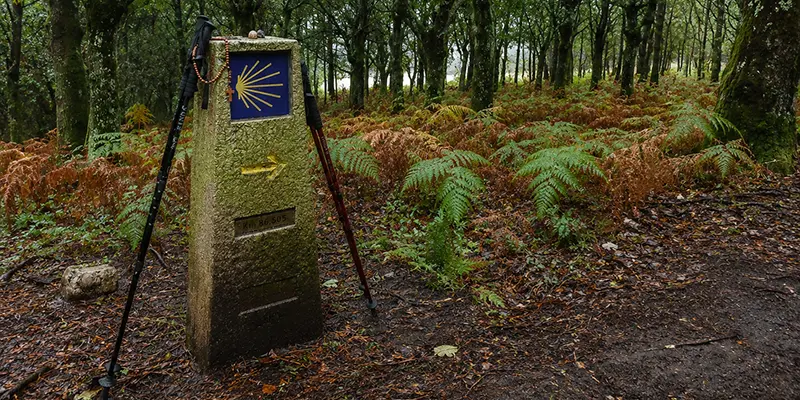
The scallop shell and yellow arrow have guided pilgrims toward Santiago for centuries—on the Camino, the road itself becomes the prayer.
Choosing a Way That Fits Your Parish
One of the great gifts of the Camino is its generosity: there is not one Way, but many. A parish need not walk five hundred miles to make a true pilgrimage. The first discernment, then, is pastoral rather than logistical—what spiritual and physical shape best fits the people you actually have.
Many parish groups walk the final hundred kilometers of the Camino Francés from Sarria, the most traveled stretch and the minimum distance recognized for the Compostela, the cathedral's certificate of completion. Others choose the quieter Camino Inglés from Ferrol, the historic route once taken by pilgrims who arrived in Galicia by sea. Each Way offers a different temperament—busier or more solitary, gentler or more demanding—and the right choice depends on your group's age, fitness, and the kind of silence they are ready to receive.
Here is where our partnership matters most. Once you have discerned the spiritual contours of the journey, we carry the rest—mapping the daily stages, securing accommodations, arranging luggage transfer and support along the route, preparing each pilgrim's credencial, and coordinating the Compostela in Santiago. You should never feel that leading a parish Camino group requires you to become a travel planner. It requires you to be a priest. We exist to keep it that way.
It is worth knowing, too, that in a Jacobean Holy Year—when the Feast of Saint James falls on a Sunday—the cathedral's Holy Door is opened, and the graces of the pilgrimage take on a jubilee character. If your discernment aligns with such a year, the occasion can lend particular weight to the invitation you extend your parish.
Preparing Your Pilgrims to Walk
The fruit of any pilgrimage depends on the groundwork laid before departure, and on the Camino this is doubly true. Encourage your pilgrims to pack their intentions, not merely their suitcases. Invite each one to name, in prayer, what they are carrying to the Apostle—a grief, a decision, a conversion long delayed—and then to carry it literally, offering it with every step of the Way.
Prepare them, too, for the discomfort. Galicia is green because it rains; the days are long; the body will protest. These are not failures of planning to be apologized for. They are the very substance of the offering. The tourist complains when the path turns hard; the pilgrim recognizes the hardship as part of the gift and unites it to the Cross. If you teach your people this single reframing before they ever lace their boots, you will have given them the key to the whole pilgrimage.
Practical formation has its place as well. Gentle training walks in the months beforehand spare your pilgrims unnecessary suffering and let them give their attention to prayer rather than pain. A few gatherings before departure—on the life of Saint James, the spirituality of walking, and the history of the Way—will deepen what they encounter on the road. The more interiorly ready they arrive, the more the Camino will give them.
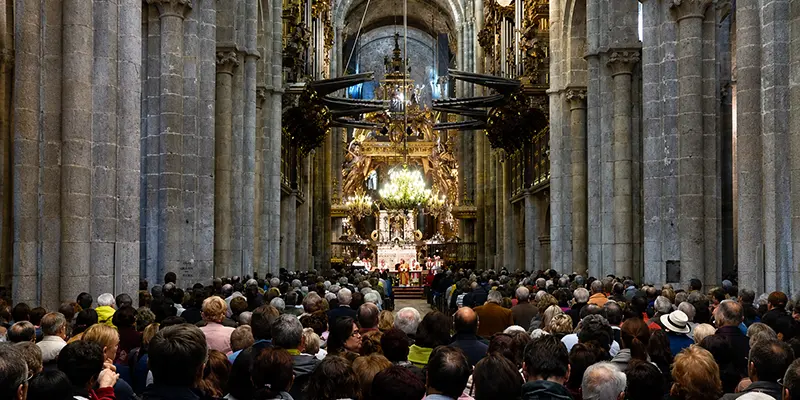
The Pilgrim's Mass at the Cathedral of Santiago de Compostela crowns the journey—the sacrament you alone can bring to your people on the Way.
The Sacraments and Prayer Along the Way
No part of a priest-led Camino matters more than the sacraments, for this is the gift no route map and no walking companion can supply. Where you can, begin the day with Mass—in a small Galician parish church, in the courtyard of a pilgrim's lodging, in whatever simple place the road provides. The Eucharist offered before the walking begins sets the day in its proper key: every mile that follows becomes an act of thanksgiving.
Make yourself generously available for Confession as well. There is something about the long, rhythmic hours of walking that loosens what people have held tightly for years; hearts open on the road that stay closed in the parish office. The Camino has been a place of reconciliation for a millennium, and your willingness to hear confessions along the Way may prove the most lasting fruit of the entire pilgrimage.
Between the sacraments, teach your people to pray the journey—a decade of the Rosary as the morning mist lifts, the Liturgy of the Hours at a rest stop, and long stretches of deliberate silence. The Camino is a patient teacher of silence, and many pilgrims meet the Lord most deeply not in words but in the quiet cadence of their own footsteps.
Arriving in Santiago—and the Camino That Begins at Home
The moment your group steps into the Praza do Obradoiro and sees the cathedral rise before them is one your pilgrims will remember for the rest of their lives. Inside, they will embrace the ancient statue of the Apostle, descend to venerate his tomb, and gather for the Pilgrim's Mass—and if grace allows, watch the great Botafumeiro swing in clouds of incense beneath the vault. After the long days on the road, the joy is unguarded and complete.
And here is the pastoral caution worth naming: the danger is to treat arrival as the destination. It is not. The Magi, having found the Child, returned to their country by a different way—and the true measure of any Camino is not the certificate collected in Santiago but the parishioner who comes home and keeps walking. Toward the confessional they had avoided. Toward the Mass they had let slip. Toward the holiness the road awakened in them. The real pilgrimage begins when ordinary life resumes.
Plan, then, for the return. A reunion in the weeks after you arrive home lets pilgrims name graces they could not yet see in the moment, and gently invites them to let the Way keep shaping their daily faith. Your shepherding does not end at the cathedral door; in many ways, that is where it begins.
A Word for the Shepherd Discerning the Way
You do not need to be a seasoned hiker or a logistics expert to lead your parish along the Camino. You need only the willingness to walk with your people toward the Apostle, to celebrate the sacraments on the road, and to help them carry their intentions to Santiago. Everything else—the planning, the reservations, the daily details—is ours to carry, and it would be our privilege to carry it for you.
Many of the priests who walk the Way with us first heard of it from a brother priest who returned changed, not merely traveled. If the Feast of Saint James has stirred something in you this year, that stirring is worth taking to prayer. The Apostle's tomb is waiting. Your people are ready to walk. And you are the shepherd called to lead them there.
Ready to walk the Way of Saint James with your parish? We would be honored to handle every detail of the road—routes, accommodations, pilgrim credencials, and the coordination in Santiago—so that you are free to shepherd. See All Upcoming Pilgrimages to explore available dates, or learn more about how to Lead Your Own Group with our dedicated support for clergy.