
Ireland Travel Guide for Catholic Pilgrims
How to Prepare for Ireland
This Ireland travel guide is written for Catholic pilgrims, and it gathers what Tekton pilgrims most often need to settle before departure: entry requirements, what the weather will actually do, what happens at Dublin Airport, money, dress, and the small practical questions that are easier to settle now than in the week you are packing.
The wise men followed a star. Not a map, not an itinerary, not a confirmed arrival time. They set out on the strength of a light they could see but could not yet explain, and the meaning of the journey only became clear at the end of it. Preparation, oddly, works the same way. You pack for a place you have not seen and a week you cannot picture.
Ireland has been sending people out on that kind of road for fifteen centuries. The Irish called it peregrinatio pro Christo — pilgrimage for the sake of Christ — and they meant it literally: monks who pushed off from these coasts in small boats with no fixed destination, trusting that they would be brought somewhere. You are going to their country. Settle the practical things now, and you arrive free to pay attention.
Already registered? Your pilgrim packet arrives two to three weeks before departure with hotel details, your final itinerary, and guidance from your Pilgrimage Manager. This guide is what you need before that packet reaches you. Our pre-pilgrimage spiritual retreat is where the interior preparation happens.
Ireland Is Not in Schengen, and That Changes Things
Ireland sits outside the Schengen Area and runs its own immigration system. For a U.S. pilgrim that is good news in one direction and a trap in another, and both are worth understanding before you book a flight.
The good news: ETIAS does not apply to Ireland. The European travel authorization that will eventually cover thirty countries — France, Italy, Spain, Poland, and the rest — does not cover Ireland, because Ireland is not in the Schengen Area. A pilgrimage that begins and ends in Ireland needs no European authorization at all. A current U.S. passport is enough.
-
Check your passport dates first
Ireland asks that your passport be valid for the duration of your stay. It does not impose the six-month rule some countries use. Even so, we advise pilgrims to travel with at least six months of validity remaining, because your airline and any connecting country may apply a stricter standard than Ireland does.
-
Check whether your itinerary crosses into Northern Ireland
Northern Ireland is part of the United Kingdom. U.S. visitors need a UK Electronic Travel Authorisation to enter it — and that applies even when you cross by road from the Republic, where there are no checkpoints of any kind. Most Tekton Ireland itineraries stay entirely within the Republic. Read yours, and if Armagh, Belfast, Derry, or the Antrim coast appear on it, apply for the ETA before you fly.
-
Check whether the trip continues into Europe
If you are adding days in Rome, Lourdes, or anywhere else in the Schengen Area on the same journey, ETIAS will apply to that leg once the system launches — before you board the flight out of Dublin, not before you board the flight into it.
-
Be ready for a conversation at the border
Irish immigration officers speak to nearly every arriving passenger. Expect to be asked how long you are staying, where you are staying, and why you have come. Say that you are on a pilgrimage with an organized group and have your itinerary reachable. It is a short and courteous exchange.
The invisible border is the one that catches people. There is no checkpoint between the Republic and Northern Ireland, no booth, no sign asking for documents. That is a political achievement, not a legal exemption. If your route enters the North for so much as an afternoon, the UK authorization is still required of you.
Irish Weather and How to Pack for It
Ireland has one of the narrowest temperature ranges of any country pilgrims travel to. Dublin's average daytime high runs from 46°F in January to 67°F in July — barely twenty degrees across the whole year. You are not packing for heat or for cold. You are packing for rain, wind, and a sky that changes four times before lunch.
| Month | Dublin | Shannon | Kerry coast | Wet days | What it feels like |
|---|---|---|---|---|---|
| January | 46° / 36° | 48° | 50° | 18 | Dark, wet, and windy. Few pilgrimages run. |
| February | 47° / 36° | 49° | 50° | 16 | Still raw, but the light begins to return. |
| March | 50° / 37° | 52° | 51° | 17 | Cool and changeable. Saint Patrick's Day fills Dublin. |
| April | 54° / 39° | 56° | 54° | 16 | The drying begins. Hedgerows green, crowds thin. |
| May | 59° / 44° | 61° | 58° | 15 | Ireland's sunniest month. Long evenings, gorse in flower. |
| June | 64° / 48° | 65° | 62° | 15 | Driest of the year and light until nearly eleven at night. |
| July | 67° / 52° | 67° | 64° | 17 | Warmest, but wetter than June. Busiest at the shrines. |
| August | 66° / 52° | 66° | 64° | 17 | Warm and showery. Knock's National Novena draws thousands. |
| September | 62° / 49° | 64° | 62° | 16 | Mild, quieter, and often lovely. A favourite month. |
| October | 56° / 45° | 58° | 58° | 17 | Cooler and wetter. Autumn colour along the lakes. |
| November | 51° / 40° | 52° | 53° | 18 | Short days and Atlantic gales on the west coast. |
| December | 47° / 37° | 49° | 51° | 19 | Wettest month. Dark by half past four. |
- Driest and brightest of the Irish year
- Mild and showery
- Wet, windy, and short on daylight
- Most comfortable months for walking
Average daytime highs in Fahrenheit, with Dublin's overnight low shown alongside. “Wet days” is the average number of days per month recording measurable rain in Dublin. Figures from Met Éireann's 1991–2020 climate averages for Dublin Airport, Shannon Airport, and Valentia Observatory in County Kerry.
The country is wetter as you go west
This matters, because most Irish pilgrimages go west. Dublin records about 30 inches of rain a year. Shannon, on the road toward Knock and Galway, records about 40. Valentia, out on the Kerry coast near the Ring of Kerry, records about 65. The national average sits near 51 inches. The same week can be grey and dry in Dublin and thoroughly wet in Connemara, and your itinerary will very likely include both.
Irish rain is also a different thing from American rain. It usually arrives as showers rather than as a storm — twenty minutes of it, then sun, then more of it. This is why nobody in Ireland cancels anything for weather, and why a forecast of rain does not mean the day is lost.
Daylight is the other thing nobody warns you about
Ireland sits far north — further north than Newfoundland. In June the light lasts until nearly eleven at night, which lengthens an evening at a shrine considerably. In December it is dark by half past four, which shortens a day just as much. Neither shows up in a temperature chart.
Dublin Airport and U.S. Preclearance
Nearly all Irish pilgrimages arrive at Dublin. The flight is short by transatlantic standards — roughly six to seven hours nonstop from the East Coast — and it usually lands early in the Irish morning after very little sleep.
On arrival
You will clear Irish immigration in person rather than at a machine. Expect a short conversation and a passport stamp. Your Tekton representative meets the group after baggage claim. Then comes the part no guide warns you about: it will be nine in the morning, you will have slept two hours, and the first day of the itinerary starts anyway. Stay upright until a normal Irish bedtime and the rest of the week sorts itself out.
On departure — the part that is genuinely unusual
Dublin and Shannon are the only airports in Europe where you clear U.S. immigration and customs before you fly, rather than after you land. You check in, pass Irish security, and then present yourself to United States border officers standing on Irish soil. Your flight then arrives in America as a domestic arrival: no immigration hall, no customs line, straight to baggage claim.
It is a real gift at the end of a long pilgrimage, and it costs you time at the front. Plan on being at the airport three hours before departure. Preclearance is in Terminal 2, and the queue is unpredictable.
What preclearance means for what you carry. You are entering the United States at Dublin, so U.S. agricultural rules apply there. Keep any food — including anything bought in the terminal — in your hand luggage so it can be declared and inspected. Bottles of holy water and blessed oils belong in checked luggage. If you buy them on the final morning, tell your Pilgrimage Manager before you pack.
General Information

- Capital city
- Dublin
- Largest city
- Dublin
- Official languages
- Irish and English
- Time zone
- 5 hours ahead of U.S. Eastern Time
- Flight time
- Roughly 6–7 hours nonstop from the U.S. East Coast
- Country code
- +353
- Emergency number
- 112 or 999 — both work
- Driving
- On the left
Will people speak English?
Everywhere. English is the everyday language of the country, and Irish — Gaeilge — is the first official language, taught in every school and spoken daily in the Gaeltacht regions of Kerry, Galway, Mayo, and Donegal. Your knowledgeable Catholic and other Christian guides speak English fluently. What may take a day or two is the accent, which changes noticeably between Dublin, Cork, and the west.
Emergency numbers
Ireland does not use 911. Dial 112 or 999 — both reach the same operator and both cover police, ambulance, fire, and coast guard. No area code, no country code, from any phone in the country including a mobile with no local SIM. Operators speak English.
You will almost certainly never need them. Your Pilgrimage Manager is with the group throughout and is the first person to find if something goes wrong. Save the number anyway, alongside your hotel address, before you leave home.
Jet lag
Five hours is the gentlest transatlantic shift Tekton pilgrims face, but it comes with a hard first morning: the overnight flight is short enough that almost nobody sleeps properly, and you land at breakfast time. Drink more water than feels necessary, get outside into the daylight, and hold out until a normal Irish bedtime. Most pilgrims are right by the second day.
Money, Cards, and Tipping
One island, two currencies
The Republic of Ireland uses the euro. Northern Ireland, part of the United Kingdom, uses pound sterling. There is no border post between them and no announcement when you cross, so pilgrims on itineraries that include the North occasionally find themselves holding the wrong money. If your pilgrimage stays in the Republic — as most Tekton itineraries do — the euro is all you will need.
Ireland is also, in practice, close to a cashless country. Cards work almost everywhere, including in small shops and rural cafes. Carry some euro for candles, votive offerings, church boxes, and small purchases at the shrines, and card the rest.
Should I buy euro before I leave?
No. Buying foreign currency from an American bank or, worse, an airport exchange counter is the most expensive way to obtain it. Those counters set their own rate well away from the market rate and add a fee on top, so you can lose a meaningful share of the value before you have left the country.
Withdraw euro from an ATM after you arrive. Two points worth knowing:
- Use an ATM attached to a bank — Bank of Ireland, AIB, Permanent TSB — rather than a standalone machine in a tourist area. The rates and fees are better.
- Always choose to be charged in euro, not dollars. When a machine or card terminal offers to bill you in U.S. dollars it is applying its own poor rate. This is called dynamic currency conversion, and declining it is free money.
Withdraw once and withdraw enough, since most cards charge a flat fee per withdrawal.
Which cards work
Visa and Mastercard are accepted nearly everywhere and contactless payment is the norm. Discover is uncommon in Ireland. American Express is accepted in hotels and larger establishments but not reliably in small shops. Before you leave:
- Notify your card issuer of your travel dates so purchases are not flagged.
- Check your foreign transaction fees — they vary considerably by card.
- Bring a second card kept somewhere separate from the first.
- Know your PIN. Chip-and-PIN is standard in Ireland and some terminals will ask for it.
What about tipping?
Gratuities for your guide and driver are customary. Tekton provides specific guidance in your pilgrim packet so the whole group works from the same expectation, and your Pilgrimage Manager will confirm arrangements before the final day. In restaurants, check the bill first — a service charge is often already included, particularly for groups.
Gaeilge, Holy Wells, and the Soft Day
Ireland is easy to travel in and easy to misread. Everyone speaks your language, the signs are in an alphabet you know, and the coffee is good, so it is easy to assume the country works the way home does. Much of what you will pass is older than it looks — place names, holy wells, and monastic sites that have been in use far longer than the roads beside them. A few things worth knowing before you arrive.
The signs are bilingual, and sometimes not
Road signs across the Republic carry Irish above English. In the Gaeltacht — the Irish-speaking districts of Kerry, Connemara, Mayo, and Donegal, which many pilgrimages pass through — the English is often gone entirely, and a place you thought you knew is signposted under a name you have never seen. Dingle is An Daingean. On a Dublin bus, An Lár simply means the city centre. None of this will strand you; your driver knows exactly where he is going. It is just one of the first signals that you are somewhere older than you thought.
Holy wells are still in use
There are thousands of them across Ireland — springs associated with a local saint, many predating the parish church beside them, most still visited. You will recognise one by the rags and ribbons tied to the tree above it, left by people asking for something or giving thanks for it. They are not folklore exhibits and they are not ruins. They are a devotional practice that never stopped, and they are among the quietest and most affecting places on an Irish itinerary.
Some carry a pattern day — the feast of the saint whose well it is, marked with Mass and a circuit of prayer. If one falls during your week, your guides will tell you, and it is worth rearranging an afternoon for.
“A soft day”
You will hear it and you should know what it means. A soft day is mild, still, and drizzling — the kind of weather an American would call miserable and an Irish person calls fine. Nothing is cancelled for it. It is a useful attitude to borrow for the week, and it explains more about Ireland than the forecast does.
The pub is the parish's front room
In much of rural Ireland the pub is where the village actually meets — families, grandparents, children in the early evening, music that is played rather than performed. An hour in one after dinner is not a detour from the pilgrimage. It is where you will meet the people whose country you have been walking through all day.
Phone, Data, and Water
Will my phone work in Ireland?
Yes, with one caveat: coverage is strong in the cities and along the main roads, and genuinely patchy in Connemara, parts of Kerry, and on the western coast road. Expect to lose signal for stretches of some of the most beautiful driving of the week. Your options:
- Carrier travel pass. Simplest. Most U.S. carriers offer a daily or monthly international plan covering Ireland. Add it before you leave.
- eSIM. Usually cheaper if you expect heavy data use. Purchase and install before departure.
- Hotel Wi-Fi. Widely available and generally reliable. Sufficient if you are content to check in once a day.
WhatsApp is widely used in Ireland and works over Wi-Fi, which makes it the simplest way to reach family at home without a data plan.
Consider using it less. The phone is useful for photographs and for a nightly word home. It is also the quickest way to be somewhere other than where you are standing. Many pilgrims decide in advance to keep it in a pocket at the holy sites — and come home glad they did.
Can I drink the tap water?
Yes. Tap water in Irish cities, towns, and hotels is treated and safe to drink. Carry a refillable bottle anyway. Irish pilgrimage days involve a great deal of walking on uneven ground, and cool damp air hides thirst rather than removing it.
Food and dietary needs
Irish hotel breakfasts are substantial and will carry you well into the afternoon. Vegetarian options are easy to find, and Irish menus label the standard allergens clearly. If you have a serious allergy or a dietary requirement, tell your Pilgrimage Manager well before departure so arrangements can be made rather than improvised.
What to Wear
Dress as you would at home, with two Irish adjustments: layers, and something properly waterproof.
Temperature is rarely the issue in Ireland. Wind and rain are. A hooded rain shell you can pull over a sweater covers most Irish days and packs down small. A heavy winter coat is usually more than you need, and you will end up carrying it. An umbrella is not much use on the west coast, where the wind gets under it.
Shoes matter more here than in most places pilgrims go. You will walk on wet grass at Glendalough, worn stone at Cashel, and gravel at Knock, and whatever you wear will get damp at some point. Bring a second pair so one can dry overnight.
For churches and shrines, knees and shoulders covered, for men and women alike. Bare midriffs are not appropriate. Women do not need a head covering and skirts are not required unless that is your preference. Jeans are fine, unless your priest has told you differently.
Electricity, Plugs, and Adapters
- Socket type
- Type G — three rectangular pins
- Voltage
- 230V, 50 Hz
- Adapter needed?
- Yes
- Converter needed?
- Only for single-voltage devices
Adapter or converter?
An adapter lets an American plug fit an Irish socket. A converter changes the voltage. Nearly all converters are also adapters; not all adapters are converters. Read the product description carefully before you buy.
Check the label on each device. If it reads INPUT: 100–240V, 50/60 Hz, it is dual-voltage and needs only an adapter. That covers most phones, tablets, laptops, and cameras. Most CPAP machines are dual-voltage as well, but confirm with your manufacturer or physician.
Single-voltage devices need a converter, or Ireland's 230 volts will destroy them — American household current is 120. Hair dryers, straighteners, curling irons, and many electric shavers and toothbrushes fall into this category. Most Irish hotels provide hair dryers; your pilgrim packet confirms the specific hotels on your departure.
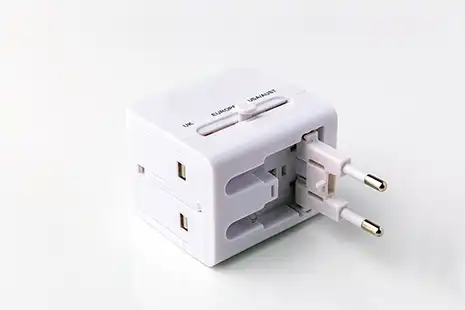
Ireland and the United Kingdom use the same plug. Type G is the British standard, so one adapter covers the Republic, Northern Ireland, England, and Scotland. It will not cover France, Italy, Spain, or anywhere else on the Continent, which use Type C or F. If your journey continues into Europe, bring a universal adapter rather than a Type G one.

Questions Pilgrims Ask
Does ETIAS apply to Ireland?
No. Ireland is not part of the Schengen Area and does not participate in ETIAS, so a pilgrimage to Ireland needs no European travel authorization. You need only a valid U.S. passport. ETIAS matters only if the same trip continues on to a Schengen country — Paris, Rome, Amsterdam — in which case you would need it before boarding that onward flight, not before flying to Dublin.
Do I need a UK travel authorization if my pilgrimage crosses into Northern Ireland?
Yes. Northern Ireland is part of the United Kingdom, and U.S. visitors need a UK Electronic Travel Authorisation to enter it — including by road from the Republic. There are no checkpoints on the land border, which is exactly why this is missed. Most Tekton Ireland itineraries stay entirely within the Republic, so it rarely applies, but check your itinerary and apply before you fly if it does.
What is U.S. preclearance at Dublin Airport?
Dublin and Shannon are the only airports in Europe where you clear U.S. immigration and customs before you fly home rather than after you land. You pass through American border officers in Dublin, then arrive in the United States as a domestic passenger and walk straight to baggage claim. Plan on being at the airport three hours before departure, and keep any food purchases in your hand luggage so they can be declared.
How should I pack for Irish weather?
Pack layers and a proper rain shell, not a heavy coat. Irish temperatures barely move: Dublin averages a daytime high of 46°F in January and 67°F in July. Rain is the real variable, and it falls in showers rather than downpours — Dublin records rain on roughly 16 days in a typical month, the Kerry coast on closer to 20. A hooded waterproof jacket beats an umbrella, because the wind will take the umbrella.
Does Ireland use the euro or the pound?
The Republic of Ireland uses the euro. Northern Ireland, being part of the United Kingdom, uses pound sterling. If your pilgrimage stays in the Republic — as most do — the euro is all you need. Withdraw it from a bank ATM after you arrive rather than buying it at home, and always decline when a machine or card terminal offers to bill you in U.S. dollars.
Will my cell phone work in Ireland?
Yes. Coverage is good across the country, though it thins in Connemara, parts of Kerry, and along the western coast road. Most U.S. carriers offer an international day pass or travel plan covering Ireland, and an eSIM bought before departure is usually cheaper for heavy data use. Hotel Wi-Fi is widely available. Ireland's country code is +353.
Can I drink the tap water in Ireland?
Yes. Tap water in Irish cities, towns, and hotels is treated and safe to drink. Carry a refillable bottle anyway — pilgrimage days in Ireland involve more walking on uneven ground than the mild temperatures suggest, and cool damp air hides thirst rather than removing it.
What kind of electrical adapter do I need for Ireland?
Ireland uses Type G sockets — the three rectangular pins used across the United Kingdom — at 230 volts, 50 Hz. American plugs will not fit, so you need a plug adapter. You need a voltage converter only for single-voltage devices. Phones, tablets, laptops, cameras, and most CPAP machines are dual-voltage and need only the adapter. Hair dryers, straighteners, and curling irons usually are not.
Next Steps
Return Changed, Not Just Traveled
For thirty years Tekton has walked with pilgrims through the island that sent saints out across Europe and never stopped praying at its own wells. Everything on this page exists so that when you arrive, the practical things are already settled and you are free to be present.