

Tekton Ministries
Publish Date: March 25, 2026
A homily at your home parish draws on Scripture, tradition, and your knowledge of your people. A homily in the Holy Land draws on all of that—plus the ground beneath your feet. When you preach at the Sea of Galilee, the very landscape becomes part of the proclamation. The wind your pilgrims feel is the wind the apostles felt. The stones they touch held the weight of Christ. Holy Land homily preparation, done well, transforms a site visit into a sacred encounter.
But this also means your usual approach to homily preparation won't quite suffice. The temptation is to deliver a mini-lecture on archaeology or history—information your local guide will handle far better than you. Your pilgrims don't need another voice explaining the dimensions of the tomb. They need their pastor to help them hear what Christ is saying to them, right now, in this place.
What follows is a practical framework for preparing homilies that honor both the sacred site and the souls standing before you. If you've been searching for pilgrimage homily ideas, you won't find pre-written scripts here—you'll find something better: an approach that helps you craft homilies only you can give. Whether this is your first pilgrimage or your fifth, this Scripture-to-site approach will help you preach with the depth and immediacy the Holy Land demands.
The Unique Challenge of Preaching in the Holy Land
In your parish, the Mass readings are assigned. In the Holy Land, you often have the freedom to select readings that correspond to each site. This is both a gift and a responsibility. You are curating the Word of God for a particular place, a particular group of pilgrims, at a particular moment in their spiritual journey.
This freedom changes your preparation. Rather than beginning with the Lectionary and asking, "What does this text say?", you begin with the site and ask a different question: "What does Christ want my people to receive here?" The answer lives at the intersection of three things—the Scripture connected to the place, the reality of the site itself, and the hearts of the pilgrims you know and love.
This is also why pilgrimage homilies cannot be borrowed from a book or downloaded from a website. Another priest's homily at the Mount of Beatitudes was prepared for his people. Yours must be prepared for yours.
A Three-Step Framework for Site-Based Homilies
The following approach works across every major Holy Land site. Begin your preparation weeks before departure, but leave room for the Spirit to refine your words once you're standing on sacred ground.
Step One: Inhabit the Text. Select the Gospel passage most closely tied to the site. Read it slowly, repeatedly, and in multiple translations. Pay attention to the sensory details the evangelist includes—geography, weather, time of day, the posture of Jesus, the reactions of those around Him. These are the details that will come alive when you and your pilgrims are physically present at the site. The Gospels of Mark and John are especially rich in this regard, offering vivid geographical and emotional texture.
Step Two: Let the Place Speak. Research what your pilgrims will actually experience at the site. Will you be in a small chapel or an open hillside? Will there be crowds pressing in or quiet solitude? Will your pilgrims have just climbed a steep path or stepped off an air-conditioned bus? These physical realities shape how your homily will land. A reflective, contemplative homily works beautifully at the Sea of Galilee at dawn. It may be lost entirely in the echoing bustle of the Church of the Holy Sepulchre at midday.
Step Three: Bridge to Your Pilgrims' Lives. This is where your pastoral knowledge becomes irreplaceable. You know the widow in your group who is traveling for the first time since her husband's death. You know the young couple discerning a major life change. You know the retired teacher who has dreamed of this trip for decades. Without naming anyone from the pulpit, let your awareness of these stories shape your preaching. The homily at Cana means something different when you know three couples in your group are struggling in their marriages. The homily at Gethsemane carries particular weight when you know someone is facing a diagnosis they haven't shared publicly.
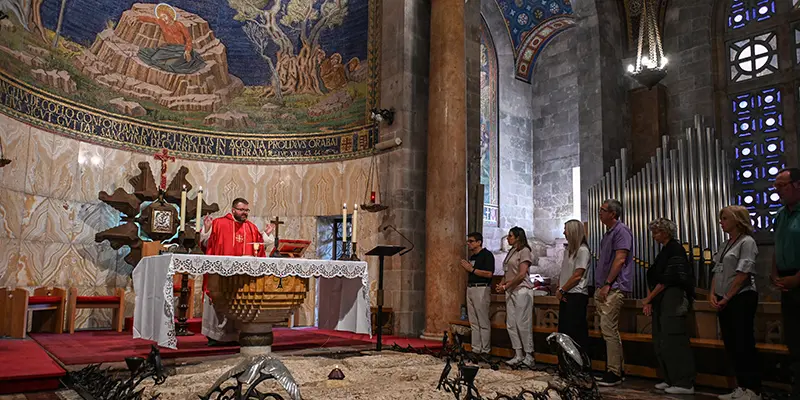
Father M. celebrates holy Mass in the Church of All Nations
Scripture-to-Site Pairings for Key Holy Land Locations
While your reading selections will ultimately depend on your pilgrims and the rhythm of your itinerary, the following pairings offer strong starting points for the sites where you will most likely celebrate Mass.
The Church of the Annunciation, Nazareth — Luke 1:26–38. This is a homily about saying yes without knowing the full cost. Mary's fiat did not come with a detailed itinerary. Invite your pilgrims to consider what God may be asking of them that requires the same trust—especially now, at the beginning of their pilgrimage, when they are still learning to surrender their expectations and become true pilgrims rather than tourists.
The Mount of Beatitudes — Matthew 5:1–12. The hillside overlooking the Sea of Galilee is one of the most peaceful settings in the Holy Land. Let the landscape do much of the work. A shorter, more contemplative homily serves well here. Focus on one or two Beatitudes rather than all eight, and connect them to the specific circumstances your pilgrims carry.
The Church of the Multiplication, Tabgha — John 6:1–14 or Luke 9:10–17. The miracle of the loaves and fishes is ultimately about trusting God with inadequacy. The boy's lunch was laughably insufficient—until it was placed in Christ's hands. This is a natural moment to speak to priests and laypeople alike about offering what little they have and trusting God to multiply it.
The Garden of Gethsemane — Luke 22:39–46 or Mark 14:32–42. The ancient olive trees still standing in this garden create an atmosphere of profound solemnity. This is often the site where pilgrims feel the Passion most personally. A homily here might explore the prayer Jesus modeled—honest, anguished, and ultimately surrendered. Encourage your pilgrims to bring their own suffering to this place and leave it in the hands of the One who sweat blood rather than abandon them.
The Church of the Holy Sepulchre — John 19:38–42 and John 20:1–18. If you have the privilege of celebrating Mass at the Holy Sepulchre, you are standing at the axis of human history. The challenge here is not finding something profound to say—it is resisting the urge to say too much. Let the place speak. A brief, focused homily on the reality of the Resurrection, grounded in the empty tomb just feet away, can be more powerful than any extended reflection.
Cana — John 2:1–11. The site of Christ's first miracle offers rich homiletic ground for marriage, for intercession (Mary's role), and for the transformation of ordinary life into something extraordinary. If married couples in your group wish to renew their vows at Cana, your homily can speak directly to the grace of fidelity and the ongoing miracle of sacramental marriage.
Practical Wisdom for Pilgrimage Preaching
Even well-prepared homilies can fall flat in the Holy Land if you don't account for the realities of pilgrimage preaching. A few practical considerations will serve you well.
Keep it short. Five to eight minutes is ideal for most pilgrimage homilies. Your people are absorbing an enormous amount—new sights, powerful emotions, physical fatigue. A concise, focused homily that gives them one clear invitation will stay with them far longer than a twenty-minute reflection they cannot absorb.
Use the senses. Point to what your pilgrims can see, hear, touch, and smell. "Look at the lake in front of you—this is what Peter saw when he stepped out of the boat." This kind of immediacy is unavailable to you at home. Use it. The physical environment is your co-preacher.
Prepare in advance, preach in the moment. Write your homilies before you leave home, but hold them loosely. Something will happen on the pilgrimage—a conversation on the bus, a pilgrim's tears at an unexpected site, a moment of shared laughter—that will offer you the perfect illustration or invitation. The best pilgrimage homilies are prepared carefully and then adapted freely.
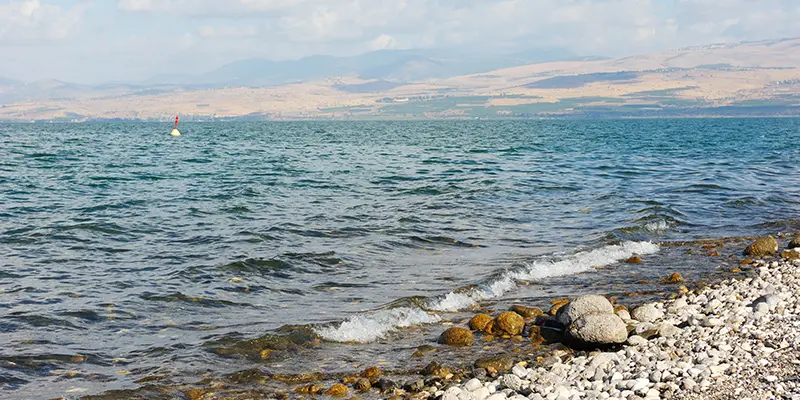
Shore on the Sea of Galilee
Don't compete with the guide. Your local guide will offer expert commentary on history, archaeology, and culture. Your homily should not repeat that information. Instead, do what only you can do: connect this place to the living faith of your community. The guide explains what happened here two thousand years ago. You help your pilgrims understand what Christ is doing here right now.
Build a narrative arc across the trip. Your individual homilies will be more powerful if they connect to one another. Consider threading a single theme through the entire pilgrimage—perhaps discipleship, surrender, or encounter. Each site then becomes a chapter in a larger story your pilgrims are living together. By the final Mass, you can draw the threads together and invite your pilgrims to consider how they will carry this story home.
The Homily That Follows Them Home
The most important homily of the pilgrimage may be the last one. As you celebrate a final Mass—perhaps at the Church of the Nativity in Bethlehem or in a quiet chapel overlooking Jerusalem—your pilgrims are already beginning to wonder how this experience will survive reentry into ordinary life. The demands of work, family, and routine have a way of eroding even the most powerful spiritual experiences.
This is where your closing homily can do its most lasting work. Remind your pilgrims that the goal was never simply to visit these sites but to be changed by them. Like the Magi who encountered the Christ Child and returned home by a different way, your pilgrims are called to carry the graces of the Holy Land into the kitchens, offices, and parishes where their real discipleship unfolds. The seeds planted at the Sea of Galilee and watered at Calvary must bear fruit in the soil of daily life.
Your homilies in the Holy Land will not be your most polished. They may not be your most eloquent. But they will be among the most fruitful words you ever speak as a priest—because you will be preaching on the very ground where the Word became flesh, to people whose hearts are wide open to receive Him.
Ready to begin preparing your parish pilgrimage? We would be honored to help you plan a Holy Land experience that gives you time and space to preach, celebrate the sacraments, and shepherd your people through the land of the Gospels. See All Upcoming Pilgrimages to explore available dates, or learn more about how to Lead Your Own Group with our dedicated support for clergy.