


Tekton Ministries
Publish Date: August 11, 2026
As the Solemnity of the Assumption draws near each August, something stirs in Catholic hearts. We turn instinctively toward our Blessed Mother—and many priests begin to wonder whether the time has come to lead a Marian pilgrimage of their own. To bring a parish to Lourdes, to Fatima, to the great shrines where Our Lady has drawn near to her children, is among the most fruitful undertakings in all of pastoral ministry. But leading such a pilgrimage is not the same as making one.
A Marian shrine is not a monument to be admired; it is a meeting place. At Lourdes, Our Lady revealed herself to a poor, asthmatic girl named Bernadette Soubirous as the Immaculate Conception—confirming in a muddy grotto what Pope Pius IX had defined as dogma only four years earlier. At Fatima, she asked three shepherd children for prayer, penance, and the daily Rosary. These are not stops on a checklist. They are thresholds where heaven has bent close to earth, and the priest who leads souls across them carries a charge no itinerary can hold.
The work of these pages is to help with that charge. Whether a first Marian pilgrimage is still only a prayer in the back of a priest's mind, or whether he has shepherded several groups already, what follows is meant to serve the one who will stand before the grotto or the Capelinha as shepherd, not merely as visitor—and to help every pilgrim entrusted to him arrive as a pilgrim rather than a tourist.
What It Means to Lead a Marian Pilgrimage
Every Marian shrine obeys a single instinct: Mary always points away from herself and toward her Son. "Do whatever he tells you" (John 2:5) is the whole grammar of these places. Bernadette was sent to do penance and pray for sinners; the children of Fatima were given the Rosary and a call to conversion. To lead a Marian pilgrimage, then, is not to manage a devotional sightseeing route but to walk with souls along the road Our Lady herself walks—the road to Christ.
This is why the priest's presence changes everything. A knowledgeable guide can explain the architecture of the Rosary Basilica or the history of the apparitions; only the priest brings the Eucharist, absolution in the confessional, and the homily shaped for the very people in front of him. He knows the widow carrying her grief to the grotto and the father quietly commending a wayward son to Our Lady's care. The shrine supplies the place; the shepherd supplies the pastoral relationship in which grace can take root in prepared soil.
It also reframes the central task. A tourist looks for souvenirs; a pilgrim looks for seeds of grace. Much of a priest's work, long before the plane departs, is to help his people make that interior shift—to come not to collect photographs of Lourdes and Fatima but to be changed by them. We explore that distinction more fully in our reflection on preparing the heart for pilgrimage, and it is worth returning to as the foundation of everything else.
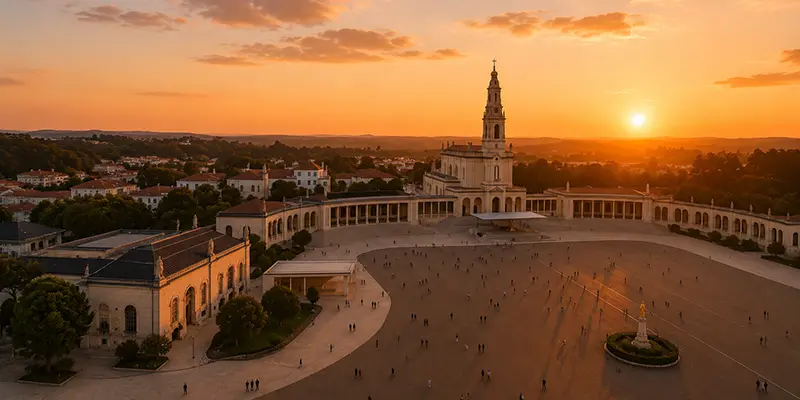
At Fatima, Our Lady's call was simple and severe: prayer, penance, and the daily Rosary. The candlelight procession gathers that call into a single moving prayer.
Knowing the Shrines: Lourdes, Fatima, and Beyond
Before a priest can shepherd his people through a shrine, he must know its particular character. The Marian shrines are not interchangeable. Each has its own message, its own rhythm, and its own pastoral demands.
Lourdes is a place of healing and of the poor. The Sanctuary spreads across more than a hundred acres at the foot of the Pyrenees, gathering the Grotto of Massabielle, three great basilicas, and the spring Bernadette uncovered at Our Lady's request. Pilgrims come to drink and wash in the water, to light candles among the Chapels of Light, and to walk in the Eucharistic and torchlight Marian processions that mark each day. It is crowded, tender, and unhurried with the sick. Because so much there centers on illness and frailty, a priest does well to read our companion reflection on leading a parish to Lourdes before he goes.
Fatima asks for a different posture. After the grandeur of Rome or the antiquity of the Holy Land, the Cova da Iria can feel almost too plain—a wide esplanade, a humble chapel marking the apparitions, the basilica where Saints Francisco and Jacinta Marto are now entombed. The transformation at Fatima does not depend on spectacle. It rises from what Our Lady asked in 1917: prayer, penance, the Rosary, and reparation. Pilgrims who arrive expecting drama often leave puzzled; those who arrive ready to pray come home changed. We say more about leading souls through this quieter shrine in shepherding souls at Fatima.
More than the sum of its sites. A multi-shrine Marian pilgrimage is not a sampler of holy places to be collected one after another. Wherever Our Lady has drawn near, her message converges on the same few things: conversion, prayer, the Rosary, and a return to the sacraments. A priest who grasps that unity can lead his people through several shrines as one unfolding catechesis rather than a string of stops, letting each place deepen what the last began. When we plan a Lourdes and Fatima pilgrimage for a parish group, we shape the route around that interior arc—so that the group is carried, by stages, toward the Son to whom Mary always points.
A word on Medjugorje. Priests are increasingly asked about it, and the distinction matters pastorally. In September 2024, the Dicastery for the Doctrine of the Faith granted a nihil obstat to the spiritual experience connected with Medjugorje, authorizing public devotion and pilgrimage while declining to declare the alleged apparitions supernatural. The faithful may go freely, the Church teaches, to encounter Mary, Queen of Peace—not to seek out the visionaries. We unpack what this means for priests in our explanation of the Vatican's decision on Medjugorje.
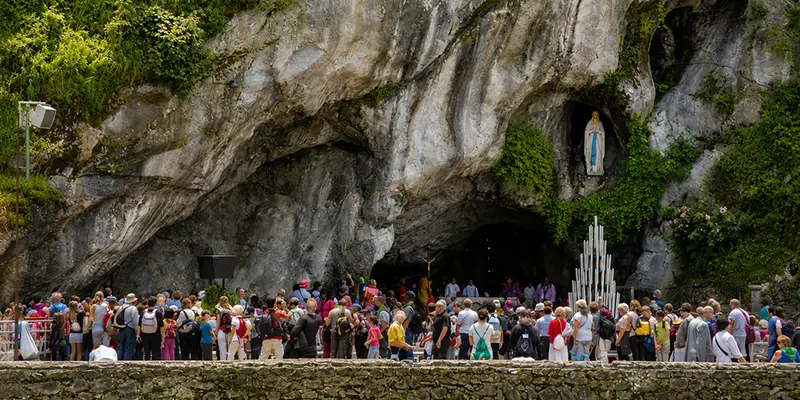
Pilgrims gather in prayer before the Grotto of Massabielle, where Our Lady appeared to Saint Bernadette and named herself the Immaculate Conception.
Forming Pilgrims Before You Depart
A Marian pilgrimage is only as fruitful as the interior groundwork laid before departure. The most memorable graces rarely happen by accident; they are prepared for. Offering a few formation gatherings in the weeks before the trip—four to six is a reasonable rhythm—lets pilgrims pack their intentions, not only their suitcases.
Teach the apparitions honestly. Walk the group through what actually happened at Lourdes and Fatima, and through the Church's careful process of approval. Helping pilgrims understand why the Church approved these apparitions—and what it means that she has not pronounced on others in the same way—forms mature devotion rather than credulity. It also prepares them to receive each shrine on its own terms.
Set expectations of simplicity. Pilgrims conditioned by travel advertising may expect grandeur and ease. Fatima's esplanade is austere; Lourdes is crowded and often damp; coach days between shrines are long. Naming this in advance turns potential disappointment into something more valuable. The pilgrim who understands that hardship is part of the gift—that a long line or an aching back can be offered rather than merely endured—is already praying before the journey begins.
Put the Rosary at the center. Both Lourdes and Fatima are, at heart, schools of the Rosary. A group that has prayed it together at home will pray it differently on the esplanade at night, candle in hand, among tens of thousands of voices in a dozen languages. Begin that habit early, and the great processions will feel less like a performance to watch and more like a prayer the group already knows by heart.
Celebrating the Sacraments at the Shrines
No part of a priest-led Marian pilgrimage matters more than the sacraments. This is the gift no travel company can supply, and it is worth protecting fiercely against a crowded schedule.
Daily Mass. Both sanctuaries assign Mass times and locations to registered groups, and the most sought-after settings fill quickly. At Lourdes, requests now run through the Sanctuary's pilgrimage office and its booking platform; a Mass celebrated at the Grotto before the day's crowds arrive is among the experiences pilgrims never forget. At Fatima, groups may be assigned the Chapel of the Apparitions or one of the basilicas. This is precisely the kind of detail we handle as your pilgrimage partner—securing reservations well in advance—so that pastoral attention stays where it belongs, on the people and the prayer.
Confession. Conversion is the recurring fruit of these shrines, and the Sacrament of Reconciliation should never be far away. Make yourself generously available; pilgrims who have carried something for years often find, in the shadow of the grotto or on the Cova, that they are finally ready to lay it down.
Anointing of the Sick. Lourdes especially draws the ill and the elderly, and the Anointing of the Sick can become a profound grace within the pilgrimage. Identify in advance which pilgrims may benefit, and choose a fitting moment and setting for the sacrament.
The processions. The Eucharistic procession and the evening torchlight Rosary at Lourdes, and the candlelight Rosary procession at Fatima from May through October, are not entertainment. Frame them for your pilgrims as corporate acts of worship—the whole Church on the move toward Christ through Mary—and encourage them to enter in rather than photograph from the edges.
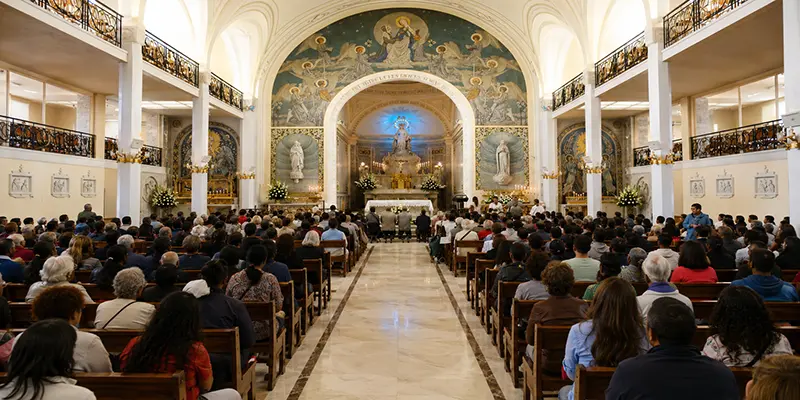
Celebrating the Eucharist at a Marian shrine is the gift only the priest can bring—the heart of every pilgrimage Mary points toward her Son.
Pastoral Care Across Borders
A multi-shrine Marian pilgrimage carries a pastoral intensity that single-site trips do not. Crossing borders between Portugal, Spain, and France means long coach days, unfamiliar languages, time changes, and the ordinary fatigue that wears on a group after the first week. For eight to twelve days, the priest is available to his people in a way parish life rarely allows—and that nearness is both the gift and the cost.
Expect the full range of responses. Some pilgrims will weep at the grotto; others will feel nothing and need reassurance that God works even when feelings are absent. The sick and the elderly, drawn especially to these shrines, may need a gentler pace and the freedom to rest while the group climbs. And friction will surface, as it always does when people share close quarters and constant togetherness. None of this is a failure of the pilgrimage; it is the pilgrimage. The discomfort, met prayerfully, becomes part of the offering. We say more about shepherding that friction in our reflection on managing group dynamics on a pilgrimage.
This is where the partnership between priest and pilgrimage company earns its worth. While we carry the logistics—the transfers, the hotels, the border crossings, the Mass reservations—the priest is freed to do what only he can do: to pray, to preach, to absolve, and to accompany. The clearer that division of labor, the more fully a shepherd can give himself to his flock.
Helping the Graces Take Root at Home
The Magi, having found the Christ Child, returned to their country by a different way. That is the true measure of any Marian pilgrimage—not the sites checked off, but the changed life that follows. The graces of the grotto and the Cova can dissipate quickly if pilgrims return to ordinary routines without support, so the wise shepherd plans for the homecoming as carefully as the departure.
A reunion gathering four to six weeks after returning lets pilgrims name what they are only beginning to understand. Pointing them toward the Rosary, toward Marian devotion in the parish, and toward the next step in their conversion keeps the fire from going out. And the priest must not neglect his own integration; leading a pilgrimage is spiritually demanding, and the shepherd who has poured himself out for his people deserves the rest and direction that let the graces settle in his own soul.
The fruits, in our experience, are abundant and lasting: the parishioner who finally forgives at the grotto, the marriage rekindled, the young person who first senses a vocation kneeling on the Cova. Our Lady draws her children near so that she can hand them to her Son. To lead a parish into her presence, and to walk them home again changed, is Marian devotion at its most pastoral—and among the most enduring gifts a priest can give the souls entrusted to him.
Considering leading your parish to the shrines of Our Lady? We would be honored to walk alongside you—handling the logistics, ticketing, and on-the-ground coordination so your attention can stay on the spiritual journey. See All Upcoming Pilgrimages to explore Marian destinations and dates, or learn how to Lead Your Own Group with our dedicated support for clergy.