

Shepherding Through Changed Plans
Pilgrimage contingency planning starts with posture. Help your parish meet delays and closed doors as pilgrims, not tourists, and return home changed.
Something will go wrong. We tell nearly every group that before they leave, and it's still the piece of pilgrimage contingency planning that gets the least attention, probably because it's the one piece nobody can put on a spreadsheet. A connection gets missed. The church promised for Tuesday morning is closed for a funeral. The wind comes up and the boat on the Sea of Galilee doesn't go out. We do a great deal of the practical work behind those moments on your behalf, and we're good at it. But the practical work only goes so far. Whether a disruption becomes a wound or a grace gets decided earlier, usually before anyone packs.
Three hours on a tarmac does something to a group. We've watched it for thirty years and we still don't describe it very well. The same delay that sours one person for two days is, for the person in the next seat, the afternoon they finally got quiet enough to pray. Temperament explains less than you'd expect. What people believed they were doing when they left home has more.
Where the Trouble Usually Starts
Most people arrive carrying some other kind of trip in their heads. It's common to find someone who's expecting, more or less, a vacation with daily Mass added, and that's not a shameful thing to want. Rest is commanded. It's just that a vacation is supposed to be easy, and this often isn't, so the first hard day lands on that person as a loss, something that wasn't what they paid for. The one with the list is different. For him each day is worth what got checked off, and a closed basilica is a hole in the collection. You'll hear about it on the bus.
The one we'd ask you to watch for is quieter than either of those, and harder to spot, because it looks like devotion. A fair number of parishioners, and more than a few priests, arrive in the Holy Land or Rome hoping for a retreat. Silence, a steady schedule, the same chapel each morning. That's a good desire and we wouldn't talk anyone out of it. But a retreat moves away from the world into a protected quiet, and a pilgrimage moves through the world toward a place, with the noise and the bus and the other forty people that implies. Nobody travels to Fatima for the hotel room. So when the week turns loud, this person feels robbed, and the feeling is harder to answer than ordinary complaint because it presents itself as seriousness about God. Sometimes it is.
Which may be why priests tend to go easier on it than they should. We've noticed that for years and we're not sure we've got the reason right. It could be that it's the temptation closest to their own. It could just be that quiet complaint is harder to confront than loud. We'd lean toward the first explanation, but not with much confidence.
The pilgrim, when you get one, cares about the plan too. He wanted that Mass at that altar as much as anyone did. He just never thought the plan was the point.
People Who Didn't End Up Where They Planned
The Church has always talked about the Christian life as a journey. The Letter to the Hebrews says we have no lasting city here (Hebrews 13:14). A pilgrimage makes that physical for ten days or so, and physical things change. Roads do. Weather does.
Scripture has a lot of people in it who didn't end up where they meant to go. The Holy Family went to Bethlehem for a census and left for Egypt in the night (Matthew 2:13–15). Paul tried to preach in Asia and wasn't allowed, tried Bithynia and was stopped again, and only then had the vision at Troas that sent him to Macedonia (Acts 16:6–10). The detour is where it happened. The Magi are the plainest case. They were warned in a dream and went home another way, and the Church has never read that as a matter of geography.
This is the practical reason posture matters more than planning. The person who came to rest and the person who came with a list have no place to put a loss except complaint. The would-be retreatant has a place, but it was built for stillness. The pilgrim expected to be moved around. So a long line, a missed lunch, a hot afternoon on a bus can be offered up as small penances, and they seem to do more good than the ones people choose for themselves. We can't prove that. It matches what we've seen.
Pilgrimage Contingency Planning Before Departure
The useful work on this happens in the formation room, months out, and most of it is just talking. Name the different ways people travel, without making any of them the villain. Most of us have been all of them in the same week. It's common for someone to laugh and admit which way they lean, and that admission usually does more than a talk would.
And then say the plain thing, that something on this pilgrimage won't go as planned and nobody knows yet what. Hope asks and trusts. Expectation demands and resents, and the gap between them is mostly entitlement, which is worth saying out loud in a parish hall. Ask people to bring three to five actual intentions instead of a list of photographs they want. Tell them that the first thing to go wrong is roughly where the pilgrimage starts. People who've heard that in advance respond differently when it happens. Not all of them.
Every registered Tekton pilgrim has access to A Pilgrim Heart, our seven-session preparation retreat, which covers this ground. Pair it with your own sessions and with our reflection on how to prepare for a Catholic pilgrimage, and the group lands with a shared vocabulary for the bad days. That's pilgrimage contingency planning too. Probably the main kind.
What's Yours to Do
When something breaks you shouldn't be the one on the phone with the airline. Rebooking, finding a new Mass time, rerouting the bus, fixing the hotel: that's your Pilgrimage Manager and our local team, and they do it every week. Let them. Your people need you for the handful of things nobody else on the bus can do.
Tell the group what happened, soon and without drama. Rumor fills a bus fast. Priests often notice that people settle the moment the facts are said plainly, even when the facts are bad.
Then, at some point, give it a meaning. One sentence recalling the formation conversation can turn a busload of disappointed travelers back toward being pilgrims. Not a homily. But there's a risk in doing this too fast, because meaning offered in the first ten minutes can sound like spin, and people can tell. We don't know the right interval. Sometimes it's an hour and sometimes it's the next morning at breakfast, and we haven't found a rule that tells you which.
Pray right then. A decade of the Rosary at the gate, a psalm in the lobby. Praying in the moment teaches more than anything said about it afterward, though we couldn't tell you exactly why.
And watch yourself, because they'll read your face before they hear you. The priest's own temptation here is usually the retreatant's. You may have wanted that quiet dawn Mass more than anyone on the bus. If you take the change as an offering, most of them will follow. If you don't, some of them will manage it anyway.
Harder is the one or two who won't come around at all, who spend the rest of the week keeping score. We don't have a good answer for them. Some pastors take them aside early. Some leave them alone and let the group's mood do the work. We've seen both help and both fail, and we can't tell you in advance which it'll be.
The Things That Keep Happening
A few situations come up often enough to be worth naming, though we're wary of lists here. They're not equally hard.
The closed church is the one we'd prepare you for most. Sacred sites are living places of worship, and a funeral, a feast day, or scaffolding will take precedence over a busload of Americans without anyone apologizing for it. We'll substitute when we can, and often we can. But sometimes you're standing outside a locked door at ten in the morning with nowhere to go for an hour. That turns out to be a surprisingly good place to talk about longing. About the people in your own parish who stand outside the Church's doors for reasons of their own, and about how a locked door feels from the outside. Some of them are on the bus with you. The conversation tends to go somewhere. We're still not sure it would go there if the door had been open.
Illness is the other one worth real thought. Someone gets sick, often somewhere in the middle of the week, and spends a day or two in a hotel room while the group goes to the places they came for. Our team handles the doctor and the logistics. Your part is presence: a visit, a blessing, the Anointing of the Sick if it's called for. What that person needs to hear from their pastor is that they haven't dropped out of the pilgrimage. They're making a harder one than anyone else on the bus. Whether they believe you is another matter.
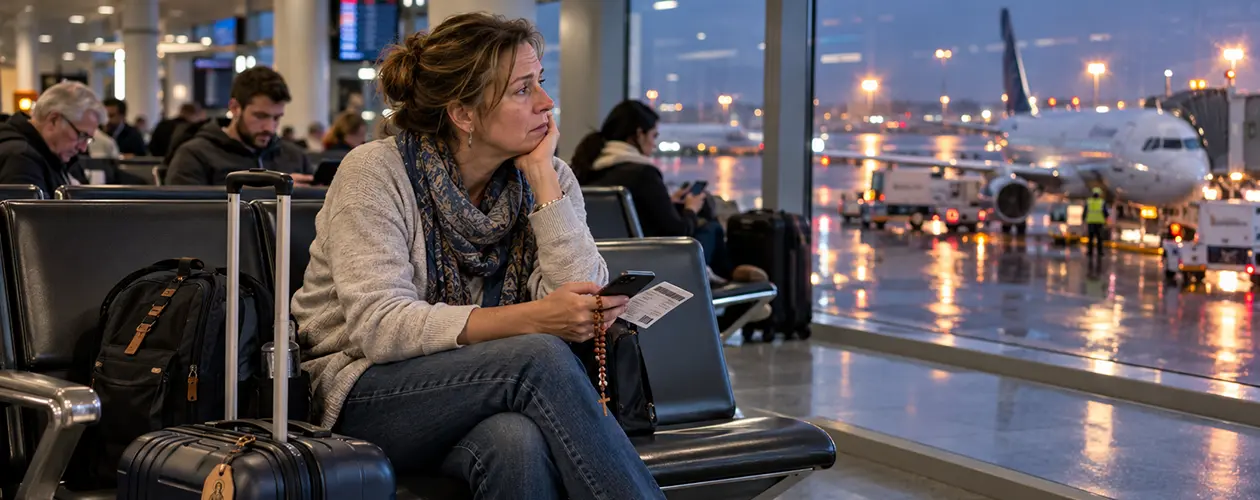
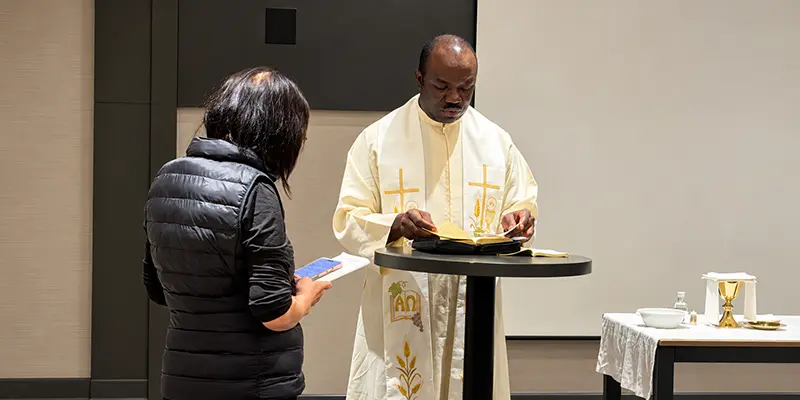
The rest are smaller. A missed connection is mostly hours in an airport, which feel wasted to the list-keeper and are, for a pilgrim, a rare unscheduled stretch with the group. Airports are hard on everyone. Still, some of the better faith conversations seem to happen at gates, and praying the Liturgy of the Hours aloud with whoever's willing is one use of the time. A Mass that gets moved is still a Mass. Keep the homily; the Gospel you prepared for Capernaum may land harder in a hotel conference room at nine at night. A lost suitcase tests detachment faster than almost anything, and the person who finishes the week in borrowed clothes usually comes home with a story about how little they needed. Usually. For the deeper struggles these things stir up, see our reflection on what to say when pilgrims struggle.
Going Home by Another Road
SCRIPTURE“And having been warned in a dream not to return to Herod, they departed for their country by another way.”MATTHEW 2:12
Ask a group at their reunion what they remember and it's the disruptions. A Mass on a hotel terrace. A night in an airport when somebody unexpected led the Rosary. The changed plan becomes the story, as far as we can tell because it was the moment people stopped consuming the week and started receiving it. We don't fully understand why that's what sticks. It does, though.
That's the fruit worth watching for afterward, and it's quieter than people expect. A tourist comes home with photographs. A pilgrim comes home a little more patient in traffic, slower to complain, more willing to let God rewrite an ordinary Tuesday. If your people learn on the road that an interrupted plan can be an invitation, they'll carry it into marriages and jobs and illness and grief. They'll have gone home by a different way. Whether it lasts is a separate question, and one we're still learning how to ask.
Ready to lead your people as pilgrims? We handle the logistics, including the ones nobody sees coming, so you can be present as their shepherd. Learn how to Lead Your Own Group, or See All Upcoming Pilgrimages to find a date for your parish.
Know someone who is discerning a pilgrimage? Pass this along.