

Renewal, Not Repeat
A Jordan River baptism on pilgrimage is a renewal, not a repeat. How priests lead the rite at the water so pilgrims return changed, not just traveled.

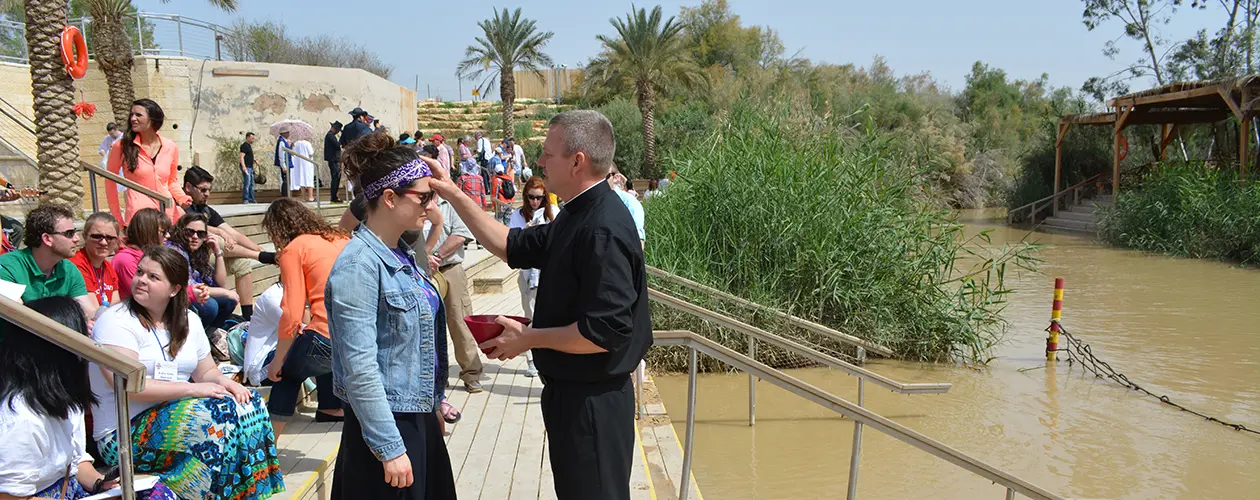
Somebody on your pilgrimage is going to ask you to baptize them in the Jordan. Ask any priest who has led a Holy Land group; it comes up nearly every time. Sometimes it is a convert who was received at an Easter Vigil in a parish hall and has always felt a little cheated. Sometimes it is a lifelong Catholic who simply wants the water on her skin. The answer is no, and the better answer is that the Church has something more honest to give her here than a second baptism. A Jordan River baptism on pilgrimage is a renewal, not a repeat, and leading that renewal well is one of the most pastoral things you will do all week.
Priests who have done it twenty times and priests standing in the Jordan for the first time tend to say the same thing afterward: the rite is short, and everything that makes it land happens before anyone reaches the water. So this is about where the rite happens, how to prepare your people for it, and how to lead it so the water does what it is supposed to do.
Why It Is a Renewal and Not a Baptism
Start with the theology, because your pilgrims will ask and because it shapes everything else. Baptism seals the Christian with an indelible mark; given once for all, it cannot be repeated (Catechism, 1272). Whatever happened at the parish font happened. Nothing the Jordan can do adds to it, and the pilgrim who wants it "done properly this time" needs to hear, gently, that it was done properly the first time.
What the Church gives instead is the renewal of baptismal promises, the same rite she places at the heart of the Easter Vigil, followed by the sprinkling of water. It is a real liturgical act, not a photo opportunity, and it lands differently at the Jordan than it does in April. People who have murmured "I do" at the Vigil for forty years find that the renunciation of Satan comes out of them with some force when they are standing in the river where Christ stood. That is the thing to protect.
The Catechism also says that Baptism is prefigured in the crossing of the Jordan (1222). Israel passed through this water into the land it had been promised. Christ went down into this water and the heavens were opened. Your pilgrims are stepping into the place where those two stories meet, and they will understand that better if you tell them before the bus stops.
SCRIPTURE“It happened in those days that Jesus came from Nazareth of Galilee and was baptized in the Jordan by John. On coming up out of the water he saw the heavens being torn open and the Spirit, like a dove, descending upon him. And a voice came from the heavens, ‘You are my beloved Son; with you I am well pleased.’”MARK 1:9–11
Where the Jordan River Baptism Site Is, and Where Your Group Will Stand
There are three places people mean when they say "the baptism site," and it helps to know the difference.
The traditional site is near Jericho, where the Jordan runs its last few miles toward the Dead Sea. On the eastern bank, in the Kingdom of Jordan, is Bethany Beyond the Jordan, the place John's Gospel names as the spot where John was baptizing (John 1:28); UNESCO inscribed it as a World Heritage site in 2015. Directly across the water, on the West Bank, is Qasr el Yahud. That stretch of river was a closed military zone after 1967. The mines around the old churches were cleared by 2020, the Franciscans of the Custody of the Holy Land regained their Chapel of St. John the Baptist that autumn, and the first Mass there in more than fifty years was offered on the feast of the Baptism of the Lord in January 2021. A large renovation of the pilgrim area, with a wider deck, changing rooms, and a covered prayer space, opened in the summer of 2026.
Yardenit is the third place, at the southern tip of the Sea of Galilee where the river leaves the lake. It is not the traditional site of the Lord's baptism. It was developed while the Jericho site was closed, and it is well set up for groups, with changing rooms, robes, and easy access down into the water. It is the stop on our standard Holy Land itinerary, because it sits an easy drive from the Galilee days, and because the water is the same river.
Which site your group visits depends on the route, the season, and conditions near Jericho, which change. Your Pilgrimage Manager and our ground team settle that; your job is the rite. Just tell your pilgrims plainly which bank they will be standing on.
Preparing Pilgrims for a Baptismal Renewal in the Holy Land
The renewal is only as deep as the preparation laid down months earlier, and the Jordan rewards it more than almost any site on the itinerary. If you are running formation sessions before departure, give the river one of them.
Have every pilgrim find out the date of their baptism and the name of the church. Most Catholics cannot tell you either. Ask them to bring the names of their godparents, living or dead, and to pray for them on the bus that morning. Read Joshua 3 and 4 together, where the priests carrying the ark stand on dry ground in the riverbed and Israel sets up twelve stones so that, when the children ask "What do these stones mean?", there will be an answer. Read Naaman going down into the Jordan seven times and coming up with the flesh of a little child (2 Kings 5). Then read Matthew 3:13–17 slowly, and let them hear that Christ came to this water from Galilee, the way they will.
Send them to confession first. Pilgrims absolved the day before who then stand in the Jordan tend to describe it afterward in the language of conversion rather than sightseeing. If the schedule allows, hear confessions on the Galilee days and keep the river for after.
And tell them this, because it is true: some of them will feel nothing in the water. A pilgrim who arrives expecting a spiritual climax and gets cold feet and a crowded deck can walk away resentful. A pilgrim who arrives with hope and no demands can receive whatever is given, including dryness. Hope and expectation look alike from the outside and are opposites underneath. Say so before anyone gets wet.
Leading the Rite at the Water
Keep it simple and keep it the Church's. The order we see work best at the river runs like this.
A short reading. Matthew 3:13–17 or Mark 1:9–11. If the river is loud, give it to the strongest reader in your group and have them face the pilgrims, not the water.
A homily of three or four minutes. Not a catechesis on baptism; they had that on the bus. One image is enough. Jacob, coming back to this river years after he fled across it, prays, "I crossed the Jordan here with nothing but my staff, I have now grown into two camps" (Genesis 32:11). Your pilgrims arrived with nothing but a suitcase. The question the river asks is what they will carry back.
The renewal of baptismal promises, using the Easter Vigil formula from the Roman Missal: the three renunciations, ending with "And all his empty show?", then the three questions of the Creed, then the concluding prayer. Have the text on a card in a plastic sleeve. Phones die, Missals get wet, and the wind off the river has carried more than one loose page into the reeds.
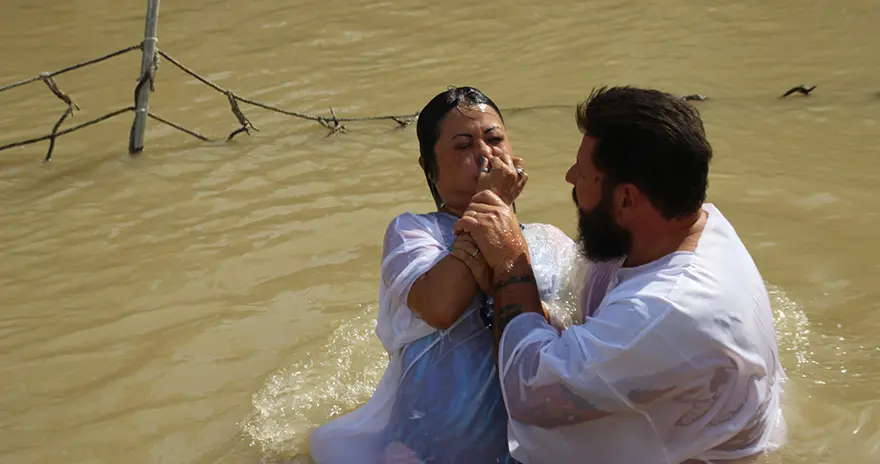
The sprinkling. An aspergillum if you packed one; a branch from the riverbank does the same work and has done it longer. If pilgrims want to go down into the river afterward, let them; the robes are there for a reason. Some will wade to the knees, some will go under, some will stay on the deck and be sprinkled, and nobody should be made to feel that the ones who went deeper received more. Keep the rite and the wading distinct, though. You renew the promises and you sprinkle. What they do with the water after that is devotion, and no one is to be spoken over with the words of baptism.
What to bring. Your stole, the card, a small vessel, a towel. Pilgrims will want to fill bottles to take home, and they can; our Israel travel guide explains why those bottles ride in checked luggage. The site arrangements, the timing, and whatever the park or the kibbutz requires are ours to handle.
Afterward, silence. The schedule will want everyone back on the bus. Ask your Pilgrimage Manager for fifteen minutes with nothing in them, and then do not fill them yourself.
What the River Asks of Them
The Jordan is not a comfortable site. The Jericho valley lies far below sea level and the heat is serious most of the year; in winter the water at Yardenit is cold enough to make grown men gasp. You will share the deck with groups from other churches and other continents. The mud is real and the changing rooms have a line. The tourist in your group will mind all of this. The pilgrim will see that none of it is in the way, and will offer it.
Say this before you arrive. The crossing in Joshua is not a scenic overlook. It is a nation going through a river with the water stacked up beside them, because the only way into the promise was through. A pilgrimage goes through things. A tourist goes around them and comes home where he started, a little more polished and otherwise the same. The deck at the Jordan is a good place to ask which of those your people came to be.
That matters for the promises themselves. "Do you renounce Satan?" is not a sentiment; it is an act of the will, and the Church asks for it out loud for a reason. Many pilgrims come home from the Holy Land with wishes: to pray more, to forgive a brother, to get back to confession. The ones who come home changed are the ones who decided something and said it, and the river is the obvious place to do that. Invite them, in the homily, to settle one thing before they answer "I do." Not three things. One.
Bringing the Jordan Back to the Parish
The real test of a Jordan River baptism renewal is not the river. It is the Easter Vigil back home, when you walk the aisle with the aspergillum and thirty people in the pews feel the water and remember. Plan for that. Keep the names of everyone who renewed at the Jordan and invite them, by name, to give two minutes at the parish reunion or a few lines in the bulletin about what the water did. Ask the ones who went under to tell the children what the stones mean.
And keep an eye on the ones who felt nothing. Paul says we were buried with Christ through baptism into death "so that, just as Christ was raised from the dead by the glory of the Father, we too might live in newness of life" (Romans 6:4). Newness has a way of showing up a few weeks after the suitcase does, and often in the pilgrim who seemed least moved at the time.
The Magi went home by a different way. Jacob crossed back over this river with a new name. That is the whole reason to bring your people to the Jordan, and it is why the rite deserves your best preparation and your fewest words. Lead them to the water, give them the Church's promises to say, sprinkle them, and get out of the way. If you are still weighing whether to lead a group at all, our priest's guide to the Holy Land covers the rest of the week.
Ready to bring your parish to the river? We arrange the Holy Land pilgrimage around the sacraments you will celebrate, the Jordan included. See All Upcoming Pilgrimages to explore dates, or learn how to Lead Your Own Group with a Pilgrimage Manager beside you the whole way.
Know someone who is discerning a pilgrimage? Pass this along.