Bosnia Travel Guide for Medjugorje Pilgrims
The Last Two Hours Are by Road
This Bosnia travel guide is written for Medjugorje pilgrims, and it gathers what Tekton pilgrims most often need to settle before departure: the currency and what is actually accepted in the village, entry requirements, the border crossing from Croatia, what each month's weather asks of you, what to wear at the holy sites, and the small logistics that otherwise occupy the mind at the very moments you would rather be praying.
Medjugorje has no airport of consequence. Whatever else your pilgrimage involves, it ends with two or three hours on a road — up from the Adriatic at Split or Dubrovnik, or down out of the mountains from Sarajevo. Somewhere along the way a coach stops at a border post, and a country changes around you.
The wise men spent far more of their journey travelling than they did arriving. Scripture gives the road more room than the stable. That is not an accident of the telling. The long approach is where a traveller becomes a pilgrim — where the ordinary distractions fall away through sheer distance and what is left is expectation.
So treat the road as part of it rather than as the gap before it. Settle these details now, and the hours between the airport and the village become the beginning of the pilgrimage instead of an obstacle to it.
Already registered? Your pilgrim packet arrives two to three weeks before departure with hotel and pansion details, your final itinerary, and guidance specific to your departure from your Pilgrimage Manager. This guide is what you need before that packet reaches you. Our pre-pilgrimage spiritual retreat is where the interior preparation happens.
The Convertible Mark, Euros, and Dollars
What currency is used in Bosnia and Herzegovina?
The official currency is the convertible mark, written KM on price tags and BAM in banking systems. It is held to the euro by a currency board at a fixed rate of 1 euro = 1.95583 marks — a rate that has not moved since 2001. Cafes and shops round it to one euro for two marks, which makes mental arithmetic easy: a 20 KM lunch is about 10 euros.
Notes come in 10, 20, 50, 100 and 200 marks. You may notice that the same denomination exists in two versions, one in Latin script and one in Cyrillic. That is not a forgery. Under the Dayton Agreement the currency was designed to belong equally to both halves of the country, so each note was issued twice. Both are legal tender everywhere.
Can I use euros or U.S. dollars in Medjugorje?
Yes — and Medjugorje is genuinely unusual in this. Four decades of pilgrims arriving from everywhere have made the village comfortable with euros and U.S. dollars, and shops, restaurants and stalls will often prefer them to the local currency. You do not need to exchange money before you leave home.
Outside Medjugorje, the picture changes. In Mostar, in Sarajevo, at a roadside cafe in the Neretva valley, the convertible mark is what is expected. If your itinerary includes a day trip — and most do — carry a small amount of marks for that day rather than assuming dollars will work the way they do in the village.
Should I exchange money before I leave?
No. Buying convertible marks from an American bank, or worse from an airport exchange counter, is the most expensive way to obtain them. Those counters set their own rate well away from the fixed one and add a fee on top.
If you want marks, withdraw them from an ATM after you arrive. There are ATMs in Medjugorje, including one by the post office near St. James Church, and they dispense marks. Two points worth knowing:
- Use an ATM attached to a bank rather than a standalone machine. The fees are better.
- Always choose to be charged in marks, not dollars. When a machine or a card terminal offers to bill you in your home currency, it is applying its own poor rate. This is called dynamic currency conversion, and declining it is free money.
Do not over-withdraw. Convertible marks are difficult to change back once you are home — most U.S. banks will not buy them. Take out what you will actually spend in the country, and spend the last of it before you leave.
Cards and what to tell your bank
Visa and Mastercard are widely accepted in hotels, pansions, restaurants and the larger shops. Discover is uncommon overseas. American Express is accepted in more places than it once was, but still not everywhere. Before you leave:
- Tell your card issuer your travel dates, and tell them Bosnia and Herzegovina specifically — some systems treat it separately from the European Union.
- Check your foreign transaction fees. They vary considerably by card.
- Carry cash for the market stalls, taxis and small shops that do not take cards.
- Bring small bills. A stallholder selling a rosary cannot break a fifty.
What about gratuities?
Gratuities for your guide and driver are customary. Tekton sets out specific guidance in your pilgrim packet so that the whole group works from the same expectation, and your Pilgrimage Manager will confirm the arrangement before the final day. In restaurants, rounding up is normal and welcome.
Entry Requirements for Bosnia and Herzegovina
Bosnia and Herzegovina is one of the simpler countries in Europe to enter on a U.S. passport. There is no visa, no online authorization, and no fee. The details that catch pilgrims out are the passport validity rule and the fact that Bosnia sits outside the European systems most travellers now expect.
-
Check the date on your passport first
Your passport must be valid for at least three months beyond your departure date from Bosnia, and it needs a blank page for the entry stamp. If your pilgrimage routes through Croatia — and most do — that three-month margin applies there too. Renew now if you are anywhere near the line.
-
There is nothing to apply for
U.S. citizens may enter for up to 90 days without a visa. No form, no fee, no waiting period. If a website offers to sell you a Bosnian travel authorization, it is selling you nothing.
-
Carry proof of your return
Airlines may decline to board a passenger holding a one-way ticket or a return dated more than three months out. Your group booking already satisfies this, but keep your itinerary accessible rather than buried in a suitcase.
-
Declare large amounts of cash
Amounts above the equivalent of 10,000 euros must be declared on arrival. This is far beyond what any pilgrim carries, but it is the rule.
Bosnia is not in the European Union or the Schengen Area. Two things follow. ETIAS, the European travel authorization that has been in the news for several years and is now expected in 2027, does not apply to Bosnia at all. And the days you spend in Bosnia do not count against the 90-day Schengen allowance you use in Croatia, Italy or anywhere else in Europe.
Crossing the Croatia–Bosnia Border
Most Tekton pilgrims do not land in Bosnia. They land in Croatia, on the Adriatic, and reach Medjugorje by coach a few hours later. Knowing that in advance explains almost everything else about the first day.
Which airport will I fly into?
It depends on the departure. Our Medjugorje pilgrimages have used all three of the practical gateways, and several itineraries fly into one and home out of another so that pilgrims see both Split and Dubrovnik:
- Split, Croatia. Roughly two hours to Medjugorje, one border crossing.
- Dubrovnik, Croatia. Roughly two and a half hours, one border crossing, through the Neretva valley.
- Sarajevo, Bosnia. Roughly two and a half hours, and no border at all — you have already landed in the country.
There are no nonstop flights from the United States to any of them, so every routing involves a connection in Europe. Your pilgrim packet confirms the specific airports for your departure.
What happens at the border
The coach pulls in at a staffed international border post. Passports are either collected by your guide and handed across in a bundle or checked seat by seat. Nobody gets off. It is usually a matter of minutes, though summer traffic on the coastal route can stretch it. There is no fee, no form, and no question you need to prepare for beyond where you are going and why — and the answer to that is simply that you are on a pilgrimage.
Keep your passport on your person rather than in the hold, and keep it accessible rather than at the bottom of a bag. That is the whole of what is asked of you.
Two countries, two systems
Croatia is in the European Union and the Schengen Area. Bosnia and Herzegovina is in neither. On an itinerary that includes Split, Dubrovnik or Makarska alongside Medjugorje, you are moving between two currencies — the euro on the Croatian side, the convertible mark on the Bosnian — and two separate sets of border rules. It is worth carrying a little of each rather than discovering the difference at a coffee stop.
The Adriatic is not a detour. Several of our itineraries build in time at Split, Makarska or Dubrovnik before or after the days in Medjugorje. That is deliberate. The road down into Herzegovina, and the road back out to the sea, do a quiet part of the work — they give the village an approach and a departure rather than a beginning and an end.
Medjugorje Weather Month by Month
Medjugorje sits in Herzegovina, the warm southern half of the country, about fifteen miles inland from the mountains that separate it from the Adriatic. It is hotter and drier in summer than Sarajevo and wetter in autumn than almost anywhere you have been. Both of those matter, because you will be climbing.
| Month | High | Low | Rain | What it feels like |
|---|---|---|---|---|
| January | 43°F | 28°F | 5.6″ | Cold and damp. Frost on the hills at dawn. |
| February | 45°F | 29°F | 5.5″ | Still cold. Quiet village, few pilgrims. |
| March | 53°F | 35°F | 5.4″ | Cool and changeable. Lent draws its own pilgrims. |
| April | 61°F | 42°F | 6.2″ | Mild and green, with showers. Layers and a light shell. |
| May | 69°F | 49°F | 4.4″ | Warm days, cool evenings. Excellent for the hills. |
| June | 77°F | 56°F | 2.8″ | Bright and dry. The anniversary of the apparitions falls on the 24th. |
| July | 83°F | 61°F | 1.9″ | The driest month. Climb at dawn or after the evening programme. |
| August | 84°F | 61°F | 2.1″ | The hottest stretch. Youth Festival crowds fill the village. |
| September | 73°F | 54°F | 5.2″ | Warm, softer light, thinner crowds. One of the finest months. |
| October | 64°F | 46°F | 7.2″ | Comfortable walking, but the wet season has begun. Bring real rain gear. |
| November | 54°F | 39°F | 9.2″ | The wettest month of the year. Cool, grey, and deeply quiet. |
| December | 45°F | 31°F | 7.4″ | Cold and wet. Christmas in the village is its own reason. |
- Hot and dry, full sun
- Mild and variable
- Cool, damp, often overcast
- Best months for the hill climbs
Average daily highs and lows with average monthly rainfall, measured at Mostar, roughly fifteen miles from Medjugorje. If your itinerary includes Split, Makarska or Dubrovnik, expect the coast to run a few degrees milder in winter and a few degrees hotter in July and August.
Autumn is wetter than most pilgrims expect. October and November are the two wettest months of the year in Herzegovina — wetter than any month of winter. That does not make them poor months to come; the temperatures are comfortable and the crowds have thinned. It does mean a waterproof shell and shoes with real grip, because the stone on Apparition Hill and Cross Mountain is slick when wet.
A word on choosing. Comfort is worth weighing, but it is not the only measure. The anniversary of the apparitions on June 24th, the Youth Festival in early August, and Christmas in the village all ask something of a pilgrim that a mild Tuesday in May does not. Those who choose them are not choosing for the forecast.
General Information
- Capital city
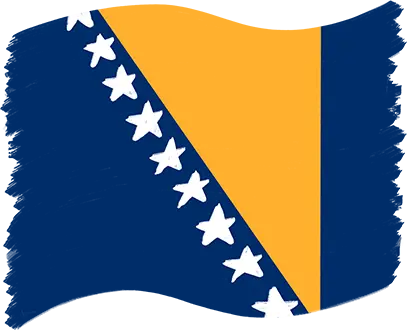
- Sarajevo
- Largest city
- Sarajevo
- Official languages
- Bosnian, Croatian, Serbian
- Time zone
- Central European Time, 6 hours ahead of U.S. Eastern
- Flight time
- No nonstop service from the U.S.; one connection in Europe
- Country code
- +387
- Emergency
- 112 general · 122 police · 123 fire · 124 ambulance
- Medjugorje sits in
- Herzegovina, the country's southern half
Will people speak English?
In Medjugorje, very widely. Four decades of pilgrims from every continent have made English ordinary in the village — in the pansions, the shops, the restaurants, and at the confessionals, where priests hear in a great many languages. Your knowledgeable Catholic and other Christian guides speak fluent English. Away from the village it thins out, and a smile does the rest.
The three official languages are closely related and mutually intelligible. Medjugorje is in a Croat-majority Catholic part of Herzegovina, so what you will hear and see written is Croatian, in the Latin alphabet you already read. Cyrillic appears in the eastern half of the country, not here. Dobar dan is good day, hvala is thank you, and either one goes a long way.
Emergency numbers
Bosnia does not use 911. The single number to remember is 112, the European general emergency line, which reaches police, fire or ambulance and is answered in English in most places. If you would rather be specific, dial 122 for police, 123 for fire, or 124 for an ambulance. Dial them exactly as written, with no area code, from any phone in the country — including one with no local SIM.
In practice you will almost certainly never need them. Your Pilgrimage Manager is with the group throughout and is the first person to find. Medjugorje also has pharmacies and a first aid room staffed by the Order of Malta near the sanctuary. Save the numbers and your pansion address to your phone before you leave home anyway.
Jet lag
Six hours ahead of U.S. Eastern time, seven from Central, nine from the Pacific. Most pilgrims find the second and third days hardest. Stay awake until a normal local bedtime on arrival day, drink more water than feels necessary, and step outside into the morning light. The rhythm of the village — Mass, Rosary, Adoration, an early night — takes care of the rest faster than most itineraries do.
What to Wear in Medjugorje
Dress as you would at home. Medjugorje is a working village, not a formal one, and unless your pilgrimage includes a particular occasion you will need nothing dressy. There is one firm exception, and it is worth knowing before you pack rather than at the church door.
The rule at the three sacred places
Church officials have asked that no shorts and no sleeveless shirts be worn in the area of St. James Church — the church itself and the courtyard around it — or on Apparition Hill, or on Cross Mountain. Those are the most sacred spots in the parish. The request applies to men and women alike.
More broadly, knees and shoulders should be covered to enter churches and shrines anywhere in the country, and bare midriffs are frowned upon. You may be asked to cover up or turned away at the door. Modesty and respectfulness are the whole of it.
Women do not need a head covering, and skirts or dresses are not required unless that is your preference. Jeans are acceptable, unless your priest has told you differently. A light scarf packs small and solves nearly every situation you will meet — including the August sun on an unshaded hillside.
Shoes are the one thing worth spending on
Apparition Hill and Cross Mountain are not paths. They are loose, uneven limestone, worn smooth in places by four decades of pilgrims, and the climb up Cross Mountain is the harder of the two. Bring shoes with real tread and break them in before you go. Many pilgrims climb Apparition Hill barefoot as a devotion; that is a decision best made on the hill, not a reason to pack badly.
A small flashlight is worth its weight. The hills are climbed before dawn and after the evening programme more often than most first-time pilgrims expect.
Phone, Data, and Water
Will my phone work?
Yes. Coverage in Medjugorje and along the route is good, including most of the way up both hills. Your options:
- Carrier travel pass. Simplest. Add it before you leave — and check that your plan lists Bosnia and Herzegovina by name, because some carriers price it outside their European bundle.
- eSIM. Usually cheaper for heavy data. Buy and install before departure while you still have Wi-Fi you trust.
- Pansion Wi-Fi. Widely available and generally fine. Sufficient if you are content to check in once a day.
If your itinerary crosses into Croatia for Split, Makarska or Dubrovnik, note that Croatia is in the European Union and Bosnia is not. Some plans cover one and not the other. It is a five-minute phone call before you leave and a frustrating afternoon if you skip it. Many pilgrims use WhatsApp, which works over Wi-Fi and is the default across the region.
Consider using it less. The phone is useful for photographs and for a nightly word home. It is also the quickest way to be somewhere other than where you are standing. Pilgrims who decide in advance to leave it in a pocket during the evening programme rarely regret it.
Can I drink the tap water?
Yes. Tap water in Medjugorje and across the country is safe to drink, though it can carry a mineral taste. Carry a refillable bottle regardless — you will walk and climb far more than you expect, and the summer heat in Herzegovina is dry enough to dehydrate you before you feel thirsty.
Food and dietary needs
Most groups stay in family-run pansions where breakfast and dinner are home-cooked and served to the whole house at a set hour. The food is simple, generous and local. It is not a menu, which is part of the point. If you have a serious allergy or a genuine dietary requirement, tell your Pilgrimage Manager well before departure so it can be arranged with the host family rather than improvised at the table.
Electricity, Plugs, and Adapters
- Socket types
- Type C and Type F
- Voltage
- 220–240V, 50 Hz
- Adapter needed?
- Yes — a standard European one
- Converter needed?
- Only for single-voltage devices
Adapter or converter?
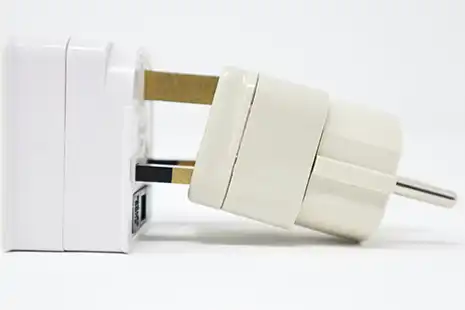
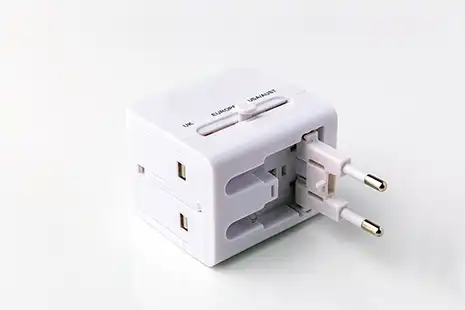
An adapter lets an American plug fit a Bosnian socket. A converter changes the voltage. Nearly all converters are also adapters; not all adapters are converters. Bosnia uses the same sockets as most of Europe, so one European adapter covers Bosnia and Croatia both.
Check the label on each device. If it reads INPUT: 100–240V, 50/60 Hz, it is dual voltage and needs only an adapter. That covers most phones, tablets, laptops and cameras. Most CPAP machines are dual voltage as well, but confirm with your manufacturer or physician.
Single-voltage devices need a converter, or the higher voltage will destroy them. Hair dryers, straighteners, curling irons and many electric shavers and toothbrushes fall into this category. Most accommodations provide hair dryers — your pilgrim packet confirms the specific pansions and hotels on your departure.
Questions Pilgrims Ask
What currency is used in Bosnia and Herzegovina?
The official currency of Bosnia and Herzegovina is the convertible mark, written KM locally and BAM in banking systems. It is fixed to the euro by a currency board at 1 euro = 1.95583 marks, a rate that has not moved since 2001. In practice shops and cafes round it to 1 euro = 2 marks. Notes come in 10, 20, 50, 100 and 200 marks.
Can I use euros or US dollars in Medjugorje?
Yes. Medjugorje is unusual in this. Euros and US dollars are accepted almost everywhere in the village and are often preferred to the local currency, so you do not need to exchange money before you leave home. Outside Medjugorje the picture changes: in Mostar, Sarajevo and everywhere else in the country, the convertible mark is what shops expect.
Do I need a visa to travel to Bosnia and Herzegovina?
No. US citizens may enter Bosnia and Herzegovina without a visa for stays of up to 90 days. There is no online authorization to apply for and no fee. Your passport must be valid for at least three months beyond your departure date and have a blank page for the entry stamp. Bosnia is not in the European Union or the Schengen Area, so ETIAS does not apply there.
Do I cross a border between Croatia and Bosnia on the way to Medjugorje?
Yes, if your pilgrimage flies into Split or Dubrovnik. Croatia is in the European Union and the Schengen Area; Bosnia and Herzegovina is in neither. The coach stops at a staffed international border post, passports are collected or checked, and the group waits together. It is routine and usually brief. Pilgrimages flying into Sarajevo land inside Bosnia and cross no border at all.
What is the weather like in Medjugorje month by month?
Medjugorje sits in Herzegovina, the warm southern half of the country. July and August are hot and dry, with average highs in the mid 80s Fahrenheit and very little rain. May, June, September and October are the most comfortable months for climbing the hills. October and November are the two wettest months of the year, so autumn pilgrims should pack real rain gear. January and February are cold and damp, with highs in the low to mid 40s.
What should I wear in Medjugorje?
Dress as you would at home, with one firm exception. Church officials have asked that no shorts and no sleeveless shirts be worn at St James Church and its courtyard, on Apparition Hill, or on Cross Mountain. That applies to men and women alike. Knees and shoulders covered, no bare midriffs. Women need no head covering and skirts are not required. Jeans are fine, unless your priest has told you differently.
Will my cell phone work in Bosnia and Herzegovina?
Yes. Coverage in Medjugorje and along the pilgrimage route is good. Most US carriers sell an international day pass or travel plan that covers Bosnia, though check whether yours treats Bosnia the same as the European Union, because some price it separately. An eSIM bought before departure is often cheaper for heavy data use. Pansion and hotel Wi-Fi is widely available.
What kind of electrical adapter do I need for Bosnia?
Bosnia and Herzegovina uses Type C and Type F sockets at 220 to 240 volts, the standard across most of Europe, so a European travel adapter is what you need. You will only need a voltage converter if a device is single voltage. Phones, tablets, laptops and most CPAP machines are dual voltage and need only an adapter. Hair dryers, straighteners, curling irons and some electric shavers often are not.
Next Steps
The Road Is Part of the Pilgrimage
For thirty years Tekton has walked with pilgrims into this village — across the border, up both hills, and into the long evenings of prayer that draw people back again and again. Everything on this page exists so that when you arrive, the logistics are already settled and you are free to be present.