

Israel Travel Guide for Holy Land Pilgrims
Preparation is the first act of the pilgrimage
This Israel travel guide is written for Holy Land pilgrims, and it gathers what Tekton pilgrims most often need to settle before departure: entry requirements, the shape of each season, what happens at the airport, money, dress, and the small logistics that otherwise occupy the mind at the very moments you would rather be praying.
The wise men did not set out empty-handed. Gold, frankincense, and myrrh were gathered deliberately, carried a long way, and given away at the end. There is nothing incidental about that gathering. What you arrange before you leave — the authorization filed, the passport checked, the right shoes packed, the expectations set — is not administrative overhead standing between you and the pilgrimage. It is where the pilgrimage begins.
A tourist prepares in order to be comfortable. A pilgrim prepares in order to be free. Settle these things now, and you arrive in Jerusalem carrying attention rather than anxiety.
Already registered? Your pilgrim packet arrives two to three weeks before departure with hotel details, your final itinerary, and destination-specific guidance from your Pilgrimage Manager. This guide is what you need before that packet reaches you. Our pre-pilgrimage spiritual retreat is where the interior preparation happens.
Entry Requirements: The ETA-IL
Since January 1, 2025, every traveler from a visa-exempt country — including the United States — must hold an approved Electronic Travel Authorization before boarding a flight to Israel. This is the single most common thing first-time pilgrims do not know about.
This applies to everyone in your party, including children and infants. An ETA-IL is not a visa. It is a pre-screening authorization linked to your passport, comparable to the ESTA that visitors to the United States must obtain. Without it, an airline will not board you.
-
Confirm your passport first
Your passport must be valid for at least six months beyond your return date. The ETA-IL is tied to that specific passport, so renew first if you are close to expiry — otherwise you will pay for the authorization twice.
-
Apply online through the official portal
Apply directly at israel-entry.piba.gov.il, run by Israel's Population and Immigration Authority. You will need your passport, an email address, and a payment card, and the form takes a few minutes.
Check that the address ends in gov.il. Many third-party sites advertise ETA-IL processing for $50 to $100 or more. They are private services filing the same form on your behalf, and the Israeli Ministry of Foreign Affairs advises using only the official government site.
-
Apply at least 72 hours before departure
Most approvals arrive quickly, but the Population and Immigration Authority can follow up with questions. Around the time of your final payment is the right moment: your travel is settled, your passport situation is known, and you are still comfortably clear of the 72-hour minimum.
-
Carry the confirmation with you
Print a copy and keep it with your travel documents, separate from the originals. Save a photo on your phone as well.
An approved ETA-IL is not entry itself. It permits you to reach the border. A border control officer at Ben Gurion makes the final determination on arrival, which is routine for pilgrims traveling with an organized group.
When to Make a Holy Land Pilgrimage
Israel is small but its climates are not uniform. Jerusalem sits at roughly 2,500 feet and stays notably cooler than the Sea of Galilee, and the Dead Sea — the lowest point on earth — is hotter than both. A single day's itinerary can move you through all three.
| Month | Jerusalem | Sea of Galilee | Dead Sea | Rain | What it feels like |
|---|---|---|---|---|---|
| January | 55°F | 65°F | 68°F | Frequent | Cool, green, quiet. Bring a real coat for Jerusalem. |
| February | 57°F | 68°F | 71°F | Frequent | Still cool. Almond blossoms begin. |
| March | 63°F | 74°F | 78°F | Occasional | Wildflowers across Galilee. Excellent walking weather. |
| April | 72°F | 83°F | 88°F | Rare | Warm, bright, and green. Holy Week draws crowds. |
| May | 79°F | 92°F | 96°F | Very rare | Warm in Jerusalem, hot at the Dead Sea. |
| June | 84°F | 97°F | 102°F | None | Dry heat begins in earnest. Start early each day. |
| July | 87°F | 99°F | 105°F | None | Hot. Manageable in Jerusalem, demanding elsewhere. |
| August | 88°F | 100°F | 105°F | None | The hottest stretch of the year. |
| September | 85°F | 96°F | 100°F | Rare | Still warm, but the edge comes off late in the month. |
| October | 79°F | 89°F | 92°F | Occasional | Comfortable and clear. One of the finest months. |
| November | 68°F | 78°F | 80°F | Increasing | Mild days, cool evenings, thinner crowds. |
| December | 58°F | 68°F | 70°F | Frequent | Cool and often wet. Bethlehem at Christmas is its own reason. |
- Warm to hot, dry, full sun
- Mild and variable
- Cool, damp, often overcast
- Best months for walking
Average daytime highs. Nights in Jerusalem run 15–20 degrees cooler than the daytime figure year-round — layers matter more than any single garment.
A word on choosing. Comfort is worth considering, but it is not the only measure. Holy Week in Jerusalem and Christmas in Bethlehem are demanding — crowded, and weather that asks something of you. Pilgrims who choose those dates are not choosing them for the forecast, and they rarely regret it.
Arrival and Departure at Ben Gurion
Nearly all pilgrimages arrive at Ben Gurion Airport near Tel Aviv. Israeli security is thorough and more conversational than what Americans are accustomed to, and knowing that in advance removes most of the anxiety around it.
On arrival
With an approved ETA-IL you will typically pass through automated border control. You will receive a small paper entry card rather than a passport stamp — keep it, as some hotels ask to see it. Your Tekton representative will meet the group after baggage claim.
On departure
Plan on arriving three hours before an international departure. Before you reach the check-in desk, a security agent will ask you a series of questions: where you stayed, who you traveled with, whether anyone gave you anything to carry, and why you came. This is normal. Answer plainly, say you were on a pilgrimage, and have your itinerary available if asked.
Olive wood, oil, and water. Items purchased at the holy sites travel fine, but bottles of Jordan River water and holy oils must go in checked luggage rather than your carry-on. If you buy them on the final day, tell your Pilgrimage Manager before you pack.
General Information
- Capital city
- Jerusalem
- Largest city
- Jerusalem
- Official language
- Hebrew (Arabic holds special status)
- Time zone
- 7 hours ahead of U.S. Eastern Time
- Flight time
- Roughly 11 hours nonstop from the U.S. East Coast
- Country code
- +972
- Emergency numbers
- Police 100 · Ambulance 101 · Fire 102
Will people speak English?
Almost everywhere you will go, yes. English is widely spoken at the holy sites, in hotels, and among the shopkeepers of the Old City. Your knowledgeable Catholic and other Christian guides speak fluent English, and where a word does not land, a smile still does.
Emergency numbers
Israel does not use 911. Three separate short numbers do the work instead: dial 100 for police, 101 for an ambulance, and 102 for the fire service. Dial them exactly as written — no area code, no country code — from any phone in the country, including a mobile with no local SIM. Operators speak English.
In practice you will almost certainly never need them. Your Pilgrimage Manager is with the group throughout and is the first person to find if something goes wrong. Save these to your phone anyway, alongside your hotel address, before you leave home.
Jet lag
The seven-hour shift is real. Most pilgrims find the second and third days hardest. Stay awake until a normal local bedtime on arrival day, drink more water than feels necessary, and step outside into the morning light — the pilgrimage rhythm takes care of the rest.
Money, Cards, and Tipping
How much cash should I bring?
Less than you might expect, and in smaller bills than you might think. The official currency is the Israeli New Shekel, but the U.S. dollar is accepted nearly everywhere and is often preferred. Prices are frequently listed in dollars, euros, and shekels together. There is no need to exchange money before departure.
Bring a supply of small bills — ones, fives, and tens. Street vendors, small shops in the Old City, and the places you will actually want to buy from often cannot break a fifty.
Should I buy shekels before I leave?
No — and most pilgrims find they barely need shekels at all. Buying foreign currency from an American bank or, worse, an airport exchange counter is the most expensive way to obtain it. Those counters set their own rate well away from the market rate and then add a fee on top, so you can lose a meaningful share of the value before you have left the country.
If you want shekels, withdraw them from an ATM after you arrive. Bank ATMs give something close to the true exchange rate. Two points worth knowing:
- Use an ATM attached to a bank rather than a standalone machine in a tourist area. The rates and fees are better.
- Always choose to be charged in shekels, not dollars. When a machine or card terminal offers to bill you in U.S. dollars, it is applying its own poor rate — this is called dynamic currency conversion, and declining it is free money.
Withdraw once and withdraw enough, since most cards charge a flat fee per withdrawal. For a typical pilgrimage, a modest amount is plenty: dollars cover most of what you will actually buy.
Can I use credit cards?
Yes. Visa and Mastercard are widely accepted. Discover is uncommon overseas, and American Express is accepted in more places than it once was but still not everywhere. Before you leave:
- Notify your card issuer of your travel dates so purchases are not flagged.
- Check your foreign transaction fees — they vary considerably by card.
- Use a card for larger purchases; many offer protection if goods are damaged in transit.
- Carry cash for smaller shops and vendors who do not take cards.
What about tipping?
Gratuities for your guide and driver are customary. Tekton provides specific guidance in your pilgrim packet so that the whole group works from the same expectation, and your Pilgrimage Manager will confirm arrangements before the final day. Restaurant service is often included; a small addition for exceptional service is welcome.
Shabbat and the Rhythm of the Land
From sundown Friday to sundown Saturday, Israel keeps Shabbat. Your itinerary is built around it, so it will not disrupt your pilgrimage — but it will change the texture of those hours, and American pilgrims are often surprised by it.
What changes
- Public transportation largely stops in Jewish areas.
- Many shops, restaurants, and businesses close Friday afternoon.
- Some hotels switch an elevator to Shabbat mode — it stops at every floor automatically so no button need be pressed.
- Hotel dining continues, though the menu and service style may differ.
- Christian sites, the Old City's Christian Quarter, and Bethlehem operate normally.
What it offers
Jerusalem grows quiet in a way few American cities ever do. The traffic thins, the noise drops, and for twenty-five hours an entire country sets down its work. Pilgrims who expect an inconvenience often find instead that they have been handed something they did not know they needed.
It is worth noticing what a whole society looks like when it stops. Few of us have seen it.
Phone, Data, and Water
Will my phone work in Israel?
Yes. Coverage is strong, including at most holy sites. Your options:
- Carrier travel pass. Simplest. Most U.S. carriers offer a daily or monthly international plan covering Israel. Add it before you leave.
- eSIM. Usually cheaper if you expect heavy data use. Purchase and install before departure.
- Hotel Wi-Fi. Widely available and generally reliable. Sufficient if you are content to check in once a day.
Many pilgrims use WhatsApp for calls and messages home, since it works over Wi-Fi and is the default across much of the region.
Consider using it less. The phone is useful for photographs and for a nightly word home. It is also the quickest way to be somewhere other than where you are standing. Many pilgrims decide in advance to keep it in a pocket at the holy sites — and come home glad they did.
Can I drink the tap water?
Yes. Tap water throughout Israel is safe to drink. Carry a refillable bottle anyway — you will walk more than you expect, and the dry heat in the Judean wilderness and around the Dead Sea dehydrates you faster than the temperature suggests.
Food and dietary needs
Hotel breakfasts are generous and typically kosher, which means dairy and meat are served separately. Vegetarian options are easy to find everywhere. If you have a serious allergy or a dietary requirement, tell your Pilgrimage Manager well before departure so arrangements can be made rather than improvised.
What to Wear
Dress as you would at home, with one consistent exception: the holy sites expect modesty, and they enforce it.
Knees and shoulders must be covered to enter churches and shrines. This applies to men and women alike. Bare midriffs are not acceptable. You may be turned away at the door, and it is a poor way to spend a morning you have waited years for.
Women do not need a head covering, and skirts are not required unless that is your preference. Jeans are fine, unless your priest has told you otherwise. A light scarf packs small and solves nearly every situation you will encounter.
The one thing worth spending money on is your shoes. You will walk several miles a day on uneven stone that has been worn smooth by two thousand years of pilgrims. Break them in before you go.
Electricity, Plugs, and Adapters
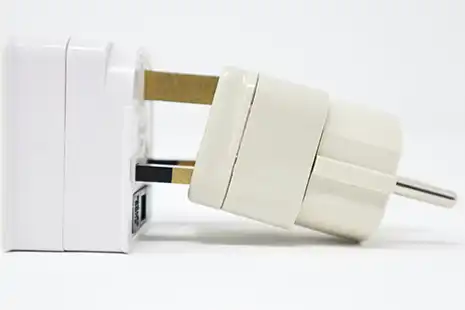
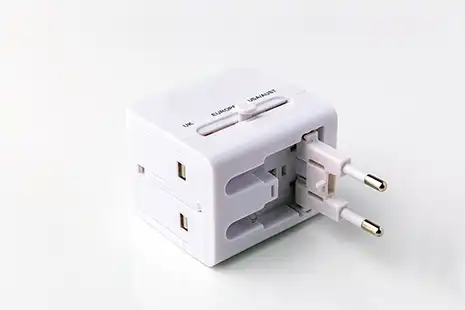
- Socket types
- Type C and Type H
- Voltage
- 220–240V
- Adapter needed?
- Yes
- Converter needed?
- Only for single-voltage devices
Adapter or converter?
An adapter lets an American plug fit an Israeli socket. A converter changes the voltage. Nearly all converters are also adapters; not all adapters are converters.
Check the label on each device. If it reads INPUT: 100–240V, 50/60 Hz, it is dual-voltage and needs only an adapter. That covers most phones, tablets, laptops, and cameras. Most CPAP machines are dual-voltage as well, but confirm with your manufacturer or physician.
Single-voltage devices need a converter, or the higher Israeli voltage will destroy them. Hair dryers, straighteners, curling irons, and many electric shavers and toothbrushes fall into this category. Most hotels provide hair dryers — your pilgrim packet confirms the specific hotels on your departure.
Questions Pilgrims Ask
Do I need a visa to travel to Israel for a pilgrimage?
U.S. citizens do not need a traditional visa for a pilgrimage stay, but since January 1, 2025 every traveler from a visa-exempt country must hold an approved ETA-IL before boarding. This includes children and infants. It is applied for online, is linked to your passport, and permits stays of up to 90 days.
How far in advance should I apply for the ETA-IL?
The minimum is 72 hours before departure, but the practical answer is around the time of your final payment. The authorization is tied to one specific passport, so applying a year ahead means paying for it twice if you renew that passport in the meantime. By final payment your travel is settled and your passport situation is known, and you are still well clear of the deadline.
When is the best time to make a Holy Land pilgrimage?
Spring and autumn offer the most comfortable walking weather. March through May brings wildflowers across Galilee and mild days in Jerusalem. September through November is warm and dry with thinner crowds. Summer is hot, particularly at the Dead Sea and around the Sea of Galilee. Winter in Jerusalem is cool and can be rainy — but Christmas in Bethlehem and Holy Week in Jerusalem draw pilgrims for reasons that have nothing to do with the forecast.
What happens at Ben Gurion Airport security?
Israeli departure security is more conversational than what Americans are used to. An agent will ask where you stayed, who you traveled with, and why you came. Answer plainly and say that you were on a pilgrimage. Plan on arriving three hours before an international departure. Your Pilgrimage Manager will confirm timing on the ground.
What is Shabbat and how will it affect my pilgrimage?
Shabbat runs from sundown Friday to sundown Saturday. Public transportation largely stops, many shops and restaurants close, and some hotel elevators switch to an automatic setting that stops on every floor. Your itinerary is built around it, so it will not disrupt your pilgrimage — but it will change the rhythm of those hours, and it is worth understanding before you arrive.
Will my cell phone work in Israel?
Yes. Most U.S. carriers offer an international day pass or travel plan covering Israel, and coverage at the holy sites is generally good. An eSIM purchased before departure is often less expensive if you plan to use significant data. Hotel Wi-Fi is widely available. Many pilgrims use WhatsApp to stay in touch with family at home.
Can I drink the tap water in Israel?
Yes, tap water in Israel is safe to drink. Most pilgrims still carry a refillable bottle, because you will be walking a great deal and the dry heat is easy to underestimate, particularly in the Judean wilderness and around the Dead Sea.
What kind of electrical adapter do I need for Israel?
Israel uses Type C and Type H sockets at 220–240 volts, so you will need a plug adapter. You will only need a voltage converter if a device is single-voltage. Phones, tablets, laptops, and most CPAP machines are dual-voltage and need only an adapter. Hair dryers, curling irons, and some electric shavers often are not.
Next Steps
Return Home by a Different Way
For more than thirty years, Tekton has walked with pilgrims through the land where Christ lived, taught, suffered, and rose. Everything on this page exists so that when you arrive, the logistics are already settled and you are free to be present.