
Sarria to Santiago on Foot
Walking the last 100 km of the Camino de Santiago from Sarria? What the Compostela really asks, what the final stretch is like, and how to return changed.
More people walk the last 100 km of the Camino de Santiago than any other stretch of any pilgrim road in Europe, and nearly all of them start in the same small Galician town. Sarria has no apparition, no basilica worth crossing an ocean to see, no relic of its own. What it has is arithmetic. It sits just far enough from the Apostle's tomb that a pilgrim who starts there and walks the whole way has covered the distance the Cathedral asks for — and so, year after year, roughly three in ten of all who reach Santiago begin their walk on its streets.
That fact draws a certain kind of scorn. You will hear it on the trail: the real Camino starts in the Pyrenees, and the last hundred kilometers are for people who want the certificate without the cost. That is nonsense. It also contains a warning worth heeding.
What the Cathedral Actually Asks
The Compostela is not a trophy. It is a certificate of visitation, issued in Latin by the Chapter of the Cathedral of Santiago, recording that a named person came to the tomb of the Apostle pietatis causa — for the sake of devotion. Before the certificate there was the badge: medieval pilgrims proved their journey with a scallop shell, and the shells were forged so freely that the popes threatened the counterfeiters with excommunication.
To receive it, the Cathedral asks that you cover at least one hundred continuous kilometers on foot or horseback along a recognized route — two hundred by bicycle — with the last stage bringing you into Santiago itself. The requirements were adjusted in 2025 to give pilgrims more flexibility about which hundred kilometers they walk, so it is worth confirming the current terms with the Pilgrim's Reception Office before you plan. What has not changed is the second half of the requirement, the part almost nobody mentions: the Compostela is granted for religious or spiritual motives. A pilgrim who walks for sport or sightseeing can still have the kilometers certified — the office sells a certificate of distance to anyone who asks — but not the pilgrimage. The Church has been drawing that line for eight hundred years.
Notice what this means. The hundred-kilometer threshold is not a measure of spiritual seriousness. It is a floor, set low enough that the office worker with one week of vacation and the eighty-year-old widow can both arrive at the tomb having genuinely walked there. The Church has never taught that grace is proportional to mileage. The question is not how far you walked. It is what you were doing while you walked.
The Last 100 km Camino de Santiago Route: Sarria to Santiago, Stage by Stage
A Sarria to Santiago pilgrimage is traditionally divided into five walking days, though it is easily stretched to six or seven, and there is no virtue in hurrying. The distance is a little over a hundred kilometers — most measurements land between 111 and 116, depending on which lanes you take through the villages.
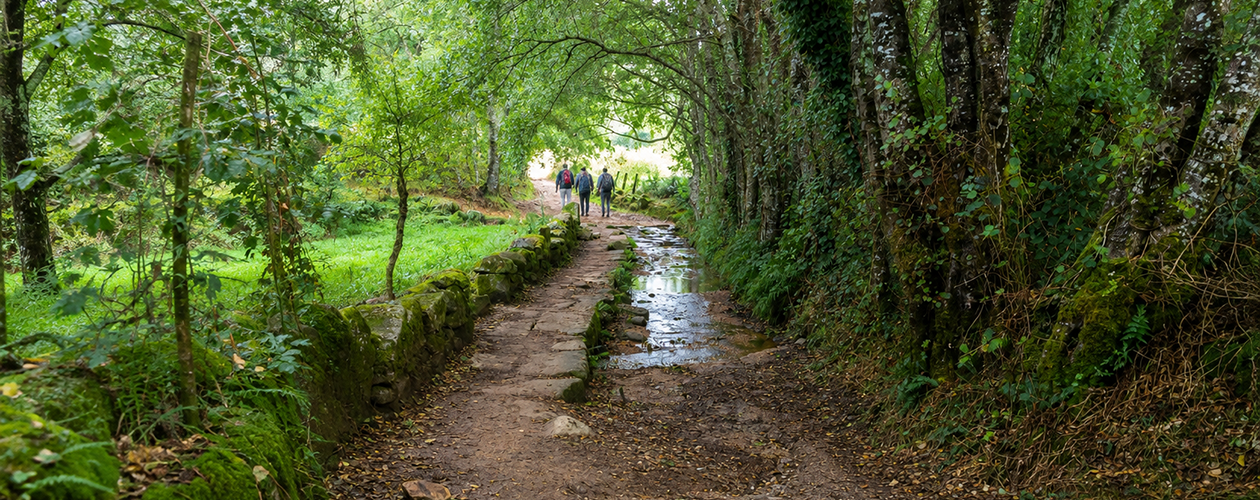
You climb out of Sarria through oak woods and sunken lanes walled with moss-covered stone, then cross into Portomarín over a high bridge above a reservoir — the old village lies beneath the water, its Romanesque church moved stone by numbered stone to higher ground. The road rises to Palas de Rei and runs down through river valleys to Melide, where the Camino Primitivo joins from the north and everyone stops for pulpo. Arzúa brings in the Camino del Norte. By the time you leave O Pedrouzo on the final morning you are walking with pilgrims who set out from the Pyrenees, from Portugal, from the Asturian mountains, all of you funneled into the same last twenty kilometers.
This is not flat country. Galicia is green because Galicia is wet, and the hills are constant even where no single climb is dramatic. In October the temperatures are kind — generally somewhere in the fifties and sixties — and the woods turn, but the rain arrives more often as the month goes on and the light fails earlier each evening. Pack for it honestly. Our Camino de Santiago packing list exists mostly to keep the weight on your back from becoming its own penance.
Two Stamps a Day
You will carry a credencial, the pilgrim's passport, and collect a sello — a stamp — from churches, hostels, bars, and town halls along the way. Pilgrims walking only the minimum distance are asked for two each day, one where the stage begins and one where it ends, each dated, so that the record shows you resumed from the place you stopped.
It sounds bureaucratic. It becomes something else within a day and a half. Ask for a stamp in a village church and the woman keeping it will often stop what she is doing, press the seal carefully, and say buen Camino as though she meant it, because she does. The stamps accumulate into a strange and lovely object: crooked, inky, no two alike. Pilgrims keep them for life.
The Crowd You Will Walk With
Here is the honest difficulty of this stretch, and the reason it deserves a warning as well as a defense. It is busy. More than half a million people received the Compostela last year, and this is the section nearly all of them walked. School groups move in loud clusters. Someone ahead of you is playing music from a phone. The café where you meant to stop for coffee has a line out the door.
A tourist experiences this as a defect in the product — the thing that was supposed to be serene and is not. A pilgrim has another option, and it is the whole art of the Camino: to receive the crowd as the penance it is. Blisters are easy to offer. Other people are harder. The teenager with the speaker is genuinely irritating and is also, right now, walking toward the tomb of an Apostle for reasons neither of you will ever discuss. You are not owed solitude. You are being given company, which is what the Church has always meant by communion, and which is considerably less comfortable.
There are practical ways to find quiet — start before dawn, walk after the morning surge has passed, break the stages where the guidebooks do not. But the deeper answer is that the interior work of pilgrimage was never contingent on conditions being pleasant. If you want to think about this before you go, our post on preparing for a Catholic pilgrimage takes up the question of what to pack besides clothes.
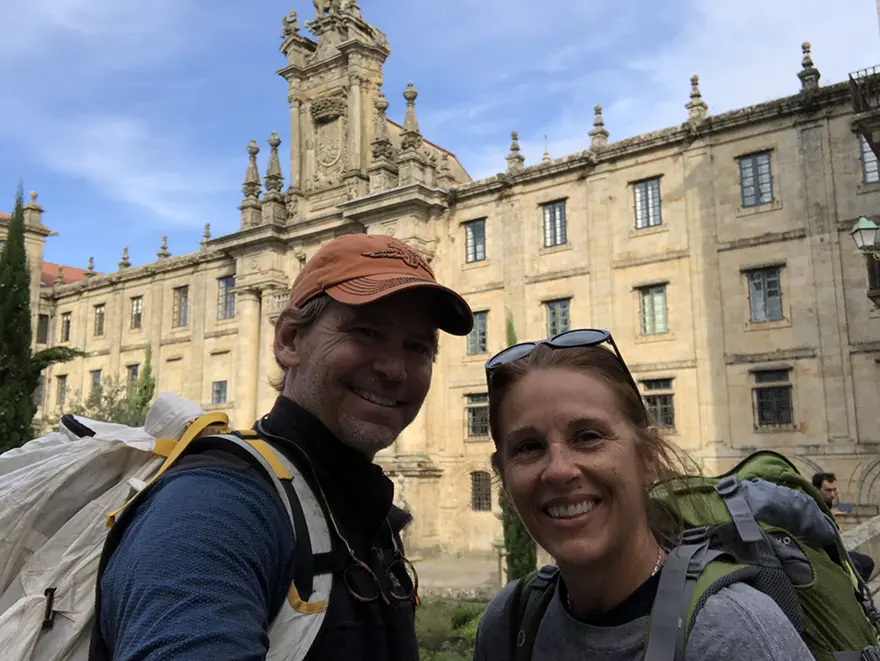
Arriving
The last morning goes over Monte do Gozo — the Mount of Joy — named for the moment medieval pilgrims first caught sight of the Cathedral's towers and, according to the old accounts, wept and ran. The city has grown up around it and the view is not what it was. You will come into Santiago through suburbs, past a shopping street, and then turn a corner under an archway with a piper playing beneath it and find yourself in the Praza do Obradoiro with the whole west front of the Cathedral in front of you. It undoes people. It will very likely undo you.
What follows is a sequence pilgrims have followed for centuries. You climb the stairs behind the high altar and embrace the thirteenth-century statue of Saint James from behind — an oddly intimate gesture in that blazing baroque room. You descend to the crypt below, where the silver reliquary holds the remains venerated as the Apostle's, and there is barely space to kneel. Both are freely open to everyone. Then there is the Pilgrim's Mass at the high altar, which begins with a reading of the pilgrims who arrived the previous day: their countries, and the place each one set out from. Sarria is read aloud, over and over, alongside Saint-Jean-Pied-de-Port and Porto and Le Puy. Nobody in the Cathedral appears to think the distinction matters much.
Two things worth knowing so you are not disappointed. The botafumeiro — the great censer swung through the transept on ropes — does not fly at every Mass; it is reserved for solemnities and for groups who arrange it in advance. As this is written it is not flying at all: restoration work inside the Cathedral has grounded it until further notice and moved the Pilgrim's Masses to nearby churches, so check the Cathedral's own notices before you go. And in high season the Pilgrim's Office cannot always issue the Compostela the day you arrive. Neither is the point, which is a useful thing to have decided before you get there.
What the Compostela Cannot Certify
There is one more reason to think seriously about this stretch now. The Holy Door on the Praza da Quintana is sealed in ordinary years and opened only when the Feast of Saint James falls on a Sunday. It is opened at the end of December 2026 for the Holy Year that follows, and a plenary indulgence is available under the usual conditions — Confession, Communion, prayer for the Holy Father's intentions, and a genuine turning of the heart. After that year the wait is five more. Whether you walk in a Holy Year or an ordinary one, though, the arithmetic that brought you to Sarria is not the arithmetic that matters.
SCRIPTURE“And having been warned in a dream not to return to Herod, they departed for their country by another way.”MATTHEW 2:12
The Compostela records that you arrived. It cannot record whether the patience you learned on a wet Galician hillside survives your first Monday back at work, or whether the prayer that grew in the rhythm of your footsteps keeps growing when there are no more footsteps to keep it. The Magi found the Child and then went home another way — not by a different road only, but as different men. That is the standard, and it is the same standard for the pilgrim who walked from Sarria and the pilgrim who walked from France.
A hundred kilometers is enough distance for God to do a great deal, if you let Him. It is also short enough to be finished without noticing anything at all. The difference is not in the mileage. It is in what you carried, what you offered, and who comes home. If you want the fuller picture of the Way before you choose your route, our introduction to the Camino de Santiago covers the major routes and how to prepare for them, and our Camino de Santiago pilgrimages walk this final stretch at a pace that leaves room to pray it.
Ready to walk the final stretch as a pilgrim rather than a tourist? Tekton Ministries has been helping Catholics reach the great holy places — and return changed — since 1996. See All Upcoming Pilgrimages, or if you are a priest or parish leader considering bringing a group to the Apostle's tomb, Lead Your Own Group.
Know someone who is discerning a pilgrimage? Pass this along.