


Tekton Ministries
Publish Date: September 9, 2026
Every Church of the Holy Sepulchre pilgrimage arrives, sooner or later, at a single overwhelming fact: under one roof in Jerusalem stand both the rock where Jesus was crucified and the tomb from which He rose. Calvary and the empty tomb — the whole arc of our redemption — sit a few dozen steps apart, sheltered by the same ancient walls. A tourist comes to see the oldest church in Christendom. A pilgrim comes to kneel where the world was remade.
When we bring pilgrims to Jerusalem on a pilgrimage to the Holy Land, this is the church we save for last, because everything else has been leading here. And almost no one walks in prepared for what they find. So let us tell you what is actually inside these walls, and how to meet it as a pilgrim rather than a sightseer.
Two Holy Places, One Church
The basilica covers two sites the Gospels hold inseparable. The first is the small rise called Golgotha — "the Place of the Skull" (John 19:17) — where Jesus was crucified. The second, a short walk across the same building, is the rock-cut tomb in the nearby garden where His body was laid (John 19:41–42). In the first century this ground lay outside the city wall: a worked-out limestone quarry used for executions and burials. That detail matters, because Scripture insists the Lord suffered "outside the gate," and the archaeology beneath the church confirms it.
In the 320s, Constantine's builders tore down the pagan temple the Emperor Hadrian had raised over the site two centuries earlier and enclosed both Calvary and the tomb inside one great church. This is why the pilgrim who pictures a green hill and a garden tomb standing in the open is, at first, disoriented. Twenty centuries of devotion, destruction, and rebuilding have folded the two holiest places in Christianity into a dim, close warren of chapels, staircases, and hanging lamps. The geography of Good Friday and Easter is still here. You simply have to learn to read it.
Calvary in Jerusalem: What the Catholic Pilgrim Sees That the Tourist Misses
Just inside the entrance, a steep, worn staircase climbs to Golgotha. Two chapels crown the rock. The first, immediately at the top of the stairs, is the Franciscan Chapel of the Nailing of the Cross, the eleventh Station of the Cross, glittering with mosaic. Beside it stands the Greek Orthodox Chapel of the Crucifixion, the twelfth station, where beneath the altar a silver disk with an opening lets you reach down and place your hand on the stone of Calvary itself — "the place called the Skull... there they crucified Him" (Luke 23:33).
Here the difference between a tourist and a pilgrim becomes visible. The line is usually long, the space cramped and warm with candle smoke, the moment at the rock brief. A sightseer files past, photographs the altar, and moves on, mildly frustrated by the wait. A pilgrim waits, kneels, and lays a hand on the stone — and offers the ache of that hour not as generic hardship but as a share, however small, in the Cross that was raised on this very rock. Here of all places, discomfort has somewhere to go: to take up even a little suffering at Golgotha is to begin to answer the Lord's own call to take up your cross and follow Him (Luke 9:23). The waiting is not an interruption of the pilgrimage. It is the pilgrimage itself, pressed into a single hour.
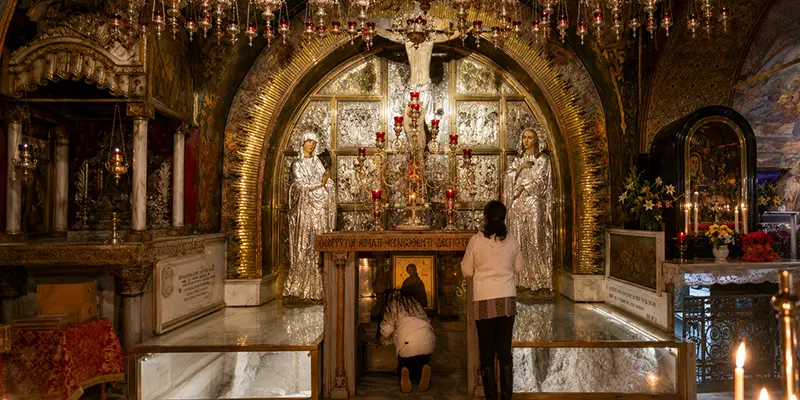
Pilgrims kneel at the Greek Orthodox altar atop Golgotha, reaching beneath it to touch the Rock of Calvary — the twelfth Station of the Cross.
The True Cross and the Woman Who Went Looking
The church's other name for this site is bound up with a relic and a pilgrim. According to ancient tradition, around the year 326 the aged empress St. Helena — mother of Constantine, and herself a pilgrim to the Holy Land — pressed the search for the cross of Christ. Workers cleared away the fill Hadrian had used to bury the site, and three crosses were found. The historical record here is genuinely old and genuinely humble: the earliest chroniclers describe the excavation, and later fourth-century writers name Helena, so the Church has long held the account as pious tradition rather than documented certainty. Deep beneath the basilica, the Chapel of the Finding of the Cross still marks where that discovery is remembered.
The wood was later divided, and fragments traveled to Rome and across the Christian world — so widely that the reformer John Calvin scoffed that the pieces together would fill a ship, though a nineteenth-century inventory found they would not amount to the wood of a single cross. The point for a pilgrim is not the arithmetic. We do not venerate the timber for its own sake; we honor the One who hung upon it. This post reaches you just days before the Feast of the Exaltation of the Holy Cross on September 14, which folds three memories into one day — Helena's finding, the dedication of this very basilica, and the cross's return to Jerusalem after it was seized by the Persians and carried home by a penitent emperor on foot. Helena is worth carrying in your heart up those stairs. She did not travel to admire. She came to find, and she went home changed.
The Empty Tomb
At the heart of the great rotunda stands the Edicule — from the Latin for "little house" — the marble shrine that encloses the tomb of Christ. For years it was bound in an iron cage to keep it from collapsing. Between 2016 and 2017 a team from the National Technical University of Athens, led by Professor Antonia Moropoulou, restored it; and on the night of October 26, 2016, they lifted the marble slab and exposed the original limestone burial bed for the first time in centuries. The scaffolding is gone now, the stone is clean, and the shrine stands free.
To enter, you stoop through a low door into a chamber barely large enough for a few pilgrims at once. A monk keeps the line moving; you may have only seconds at the slab where the Lord's body lay. Many pilgrims are unsettled by how brief it is. But the brevity is itself the gift. You are not a ticket-holder granted a private viewing; you are one of the women arriving in the dark, and you find, as they did, that the grave is open: "Why do you seek the living among the dead? He is not here, but has risen" (Luke 24:5–6). You touch the stone, you are moved along, and you carry the emptiness of that tomb out into the noise of the church — which is exactly the direction the Resurrection is meant to travel.
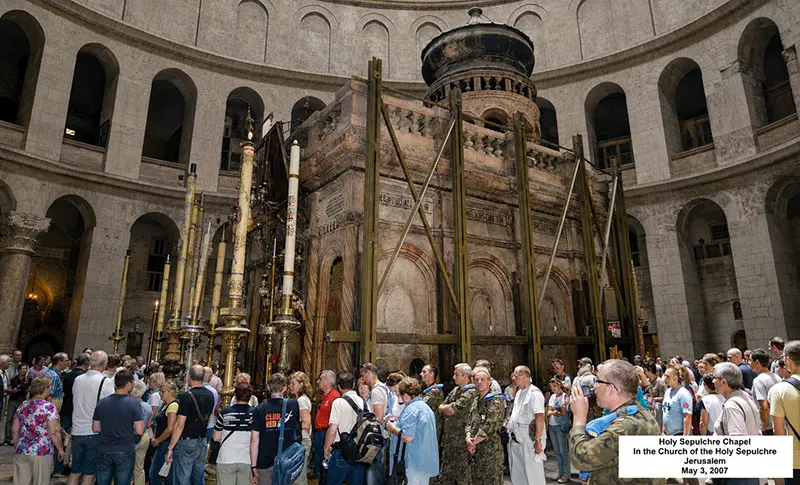
The restored Edicule beneath the rotunda dome encloses the tomb of Christ, where pilgrims wait to stoop through the low doorway to the place of the Resurrection.
What a Church of the Holy Sepulchre Pilgrimage Asks of You
First-time pilgrims are often startled by the sheer commotion of the place. Six Christian communities — Greek Orthodox, Latin (the Franciscans, who have kept the Catholic watch here since the fourteenth century), Armenian, Coptic, Syriac, and Ethiopian — share the church under an arrangement so delicate that a Muslim family has held the door key for centuries, and a wooden ladder on a ledge above the entrance has gone unmoved for nearly three hundred years because no one may move it. Incense from one liturgy drifts into the chant of another. Crowds press. It can feel less like a sanctuary than a crossroads.
A tourist finds this chaotic. A pilgrim, in time, finds it fitting — the whole struggling, praying, imperfect Body of Christ crowded into the one room that holds His cross and His tomb. The way to meet it is to prepare your heart before you ever board the plane. Pack your intentions, not just your camera. Come early, when the doors open and the church is quiet enough to pray. Join the Franciscans as they process through the stations inside the church each afternoon, incensing Calvary and the tomb with hymns of the Passion and Resurrection — pilgrims are welcome to walk with them. The goal of a Church of the Holy Sepulchre pilgrimage is not a full memory card. It is a handful of seeds of grace, carried home and planted, rather than souvenirs bought off a shelf.
A practical word for those planning to come soon: in recent years the basilica has undergone a major, years-long restoration of its floor, with archaeologists excavating the layers beneath the pavement — work that has continued into 2026 and at times has even seen the ancient entrance doors taken down for repair. Throughout, the church has remained open to pilgrims, with temporary flooring laid so that the liturgies and the lines to the tomb go on. You will not be turned away. You may simply find part of the ancient ground fenced for the work of preserving it for the pilgrims who come after you.
The measure of this pilgrimage is not how many chapels you saw or how many photographs you took. It is what you carry back out the door. St. Paul wrote that he would boast in nothing except the cross of our Lord Jesus Christ (Galatians 6:14). To stand at Calvary and kneel at the empty tomb is to be handed that same boast — and, like the Magi who met the newborn King and could not go home the way they came, to be quietly asked to return to your ordinary life by a different way.
Ready to kneel where He rose? If your heart is stirring toward Jerusalem, we would be honored to walk with you. See All Upcoming Pilgrimages to find a journey to the Holy Land, or, if you are a priest considering leading your parishioners to Calvary and the empty tomb, learn how to Lead Your Own Group. However you come, come as a pilgrim — and return changed.