


Tekton Ministries
Publish Date: August 25, 2026
There is a reason Medjugorje has drawn more than forty million pilgrims in four decades, and it has little to do with sightseeing. People come down off the hillsides changed. They return to confession after twenty years away. Marriages are mended, vocations discovered, lukewarm faith set ablaze. For the priest discerning whether to bring a Medjugorje pilgrimage group from his own parish, that documented record of conversion is both a great consolation and the source of a particular pastoral weight. This is not a place you simply visit. It is one you must prepare your people to receive.
Leading any pilgrimage asks more of a shepherd than making one ever could. But Medjugorje carries considerations that even priests seasoned in Holy Land or Rome groups may not anticipate—questions of how to speak about the apparitions, how to channel intense spiritual experiences toward lasting fruit, and how to keep the focus precisely where the Church herself has placed it. What follows is meant to help weigh that responsibility with clarity, so that the graces waiting in this village take root rather than evaporate on the flight home.
What Leading a Medjugorje Pilgrimage Group Asks of a Priest
A travel company can move a group of travelers to a famous place. Only a priest can help a group of pilgrims encounter Christ there. That distinction matters everywhere, but at Medjugorje it becomes the whole game. The atmosphere of the village is saturated with prayer, and pilgrims feel it almost immediately. Your role is to make sure that what they feel becomes something they keep—seeds of grace planted for a lifetime, not souvenirs gathered for a weekend.
You know your parishioners in a way no local guide can. You know which marriage is fragile, which father has drifted from the sacraments, which grieving widow is quietly hoping for a sign. When the rest of the group climbs Apparition Hill, you are the one who can connect that ascent to the particular cross each person is carrying. This is why a priest-led pilgrimage bears fruit that a self-organized journey cannot: you bring the homily tailored to your people, the confessional always within reach, and the pastoral relationship in which grace finds prepared soil.
Understanding the Church's Position—and Teaching It Well
No pastoral consideration is more important than this one, and it is where a priest's leadership becomes indispensable. In September 2024, the Dicastery for the Doctrine of the Faith issued a note titled The Queen of Peace, approved by Pope Francis, granting a nihil obstat—"nothing stands in the way"—to the spiritual experience connected with Medjugorje. Under the Church's revised norms for discerning such phenomena, this is the most favorable judgment available short of a declaration of supernaturality. It authorizes public devotion and openly encourages pilgrimage to the shrine.
What the note does not do is equally important to teach. The Church has not declared the apparitions themselves to be supernatural in origin, and the faithful are not obliged to believe in them. The messages are referred to as "alleged," welcomed as edifying texts rather than confirmed private revelations. A priest who explains this honestly does his pilgrims a great service: he frees them from anxiety on one side and from credulity on the other. For a fuller treatment to share with your group beforehand, our reflection on the Vatican's decision on Medjugorje lays out the distinction in accessible terms.
The most valuable line in the entire document may be its pastoral instruction on where to point the heart. Pilgrims, it advises, should go to Medjugorje not to meet the alleged visionaries or to witness an apparition, but to encounter Mary, the Queen of Peace, and through her to encounter Christ in the Word, the Eucharist, and Eucharistic Adoration—exactly as the faithful do at shrines the world over. Make that your group's compass. When you set it clearly from the first formation meeting, you protect your people from the one disappointment Medjugorje can produce: arriving in search of spectacle and missing the Savior who is quietly waiting in the tabernacle.
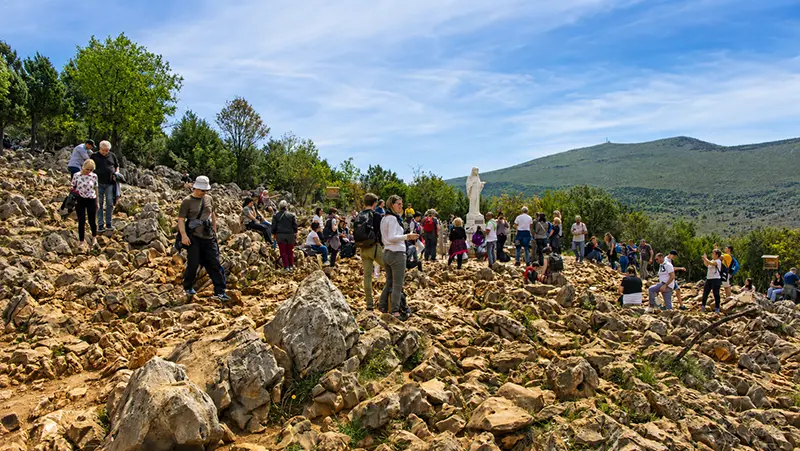
The stony ascent of Apparition Hill, where pilgrims pray the Rosary on their way to the place of the first reported apparitions.
Forming Your Pilgrims Before You Go
Medjugorje rewards the prepared heart. The fruit a pilgrim gathers there is largely proportional to the interior groundwork laid before departure, and that groundwork is the priest's to lead. Consider gathering registered pilgrims several times in the weeks beforehand—not to review luggage allowances, but to help them pack their intentions.
Set expectations honestly. Medjugorje is not a resort. The daily life of the parish is built around the evening prayer program—the Rosary, Holy Mass, and Adoration—and around two demanding climbs: Podbrdo, the hill of the apparitions, and Križevac, Cross Mountain, a steep and rocky ascent to a towering cross. Pilgrims who understand they are undertaking a spiritual discipline will thrive; those expecting leisure will struggle. Frame the difficulty the way the Church has always framed pilgrimage: the sore feet and early mornings are not obstacles to the grace but part of the offering.
Cultivate the pilgrim's posture. Help your people see the difference between a tourist, who looks for something to bring home, and a pilgrim, who goes expecting to be changed. Our foundational reflection on how to prepare for a Catholic pilgrimage is a fitting resource to assign in advance; it gives the group a shared language for the interior journey before the exterior one begins.
The Sacraments: The Heart of What You Bring
Medjugorje has been called the confessional of the world, and for good reason. The Vatican's own note singles out the frequent return to the sacraments—especially Reconciliation and the Eucharist—as among the most evident fruits of the place. As a priest, this is your irreplaceable gift, the one thing no coordinator or guide can supply.
Make yourself generously available for Confession. Pilgrims who have not approached the sacrament in years often find the courage to do so here. Anticipate it. Build unhurried time into the schedule, hear confessions on the bus journeys and in the quiet hours, and let your people know from the outset that you are ready whenever grace moves them. Many priests find they hear more life-changing confessions in a week at Medjugorje than in months at home.
Anchor each day in the Eucharist. Celebrating Mass for your group, and joining the parish's evening Adoration, gives the whole pilgrimage its center of gravity. When pilgrims feel the pull toward emotional highs or toward the visionaries, the Blessed Sacrament gently re-centers them on the One the Queen of Peace always points toward.
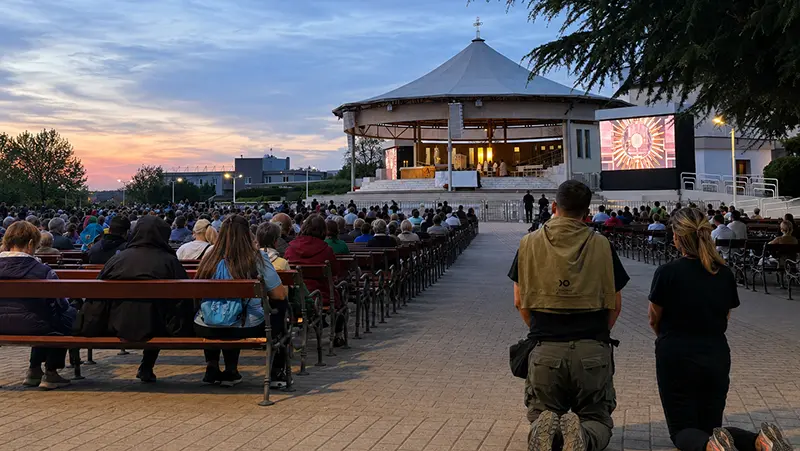
Evening Adoration in Medjugorje, the quiet center of a daily program built around prayer and the sacraments.
Pastoral Care When Emotions Run High
Few destinations stir the heart like this one, and intense emotion brings its own pastoral challenges. Some pilgrims will report profound consolations; others will quietly wonder why they feel nothing while the person beside them weeps. Part of your work is to assure the second group that God is no less present in dryness than in tears, and that the measure of a pilgrimage is never the intensity of feeling but the depth of conversion.
Be ready, too, to redirect the pilgrim who comes hunting for phenomena—spinning suns, miraculous photographs, a private word from a visionary. Gently and without condescension, turn their gaze back to the sacraments and to Our Lady's consistent message of prayer, penance, and peace. This is not to diminish anyone's experience but to protect it, ensuring that what they carry home is Christ rather than a curiosity. And as with any group living in close quarters for a week, expect ordinary friction and address it early; the shepherd who is attentive on the bus prevents most troubles before they reach the dinner table.
Let Us Carry the Logistics
A priest cannot shepherd a group well while also negotiating airport transfers, confirming guesthouse rooms, and arranging Mass times. That is our work, and we are glad to carry it. When we organize a pilgrimage to Medjugorje, we handle the travel, the lodging within the village, the daily schedule, and knowledgeable local guides who respect the devotional purpose of the journey—so that you are freed to do what only you can do.
The clearer this division of roles, the better the pilgrimage. Our role is operational; yours is pastoral. We make the days run smoothly; you lead the prayer, preach the homilies, hear the confessions, and accompany each soul. The best pilgrimages we have ever helped lead are the ones where a priest could give himself entirely to his people because he never had to worry about a single reservation.
Returning by a Different Way
The Magi, having found the Child, went home by another road. The truest sign that a Medjugorje pilgrimage has borne fruit is not what happens on Cross Mountain but what happens the following Tuesday in an ordinary parish kitchen—the resumed Rosary, the repaired marriage, the return to weekly confession. The real pilgrimage begins when your people come home, and your accompaniment should not end at the airport.
Plan a reunion a few weeks after your return. Invite pilgrims to name what has changed, and help them build the new habits the pilgrimage awakened into the fabric of their daily lives. Some of the deepest fruits surface only in hindsight, when a pilgrim realizes that the peace he found in the village has quietly followed him home.
If you are weighing whether to take on this responsibility, take heart. Few things you do as a priest will so visibly rekindle faith as leading your parishioners to the Queen of Peace. The graces are real, the Church has opened the way, and your people are ready to return changed—not merely traveled.
Considering leading your parishioners to Medjugorje? We would be honored to walk beside you, handling every logistical detail so you can give yourself fully to shepherding souls. Explore current dates among our Upcoming Pilgrimages, or learn how we support clergy who wish to Lead Your Own Group.