

Tekton Ministries
Publish Date: July 29, 2026
Every year, hundreds of thousands of people set out across northern Spain on foot, following a thin line of yellow arrows and scallop shells toward a single cathedral in Galicia. Some are hikers. Some are tourists collecting a story. And some are pilgrims. The path is identical for all of them; the journey is not. A Catholic Camino de Santiago pilgrimage is not a long walk that happens to end at a church. It is a thousand-year-old prayer made with the whole body, and the difference between walking it and merely completing it is the difference between a souvenir and a seed of grace.
The temptation on the Camino is to treat the route as a challenge to be conquered: so many kilometers, so many days, a certificate at the end. But the early pilgrims did not walk for the accomplishment. They walked because the body of an Apostle lay at the end of the road, and because the walking itself was a way of saying with their feet what they could not always say with words — that we are not home yet.
What Makes a Catholic Camino de Santiago Pilgrimage Different
The Way of St. James leads to the tomb of the Apostle James the Greater, brother of John, one of the three who saw the Transfiguration and the agony in Gethsemane. According to ancient tradition, after his martyrdom in Jerusalem his remains were carried to the far northwest of Spain, and by the ninth century pilgrims were already streaming toward the site that would become Santiago de Compostela. For a medieval Christian, this was one of the three great pilgrimages of Christendom, alongside Rome and Jerusalem. To walk to Santiago was to walk into the company of the Apostles.
That history is precisely what a tourist can miss while standing on top of it. You can walk the entire route, photograph every village church, and arrive in Santiago having encountered nothing but your own endurance. The pilgrim walks differently. He carries intentions, not just trekking poles. He notices the wayside crosses and the names of the dead carved into stone markers. He understands that the discomfort in his feet is not an interruption of the pilgrimage but part of its substance. The Pilgrim's Office in Santiago makes this distinction official: the Compostela certificate is granted only to those who walk for religious or spiritual reasons, or at least in what the Church beautifully calls "an attitude of search." Everyone else receives a welcome certificate instead. The Camino itself, in other words, asks you which one you are.
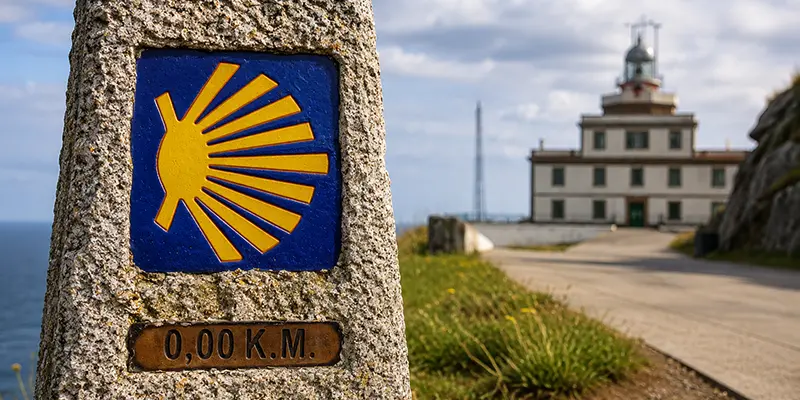
The scallop shell has marked the Way for a thousand years — its grooves, like the many routes, all converging on a single tomb.
When the Body Becomes the Prayer
The Camino is unusual among Catholic pilgrimages because the hardship is not incidental — it is the point. At Lourdes or Fatima you arrive and then pray. On the Camino, the walking is the prayer. Day after day you rise before dawn, shoulder your pack, and put one blistered foot in front of the other for fifteen or twenty miles. There is rain. There is the relentless meseta where the horizon never seems to move. There are mornings your body simply does not want to begin.
This is where the modern instinct to optimize and complain has to die. A tourist treats every inconvenience as a defect in the product. A pilgrim receives the same blister as something he can offer — a small penance united to a much larger Cross. The exhaustion strips away the noise we usually use to insulate ourselves from God, and somewhere around the second week most pilgrims discover that the Camino has begun to walk them. The rhythm of footsteps becomes a kind of rosary. The body, doing something difficult and pointless by the world's standards, finally teaches the soul what it already knew: that we are homo viator, man on a journey, exiles walking home. The Camino simply makes that truth impossible to ignore for a few weeks.
Camino Spiritual Preparation Begins Before the First Step
Most of what determines whether your Camino bears fruit is decided before you ever reach Spain. Serious Camino spiritual preparation means more than breaking in your boots, though you should certainly do that. It means deciding, in advance, what you are carrying interiorly. What are you bringing to the tomb of St. James? A grief, a decision, a conversion you have been avoiding, a person you are walking for? The pilgrims who arrive transformed are almost always the ones who left home with their intentions already packed. This is the heart of the pilgrim mindset, and it is worth reading more about how to prepare your interior life before any pilgrimage long before you book a flight.
There are practical decisions, too. The Camino is not one road but many: the popular Camino Francés that crosses the Pyrenees and runs the width of northern Spain; the coastal Camino del Norte; the Camino Portugués rising up from Lisbon and Porto; the ancient Camino Primitivo. Each has its own character, and the route you choose shapes the pilgrimage you make. Tekton's own Camino de Santiago pilgrimage walks the final stretch of the French Way into Santiago, paced so that pilgrims can pray the road rather than race it. You will carry a credencial, the pilgrim's passport, collecting stamps from churches, hostels, and cafés along the way. To receive the Compostela in Santiago, the Cathedral asks that you cover at least the final hundred kilometers on foot — or two hundred by bicycle — with the credencial stamped to show that you truly walked. For those who cannot manage long distances, even that final stretch into Santiago is enough to make a genuine pilgrimage. When it comes time to fill your pack, a Camino de Santiago packing list will keep the weight on your back honest and your feet protected.
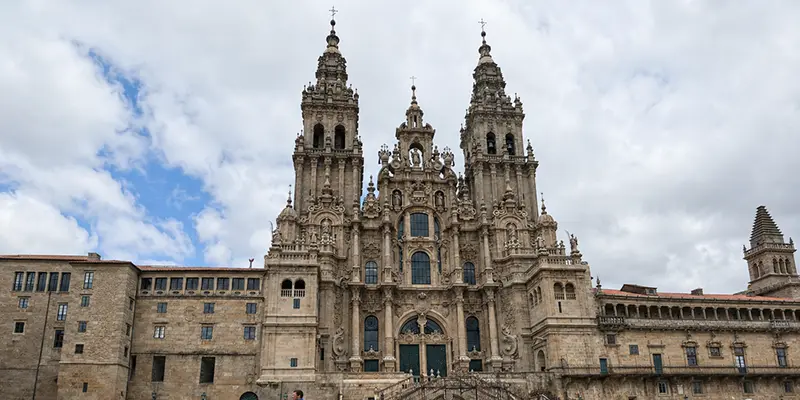
Pilgrims reaching the Praza do Obradoiro after weeks on the road — the moment the Cathedral finally comes into view.
Arriving at the Tomb of the Apostle
The first sight of the Cathedral's spires above the rooftops of Santiago undoes even the most composed pilgrim. You walk into the great square, the Praza do Obradoiro, often in silence, often in tears, surrounded by strangers who have just done the same impossible thing you have. Inside, the tradition is to climb behind the high altar and embrace the jeweled statue of St. James, and to descend to the crypt where his relics are venerated. Whatever you have been carrying for weeks, you lay it down here.
The Pilgrim's Mass gathers the day's arrivals together, and on feast days and certain occasions you may witness the Botafumeiro — the enormous silver censer, taller than a man, swung in great arcs across the transept by a team of red-robed attendants until it nearly touches the vaulted ceiling, trailing incense over the heads of weary pilgrims. It is one of the most stirring sights in the Catholic world, and it carries a meaning beyond spectacle: the prayers of the pilgrims, like the incense, rising. The Compostela you receive afterward, written in Latin, is not a finish-line medal. It is the Church's recognition that you came to the Apostle's tomb as a believer.
Why 2027 Is a Once-in-a-Generation Year to Walk
There is a particular reason to begin thinking about the Camino now. Because the Feast of St. James falls on a Sunday in 2027, that year is a Holy Year — an Año Santo Jacobeo — and these come only a handful of times each century. During a Holy Year the Cathedral's Holy Door, the Porta Santa, is opened, a door pilgrims pass through only in these rare years. The Church offers a plenary indulgence to those who make the pilgrimage and pass through the door, attend Mass, pray for the Holy Father's intentions, and receive the sacraments of Confession and Holy Communion within the customary period.
The last Holy Year fell in 2021 and was muted by the pandemic; the one after 2027 will not come until 2032. For a Catholic weighing whether this is the season to finally make the journey, the calendar is offering a clear answer. Walking to Santiago in any year is a grace. Walking in a Holy Year, through the Porta Santa, to the Apostle's tomb, is the kind of opportunity that does not return often in a lifetime.
The Camino That Begins in Santiago
Here is the paradox every honest pilgrim discovers: arriving in Santiago is not the end. The Magi, after they found the Child, "returned to their country by a different way." So it is with the Camino. The real test of your pilgrimage is not whether you reached the Cathedral but what you carry home from it — whether the patience you learned on the trail survives your return to ordinary life, whether the prayer that grew up in your footsteps keeps growing, whether you have, in fact, become someone different than the person who set out. The certificate goes in a drawer. The transformation, if it took root, comes home with you. That is what it means to return changed, not just traveled — and it is the only measure of a pilgrimage that finally matters.
Ready to walk the Way of St. James as a pilgrim, not a tourist? Tekton Ministries helps Catholics encounter Christ on the Camino and the world's great holy places — and return transformed. See All Upcoming Pilgrimages to find a journey that fits your heart, or if you are a priest or parish leader feeling called to shepherd a group, learn how to Lead Your Own Group to Santiago de Compostela.