


Tekton Ministries
Publish Date: July 13, 2026
On the last free night of his life, Jesus did not look for a quiet room. He went outside the city wall, crossed the Kidron Valley, and climbed a little way up the Mount of Olives to a grove where olives were crushed for their oil. There, beneath the trees and a Passover moon, he fell to the ground and sweated blood. For many travelers, the Garden of Gethsemane becomes the most unforgettable hour of an entire Holy Land pilgrimage—the place where the whole journey suddenly turns personal. To kneel on this exact slope of ground, where Christ accepted his Passion, is to face a question that has nothing to do with whether you found the site and everything to do with whether you are willing to stay awake in it.
A Garden That Remembers an Agony
The name tells you what kind of place this was. Gethsemane comes from the Aramaic gat shemanim, "oil press" — the spot at the foot of the Mount of Olives where the fruit of the harvest was crushed under stone until it gave up its oil. Scripture chose its setting carefully. On this ground, on the night before he died, the One who would be pressed beyond any man's endurance knelt among the presses.
What happened here was not stoic resignation. The Gospels are blunt about it. "My soul is sorrowful even to death," Jesus told Peter, James, and John (Matthew 26:38). He prayed that the cup might pass, then surrendered it back: "Not my will, but yours be done" (Luke 22:42). Luke, the physician, records that his sweat became like drops of blood falling to the ground. This is the first Sorrowful Mystery of the Rosary, and it is the hinge of the whole Passion — the moment Christ freely accepts what is coming.
The Fathers of the Church saw a second garden behind this one. In Eden, a man stood among trees and grasped at a fruit that was not his to take. In Gethsemane, the new Adam knelt among olive trees and refused to grasp anything at all — handing his will entirely to the Father. What was undone under one tree is set right under others. You feel the weight of that the moment you step off the road and into the shade of the grove.
The Question Still Echoes: "Could You Not Watch One Hour?"
There is a detail in the account that should make every pilgrim uneasy, because it is about us. Jesus asked three friends to keep watch while he prayed. He came back and found them asleep. "Could you not watch one hour with me?" he said to Peter. "Watch and pray, that you may not enter into temptation; the spirit indeed is willing, but the flesh is weak" (Matthew 26:40–41).
That question hangs over the garden still, and it is the difference between visiting Gethsemane and praying in it. A tourist comes to photograph trees that are nearly a thousand years old, checks the site off the itinerary, and is back on the coach in twenty minutes. A pilgrim hears the question as addressed to him personally and decides, for once, not to fall asleep. The whole devotion of the Holy Hour — Catholics keeping vigil before the Blessed Sacrament — was born from these words. To stand in the actual garden and refuse to look away is to answer, in your body, a question the apostles failed.
This is why interior preparation matters more here than almost anywhere else in the Holy Land. If you arrive with your heart asleep, the oldest olive trees on earth will not wake it. Pack your intentions before you pack your bag. Decide now what you will bring to the rock — the grief you have not surrendered, the cup you have been asking God to take away. The garden has room for it.
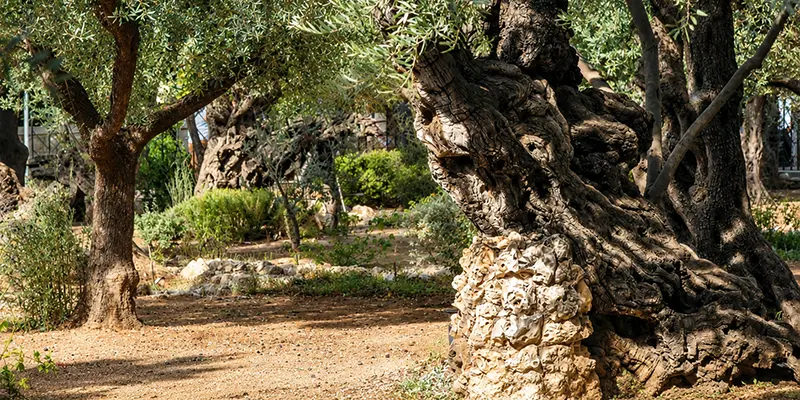
The garden's ancient olive trees stand watch over ground where Jesus prayed in agony the night before his Passion.
What You Will Actually Encounter
The garden today is smaller than most pilgrims expect — a walled grove beside a busy road on the lower slope of the Mount of Olives, directly across the valley from the Old City. Eight enormous olive trees grow there, their trunks split and hollowed with age. When Italian researchers radiocarbon-dated three of them, the wood came back to the twelfth century, making these among the oldest known olive trees in the world. The other five are too hollow to date. They will not be the same trees that sheltered Jesus, then — yet because olives regenerate from their own roots, no one can rule out that these grew up from stumps that did. The Custos of the Holy Land put it plainly: the question is not whether these are the very trees, but whether this is the place. Of that, he said, there is no doubt.
Beside the grove rises the Church of All Nations, also called the Basilica of the Agony. Consecrated in 1924 and designed by Antonio Barluzzi — the architect who shaped so many of the Holy Land's modern shrines — it was built with donations from a dozen countries, whose coats of arms are set into the twelve domed ceilings. Barluzzi did something rare with this church: he made it dark on purpose. The windows are glazed in violet-blue alabaster, the domes painted with a star-filled night sky, so that even at noon you step into the perpetual dusk of that one night. Few churches in the world impose silence so quickly.
At the front, before the high altar, a flat shelf of bare limestone is left exposed and ringed with a crown of thorns wrought in iron. Tradition holds this as the rock where Jesus prayed. Pilgrims kneel and lay their hands on it. After the polished marble of so many holy sites, there is something disarming about touching rough, unfinished stone — the same kind of ground a man would press his face against in anguish.
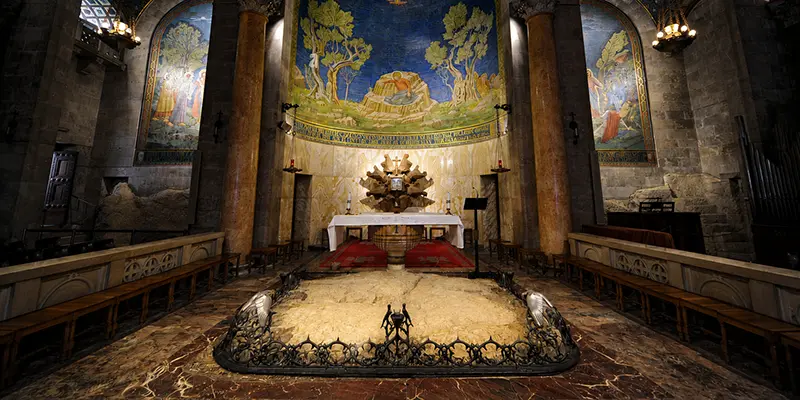
Inside the Church of All Nations, the Rock of the Agony lies exposed before the altar, lit by Barluzzi's violet-blue windows.
How to Pray on a Garden of Gethsemane Pilgrimage
The hardest part of praying at Gethsemane is rarely the travel. It is the crowds, the heat of a Jerusalem summer, the guides moving the next group through, the noise of the road just beyond the wall. You will be tempted to feel that the moment was stolen from you. Don't. The discomfort is not an interruption of the pilgrimage; it is part of it. Christ did not pray here in serenity, and the pilgrim who offers up the press of the crowd as a small share in his agony is closer to the heart of the place than the one who waits, frustrated, for perfect silence that never comes.
Come with a plan to be still. If your group celebrates Mass at one of the altars on the Mount of Olives, let that be the center of your day rather than one stop among many. If there is time to kneel at the rock, pray the first Sorrowful Mystery slowly and name your own cup — the thing you most want God to take away. Then say the harder line and mean it: not my will, but yours. Stay the full hour if you can. The apostles could not, and they loved him. You may surprise yourself.
This is the posture a good pilgrimage cultivates long before arrival, which is why the spiritual groundwork laid at home matters as much as the flight. If you have never thought about the difference between traveling to a holy place and being changed by one, it is worth understanding how to prepare your heart for a pilgrimage before you go. The garden rewards those who arrive ready.
Returning by a Different Way
The Magi who knelt before the Christ Child went home by a different road, and a pilgrimage works the same way: it is measured not by what you saw but by what you cannot un-see once you are home. Gethsemane plants a particular seed. After you have knelt where Jesus accepted the cup, your own moments of dread — the diagnosis, the loss, the night you cannot sleep for worry — carry a memory. You know now that Someone went there first, and went there for you. The grace of this garden is rarely a feeling at the rock. It is the next agony of your ordinary life, met differently.
That is the whole point of coming. Not to gather souvenirs, but to gather seeds of grace; not to return having merely traveled, but to return changed. The trees in the garden will outlive all of us. The question is whether something planted in you there will, too.
Ready to pray where Jesus prayed? Gethsemane is one stop on a Holy Land pilgrimage that can reshape your faith from the inside out. See All Upcoming Pilgrimages to find the journey that's calling you — or, if you're a priest considering leading your parish to the Holy Land, learn how to Lead Your Own Group and shepherd your people through this holy ground.