


Tekton Ministries
Publish Date: June 3, 2026
A Sea of Galilee pilgrimage begins with a strange disappointment. The water looks ordinary — a wide, calm lake ringed by low brown hills, fishing boats still working the same shallows their ancestors did. There is no soaring basilica rising from the shoreline, no obvious drama. And then it settles over you: this is where Jesus walked at the water's edge and said, Come after me. This is where four working men set down their nets in the middle of an ordinary workday and never picked them up again.
That is the question the lake puts to everyone who comes, and it is the whole difference between a tourist and a pilgrim. A tourist comes to see the place where it happened. A pilgrim comes to find out whether it will happen again — to him. The Gospels record no deliberation from Peter, Andrew, James, and John. They left their boats, their nets, their father in the boat with the hired men, and they followed. If you arrive at Galilee asking only what there is to see, you will see a lovely lake. If you arrive asking what He is calling you to drop, you will have made a pilgrimage. (This is the heart of what we call the pilgrim's posture — and it is worth preparing for before you ever board the plane.)
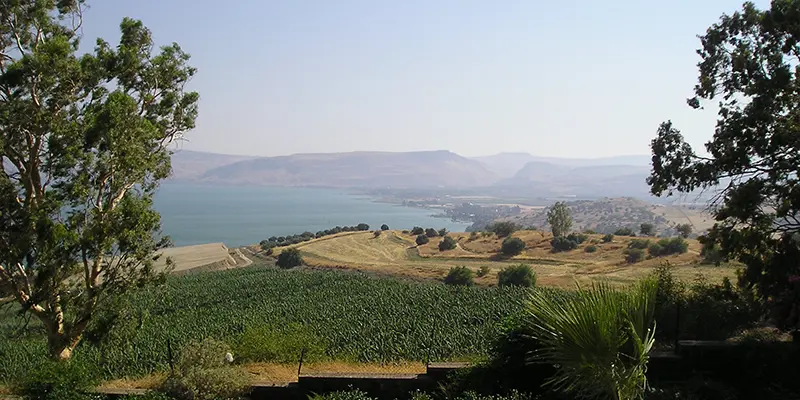
Dawn over the Sea of Galilee, where Jesus first called fishermen to become fishers of men.
Capernaum: The Town That Watched Jesus Work
Scripture calls Capernaum Jesus' "own town" (Matthew 9:1), and standing in its ruins you understand why pilgrims linger here longer than they expect. This was His base — the place He returned to between journeys, the synagogue where He taught the Bread of Life discourse (John 6), the home of Simon Peter where He healed Peter's mother-in-law as she lay in fever. On a Capernaum Catholic tour you can still trace the black basalt foundations of first-century houses and stand beneath a modern church built directly over the home archaeologists believe belonged to Peter himself.
What strikes most pilgrims is not grandeur but smallness. The streets are narrow, the houses humble, the synagogue modest. Jesus chose to spend the bulk of His public ministry not in Jerusalem's grandeur but in a working fishing village where men smelled of the lake. That is a lesson the lake teaches before you have walked a hundred yards: grace is not reserved for the spectacular. It comes to people in the middle of their labor. The pilgrim who grasps this stops waiting for a mountaintop experience and starts watching for Christ in the ordinary — which is precisely where He spent His days.
The Mount of Beatitudes: A Sermon You Can Stand Inside
A short distance up the northern shore, a gentle hillside slopes toward the water. Tradition holds this as the place where Jesus preached the Sermon on the Mount, and the natural amphitheater of the slope makes the claim feel right — a voice from partway up the hill would carry to a crowd gathered below. The octagonal church at the summit, one of the eight sides for each Beatitude, is quiet and unhurried, and most groups celebrate Mass nearby with the lake spread out beneath them.
It is one thing to read "Blessed are the poor in spirit" from a pew at home. It is another to hear those words on the very ground where they were spoken, looking out over the water Jesus knew. The Beatitudes are not comforting platitudes; they are a reordering of everything the world calls success. Pilgrims who let them land here often find the discomfort is the point. You did not travel across the world to have your assumptions confirmed. You came to have them overturned — and the hillside obliges.
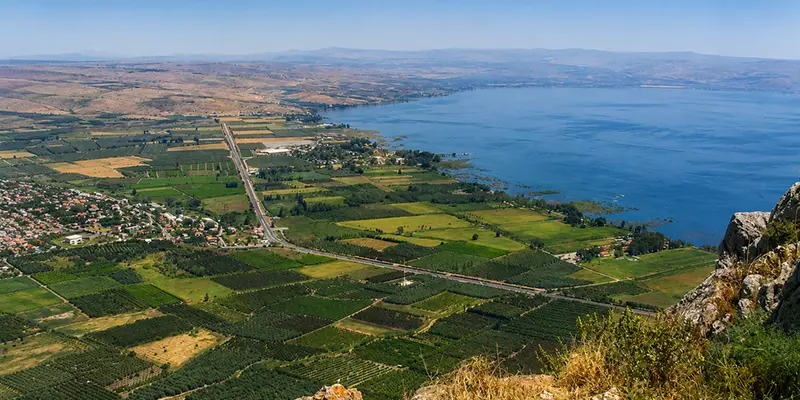
The slope of the Mount of Beatitudes descends toward the lake — a natural setting for the Sermon on the Mount.
Tabgha and the Primacy of Peter: Where Mercy Got the Last Word
Down at the shoreline in Tabgha sits a small, dark chapel built around a flat rock the early Christians called the Mensa Christi — the Table of Christ. This is the traditional site of John 21, where the risen Jesus stood on the shore at dawn, cooked breakfast over a charcoal fire, and asked Peter three times: "Do you love me?" Three questions for three denials. Three commissions — "Feed my sheep" — to undo three failures by the same kind of fire where Peter had warmed his hands and lied.
No pilgrim who has ever failed Christ can stand here unmoved. The lake that witnessed Peter's call also witnessed his restoration, and that is not an accident of geography but a promise. The same shoreline that hears your "yes" will be there when you stumble — and Christ will be standing on it, charcoal fire already lit, asking again. For many who travel to the Holy Land carrying old guilt, the Primacy of Peter is where the trip quietly cracks open.
Out on the Water: The Heart of a Sea of Galilee Pilgrimage
Almost every Sea of Galilee pilgrimage includes a boat ride across the open water, and it is not a sightseeing add-on. It is the closest you will come to standing where the disciples stood. The engine cuts. The boat drifts. The hills that ring the lake look exactly as they did when Jesus told Peter, "Put out into deep water and lower your nets for a catch" (Luke 5:4). Peter, exhausted from a fruitless night, obeyed against his better judgment — and hauled in a catch so heavy the nets began to tear. He fell to his knees: "Depart from me, Lord, for I am a sinful man."
That Latin phrase — Duc in altum, "put out into the deep" — became a rallying cry for Saint John Paul II at the start of the new millennium, a summons not to settle for the shallows of a comfortable, surface faith. It is the precise opposite of the tourist instinct, which prefers the safe edge of the harbor. The pilgrim is asked to row out where the bottom drops away. And this is the same water where the storm rose and the disciples panicked while Jesus slept, where He woke and rebuked the wind, and where they asked one another, trembling, "Who then is this?" To sit on that water in silence is to be handed their question as your own.
This is why the discomfort of pilgrimage matters — the early mornings, the long bus days, the heat, the crowds at the holy sites. None of it is incidental. A tourist resents the inconvenience; a pilgrim offers it. The fatigue is not in the way of the grace. It is part of how the grace arrives, the same way the labor of the nets was never separate from the call.
Returning by a Different Way
The first disciples were called by this lake, but they were not formed by a single dramatic morning. They were formed in the ordinary days that followed — walking the roads, misunderstanding parables, arguing about who was greatest, learning slowly. Discipleship was lived out not on the shoreline but in the long stretch of ordinary time afterward. That is the truest measure of a Sea of Galilee pilgrimage, and it has nothing to do with how many sites you photograph.
The question is what changes when you get home. Which nets do you finally set down? What did you stop carrying because you knelt on that rock at Tabgha or sat in silence on the open water? The Magi met the Christ Child and "returned to their country by a different way," and the disciples who answered the call by this lake never went back to the life they had before. A pilgrimage is fruitful not when it ends but when your ordinary days begin to bear its mark — when the people around you notice that you came back changed, not just traveled. That is what we hope every pilgrim carries home from Galilee: not souvenirs, but seeds of grace.
If the call of Galilee is stirring something in you, the next step is simply to begin. The lake is still there, the question still waiting.
See All Upcoming Pilgrimages →
Are you a priest considering leading your parish to the Holy Land? Learn how to lead your own group →