


Tekton Ministries
Publish Date: June 15, 2026
The sixth day is often when something gives. The group has settled into bus seats and dining-table groupings. The early-trip courtesies have thinned. Someone has started to grate on someone else. A small grievance from yesterday has fermented overnight, and at breakfast it slips into the open.
Anyone who has led a parish pilgrimage knows this rhythm. Twenty or thirty people, many of whom have never traveled together, are sharing meals, hotels, devotional moments, and physical exhaustion for ten consecutive days. Friction is not a sign that something has gone wrong. It is, in many cases, a sign that the pilgrimage is doing exactly what it was meant to do.
A tourist plans a trip and expects it to run smoothly. A pilgrim accepts that the journey itself is part of the offering — that the inconveniences, the close quarters, the personalities that rub against one another are themselves invitations to grace. Seen this way, pilgrimage group management is less about smoothing every interpersonal wrinkle and more about shepherding a small flock through a real spiritual terrain.
Still, shepherding takes wisdom. What follows is not a formula but a set of pastoral observations gathered from years of accompanying priests leading groups through the Holy Land, Rome, Lourdes, and Medjugorje. Some of it may sound familiar. Some of it may help name what hasn't quite had a name yet.
Why Pilgrim Groups Strain — And Why It Is Often a Good Sign
Pilgrimage breaks open the routines that ordinarily keep people composed. Sleep is short. Schedules are dense. Meals are eaten with strangers who, by day seven, are no longer strangers. The interior life is being stirred — sometimes consoled, sometimes confronted — and that stirring rarely stays interior.
What rises to the surface is real. A widow who has held her grief at arm's length for years may find it pressing into every Mass. A husband and wife who travel pleasantly at home may discover they no longer know how to pray together. A capable parishioner who organizes the school carnival without breaking a sweat may find herself, somewhere near the Sea of Galilee, undone by something she cannot quite name.
Group friction, in this light, is often a downstream effect of grace doing its work upstream. The complaint about the breakfast hour is rarely about the breakfast hour. The withdrawn pilgrim is usually not bored. The conflict in the back of the bus is, more often than not, conflict that came from home and traveled along.
Early Signs of Strain — And Why to Address Them Quickly
The first sub-groups that form naturally — friends who flew in together, couples, the women who clicked at the welcome dinner — are healthy. The second tier, the one that hardens into "us and them" by day four, is the one to watch. Cliques can curdle quickly when one segment of the group feels overlooked while another feels superior in their devotion.
Other early signs worth attending to include a pilgrim who consistently sits alone at meals and is not by temperament a solitary; repeated late arrivals that begin to draw eye-rolls from the rest of the group; the pilgrim whose questions at sites are sharpening from curious to combative; quiet tears at locations the rest of the group seems to take in stride; or a spouse who has stopped speaking to their partner at meals.
None of these require an intervention in front of the group. Most can be addressed by a quiet five minutes in the lobby after dinner, or by an inviting walk before the next morning's Mass. The earlier these conversations happen, the smaller they need to be — and much of this work is quietly accomplished even earlier, in the pre-trip formation that sets the group's expectations before the suitcases come out.
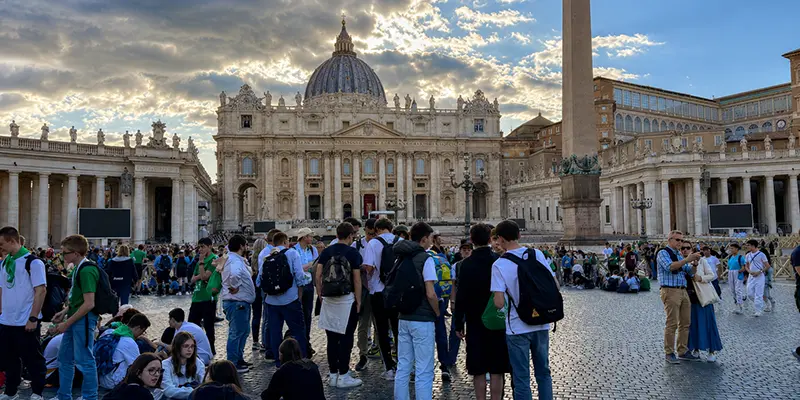
Pilgrims gathered in conversation outside a basilica; the quiet hour between sites is often where pastoral care happens.
Common Personalities — And Pastoral Postures That Help
The Chronic Complainer. Every group has at least one. The hotel pillows, the bus temperature, the pace, the food — nothing quite measures up. It can be tempting to write this pilgrim off, but the complaint is almost always a deflection from something else. Hunger, tiredness, fear of being far from home, grief that hasn't yet found its words. The pastoral move is not to argue with the complaint but to gently widen the conversation: How are you doing? What has stayed with you from today?
The "I Paid for This" Pilgrim. A close cousin of the complainer, but with a different posture — this is the pilgrim who treats the trip as a transaction and the priest (or the guide) as the customer-service desk. The most useful response is a quiet, non-defensive redirection back to the spiritual frame: This isn't a trip we control. We're guests at these sites, and we receive them as gifts. Often, naming the pilgrim posture explicitly is enough.
The Wounded Pilgrim Breaking Open. This is the one to watch for most carefully. A pilgrim who has been carrying something — illness, estrangement, loss, a wound from long ago — sometimes finds it surfacing in the Holy Land or at Lourdes with a force that surprises them. They may need an unscheduled confession. They may need to skip a site. They may need to sit on a bench outside the Holy Sepulchre for thirty minutes and simply be accompanied. This is not a disruption of the pilgrimage. This is the pilgrimage.
The Spiritually Competitive. Less common but worth naming: the pilgrim who keeps tally of who is praying more rosaries, who is at every Mass, who has spent more time in adoration. This usually softens by midweek as the group's own spiritual rhythm absorbs them. A gentle homiletic word about how pilgrimage is not a performance — said to the whole group rather than to one person — often does the work without anyone feeling singled out.
The Pilgrim Who Disappears. Some pilgrims grow quieter as the trip goes on. This is sometimes a sign of deep prayer, sometimes a sign of overwhelm, occasionally both. A brief check-in — I noticed you slipped out of the chapel today. Anything I can pray for? — is almost always welcome, and almost never resented.
The Group as Group: Forming a Common Spiritual Rhythm
Beyond the individuals, the group itself has a shape and a soul. A few practices help it cohere.
Open and close the day together. Morning prayer on the bus, evening reflection at the hotel — even five minutes — does more for group cohesion than any organized "team building." A pilgrimage is held together by its rhythm of prayer, not its rhythm of activities.
Give the group a shared intention. Naming one or two intentions the whole group is carrying — a sick parishioner back home, an upcoming parish initiative, vocations from the parish — gives every Mass and every Rosary a thread that runs through the trip.
Resist the urge to over-program. Pilgrims who have no margin become irritable pilgrims. A free hour in the afternoon does more for group harmony than a third site of the day.
Trust the sacraments to do their work. Daily Mass, generous availability for confession, and quiet time before the Blessed Sacrament will resolve more interpersonal friction than any conversation can. The pastoral care of a pilgrimage group is, at its heart, sacramental care.
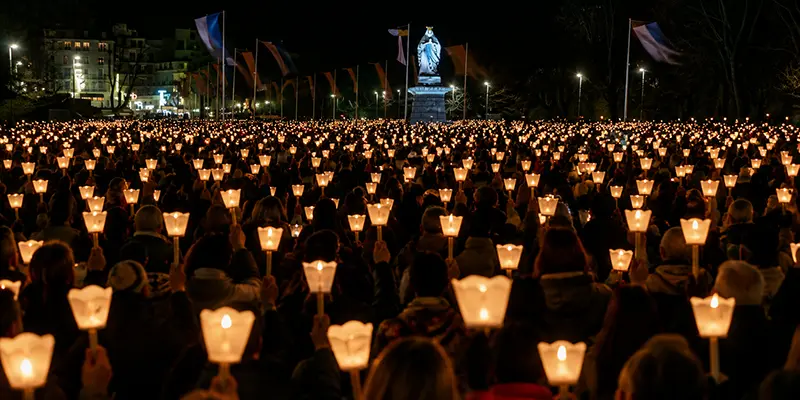
Evening prayer at the close of the day; the rhythm of common prayer steadies a group more than any agenda can.
When Friction Becomes Conflict
Occasionally a tension escalates into something that needs to be named. Two pilgrims who can no longer share meals. A married couple who needs a quiet evening apart from the group. A misunderstanding among friends that has hardened into silence.
The pastoral move in these cases is rarely the public homily. It is almost always the quiet conversation — one pilgrim at a time, listened to fully, then gently invited to release the matter for the sake of the group and, more deeply, for the sake of their own pilgrimage. Few pilgrims, asked directly, will choose to carry a grievance home from the Holy Land. The act of naming the conflict is often most of the resolution.
A useful pastoral question: What would you like to be different when we land back home next week? It moves the pilgrim from the immediate friction to the larger arc of the trip — and to the kind of person they are hoping to be when they walk back into their ordinary life.
The Priest's Own Interior Weather
A priest leading a ten-day pilgrimage is, by midweek, a tired man. He has celebrated daily Mass, heard confessions in inconvenient places, accompanied parishioners through both tears and elation, and likely lost a meal or two to a pilgrim who needed half an hour. His own interior life can drift quietly to the bottom of the list.
This matters not only for his own sake but for the group's. A depleted shepherd reads the group less well, and the group senses depletion before the shepherd does. The simplest practices help: a daily holy hour even if it must be cut short, a brief message to a brother priest or spiritual director, permission given to oneself to step away from an optional site for the sake of prayer. The priest who shepherds himself well shepherds the group well.
After the Trip — Helping the Group Re-Enter
The friction of a pilgrimage often makes more sense in hindsight. The tension on day six becomes, in retrospect, the moment the group began to pray for one another in earnest. The complaining pilgrim returns home and writes a quiet note of gratitude. The marriage that strained on the trip is the marriage that prays together again at home.
A reunion gathering four to six weeks after return — over coffee, with photos shared and stories told — gives the group a chance to harvest what was sown. It is often in this gathering that the priest first hears what really happened beneath the surface of the trip. He should expect to be surprised.
Friction as Part of the Fruit
The Magi did not return by a different way because the journey was easy. They returned changed because something in them had been shifted by what they encountered. Group pilgrimage compresses that pattern — long days, close quarters, real prayer, real grace, real human friction — and asks every pilgrim in the group to let themselves be changed.
The priest who leads the group is not principally a problem-solver. He is a shepherd accompanying a small flock through a country not their own. The friction will come. The graces will come with it. And the group that lands back at the parish on day eleven — quieter, a little worn, carrying something they did not have when they left — is a group that has done the real work of pilgrimage together.
Considering leading your parish on pilgrimage? We walk alongside priests at every stage — handling the logistics, ticketing, and on-the-ground coordination so pastoral attention stays where it belongs. See All Upcoming Pilgrimages to explore available dates, or learn more about how to Lead Your Own Group with our dedicated support for clergy.