

Tekton Ministries
Publish Date: June 9, 2026
The liturgical calendar is more than a schedule of feasts. It is the Church's annual passage through the mystery of Christ—His birth, ministry, passion, resurrection, and the gift of His Spirit. And nowhere is this rhythm felt more vividly than in the land where those mysteries actually unfolded.
In the Holy Land, feasts are not commemorations of distant events. They are celebrations held within yards of where those events occurred. The Mass of Christmas Day at the Grotto of the Nativity. The Easter Vigil at the Holy Sepulchre. Pentecost on Mount Zion. The geography itself participates in the liturgy, and the calendar of the Church becomes a way of walking through the land.
For pastors planning a parish pilgrimage, this changes everything. Choosing the season is not merely a logistical decision—it is a pastoral one. The same itinerary visited in January and in April will yield two profoundly different journeys. Aligning a group with the liturgical year can open doors that no plan, however careful, can unlock on its own.
The Holy Land Lives the Liturgical Year
Elsewhere, the liturgical calendar is observed in parish churches against a backdrop of ordinary life. In the Holy Land, it is observed against the backdrop of its own origin. Lent is walked along the Via Dolorosa not as devotion alone but as memory. Easter is celebrated in the very tomb that could not hold the Lord. The feast and the place collapse into one another.
Pilgrims often describe the experience as something deeper than commemoration—closer, perhaps, to participation. To pray the Rosary in Nazareth on the Solemnity of the Annunciation is to enter the same town, in some real sense, where Mary said yes. To sing the Exsultet at the Holy Sepulchre on Easter night is to stand a few steps from the empty tomb. The mystery and the location are no longer separable.
This is the deepest reason to think carefully about timing. A pilgrim who arrives during Holy Week receives more than added programming. They receive an invitation to step into the mystery the Church is celebrating worldwide, in the very city where it first took place.
The Three Great Pilgrim Seasons: Christmas, the Triduum, and Pentecost
Three liturgical seasons in particular transform a Holy Land pilgrimage into something extraordinary, and each carries its own character.
Christmas in Bethlehem. The days surrounding the Nativity bring an unmatched concentration of devotion to a single square mile. Latin-rite Catholics celebrate the Solemnity on December 25, and the Mass at Saint Catherine's Church beside the Basilica of the Nativity remains one of the most attended and televised Catholic liturgies in the world. The procession from Jerusalem, the candlelit cave beneath the basilica, and the cold desert nights together produce an unforgettable encounter with the Incarnation. The crowds are substantial; the graces, even more so.
The Easter Triduum in Jerusalem. For a Catholic pilgrim, no week is more powerful than Holy Week in Jerusalem. The Stations of the Cross are prayed along the actual Via Dolorosa. Good Friday processions move through the Old City. The Easter Vigil at the Holy Sepulchre—celebrated at various altars within the basilica—places the mystery of the Resurrection at the very edicule from which Christ rose. Logistically, it is the most demanding pilgrimage season. Spiritually, it is the season in which the Holy Land most fully becomes the Fifth Gospel.
Pentecost on Mount Zion. Fifty days after Easter, the Church returns in spirit to the Upper Room where the Holy Spirit descended on the apostles. The Cenacle itself is held under Israeli civil authority, and ordinarily Catholic Mass is not celebrated within its walls, but the Franciscan Custody arranges access for pilgrim prayer, and Mass for parish groups is typically celebrated at nearby churches. Groups on pilgrimage during the Pentecost season often find the readings of Acts coming alive in a wholly new way as they trace the apostles' first journeys outward from Jerusalem.
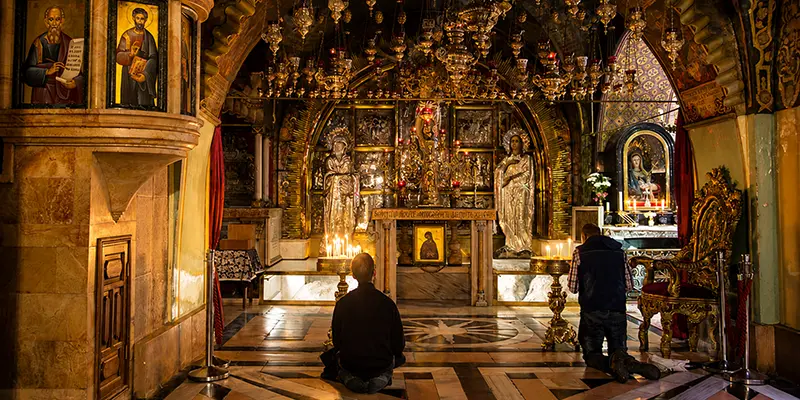
Pilgrims gather inside the Church of the Holy Sepulchre, where the rhythms of the liturgical year unfold steps from the empty tomb.
Marian Feasts in Mary's Own Land
Few experiences match celebrating a Marian feast at the very places where her life unfolded. March 25, the Solemnity of the Annunciation, transforms Nazareth: the Basilica of the Annunciation fills with pilgrims who come to honor the moment when, beneath that very ground, the Word became flesh. The Mass on this day is celebrated at the grotto altar bearing the Latin inscription Verbum caro hic factum est—"the Word was made flesh here."
August 15, the Assumption, draws pilgrims to Mary's Tomb in the Kidron Valley at the foot of the Mount of Olives, and to the Church of the Dormition on Mount Zion, where tradition holds she "fell asleep" before her bodily Assumption. Both sites maintain extended liturgies, and the Catholic community of the Holy Land—small but vibrant—turns out in numbers that fill the streets.
Other feasts to keep in mind: the Visitation (May 31), commemorated at Ein Karem, where Mary went "in haste" to her cousin Elizabeth; the Nativity of Mary (September 8); and the local feast of Our Lady of Palestine, observed in October. For parishes whose Marian devotion is central to their spiritual life, scheduling around one of these feasts can give the pilgrimage a unifying thread.
When the Calendars Differ: Christianity's Many Voices in the Holy Land
One of the most distinctive features of the Holy Land is that several ancient Christian traditions worship side by side, each according to its own calendar. The Greek Orthodox, the Armenian Apostolic Church, the Coptic Orthodox, the Syriac Orthodox, and the Ethiopian Orthodox communities all maintain their own liturgical years, and the Holy Sepulchre itself is shared among them through the centuries-old Status Quo.
For pilgrims, this means that Christmas may be celebrated in Bethlehem three times: by Latin-rite Catholics on December 25, by most Orthodox communities on January 7, and by the Armenian Apostolic Church on January 19. Easter sometimes aligns between Eastern and Western calendars and sometimes diverges by weeks. A group that arrives the week after Latin Easter may find the Holy Sepulchre filled with Orthodox pilgrims preparing for their own Paschal celebrations.
This is not a distraction from the Catholic pilgrimage. It is part of the wonder. Few places make the breadth of the Christian East and West—and the longing for the unity for which Christ prayed—so palpably visible. A well-planned pilgrimage can take advantage of these differences, allowing pilgrims to witness the Eastern liturgies as a moving expression of the same faith in another voice.
Ordinary Time and the Hidden Graces of Quieter Seasons
Not every pilgrimage should be planned around a feast. The stretches of Ordinary Time—particularly late September through early November, and parts of January and February—offer something the great feasts cannot: quiet.
At the Holy Sepulchre on an ordinary Wednesday morning, a parish group can pray at the Stone of Anointing without crowds pressing in. Mass at the Mount of Beatitudes can be celebrated under an open sky with only the wind and the lake for company. The Garden of Gethsemane, almost empty, becomes a place where a pilgrim can actually sit in the shade of an ancient olive tree and pray.
For groups whose spiritual goals lean toward contemplation, silence, and unhurried prayer—particularly those including pilgrims who have been to the Holy Land before—the quieter seasons are often the richer choice. The liturgical year is not absent in Ordinary Time. The green of the vestments is the color of growth, and growth tends to happen in stillness.
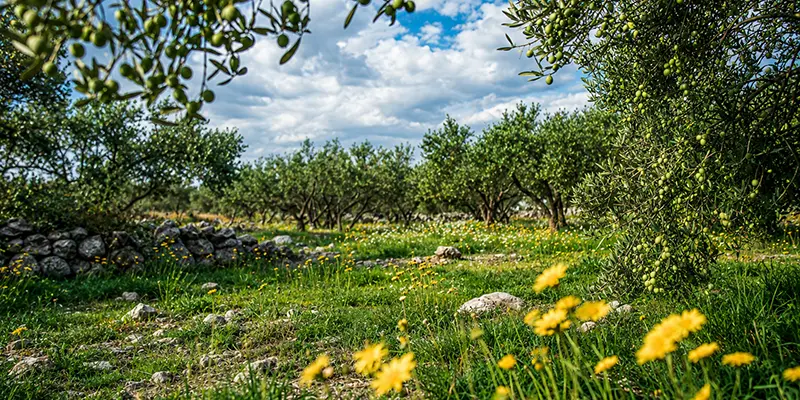
An olive grove at the Mount of Beatitudes in Ordinary Time, when quieter days allow pilgrims to settle into prayer.
Practical Realities of Feast-Day Pilgrimage
Pilgrimages timed to major feasts carry particular logistical demands. Hotels in Bethlehem and Jerusalem book months—sometimes a year—in advance during Christmas and Holy Week. Mass reservations at the major churches, especially the Holy Sepulchre and the Basilica of the Nativity, must be secured well ahead of time and confirmed in writing. Bus and walking routes must adapt around processions and street closures, and certain sites limit group sizes during peak weeks.
At Tekton, we coordinate the practical side of all of this—Mass times, hotels near the holy sites, transportation around feast-day disruptions, and the relationships with the Franciscan Custody of the Holy Land that make Catholic liturgy possible at restricted locations. Our aim is to relieve clergy of the logistical weight so the pastoral work can have their full attention.
Pilgrims should also expect that the experience itself will be more demanding. The crowds, the late-night vigils, the longer waits, the early starts: all are part of the offering. Embracing these difficulties as part of the pilgrim's gift, rather than treating them as obstacles, is the difference between a feast-day journey that exhausts and one that transforms.
Discerning the Right Season for a Parish Group
The right season depends on the group. A parish whose pilgrims are largely first-time travelers may benefit from a quieter season, when the basic geography of the Holy Land has room to settle into the heart. A group whose members are seasoned in the faith and seeking an intense liturgical immersion may flourish during the Triduum. A parish with strong Marian devotion may want to time the trip to the Annunciation in Nazareth or the Assumption on Mount Zion.
Consider also the spiritual goals being held in prayer. Are pilgrims seeking healing, vocational discernment, marital renewal, conversion of life? Each of these can find a particular home in the liturgical calendar. The pilgrim wrestling with suffering may find Holy Week transformative. The Marian devotee comes most fully alive at Nazareth, Ein Karem, or Mount Zion in August. The parish seeking renewal in the Holy Spirit may find Pentecost season exactly the moment.
Most importantly, the question that lingers in the background is the one the Magi might have asked: not when is it convenient, but when is the Lord calling our parish to set out? The star moves at its own pace.
The liturgical year does not exist to crowd a pilgrimage with extra commitments. It exists to mark the rhythm by which the Church walks through the mystery of Christ year by year. To plan a pilgrimage in conscious dialogue with that rhythm is to acknowledge that the Holy Land is not simply a destination but a participation—and that the calendar of the Church is the keel by which we orient ourselves through it.
Whatever season is chosen, the deepest fruit of pilgrimage is never measured by what was seen but by what comes home. The pilgrim who walks the Via Dolorosa on Good Friday and the pilgrim who walks it on a quiet Tuesday in October are walking the same path—and both, if they have made the journey as pilgrims and not as tourists, return by a different way.
Discerning the right season for your parish? We would be honored to help you weigh the liturgical timing alongside the spiritual goals you are carrying into the journey. See All Upcoming Pilgrimages to explore dates throughout the liturgical year, or learn more about how to Lead Your Own Group with our dedicated support for clergy.