

Tekton Ministries
Publish Date: May 27, 2026
The disciples were behind locked doors. Christ had risen, but the men who had walked with Him were still afraid. They stayed in that room for nine days after the Ascension — praying with Mary, waiting on a promise they did not yet understand. Then came the rush of wind. The tongues of fire. They walked out into the streets of Jerusalem and preached to a crowd in languages they had never learned. About three thousand were baptized that day. The men who had hidden in an Upper Room emerged from it as the Church.
Two thousand years later, pilgrims climb the stone stairs of Mount Zion and step into the same room.
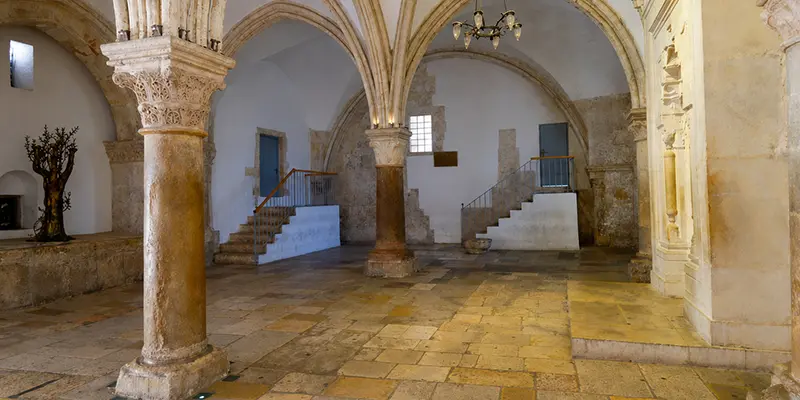
The Cenacle on Mount Zion — the Gothic vaults of the Crusader-era structure where Christians have venerated the site of the Last Supper and Pentecost for centuries.
Where the Church Was Born
The Upper Room — also called the Cenacle, from the Latin cenaculum for "dining room" — sits on Mount Zion just outside the southwestern wall of Jerusalem's Old City. The building you walk into today is a medieval Gothic structure — scholars debate whether the surviving rib vaults belong to the Crusader period, to Frederick II's brief Christian rule in the thirteenth century, or to the Franciscan reconstruction of the 1330s — raised over the foundations of what the earliest Christians venerated as the site of the Last Supper, the post-Resurrection appearances, and Pentecost.
That is a great deal of weight for one room.
Scripture places these events in "the upper room" without giving a street address. But by the late first century, the Christians of Jerusalem had marked this exact place as the gathering site of the apostles. A church was built here in the fourth century. It was destroyed and rebuilt many times — by Persian invasion, Muslim conquest, Crusader reconstruction, Ottoman conversion to a mosque. The Arabic inscriptions and mihrab (prayer niche) still visible in the walls testify to that complicated history. So does the small dome above. So does the silence.
What Happened in This Room
Three moments give the Upper Room its weight, and a pilgrim's preparation should sit with each of them.
The first is the Last Supper. Here Christ instituted the Eucharist on Holy Thursday — "Do this in remembrance of Me." Every Mass in every Catholic church on earth flows from that table.
The second is the Resurrection. After His rising, Jesus appeared to the disciples in this room twice — first to ten of them with Thomas absent, then a week later to all eleven (John 20:19–29). It was here He breathed on them and gave them the power to forgive sins: "Receive the Holy Spirit. Whose sins you forgive are forgiven them." The sacrament of Reconciliation begins in this room.
The third is Pentecost. Mary was there. The apostles were there. So were the other disciples — about a hundred and twenty in all (Acts 1:15). They had been praying for nine days. Then "suddenly there came from heaven a noise like a strong driving wind, and it filled the entire house in which they were. Then there appeared to them tongues as of fire, which parted and came to rest on each one of them" (Acts 2:2–3).
Peter — who weeks earlier had denied even knowing Christ — stepped outside and preached the Gospel to Jews from every corner of the diaspora. The Church was no longer a frightened community behind locked doors. It was a missionary Body.
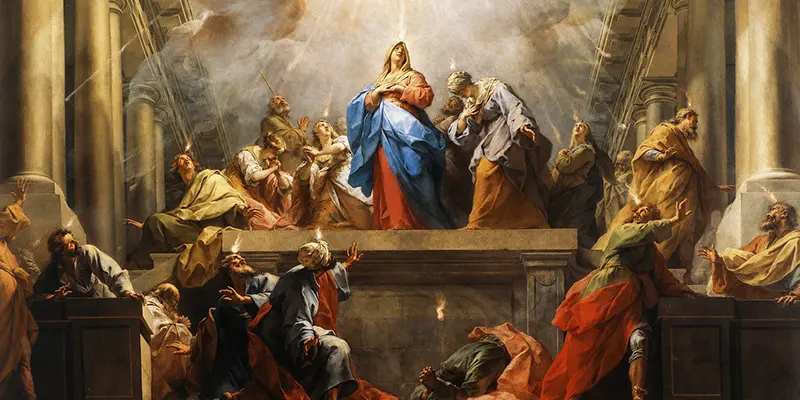
A traditional depiction of Pentecost — Mary and the apostles receiving the Holy Spirit in tongues of fire, the moment the Church became visible to the world.
What Pilgrims Find on Mount Zion Today
The walk up Mount Zion takes you past the Zion Gate, still scarred by bullet holes from the 1948 war. The Cenacle sits at the top of an unassuming stone staircase. There is no admission fee. There is no ticket booth. There is also, for most groups, no Mass.
This is the part of the visit that surprises pilgrims most. The building is owned by the State of Israel, and for complex reasons rooted in the layered religious history of the site, public Catholic Mass inside the Cenacle is not permitted on ordinary days. The Franciscans of the Custody of the Holy Land are allowed to celebrate Mass inside the room only twice a year: on Holy Thursday and on Pentecost Sunday. The rest of the time, Mass for Catholic pilgrims is celebrated a few steps away at the Franciscan convent of St. Francis Ad Coenaculum — affectionately known as the Cenacolino, or "Little Cenacle" — and many groups also celebrate the Upper Room mysteries at the nearby Church of St. Peter in Gallicantu.
What you encounter in the Cenacle itself is something different: quiet. A high Gothic ceiling. A few groups praying softly in their own languages. Light through narrow windows. The strange weight of standing in a place where Christ gave Himself to His Church in bread and wine, where He breathed the Spirit on terrified men, where Mary prayed for the fire to come down.
Below the Cenacle, on the ground floor, is a Jewish shrine venerated as the Tomb of King David. Catholic pilgrims often visit both — a reminder that the same hill held the throne of David and the birth of the New Covenant. Adjacent to the building stands the Church of the Dormition, marking the traditional site where Mary fell asleep at the end of her earthly life.
Preparing Interiorly Before You Visit
A pilgrim who walks into the Cenacle without preparation will see a room. A pilgrim who comes prepared will encounter a moment.
Before you travel, read Acts 1 and Acts 2 slowly. Notice that nothing happened immediately. The apostles waited. They prayed. Mary was with them, persevering in prayer with the others (Acts 1:14). The descent of the Spirit followed nine days of patient waiting — the original novena. Bring that posture into your trip.
Pack your intentions, not just your suitcase. Ask the Holy Spirit, before you leave home, to give you whatever gift you most need: courage, clarity, conversion, the grace to forgive someone, the strength to abandon a habit you cannot abandon on your own. Write the intention down. Carry it into the room.
A tourist visits the Cenacle and takes a photograph. A pilgrim visits the Cenacle and asks for fire.
The Real Pentecost Begins When You Go Home
The disciples did not stay in the Upper Room. They left. They preached. They went on to die for what happened to them there.
This is the standard for a pilgrimage to Mount Zion, and for any pilgrimage. The visit is not the point. The transformation is the point. What you carry back into ordinary life — your parish, your family, your work, your prayer — is the measure of whether the Holy Land took root in you, or whether you were only a traveler passing through.
The Magi, after meeting the Christ Child, returned to their country by a different way. The apostles, after Pentecost, returned to the streets of Jerusalem as a different Body. A faithful pilgrim returns home changed — slower to anger, quicker to forgive, more alive to the Eucharist, less attached to comfort, more in love with Christ than before.
That is why we go.
Walk with us to the Upper Room.
Tekton Ministries leads Catholic pilgrims to Jerusalem and the holy sites of the Holy Land each year, traveling with priest chaplains, Knowledgeable Catholic or Christian guides, and small groups committed to the pilgrim's interior journey. If the Spirit is stirring something in you about the Holy Land, we would be honored to walk that road with you.
See All Upcoming Pilgrimages →
Lead a Group from Your Parish →
For a deeper look at how to approach any pilgrimage as more than religious tourism, read our foundational guide: How to Prepare for a Catholic Pilgrimage — The Magi Principle.