


Tekton Ministries
Publish Date: May 20, 2026
There is something disarming about Fatima. After the grandeur of Rome or the layered antiquity of the Holy Land, the Cova da Iria can feel almost too plain — a wide esplanade, a humble chapel marking the place of the apparitions, a basilica at one end. The transformation that happens at this Marian shrine does not depend on architecture or scale. It happens through what Our Lady asked of three shepherd children in 1917: prayer, penance, and an utterly Catholic seriousness about the things of God. To lead a Fatima pilgrimage is to lead souls into that seriousness — and that asks something distinct of the priest who shepherds the group.
We have walked the esplanade with many groups over the years, and we have watched the same pattern unfold again and again. The pilgrims who arrive expecting spectacle leave puzzled. The pilgrims who arrive ready to pray come home changed. The priest who leads them stands at the center of that difference.
Why Fatima Asks Something Different of the Shepherd
Fatima is shaped by a private revelation that the Church has formally approved and that profoundly marked the twentieth century. Unlike Jerusalem, where the Gospel itself unfolds beneath one's feet, or Rome, where two millennia of Tradition rise on every corner, Fatima centers on a single message delivered to three shepherd children: Lúcia dos Santos and her cousins Francisco and Jacinta Marto. The geography is real and important, but it is secondary to the call. The Cova da Iria matters because of what was said there.
This shifts the pastoral task. A priest at Fatima is not primarily orienting his pilgrims to layers of biblical or ecclesial history. He is forming them to receive a maternal correction. The message of Fatima is not gentle in the saccharine sense — it is the kind of gentle that asks for the daily Rosary, for sacrifice offered for sinners, for consecration to the Immaculate Heart. Helping pilgrims hear and accept that call is the substance of the work.
Forming Pilgrims Before They Arrive
Fatima will not impress a tourist. There are no Renaissance frescoes, no Roman ruins, no Sea of Galilee at sunrise. The Sanctuary is sober and uncluttered by design. Pilgrims arriving in a tourist posture — collecting photographs, hunting for spectacle — will often leave underwhelmed. Those who arrive prepared to pray will find the place opening before them like a door.
Pre-pilgrimage formation makes the difference. A handful of evening sessions in the months before departure can prepare pilgrims to read Fatima rightly. Walk through the chronology of the apparitions, from the Angel of Peace's visits to the children in 1916 through Our Lady's six appearances between May and October 1917. Introduce the children themselves — Francisco's silent reparation, Jacinta's burning love for souls, Lúcia's long obedience over a lifetime in the cloister. Read together from Sister Lúcia's memoirs. Pilgrims who arrive knowing the children's faces and stories meet them at Aljustrel as friends, not strangers.
Formation also reorients expectations. Catholics raised on travel content sometimes carry an unconscious sense that a holy site should be impressive in a worldly register. Fatima is impressive in a different register — the register of obedience, of small things done with great love, of Heaven choosing illiterate children in a remote Portuguese village to deliver a message to the whole Church. Naming this in advance saves the disorientation many pilgrims feel in the first hour at the Cova.
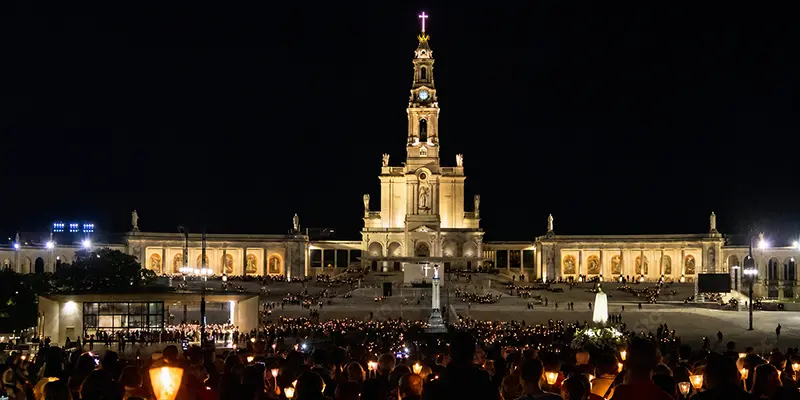
The candlelight Rosary procession crosses the esplanade at the Sanctuary of Fatima each evening, a devotional rhythm that has marked the Cova da Iria for over a century.
The Rhythm of the Sanctuary
The Cova da Iria has its own liturgical rhythm, and a Fatima group pilgrimage finds its shape inside that rhythm rather than imposing one from outside. The day at the Sanctuary moves through several anchor moments: morning Mass at the Capelinha das Aparições — the small chapel marking the exact spot of the apparitions — the International Rosary recited at midday in many languages, and the candlelight Rosary procession after dusk. That evening procession is perhaps the most affecting devotional moment in the modern Church. Pilgrims walking the esplanade with candles in hand, hearing the Ave Maria sung as Our Lady's statue is carried from the Capelinha, sustain a memory that lasts a lifetime.
Building the itinerary to honor these moments rather than rush past them matters. We typically structure days so that each evening ends at the procession, rather than scheduling departures or dinners that compete with it. The interior fruit of a Fatima visit gathers slowly, in repeated returns to the Capelinha. A group that prays the Rosary there in the morning, again at midday, and again at night has done the work of pilgrimage as Our Lady asked it to be done.
Mass at the Heart of Fatima
The Eucharist sits at the center of the message of Fatima. When the Angel of Peace appeared to the three children in 1916, he gave them Holy Communion. Our Lady, during her own apparitions the following year, repeatedly directed the children toward reparation for sins against the Blessed Sacrament and toward devotion to her Son in the Eucharist. To celebrate Mass at Fatima is to enter directly into that current.
Mass at the Capelinha is the most sought-after liturgy at the Sanctuary, and securing a time requires advance coordination. We handle that arrangement for the priests we work with — along with vesting, server coordination, and the practical pieces that allow the priest to focus entirely on the altar. Side chapels in the Basilica of the Most Holy Trinity and the Basilica of Our Lady of the Rosary offer additional opportunities for daily Mass, each with its own atmosphere of recollection.
Confession and the Call to Conversion
It would be hard to overstate the role of confession at Fatima. The message of the apparitions is, at its core, a call to conversion, and pilgrims feel that call viscerally on the esplanade. The Sanctuary maintains an extensive confession center where priests hear in many languages throughout the day, a quiet engine of grace that runs beneath the public devotions.
Priests leading groups do well to make themselves available for the sacrament beyond the official confession hours — at the hotel after dinner, on the bus during transitions, in quiet corners of the basilica between liturgies. Pilgrims often surface long-carried burdens at Fatima that have resisted resolution at home. The grace of the place breaks them open, and the priest's presence at the right moment is the difference between a stirring and a healing.
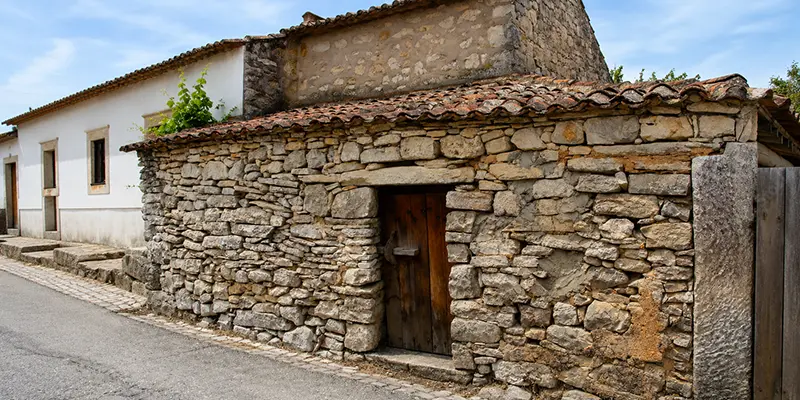
The modest stone homes of the three shepherd children at Aljustrel, a short walk from the Sanctuary, where the faith of Fatima becomes domestic and ordinary.
Beyond the Esplanade
The Sanctuary is the center, but a complete Fatima pilgrimage extends outward into the children's own landscape. Aljustrel — the small village a short distance from the Cova — preserves the homes of Lúcia and of Francisco and Jacinta Marto, modest stone houses where the children lived their hidden lives. Walking through these rooms is a different experience from standing on the esplanade. The faith of Fatima becomes domestic, ordinary, accessible.
Nearby, Valinhos marks the site of the August 1917 apparition, when Our Lady appeared to the children after they had been detained by the local civil administrator. Loca do Cabeço, a stony hollow up the hillside, is where the Angel of Peace appeared in 1916 and taught the children the prayer beginning, "My God, I believe, I adore, I hope, and I love You." These quieter sites reward slow visits and unhurried prayer.
The Hungarian Way — a Stations of the Cross built by exiled Hungarians after the Second World War — leads from the edge of Aljustrel to the Calvário Húngaro at the summit. Walking it with a group, pausing to pray each station along the rising path, is one of the more powerful penitential exercises a pilgrimage can offer, and it situates the suffering of the children inside the wider mystery of the Cross.
Returning by a Different Way
Fatima is unusual among major pilgrimage destinations in that its message is portable. The Holy Land cannot be carried home; Rome stays in Rome. But the daily Rosary, the First Saturday devotion, the consecration to the Immaculate Heart — these are practices a pilgrim can take up at the kitchen table on a Tuesday in November. A successful Fatima pilgrimage is one where the prayers begun at the Capelinha do not end at the airport.
This is where the priest's role extends past the pilgrimage itself. The graces a pilgrim receives at the Sanctuary need a structure to take root in when ordinary life resumes. A parish Rosary group, a renewed catechesis on Marian devotion, the priest's continued pastoral attention to those he led — the work of integration is part of the arc of the pilgrimage, not an addendum to it.
Our Lady did not ask the children at Fatima to be impressed. She asked them to pray, to make sacrifices, and to consecrate themselves to her Son through her Immaculate Heart. The priest who leads pilgrims well at Fatima invites them into that same posture — and watches them return home with the prayer that has shaped saints for more than a hundred years now beating quietly under their everyday lives.
Considering a Marian pilgrimage for your parish? We would be honored to walk that road with you. See All Upcoming Pilgrimages to explore Fatima dates and itineraries, or learn how to Lead Your Own Group with the support we provide for clergy at every step.