


Tekton Ministries
Publish Date: May 6, 2026
To stand at the tomb of Peter is to stand at the foundation of the Church. To kneel before the relics of saints whose names we invoke at every Mass, to walk the catacombs where our forebears in faith celebrated the Eucharist in secret, to hear the Successor of Peter teach with his own voice—Rome offers Catholic pilgrims something no other destination can: a tangible encounter with the universal Church across two millennia.
For priests, leading a parish to Rome is among the most formative pastoral works imaginable. It is not simply a matter of organizing travel. It is an opportunity to root your people more deeply in their Catholic identity, to introduce them to the saints whose witness has shaped the Church, and to bring them face to face with Peter himself.
It is also why a Rome pilgrimage requires careful preparation that goes well beyond logistics. Done well, it changes parishioners. Done hastily, it overwhelms them and reduces one of the most sacred cities on earth to a checklist of monuments. What follows is the wisdom we have gathered from three decades of accompanying priests as they lead parish groups to Rome and the Vatican.
Why Rome Matters: The Heart of Catholic Pilgrimage
Rome is the city of two apostolic martyrs. Peter was crucified upside down on the Vatican Hill; Paul was beheaded along the Via Ostiensis. Their bones still rest beneath the basilicas that bear their names, anchoring the faith of every Catholic across the globe. When pilgrims grasp this, the entire experience shifts. They are not visiting a city of art and history. They are coming home to the family seat of the Universal Church.
For parishioners, this encounter does something that no Bible study or homily quite can. The Church becomes visible, ancient, and concrete. The Communion of Saints stops being an abstraction. The continuity of apostolic teaching—from Peter to Linus to Cletus to Clement, all the way to the Holy Father in our own day—becomes a living reality they can trace with their own footsteps.
This is the difference between a Rome tour and a Rome pilgrimage. Tourists collect images of the Sistine Chapel; pilgrims encounter the patrimony of the faith handed down to them. Tourists look for souvenirs; pilgrims look for seeds of grace they will carry home and plant in the soil of their ordinary lives. The priest's role, as their shepherd, is to help them make that distinction—and to live into it once the trip ends.
Spiritual Preparation: Forming Pilgrims Before Departure
The most fruitful Rome pilgrimages begin months before the plane takes off. We strongly encourage offering a series of formation sessions for registered pilgrims—four to six gatherings in the weeks leading up to departure. Rome is too rich, too layered, and too overwhelming to encounter cold.
The Acts of the Apostles is the Scripture text for a Roman pilgrimage. Walking with Peter and Paul through Acts—their preaching, their imprisonments, Paul's eventual journey to Rome under Roman guard—prepares pilgrims to grasp the weight of what they will see. Many will have read these chapters distractedly for years. Reading them in light of the impending trip transforms the experience.
Lives of the saints connected to Rome deepen the encounter further. Introduce your pilgrims to St. Cecilia, whose body was found incorrupt; St. Agnes, martyred at thirteen; St. Catherine of Siena, who is buried at Santa Maria sopra Minerva; St. Philip Neri, the joyful apostle of Rome; and the early popes whose witness preserved apostolic teaching. When pilgrims arrive at the basilicas dedicated to these saints, they meet old friends rather than strangers.
Papal teaching is another point of preparation that priests are uniquely positioned to provide. Reading a brief encyclical or working through a key magisterial theme gives pilgrims a sense of the Petrine office before they hear Peter's successor speak in person. Even thirty minutes of guided reading on the keys of the kingdom, or on the role of the papacy across history, elevates the eventual experience.
Personal intentions matter as much in Rome as anywhere. Encourage pilgrims to consider what they are bringing. What do they wish to lay at the tomb of Peter? What confession are they preparing to make? What healing are they seeking through the saints whose relics they will venerate? Pack the intentions, not just the suitcase. Rome richly rewards the pilgrim who arrives with an open and expectant heart.
Planning the Itinerary: Rome's Particular Challenge
Rome rewards depth more than breadth. The temptation is to see everything—the Forum, every basilica, every museum—and to leave exhausted with little remembered. Resist this. A parish pilgrimage is not a survey course in Roman history. It is a spiritual encounter, and the encounter requires time to take root.
The Four Major Basilicas form the sacred heart of any Roman itinerary: St. Peter's at the Vatican, St. John Lateran (the cathedral of Rome and the Pope's own basilica), St. Mary Major, and St. Paul Outside the Walls. Each tells a different chapter of the Church's story. Build in time at each not just for sightseeing but for prayer.
The Scavi tour—the excavations beneath St. Peter's leading to the bones of the apostle himself—is one of the most powerful experiences available to Catholic pilgrims. Spaces are extremely limited, and reservations must be requested months in advance through the Vatican's Excavations Office. If a group can secure even a small allocation of spots, the impact is unforgettable.
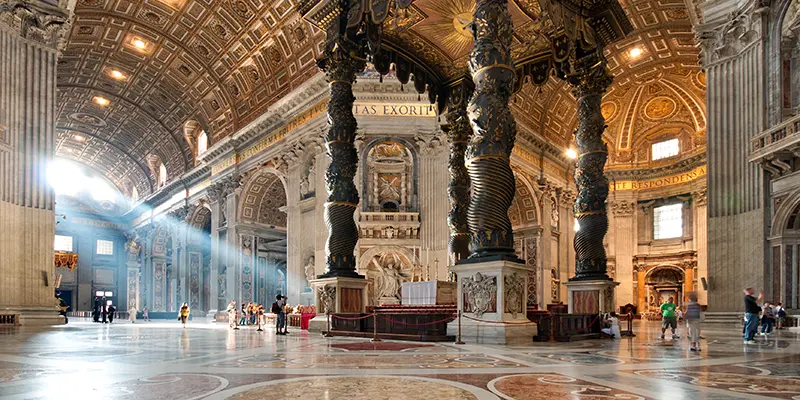
A pilgrim group pauses in St. Peter's Basilica, where the bones of the apostle rest beneath the high altar
The Catacombs—particularly those of St. Callixtus, Domitilla, or Priscilla—connect pilgrims to the earliest generations of Christians. To celebrate Mass in a catacomb chapel, surrounded by the graves of those who died for the faith, is to participate in something unbroken since the first century. Few moments in pilgrimage carry more weight.
The Papal Audience on Wednesdays in St. Peter's Square (or the Paul VI Audience Hall in winter) gives pilgrims the experience of seeing and hearing the Successor of Peter in person. Tickets must be requested well in advance through the Prefecture of the Papal Household, and we have written separately about the process of securing them for a parish group.
Time outside the obvious sites is what separates a deep pilgrimage from a rushed tour. Quiet hours in San Clemente (where three layers of history are stacked from a fourth-century basilica down to a first-century pagan mithraeum), an unhurried morning at Santa Maria sopra Minerva, a slow afternoon at the Holy Stairs—these are the moments where the Spirit often moves most powerfully. We recommend planning no more than three major sites per day, with genuine breaks between them.
Celebrating the Sacraments in Rome
The opportunity to celebrate Mass at the altars of Rome is among the most profound graces available to a priest. No tour company can offer this; only a priest can.
Daily Mass at significant sites should anchor each day of the pilgrimage. We work with our priest groups to secure Mass times at St. Peter's, the Major Basilicas, the Catacombs, and other significant churches. Celebrating the Eucharist at a side altar in St. Peter's, or in one of the chapels of Santa Maria Maggiore, creates moments of grace parishioners remember for the rest of their lives.
Prepare homilies in advance that connect each site to the lives of your parishioners back home. The witness of St. Cecilia speaks to a parish wrestling with how to give witness in a hostile culture. The repentance of St. Augustine, whose mother Monica is buried at Sant'Agostino, speaks to families who pray for wayward children. Site-specific preaching is one of the great pastoral gifts of pilgrimage.
Confession in Rome carries its own grace. The confessionals at St. Peter's are staffed in many languages by priests of various religious orders—an experience pilgrims often describe as profoundly freeing. Make yourself generously available throughout the trip as well; many pilgrims will have movements of conversion that they will want to bring to their own pastor.
Renewal of baptismal promises at the baptistry of St. John Lateran—where catechumens were baptized in the early Church—or a renewal of marriage vows in a beloved side chapel can become some of the most treasured memories of the pilgrimage.
Pastoral Care in the Eternal City
Leading a parish in Rome is intensive pastoral work. Be ready for the full range of pilgrim experiences—and the particular ways Rome can challenge a group.
Sensory overwhelm is real. Rome assaults the senses. The Vatican Museums alone can leave pilgrims dizzy. Watch for the parishioner who is going quiet not from prayer but from exhaustion. Sometimes the most pastoral act is to give someone permission to skip the next site, return to the hotel, and recover.
Disorientation can affect pilgrims who expected medieval reverence and instead encounter Roman traffic, vendors, and bustling crowds. Help them understand that the city has always been like this. Peter and Paul were martyred in a chaotic, crowded imperial capital, not in a tranquil monastery. The holy and the messy have always coexisted in Rome.
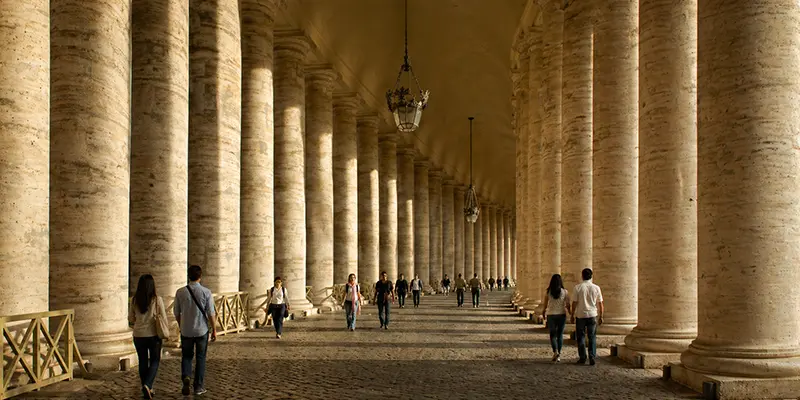
Quiet moments in side chapels and colonnades often shape pilgrims more than the famous landmarks.
Spiritual responses vary widely. Some pilgrims weep at the tomb of Peter. Others feel surprisingly little there and are then unexpectedly moved by a quiet side chapel. Reassure them that the Lord moves where He wills, and that grace is at work even when feelings are absent. Embrace the discomforts—the lines, the crowds, the aching feet—as part of the offering rather than as obstacles to it.
Physical demands in Rome are different from the Holy Land—long stretches of cobblestone, museum corridors that require hours of standing, basilicas without elevators. Work with your guide to identify accessible alternatives so that no pilgrim feels excluded from the heart of the experience.
Working With Your Pilgrimage Company
A successful Roman pilgrimage requires logistical depth. Vatican bookings—Mass reservations at altars in St. Peter's, papal audience tickets, Scavi reservations—are not the kind of arrangements parish staff can coordinate without specialized relationships. This is where a pilgrimage partner experienced in Catholic Rome makes an enormous difference.
What to look for: established relationships at the Vatican, with the basilicas, and with reputable Catholic or Christian guides who understand the devotional weight of the sites. Not every Rome guide treats the Sistine Chapel as anything more than a museum exhibit. Ask directly about how guides handle the spiritual character of each location.
Clarify roles early. The local guide handles navigation, historical context, and entry logistics. The priest's role is the spiritual leadership—the homilies, the prayers, the pastoral conversations on the bus and at meals. The strongest pilgrimages emerge from real partnership, with each side contributing what they do best.
After the Pilgrimage: The Real Pilgrimage Begins at Home
Rome's graces can fade quickly if pilgrims return to ordinary life with no scaffolding. Plan deliberately for the integration phase.
A reunion gathering four to six weeks after return surfaces fruits the pilgrims often did not recognize in the moment. Invite them to share photos, reflections, and how the trip has continued to work in their hearts. These conversations frequently reveal that the deepest movements were not on the day they expected.
Ongoing formation matters. Point pilgrims toward continued reading on the saints they encountered, on papal teaching, on the early Church. The visit to Rome is the seed; what they read and pray at home is the soil where it grows.
Witness in the parish multiplies the fruit. Encourage pilgrims to share at adult faith formation, in the bulletin, in conversation with parishioners who could not make the trip. Their testimony often inspires the next group of pilgrims.
Your own integration matters too. Leading a Rome pilgrimage is spiritually demanding. Make space afterward for retreat or spiritual direction, so that the graces of the trip take root in you as the shepherd as well as in the flock.
This, finally, is the test of any pilgrimage—whether the parishioner who stood at the tomb of Peter returns home and lives differently. Whether the family that prayed together at Mary Major prays together more often on ordinary Tuesdays. Whether the priest who celebrated Mass at the altar of a saint preaches with new fire. Like the Magi, the pilgrim is meant to return by a different way. The journey to Rome is only the beginning. The real pilgrimage begins when the bags are unpacked.
A Final Word
Rome will not exhaust its riches in a single trip. Some priests lead a parish to Rome once in a lifetime; others return every few years and find new graces each time. Whatever the situation, this much is true: leading parishioners to the city of Peter and Paul is among the most profound things a priest will do in pastoral ministry. Few experiences form a parish more deeply in Catholic identity. Few make a shepherd more visibly the bridge between his people and the Universal Church.
If the call to lead a parish to Rome has been stirring, we would be honored to walk with you through the planning. We have spent three decades helping priests bring their flocks to the heart of the Church. We will help you do the same.
Considering Rome for your parish? We would be honored to help you shape a pilgrimage that forms your people in the heart of the Universal Church. See All Upcoming Pilgrimages to explore available dates, or learn more about how to Lead Your Own Group with our dedicated support for clergy.