


Tekton Ministries
Publish Date: April 29, 2026
Halfway up Apparition Hill in Medjugorje, most pilgrims stop. The path isn't dangerous. The distance isn't far — less than half a mile from the village below. They stop because the karst limestone underfoot is sharp, the Bosnian sun is unforgiving, and what looked like a gentle hillside from the road has become something harder. This is not an interruption of the pilgrimage. This is where the pilgrimage begins.
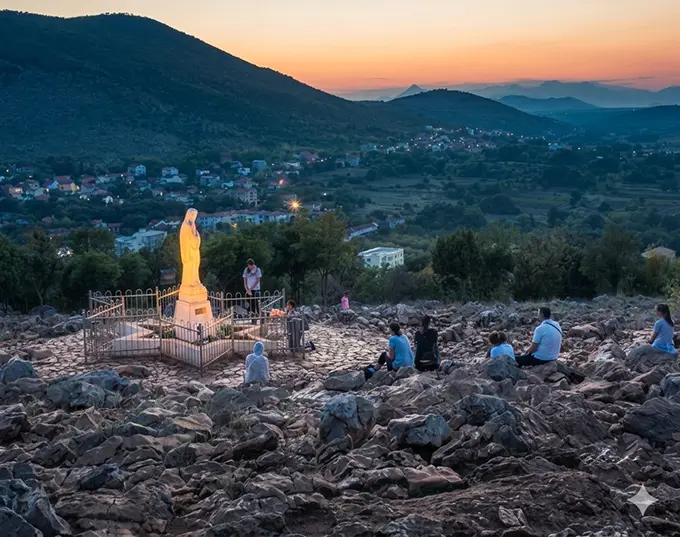
Apparition Hill — known locally as Podbrdo — rises above the village of Medjugorje in Bosnia and Herzegovina.
What Happened on Podbrdo
The apparitions began on June 24, 1981 — the feast of St. John the Baptist. Six young people from the parish of Medjugorje saw a figure on the hillside and, the next day, returned to speak with her for the first time. For more than forty years, the visionaries have described her the same way: a young woman, her hands folded in prayer, who introduced herself as the Queen of Peace.
The Church has not declared these apparitions authentic. In September 2024, the Dicastery for the Doctrine of the Faith issued a nihil obstat — nothing stands in the way — affirming the spiritual fruits of Medjugorje while leaving the question of supernatural origin open. For most pilgrims, this is enough. Climbing Apparition Hill isn't about proving anything. It's about answering a call you already feel.
The Climb Itself
The path to the summit takes most pilgrims thirty to forty-five minutes, longer if you stop to pray. It is not a hike in any recreational sense. The stones are angular, exposed, and unkind to ordinary shoes. Most pilgrims wear tennis shoes; some wear sandals; a number climb barefoot as a deliberate act of penance. There is no requirement — no one will look sideways at you for keeping your shoes on — but the barefoot pilgrims are doing something ancient. They are making their bodies pray.
Along the path, bronze reliefs by the Italian sculptor Carmelo Puzzolo mark the mysteries of the rosary. Most groups pray a decade at each one, moving from the Joyful to the Sorrowful to the Glorious as they climb. If you have never prayed the rosary outdoors, in the heat, on tender feet, surrounded by strangers doing the same thing in twenty different languages, there is only one thing worth telling you: the Hail Marys take on weight.
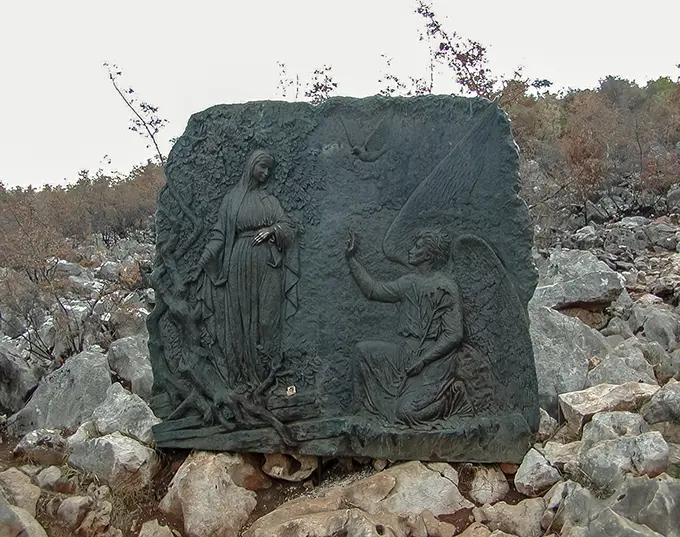
The path rises through bronze reliefs depicting the mysteries of the rosary — most pilgrims pray a decade at each.
Near the base sits the Blue Cross, placed in 1985 at a spot where the visionary Vicka was once led by Our Lady to pray. Pilgrims often stop there on the way up or on the way down. The cross is small. The grace is not.
What You Find at the Summit
At the top is a white statue of the Queen of Peace, sculpted by Dino Felici and installed in 2001. There is no altar. There is no liturgy scheduled. What you will find is a small clearing, uneven stones to sit on, a view of the village and the fields below, and people praying in every language the Church speaks.
This is not Lourdes. There are no banners, no organized processions up the hill, no candles being passed from hand to hand. The silence at the summit is more ordinary than that — and somehow more piercing. You reach the statue, you sit, and you pray what you came to pray. Then, often, you cry. Hardened men weep at this summit. Teenagers who came reluctantly sit motionless for an hour afterward. Something about the combination of the climb and the quiet does its work.
The Interior Climb
The exterior journey up Podbrdo is only as fruitful as the interior one, and on this hill the two are not easy to separate. You will be physically uncomfortable. You will want to turn back. The question is what you do with that.
A tourist hikes Apparition Hill. A pilgrim climbs it. The distinction isn't about exertion — both people sweat the same amount. The distinction is about offering. The pilgrim carries the discomfort as currency and spends it: for a marriage under strain, for a child who has left the Church, for an illness that won't lift, for a sin that won't leave. The climb becomes what St. Paul called filling up "in my flesh what is lacking in the afflictions of Christ" for the sake of His Body (Col. 1:24).
This is why many pilgrims who climb Podbrdo once come back to climb it again. Not because they need to see the statue a second time. Because they have learned what the stones are for.
Before You Climb
Some practical counsel, offered in the spirit of preparation rather than packing-list completism.
Climb early or climb late. Summer in Bosnia and Herzegovina can push well into the nineties. Most seasoned pilgrims ascend at dawn or after sunset, with a flashlight for the latter. Night climbs are quieter and often unexpectedly luminous — the village lights below, the stars above, the rosary between.
Bring water. Not much else. You don't need hiking poles. You don't need bottled holy water. The rosary in your pocket will do.
Wear sturdy shoes. The path is steep and rocky, with sharp, uneven limestone in some stretches and stones smoothed by thousands of pilgrims in others. Thin-soled or worn-out footwear will not hold up well. Sturdy walking shoes or hiking boots with good grip are strongly recommended.
Come with intentions, not expectations. Some pilgrims arrive hoping for a sign, a vision, a consolation. Most receive something harder to name — a quieting, a reordering, a sense that something has shifted one degree. That degree, over time, changes the destination.
Prepare sacramentally. Go to confession before you reach the hill, not after. The climb is better made with a soul that has already been cleared out. Medjugorje is known as "the confessional of the world" for a reason, but the grace of the hill meets the grace of the sacrament, and the order matters.
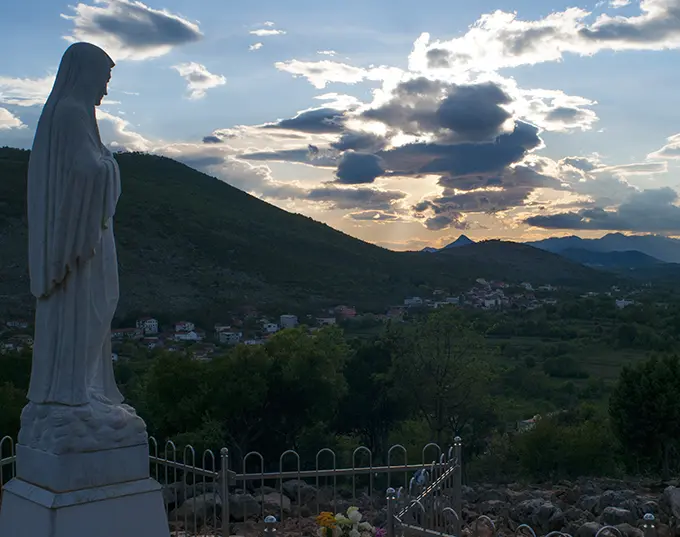
The Queen of Peace statue, sculpted by Dino Felici, marks the summit of Apparition Hill.
Returning by a Different Way
The descent is gentler on the body than the ascent, but it is the more important half. You will come back to the village. You will eat dinner with your group. You will go home. And then — the real test — you will return to your parish, your family, your ordinary Tuesday afternoon.
The climb itself is finished in under two hours. The pilgrimage it begins is measured in years. For the pilgrims we have the privilege of serving, Apparition Hill is rarely the photograph they show to friends when they get back. It is the experience they cannot quite describe — and cannot forget. Like the Magi, they do not return home the same way they came. If you want to understand the interior framework that shapes how we prepare pilgrims for exactly this kind of encounter, our piece on preparing for a Catholic pilgrimage is the place to start.
Medjugorje is not a destination you visit. It is a hill you climb, a cross you carry for an hour, a rosary you pray on sharp stones. It is a place that asks something of you — and then, if you let it, gives far more back.
Ready to Climb Apparition Hill Yourself?
Tekton Ministries leads regular pilgrimages to Medjugorje built around exactly this kind of encounter — not a checklist of sites, but a journey that changes how you go home.