


Tekton Ministries
Publish Date: April 1, 2026
Every parish in the world observes Holy Week. We hear the Passion read aloud. We venerate the cross. We sit in darkened churches and wait. But imagine, for a moment, doing all of this not in your hometown but in the actual streets, gardens, and stone chambers where it happened. A Holy Week Jerusalem pilgrimage does not simply tell you the story of Christ's Passion and Resurrection—it places you inside it, physically, in the very geography of salvation.
This is not a metaphor. On Palm Sunday, you walk the same road from the Mount of Olives that Jesus rode on a donkey. On Holy Thursday, you pray in the garden where His sweat fell like drops of blood. On Good Friday, you carry a cross through the narrow streets of the Via Dolorosa and climb the stairs to Calvary. And on Easter morning, you stand before the empty tomb—not a replica, not a painting, but the place itself—and hear the words that changed everything: He is not here. He is risen.
There is a difference between knowing the story and inhabiting it. That difference is what separates a tourist from a pilgrim, and it is what makes Holy Week in Jerusalem unlike anything else in the Christian life.
Palm Sunday: Walking the Road Christ Walked
Holy Week in Jerusalem begins the way it began two thousand years ago—with a procession from the Mount of Olives down into the city. Each year, pilgrims and local Christians gather at the Franciscan church of Bethphage, where tradition holds that Jesus sent His disciples to find the donkey He would ride into Jerusalem. From there, the procession winds along the ridge of the Mount of Olives, offering one of the most breathtaking panoramas in the world: the Old City spread out below, the Temple Mount, the Kidron Valley falling away steeply between you and the ancient walls.
The crowd carries palm fronds and olive branches. Franciscan friars play music and sing. Scouts from the local Christian community lead the way. The procession passes Dominus Flevit—the chapel marking the spot where Jesus wept over Jerusalem—and descends past the Garden of Gethsemane before entering the Old City through the Lion's Gate. It is joyful and chaotic and deeply moving, and it is also your first lesson in what a Holy Week Jerusalem pilgrimage actually demands of you: surrender your comfort, join the crowd, and let the liturgy carry you.
A tourist might find the press of bodies inconvenient, the pace unpredictable, the route confusing. A pilgrim recognizes that the disorder is the point. You are not watching a reenactment. You are joining a living tradition that has continued on this road, in this city, for nearly two millennia. The discomfort is not a failure of logistics—it is an invitation to enter into the mystery more deeply, to offer your small frustrations alongside the hosannas.
Holy Thursday: Keeping Watch in Gethsemane
If Palm Sunday is an experience of communal joy, Holy Thursday strips everything back to intimacy and anguish. The day commemorates the Last Supper, and pilgrims often visit the Cenacle on Mount Zion—the traditional site of the Upper Room where Jesus washed His disciples' feet and instituted the Eucharist. The room itself is simple, almost austere, with Gothic arches from the Crusader period. There is no altar, no elaborate decoration. You stand where the first Mass was celebrated and feel the weight of that simplicity.
But the heart of Holy Thursday in Jerusalem is Gethsemane. As evening falls, pilgrims walk down from the city to the Garden of Gethsemane at the foot of the Mount of Olives. The ancient olive trees still stand there—gnarled, massive trunks that scientists estimate are among the oldest living things in Jerusalem, with roots that may date to the time of Christ. The Church of All Nations, built over the Rock of Agony where tradition holds Jesus prayed before His arrest, opens for a Holy Hour that can only be described as shattering.
You kneel in the dim church, before that exposed bedrock, and you hear the same words: "Could you not keep watch with me for one hour?" (Mt 26:40). In your home parish, this is a powerful reading. In Gethsemane, it is a direct address. The question is not abstract. You are here. You are keeping watch. And you realize, perhaps for the first time, that the invitation Jesus extended to Peter, James, and John is the same one He extends to you right now—to stay awake, to remain present to suffering, to resist the comfortable sleep of indifference.
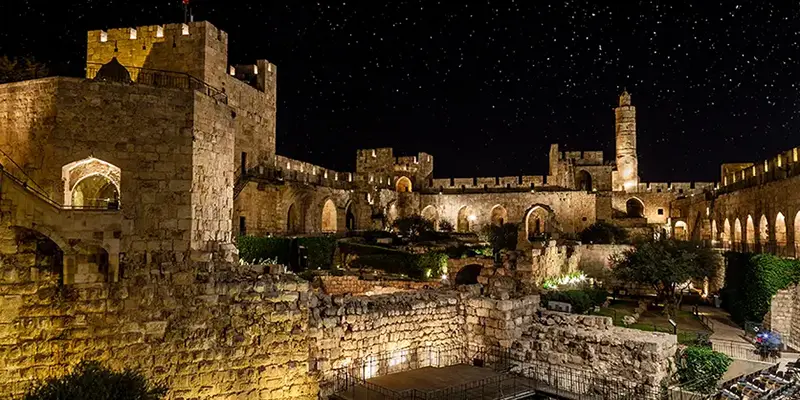
Fortress of David
Some pilgrimage groups follow the Holy Hour with a candlelight walk through the Kidron Valley to the Church of St. Peter in Gallicantu, which marks the site of the High Priest Caiaphas's house—where Jesus was imprisoned overnight before His trial. The walk in the dark, by candlelight, retracing the steps of the arrested Christ, is one of those experiences that pilgrims describe as unforgettable. Not beautiful in the way a sunset is beautiful. Beautiful in the way a sacrifice is beautiful.
Good Friday: The Via Dolorosa and Calvary
Good Friday in Jerusalem is the day the city becomes a cathedral. The Franciscans of the Custody of the Holy Land have led the Stations of the Cross along the Via Dolorosa every Friday since the thirteenth century, but on Good Friday the procession takes on an intensity that words strain to capture. Pilgrims gather near the site of Pilate's Praetorium—the First Station—and walk the narrow, cobbled streets through the Muslim and Christian Quarters, stopping at each of the fourteen stations to pray and reflect on Christ's journey to His death.
The Via Dolorosa is not a sanitized museum path. It cuts through a living city—past shops, through market stalls, between stone walls worn smooth by centuries of hands and shoulders. The streets are narrow. The crowd presses close. You may find yourself carrying a wooden cross on your shoulder, stepping carefully on ancient stones, hearing the prayers of fellow pilgrims in a dozen different languages. This is uncomfortable. It is supposed to be. Christ did not carry His cross down a wide boulevard with water stations and crowd control. The Via Dolorosa gives you a fraction of that reality, and even that fraction is enough to change you.
The final five stations are inside the Church of the Holy Sepulchre—the most sacred site in Christianity. You climb a steep staircase to Calvary, where two chapels stand over the exposed rock of Golgotha. Under the Greek Orthodox altar, you can reach through an opening and touch the bedrock where the cross stood. Below Calvary, the Stone of Anointing marks where tradition holds that Joseph of Arimathea and Nicodemus prepared Jesus' body for burial. Pilgrims kneel at this stone, pressing their foreheads or their rosaries against it, and the oil with which the stone is anointed clings to whatever touches it—a small, tactile reminder that the Passion is not distant history but present reality.
On Good Friday evening, the Latin Catholic community celebrates the rite of the funeral procession inside the Church of the Holy Sepulchre—a solemn reenactment of Christ's burial. It is the most difficult moment of the most difficult day, and it is exactly the kind of experience that separates pilgrimage from tourism. A tourist wants to feel good. A pilgrim is willing to feel everything, including grief, because the grief is the doorway to Easter.
Holy Saturday and Easter: From the Tomb to the Resurrection
Holy Saturday in Jerusalem is a day of paradox. The Church of the Holy Sepulchre operates on its own ancient schedule, governed by the Status Quo agreement among the Christian communities that share custody of the site. Catholics celebrate the Easter Vigil early on Saturday morning rather than Saturday evening—an adjustment that can surprise first-time pilgrims but that carries its own grace. You rise in the dark, walk through quiet streets, and enter the basilica for the most important liturgy of the year while the rest of the city is still asleep.
The Vigil Mass, celebrated steps from the empty tomb, is unlike any liturgy you have experienced. The readings of salvation history—Creation, the Exodus, the prophets' promises—take on a different resonance when you are sitting inside the place where God fulfilled all of them. The Exsultet echoes off ancient stone. The Alleluia, silent since the beginning of Lent, erupts with a force that moves grown men and women to tears. This is Easter in the Holy Land, and it does not feel like a holiday. It feels like the axis on which the entire world turns.
Easter Sunday itself is often given to rest and quiet celebration—Mass, a festive meal, time to reflect. Many pilgrimages use the day to visit Bethlehem's Church of the Nativity, holding Christ's birth and Resurrection together in a single day. The juxtaposition is startling and theologically rich: the cave where He entered the world and the tomb where He conquered death, both visited within hours. It is the kind of experience that does not need to be explained. It explains itself.
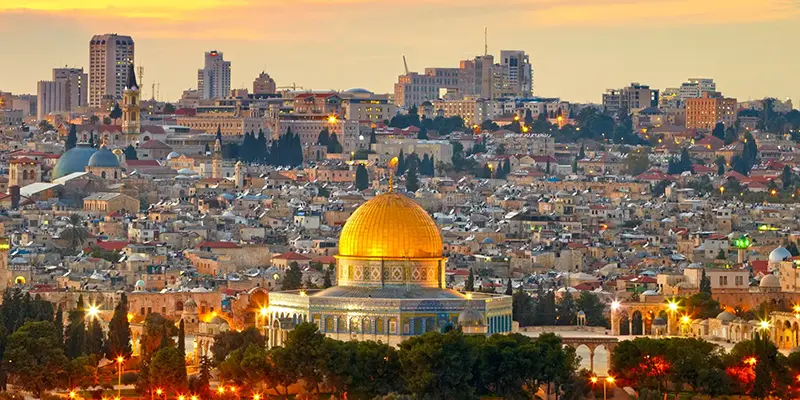
Holy City of Jerusalem
What a Holy Week Jerusalem Pilgrimage Asks of You
It would be dishonest to describe Holy Week in Jerusalem as easy. It is physically demanding—long days on your feet, early mornings, significant walking over uneven terrain. The Church of the Holy Sepulchre is crowded, noisy, and shared among six Christian denominations whose liturgical schedules overlap in ways that can feel bewildering. Lines are long. Personal space is scarce. The weather in spring can swing from warm sun to sudden rain. If you are considering a Holy Land pilgrimage, pack accordingly—and pack your patience most of all.
But here is what pilgrims discover, again and again: the difficulty is not separate from the grace. The long wait in line at the Edicule—the small structure over Christ's tomb—becomes an extended meditation. The jostling crowd becomes a reminder that you are not alone in your faith, that Christians from every nation on earth are drawn to this place. The exhaustion at the end of Good Friday becomes a tiny share in the fatigue Christ carried to Calvary. None of this registers if you approach Jerusalem as a tourist seeking a comfortable religious experience. All of it transforms you if you approach it as a pilgrim willing to be broken open.
Returning by a Different Way
The real test of an Easter in the Holy Land is not what you feel standing before the empty tomb. It is what happens when you board the plane home. Do the graces of Holy Week survive the return to ordinary life—to the commute, the inbox, the familiar parish where the Passion narrative is read from a pulpit rather than lived in the streets?
This is the question that matters. After encountering the Christ Child, the Magi did not go back the same way they came. They returned to their country "by a different way" (Mt 2:12). The same standard applies to every pilgrim who walks the Via Dolorosa, kneels in Gethsemane, and touches the rock of Calvary. The Holy Land does not ask you to stay. It asks you to carry it home—to let the encounter with Christ in these sacred places reshape the way you pray, the way you suffer, the way you love.
A Holy Week Jerusalem pilgrimage is not a once-in-a-lifetime trip. It is a once-in-a-lifetime turning point. The week will end. The flight will take you home. But if you let it, the stone rolled away from the tomb will also roll away something inside you that was sealed shut—and what rises in its place will be something you could not have predicted and cannot un-know.
That is not tourism. That is pilgrimage. And it is waiting for you in Jerusalem.
Ready to walk where Christ walked? Tekton Ministries organizes Catholic Holy Land pilgrimages led by Catholic priests with daily Mass at sacred sites. View upcoming pilgrimages or learn how to lead your own group.