


Tekton Ministries
Publish Date: March 11, 2026
Of all the graces available to a priest leading pilgrimage in the Holy Land, none compares to celebrating Mass at the Church of the Holy Sepulchre. To stand at the altar on Calvary—yards from where Christ was crucified—and speak the words of consecration is to experience the unity of the Mass and the Cross in a way that no theology book can convey. This is the place where redemption was accomplished. And you are being invited to offer the Holy Sacrifice there.
But celebrating Mass at the Holy Sepulchre is not as simple as walking in and finding an open altar. The basilica operates under a complex system of shared custody, strict scheduling, and logistical realities that require careful preparation. Priests who arrive without understanding these details risk disappointment—or worse, missing the opportunity entirely.
This guide will walk you through everything you need to know: where you can celebrate Mass, how reservations work, what to bring, and how to prepare your heart and your homily for what may be the most profound liturgical experience of your priesthood.
Understanding the Basilica: A Church Like No Other
The Church of the Holy Sepulchre is not a single church in the way most priests imagine it. It is a vast, labyrinthine complex encompassing some thirty chapels and worship spaces shared among six Christian communities: Roman Catholic (represented by the Franciscan Custody of the Holy Land), Greek Orthodox, Armenian Orthodox, Coptic Orthodox, Syriac Orthodox, and Ethiopian Orthodox.
Everything within the basilica is governed by an arrangement known as the Status Quo, a set of rules formalized in the eighteenth century that dictates precisely when, where, and how each community may pray, process, and celebrate liturgy. The Status Quo is not a suggestion—it is an exacting framework, and adherence to it is essential. Mass times, altar assignments, and even the placement of a candlestick are regulated. Understanding this system is the first step toward celebrating Mass here with confidence rather than confusion.
The Franciscans have served as custodians of the Catholic presence in the Holy Land since 1342, when Pope Clement VI confirmed their role through the papal bull Gratiam agimus. They maintain the Catholic altars, coordinate liturgical schedules, and facilitate Mass reservations for visiting priests and pilgrim groups. Their faithfulness across nearly seven centuries is one of the quiet miracles of the Church—and your ability to celebrate Mass at the tomb of Christ today is a direct fruit of their enduring mission.
Where You Can Celebrate Mass at the Holy Sepulchre
Catholic priests have access to several altars and chapels within the basilica, each with its own character and its own connection to the Paschal Mystery.
The Altar on Calvary (Latin Chapel): This is the altar most priests dream of. Located atop the rock of Golgotha, the Latin chapel encompasses the tenth and eleventh Stations of the Cross—where Jesus was stripped of His garments and nailed to the Cross. The Greek Orthodox chapel, just steps away, marks the twelfth Station where the Cross was raised. Celebrating Mass on Calvary means offering the Eucharistic Sacrifice within yards of where the original sacrifice took place. The space is intimate and standing-room only, so your group will be close together in prayer. Mass times on Calvary are typically assigned in thirty-minute intervals during the early morning hours, between approximately 5:00 and 7:00 AM.
The Tomb of Christ (the Edicule): The Franciscans celebrate a solemn community Mass at the Edicule each morning—at 6:30 AM on weekdays and 5:30 AM on Sundays. Space within the Edicule itself is extremely limited, and individual group Masses at the Tomb are rare and difficult to arrange. If you are granted this privilege, understand that you are celebrating the Eucharist at the very site of the Resurrection. There is no holier altar in Christendom.
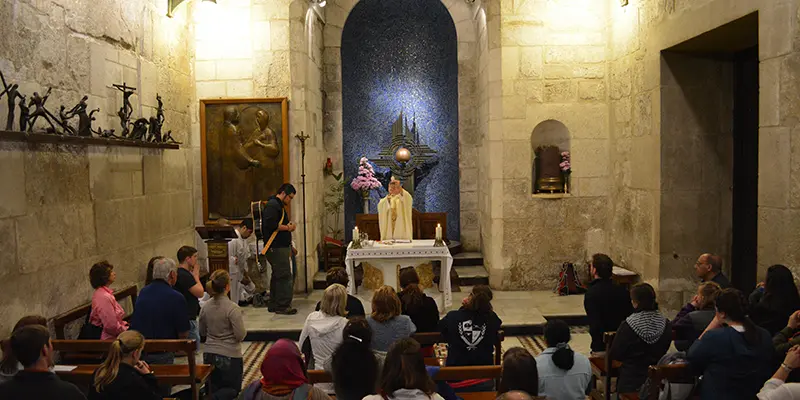
Chapel of the Apparition
The Chapel of the Apparition: Reserved exclusively for Roman Catholic use, this chapel commemorates the tradition that the risen Christ first appeared to His Mother near the empty tomb. It is located on the northwestern edge of the Rotunda, to the right of the Edicule. The Chapel of the Apparition offers a more spacious and contemplative setting than Calvary and is often available for group Masses.
The Chapel of the Blessed Sacrament: This is the primary Catholic chapel within the basilica, where the tabernacle resides and where confessionals are available. Located deeper within the church past the Tomb, it is identifiable by the organ pipes near its entrance. While not as dramatically situated as Calvary or the Tomb, celebrating Mass here places you in the ongoing liturgical heart of the Catholic presence in the Holy Sepulchre.
Securing Your Mass Reservation
Mass reservations at the Holy Sepulchre and all Franciscan-administered holy sites in the Holy Land are coordinated through the Franciscan Pilgrims Office (FPO). If you are traveling with a pilgrimage company—and we strongly recommend that you do—your travel provider will handle the reservation process on your behalf. This is one of the most important services a good pilgrimage company provides, as the FPO works directly with agencies to manage the complex scheduling across dozens of holy sites.
A few things to keep in mind about the reservation process. Mass slots at the Holy Sepulchre are assigned months in advance, particularly for Calvary and the Tomb. The earlier your pilgrimage dates are confirmed, the better your chances of securing the altar and time you prefer. Groups are limited to one Mass reservation per day, though you may also reserve a time of prayer or a Holy Hour of Adoration. Arrive at least fifteen minutes before your scheduled time—this is not optional courtesy but a firm expectation. And if the previous group's Mass is still concluding, patience is required. The Status Quo governs all, and flexibility is part of the pilgrim's discipline.
Communicate clearly with your pilgrimage coordinator about your liturgical preferences. If celebrating Mass on Calvary is your priority, say so early and emphatically. A company with deep experience in Catholic pilgrimage—one with established relationships with the Franciscan Custody—will understand the significance of this request and work to make it happen.
Preparing for an Early Morning
There is no delicate way to say this: celebrating Mass at the Holy Sepulchre means waking up very early. Catholic liturgies at the basilica begin around 4:30 AM, when the Franciscans start their daily cycle following the Armenian services. Pilgrim group Masses on Calvary are typically scheduled between 5:00 and 7:00 AM. Your group will need to be up, dressed, and moving through the narrow streets of the Old City while Jerusalem is still dark and quiet.
Prepare your pilgrims for this in advance. Frame the early wake-up not as an inconvenience but as an offering—a small discomfort embraced for the sake of encountering Christ at the place of His death and Resurrection. Pilgrims who understand they are making a sacrifice, not suffering an imposition, will rise with purpose rather than reluctance. This is the pilgrim mindset at work: the early alarm becomes part of the gift, not a reason to complain.
There is also a practical beauty to the early hour. The basilica in the predawn darkness is profoundly different from the crowded, noisy space it becomes by midmorning. Candlelight flickers off ancient stone. The sounds of competing tour groups are replaced by the murmur of prayer in a half-dozen languages. In these early hours, the Holy Sepulchre reveals itself as what it truly is—not a museum or a tourist destination, but a living church where the Paschal Mystery is celebrated every single day, as it has been for centuries.
What to Bring and How to Prepare
Vestments and Sacred Vessels: Bring your own vestments—alb, stole, and chasuble at minimum. Confirm with your pilgrimage company whether a chalice, paten, and other sacred vessels will be available at the site or whether you should bring a travel set. Many priests find that bringing their own travel Mass kit gives them one less thing to worry about in an already complex logistical environment. Pack vestments carefully in your carry-on luggage; checked bags occasionally arrive late, and you cannot celebrate Mass without proper vestments.
Liturgical Texts and Readings: Bring your own Roman Missal or a compact travel edition. Have the readings for the day prepared, along with any specific prayers or intentions your parish community has entrusted to you. Many priests carry a binder with readings, intercessions, and hymn texts organized by day and site—a small investment of preparation time that pays enormous dividends on the ground.
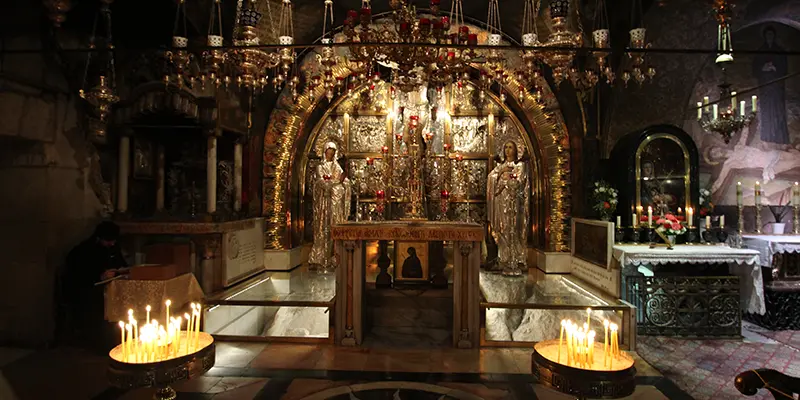
Altar of Crucifixion
Your Homily: Prepare your homily before you leave home. You will know the readings for the day, and you know the site where you will celebrate. The homily at the Holy Sepulchre should not be a lecture on archaeology or history—your local guide can provide that context before or after Mass. Your homily should do what only you as pastor can do: connect this sacred place to the lives of your parishioners. Speak to the reality of suffering and hope, of death and resurrection, that your people carry within them. You are preaching on Calvary. Let the place do the heavy lifting, and let your words point your people toward the Christ who died here and rose for them.
Shepherding Your Pilgrims Through the Experience
The Holy Sepulchre can overwhelm even seasoned travelers. The space is crowded, the layout is confusing, and the sensory experience of incense, chanting, and candlelight from multiple traditions can feel disorienting. As their pastor, you can help your pilgrims move from confusion to contemplation.
Brief your group before entering the basilica. Explain the layout, point out where your Mass will be celebrated, and give them a sense of what to expect. Remind them that the apparent chaos of the Holy Sepulchre—the competing liturgies, the territorial boundaries, the worn stone—is actually a testimony to how fiercely Christians have guarded this place for centuries. Every scuffed floor tile and jealously maintained lamp represents a community that refused to let the memory of Christ's death and Resurrection be forgotten.
After Mass, give your pilgrims time. Don't rush them to the next site. Allow them to venerate the Stone of Anointing, to kneel at the Tomb, to light a candle in the Chapel of the Blessed Sacrament. Some will weep. Some will feel numb. Some will want to linger; others will need to step outside into the air. All of these responses are valid. Trust that God is working in each pilgrim according to the soil He has prepared—and trust that the seeds of grace planted here will bear fruit long after you've returned home.
A Place That Changes Everything
Every Mass is Calvary made present. Every priest knows this theologically. But to celebrate the Eucharist on the actual rock of Golgotha—to hold the consecrated Host aloft in the very place where Christ breathed His last—is to know it in your bones. It will change the way you celebrate Mass for the rest of your priesthood. The altar at your home parish will never again feel ordinary, because you will forever carry within you the memory of what it felt like to offer the Sacrifice at its source.
This is the grace that awaits you at the Holy Sepulchre. Not merely a historical encounter, not a spiritual souvenir, but a transformation of your priestly identity that follows you home and reshapes every liturgy you celebrate. The Magi, after encountering Christ, returned by a different way. You will too.
Ready to celebrate Mass at the holiest site in Christendom? We would be honored to help you plan a Holy Land pilgrimage that places the sacraments at the center of every day. See All Upcoming Pilgrimages to explore available dates, or learn more about how to Lead Your Own Group with our dedicated support for clergy.