


Tekton Ministries
Publish Date: April 8, 2026
Something happens to pilgrims in the Holy Land that doesn't happen anywhere else. Standing where Christ suffered, died, and rose again, the distance between head knowledge and heart knowledge collapses. Sins that were "manageable" at home suddenly feel unbearable in the shadow of Calvary. Conversions that had been brewing for years finally break through at the Sea of Galilee. And when that happens, pilgrims need the Sacrament of Reconciliation—not tomorrow, not when they get home, but now.
This is one of the most important and most overlooked dimensions of priest-led pilgrimage. A professional tour guide can explain the history of Jerusalem, but only a priest can absolve sins at the foot of the cross. A priest's availability for confession throughout the trip may be the single greatest gift he offers his pilgrims—and the reason many of them return home truly changed.
What follows is a practical guide to making the Sacrament of Reconciliation accessible, meaningful, and pastorally sensitive throughout your Holy Land pilgrimage.
Why the Holy Land Stirs the Need for Confession
A pilgrim who approaches the Holy Land with an open heart is not simply visiting ancient sites—she is encountering the living Christ in the places where salvation was won. That encounter has a way of surfacing what has been buried. The businessman who hasn't been to confession in fifteen years may find himself weeping at Gethsemane without fully understanding why. The woman who has carried resentment for decades may feel it loosen as she walks the Via Dolorosa and realizes what Christ carried for her.
This is the grace of pilgrimage doing its work. But grace that stirs the heart without access to the sacrament can leave a pilgrim in a painful half-state—convicted but not reconciled, moved but not healed. The priest-leader's role is to ensure that when the Holy Spirit moves, the sacrament is close at hand.
Sites Where Confession Carries Particular Power
While confessions can be heard at any point during the trip, certain sites create a natural setting for the sacrament. The location itself becomes part of the encounter with God's mercy.
The Garden of Gethsemane: This is where Christ sweat blood in agony over the sins of the world—including the sins every pilgrim carries. The Church of All Nations beside the garden offers a quiet, prayerful atmosphere. Many priests find that offering confession here, while the rest of the group prays before the Rock of Agony, creates one of the pilgrimage's most profound moments.
The Church of the Holy Sepulchre: The place of Christ's crucifixion, burial, and resurrection is the spiritual center of the Christian world. Pilgrims often experience overwhelming emotion here. When the schedule allows time within the church, a quiet corner or chapel—the Chapel of the Franks or an adjacent space—can become a place for the sacrament. Receiving absolution at the very site of Christ's redemptive sacrifice is something pilgrims will never forget.

The Holy Land creates moments of quiet encounter—in a garden, a chapel corner, or a shaded cloister—where pilgrims unburden their hearts and receive the gift of absolution.
The Jordan River: If the itinerary includes a baptismal renewal at the Jordan, confession beforehand deepens the experience immeasurably. Pilgrims who have just received absolution and then renew their baptismal promises in the waters where Christ was baptized often describe it as a second conversion.
The Sea of Galilee: The peaceful shores where Jesus called His disciples and forgave Peter after the Resurrection carry a gentler energy than Jerusalem. For pilgrims who are not yet ready for the intensity of confessing at Calvary, Galilee may feel like safer ground. If the itinerary begins in Galilee—as many experienced pilgrimage leaders recommend—making confession available early in the trip allows pilgrims to spend the remaining days in a state of grace.
Practical Strategies for Making Confession Accessible
Knowing where to hear confessions is only half the challenge. The other half is creating the conditions that help pilgrims actually approach the sacrament—especially those who haven't been in years.
The priest announces his availability early and often. On the first evening of the pilgrimage, the best priest-leaders let the group know that confession will be available throughout the trip. They name specific times and places, and repeat the invitation gently every day or two. Some pilgrims need to hear it several times before they find the courage to respond.
Free time becomes sacramental time. When the group has an hour of unstructured time at a site, a priest who positions himself visibly in a quiet spot—a garden bench, a chapel alcove, a shaded corner—creates a low-pressure opportunity for pilgrims to approach. This works especially well for those who feel intimidated by a formal confession line.
The bus becomes a confessional. On longer drives between sites, some priests quietly make themselves available for confession in the back of the bus. This won't work for every group dynamic, but experienced pilgrimage priests report that the semi-private setting and the fact that no one has to "be seen" approaching a confessional lowers the barrier considerably.
A communal penitential service prepares hearts. A group examination of conscience—perhaps on the evening before visiting the Holy Sepulchre—can prepare hearts for individual confession. An examination tied to the sites already visited brings the pilgrimage into focus: "At the Mount of Beatitudes, Christ called us to be poor in spirit. Where have I clung to pride? At the Sea of Galilee, He called His disciples to leave everything. What am I still refusing to surrender?"
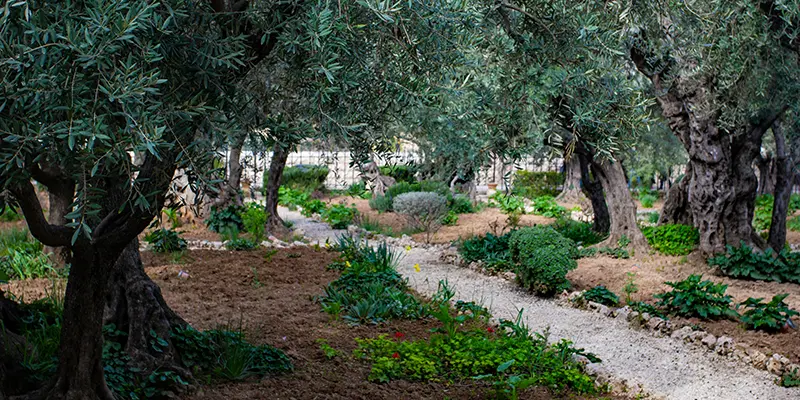
A quiet path winds through the Garden of Gethsemane, where ancient olive trees stand witness to Christ's agony and the countless pilgrims who have come to pray in His footsteps.
Pastoral Sensitivity: Meeting Pilgrims Where They Are
Some pilgrims will be regular penitents who simply want to continue their sacramental rhythm on the road. Others may be approaching confession after years—or decades—away. The Holy Land has a way of drawing the latter group forward, and a priest's pastoral sensitivity in those moments matters enormously.
Patience with pilgrims who are nervous or who have forgotten the form makes all the difference. For someone who hasn't confessed in twenty years, approaching a priest at the Garden of Gethsemane may be the bravest thing they've done in their spiritual life. That courage deserves to be received with tenderness.
Priests should also be prepared for the weight of what they may hear. The Holy Land strips away defenses. Pilgrims may confess things they've never spoken aloud. This is the sacrament doing what it was designed to do—and the setting of the Holy Land amplifies its power. Experienced pilgrimage priests recommend guarding their own hearts with prayer and bringing a breviary or devotional to pray between penitents.
The Sacrament That Completes the Pilgrimage
A pilgrim can walk every street in Jerusalem and still return home unchanged. What transforms a trip into a true pilgrimage is interior conversion—and the Sacrament of Reconciliation is the hinge on which that conversion turns. The Holy Land opens the heart. Confession heals it. Together, they ensure that pilgrims don't merely visit the places where Christ redeemed the world but actually receive that redemption anew.
When pilgrims return home and someone asks, "What was the most powerful part of the trip?"—the answer often isn't the Holy Sepulchre or the Sea of Galilee. For many, it will be a quiet moment in a garden or a chapel corner, where they unburdened their hearts and heard the words of absolution spoken in the land where mercy was born.
Ready to shepherd your parish through the Holy Land? We would be honored to help you plan a pilgrimage where the sacraments are at the center of every day. See All Upcoming Pilgrimages to explore available dates, or learn more about how to Lead Your Own Group with our dedicated support for clergy.