


Tekton Ministries
Publish Date: March 4, 2026
There is a small village tucked into the hills of Herzegovina where something quiet and extraordinary has been happening for over four decades. Millions of people have traveled there—not for scenery or cuisine, not for museums or nightlife, but for something they struggle to put into words once they return. They go seeking Mary. Many of them find far more than they expected. If you've been feeling a pull toward Medjugorje but aren't sure what to expect on your first time Medjugorje pilgrimage, this guide is for you.
But before we get into the practical details, it's worth pausing on a question that matters more than any packing list or itinerary: What kind of traveler do you want to be when you get there? A tourist arrives with a checklist—sites to photograph, boxes to tick, souvenirs to collect. A pilgrim arrives with an open heart, ready to be changed. Like the Magi who encountered the Christ Child and returned home by a different way, pilgrims who go to Medjugorje often find they can't simply resume their old routines. Something has shifted. Medjugorje, perhaps more than any other pilgrimage destination, strips away the noise and invites you into encounter.
What Is Medjugorje—and Why Do Pilgrims Keep Coming Back?
On June 24, 1981, six Croatian young people in the village of Medjugorje, then part of communist Yugoslavia, reported seeing an apparition of the Blessed Virgin Mary on a rocky hillside. She identified herself as the Queen of Peace and began delivering messages centered on prayer, fasting, conversion, reconciliation, and peace. Some of those visionaries continue to report receiving apparitions to this day.
Since then, tens of millions of people from around the world have made the journey to this unassuming Herzegovinian village. In September 2024, the Vatican's Dicastery for the Doctrine of the Faith issued a formal nihil obstat—the highest and most positive ruling under the Church's current norms for evaluating such phenomena. Because the apparitions are ongoing, messages continue to be received, and the secrets have not yet been revealed, the Church is not yet able to rule on its' supernatural nature. While the Church has not made a definitive declaration on the supernatural character of the apparitions themselves, it has formally recognized the abundant spiritual fruits associated with Medjugorje and actively encourages pilgrimages there. The document specifically points to abundant conversions, a return to the sacraments, vocations to priestly and religious life, and the renewal of marriage and family life as evidence of the Holy Spirit at work.
For first-time pilgrims, this matters. You don't need to have a settled opinion on the apparitions before you go. What the Church is saying, in effect, is this: something real and good is happening here, and you are free—even encouraged—to experience it for yourself. That's a powerful invitation, especially during Lent, when the Church calls all of us to deeper conversion and a more honest encounter with God.
The Sacred Sites: What to Expect in Medjugorje
Medjugorje is not a sprawling pilgrimage complex. It's a village—small, walkable, and strikingly simple. There are no grand basilicas or ornate shrines. The holy sites are hills, a parish church, and open-air spaces. And that simplicity is part of the grace. Here's what to expect in Medjugorje at each of the major sites.
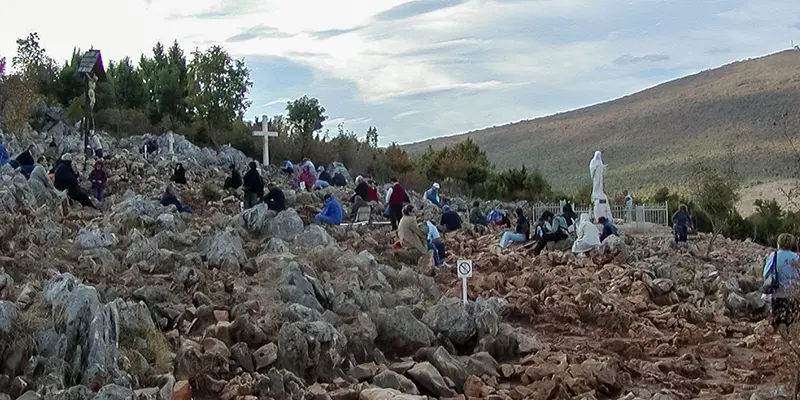
Apparition Hill (Podbrdo). This is where it all began—the rocky hillside where the visionaries first reported seeing Our Lady in June 1981. A path winds upward from the village through the rocks, lined with bronze relief plaques depicting the Joyful, Sorrowful and Glorious Mysteries of the Rosary. Pilgrims traditionally pray the Rosary as they climb. Near the top, a statue of the Queen of Peace marks the spot of the first apparition. The terrain is uneven and rocky, but the climb is manageable for most. Many pilgrims remove their shoes as an act of penance—a small gesture of willingness to offer something of themselves on the way up.
Cross Mountain (Križevac). In 1933, in commemoration of the 1900th anniversary of the death and resurrection of Christ, the parishioners of Medjugorje built a 16-ton, 8.5-meter concrete cross atop the highest mountain in the area, carrying every ounce of material up the steep, rocky slope by hand. A relic of the True Cross, obtained from the Church of the Holy Cross of Jerusalem in Rome, is embedded in its arm. On August 30th, 1984, Our Lady spoke about the cross, saying "Dear Children, the cross was also in God's plan when you built it. These days especially, go on the mountain and pray before the cross." The climb is more demanding than Apparition Hill—expect about an hour each way over rough terrain. Bronze plaques depicting the Stations of the Cross line the path. This is penitential prayer in its most physical form. The exhaustion, the aching knees, the shortness of breath—these are not inconveniences. They are your participation in the suffering of Christ. Pilgrims who make this climb during Lent often describe it as one of the most profound Stations of the Cross experiences of their lives.
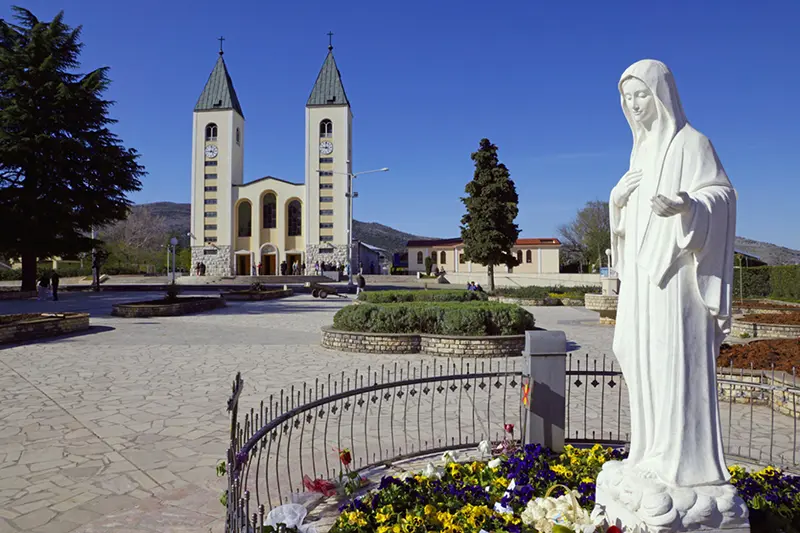
St. James Church. The parish church is the sacramental heart of Medjugorje. Originally built in 1892 and rebuilt in 1969, no one understood at the time why such a large church was needed for such a small village. History answered that question in 1981. Today, St. James hosts daily Mass, the evening prayer program, and Eucharistic Adoration. It is where pilgrims from dozens of countries gather each evening to pray the Rosary together, attend Mass, and sit in the presence of the Blessed Sacrament. The outdoor altar area, built in 1989 to accommodate growing crowds, holds up to 15,000 in total, with seating for approximately 5,000, and is under the shadow of Cross Mountain—a powerful visual reminder that prayer and penance are inseparable.
The Blue Cross. At the base of Apparition Hill, this quiet prayer spot marks the location where one of the visionaries' prayer groups has gathered regularly since 1982. During the earliest days of the apparitions, when the communist Yugoslav government tried to suppress the events, this hidden location allowed the visionaries to meet for prayer undetected by soldiers. It remains one of the most peaceful spots in Medjugorje—an invitation to slow down, be still, and listen.
The Risen Christ Statue. This striking 30-foot bronze sculpture by Slovenian artist Andrija Ajdič depicts Christ stepping from the cross with arms raised in triumph. Since 2000, a liquid substance has been observed dripping from the statue's right knee. The Church has not made any declaration on this phenomenon, but pilgrims frequently gather here for quiet prayer and reflection, and many bring cloths to the site as an act of devotion.
The Evening Prayer Program: The Heartbeat of Medjugorje
If there is one experience that defines a first time Medjugorje pilgrimage, it may be the evening prayer program at St. James Church. Every evening, the community of pilgrims and local parishioners gathers for a program that typically includes all three sets of Rosary mysteries, Holy Mass, and a blessing. On certain days, the program also includes Eucharistic Adoration for veneration of the Cross.
What makes this experience so powerful is not the program itself—you can pray the Rosary and attend Mass anywhere. It's the atmosphere. Thousands of people from every continent, praying together in one voice, in a small village church in the middle of Herzegovina. The translations come through in multiple languages. The silence during Adoration is so thick you can feel it. There is no performance, no production. Just prayer, sustained and sincere. Many pilgrims say this is where Medjugorje truly "happened" for them—not on the hilltops, but in the pews, surrounded by the universal Church at prayer.
Confession: Why Pilgrims Call Medjugorje "The Confessional of the World"
If the evening prayer program is the heartbeat of Medjugorje, the Sacrament of Reconciliation may be its soul. Medjugorje has approximately 65 confessionals, and during peak pilgrimage season, that is still not enough. Lines stretch across the church grounds as pilgrims wait—sometimes for hours—to receive the sacrament. Far from being an inconvenience, many pilgrims describe the wait itself as a grace. The time spent in line becomes time spent in examination of conscience, in prayer, in preparation for an encounter with God's mercy.
The Vatican's 2024 document on Medjugorje specifically highlighted the "frequent return to the sacraments, particularly the Eucharist and Reconciliation," as one of the most significant fruits of the Medjugorje experience. Confessions are available in numerous languages throughout the day. For many first-time pilgrims—and even for those who haven't been to Confession in years or decades—this is where the real transformation begins. If you're visiting during Lent, there is no better way to enter into the penitential season than to receive the Sacrament of Reconciliation in a place so profoundly associated with conversion.
How to Prepare for Your First Medjugorje Pilgrimage
The most important preparation isn't physical—it's interior. A pilgrimage is only as fruitful as the spiritual groundwork laid before departure. Here are some ways to prepare your heart before you go:
Set your intentions. Why are you going? What are you carrying that you want to lay at Our Lady's feet? Write down your prayer intentions and bring them with you. Be specific. Don't just ask for "a good trip"—ask for the grace you actually need.
Begin a prayer routine before you leave. If you don't pray the Rosary regularly, start now. Our Lady's messages in Medjugorje consistently emphasize the Rosary, fasting, and daily prayer. Arriving in Medjugorje already immersed in these practices means the experience deepens what's already growing, rather than starting from scratch.
Go to Confession before you go. This might seem counterintuitive—why confess before traveling to a place famous for Confession? Because arriving with a clean conscience allows you to go deeper. The confession you make in Medjugorje can build on interior work already underway rather than serving as damage control.
Prepare physically for the climbs. Both Apparition Hill and Cross Mountain involve hiking over uneven, rocky terrain. Wear sturdy shoes with good grip. Bring water. Go at your own pace. If physical limitations prevent you from climbing, there is no obligation—the grace of Medjugorje is not restricted to those who can summit a hill. Many pilgrims find the deepest graces in the pews of St. James Church.
Leave space in your schedule. The temptation for first-time visitors is to pack every hour with activity. Resist it. Medjugorje's most powerful moments often arrive in unstructured time—an unexpected conversation with a fellow pilgrim, a quiet hour before the Blessed Sacrament, a sunset on the church grounds with Cross Mountain silhouetted against the sky. Build margin into your days.
Practical Tips for First-Time Medjugorje Pilgrims
Getting there. Medjugorje is located in Bosnia and Herzegovina, accessible by roughly a 3-hour drive from airports in Split (Croatia), Dubrovnik (Croatia), or Sarajevo (Bosnia and Herzegovina). Most organized pilgrimages arrange ground transportation from one of these airports directly to the village.
Accommodations. The village offers a range of hotels, guesthouses, and family-run pansions (pensions). Accommodations are simple but comfortable. Most pilgrimage groups stay in pansions where breakfast and dinner are provided—home-cooked meals, often with local wine. Don't expect luxury resort standards. The simplicity is part of the pilgrim experience.
What to bring. Comfortable walking shoes with good traction are essential for the hill climbs. Dress modestly—shoulders and knees should be covered when visiting the church and sacred sites. Bring a rosary, a journal, and your prayer intentions. A small flashlight can be helpful for early morning or evening climbs. The local currency is the Bosnian Convertible Mark, though euros, dollars, and credit cards are widely accepted.
How long to stay. Most Medjugorje pilgrimages last six to eight days, and that length is ideal. It takes a day or two to shed the pace of ordinary life and settle into the rhythm of prayer that defines Medjugorje. By day three or four, something shifts. You stop watching the clock and start listening. A shorter visit is possible but may not allow you the time to fully enter in.
The Real Pilgrimage Begins When You Go Home
Here is what experienced Medjugorje pilgrims will tell you, and it's the most important thing in this guide: the grace you receive in Medjugorje is not meant to stay in Medjugorje. Our Lady's messages consistently call pilgrims to bring what they receive back into their daily lives—to pray more, fast more, love more, forgive more.
The measure of a successful first time Medjugorje pilgrimage is not how many sites you visited or how many photos you took. It's whether the seeds of grace planted in that small village take root in the soil of your ordinary life. Did the Rosary you prayed on Apparition Hill become a daily habit at home? Did the peace you felt during Adoration reshape how you handle conflict in your family? Did the confession that broke something open in you lead to a lasting change in how you live?
That is what Medjugorje is for. Not a spiritual vacation, but a turning point. A place where Our Lady takes you by the hand and leads you—gently but unmistakably—closer to her Son. And if you let her, you will not return the same way you came.
Ready to answer the call? A pilgrimage with Tekton Ministries provides the spiritual framework, experienced local guides, and faith-filled community to help you encounter Christ through Mary—not just visit where she appeared. See All Upcoming Pilgrimages to explore available Medjugorje dates, or learn more about how to Lead Your Own Group pilgrimage.