

Tekton Ministries
Last Updated: January 5, 2026
They came from the East, following a star. Wise men—magi—who left behind comfort and certainty to seek a newborn king in an obscure Judean village. Their journey, commemorated on the Feast of the Epiphany, wasn't just a geographical trek across deserts and mountains. It was an act of faith that has echoed through twenty centuries of Christian pilgrimage.
Today, pilgrims still follow in the footsteps of the Magi, traveling to Bethlehem to kneel where Christ was born. If you've ever felt drawn to make this journey yourself, you're responding to the same call that stirred those ancient travelers to leave everything familiar behind.
This guide will walk you through the sacred sites of Christ's birth in Bethlehem—what you'll see, what you'll experience, and how to prepare your heart for an encounter that pilgrims have described as life-changing.
The Church of the Nativity: Christianity's Oldest Church
At the heart of any Bethlehem pilgrimage stands the Church of the Nativity, the oldest major church in the Holy Land and one of the oldest continuously operating churches in Christianity. The original basilica was commissioned by Emperor Constantine around 330 AD, after his mother Helena identified the traditional site of Christ's birth. Though that first church was destroyed during the Samaritan revolts of the sixth century, Emperor Justinian rebuilt it in essentially its current form around 565 AD.
Your first encounter with the church comes at the Door of Humility—a small, low entrance that requires every visitor to bow as they enter. The doorway, reduced to its current size during the Ottoman period to prevent carts from entering and to force mounted soldiers to dismount, has become a powerful symbol. To enter the place where God humbled Himself to become man, we too must humble ourselves.
Inside, the basilica opens into five aisles formed by ancient Corinthian columns, many bearing the faded traces of medieval paintings of saints. Patches of golden Byzantine mosaics still cling to portions of the upper walls, remnants of the church's former splendor. Look down as you walk—sections of the floor have been opened to reveal stunning fourth-century mosaics from Constantine's original church, giving you a direct visual connection to the earliest generations of Christian pilgrims.
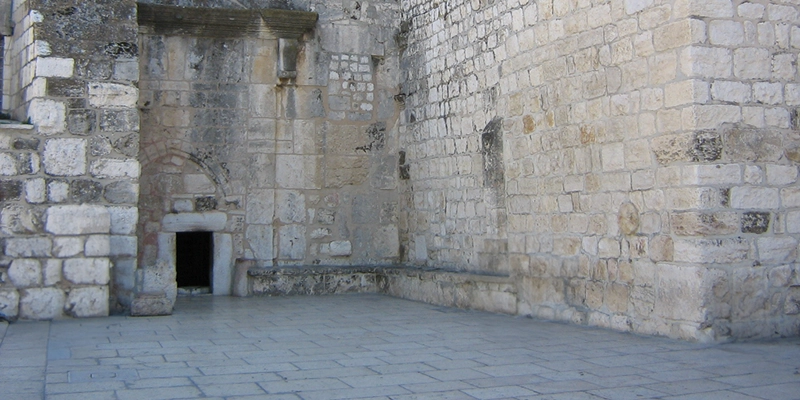
The Door of Humility, the low entrance to the Church of the Nativity that requires every visitor to bow upon entering.
The Grotto of the Nativity: Where Heaven Touched Earth
Beneath the main altar, narrow stone staircases on either side lead down to the Grotto of the Nativity—the cave venerated since at least the second century as the birthplace of Jesus. In an age when Bethlehem's homes often included caves for sheltering animals, this tradition carries historical plausibility. The Roman writer Origen mentioned in 248 AD that locals pointed to a specific cave as Christ's birthplace, even before Constantine's mother arrived to build the first church.
The grotto itself is surprisingly intimate. Tapestries line the walls, and oil lamps cast a warm glow over the space. Beneath a small altar, set into the marble floor, you'll find a fourteen-pointed silver star bearing the Latin inscription: "Hic de Virgine Maria Jesus Christus natus est"—"Here Jesus Christ was born of the Virgin Mary."
Why fourteen points? The number corresponds to the genealogy in Matthew's Gospel, which traces Christ's lineage through three sets of fourteen generations. In Hebrew numerology, the letters of King David's name add up to fourteen. The star beneath your feet quietly proclaims that the promises made to David have been fulfilled in this very place.
A few steps away, another altar marks the spot of the manger where Mary laid her newborn son. Here, pilgrims often pause longest, allowing the reality of the Incarnation to sink in. God entered human history not in a palace but in a feeding trough, in a cave, in an occupied territory, to parents who couldn't find better accommodations.
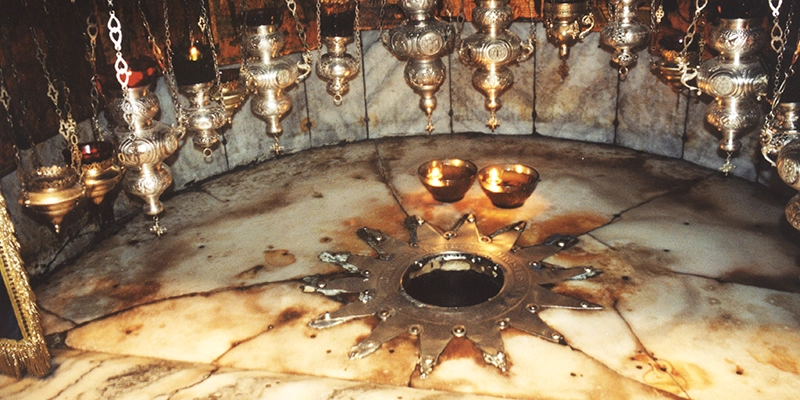
The 14-pointed silver star marks the traditional site of Christ's birth in the Grotto of the Nativity.
The Shepherds' Field: Where Angels Sang
About a mile east of Bethlehem, in the town of Beit Sahour, lies the area traditionally identified as the Shepherds' Field—where angels announced Christ's birth to shepherds watching their flocks by night. Two sites preserve this memory: a Greek Orthodox church built over Byzantine-era ruins, and a Franciscan chapel designed by the renowned architect Antonio Barluzzi.
The Franciscan Chapel of the Angels, with its distinctive tent-like shape, commemorates the angels' appearance. The design intentionally evokes the temporary shelters shepherds would have used, connecting modern pilgrims to the humble witnesses who were first to hear the good news. Beneath the chapel, a cave recalls the shelters where shepherds actually slept with their flocks.
What makes this site particularly moving is its theological significance. The shepherds in these fields weren't just any shepherds—according to ancient Jewish sources, they raised the lambs destined for Temple sacrifice in Jerusalem. The Lamb of God was announced first to those who raised lambs for sacrifice. The symbolism could not be more perfect.
The acoustic properties of the Franciscan chapel are remarkable, and pilgrim groups are invited to sing Christmas carols within its walls. There are few experiences quite like joining voices with fellow pilgrims to sing "Silent Night" or "O Little Town of Bethlehem" in view of the very hills where angels once sang "Glory to God in the highest."
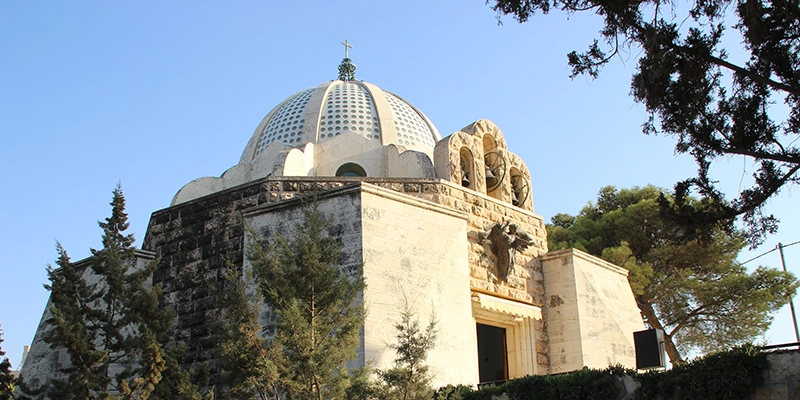
Chapel of the Angels at Shepherds' Field, designed by architect Antonio Barluzzi.
Manger Square and St. Catherine's Church
The Church of the Nativity opens onto Manger Square, Bethlehem's central plaza and the gathering place for Christmas Eve celebrations that are broadcast around the world each year. Adjacent to the basilica stands the Catholic Church of St. Catherine, built by the Franciscans and consecrated in 1882. This is where the Latin Patriarch of Jerusalem celebrates the famous Christmas Midnight Mass.
From St. Catherine's, you can access a series of caves and grottoes connected to the Nativity complex. These include the cave where St. Jerome spent thirty years translating the Bible into Latin—the famous Vulgate translation that would shape Western Christianity for more than a millennium. Jerome chose this location deliberately, believing that working in sight of Christ's birthplace would illuminate his understanding of Scripture.
The Chapel of the Holy Innocents, also in these caves, commemorates the children of Bethlehem killed by King Herod in his attempt to eliminate the newborn king the Magi had described. It's a sobering reminder that the Christmas story, while joyful, unfolds against a backdrop of political violence and refugee flight—themes that resonate painfully in Bethlehem today.
The Milk Grotto
A short walk from the Church of the Nativity brings you to the Milk Grotto, a small cave-chapel with walls of soft white chalk. According to tradition, the Holy Family sheltered here before their flight into Egypt, and a drop of Mary's milk fell to the ground while she was nursing Jesus, turning the stone white.
The grotto has become a place of pilgrimage for couples praying for fertility and nursing mothers seeking Mary's intercession. The Franciscans who care for the site distribute small packets of powdered stone from the grotto to pilgrims who request them. Whether or not one embraces the legend, the Milk Grotto offers a quiet, contemplative space away from the crowds at the main basilica—and a reminder of the vulnerability of the infant Christ and his young mother.
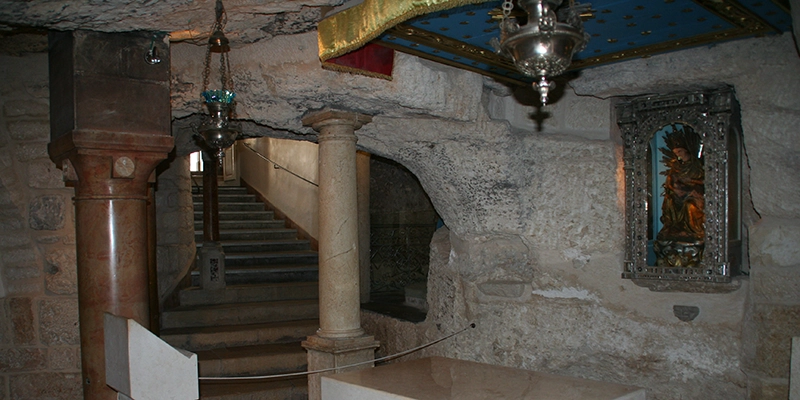
The Milk Grotto offers a quiet, contemplative space—its chalky walls adorned with hanging lamps and an icon of Mary nursing the infant Jesus.
What to Expect on Your Visit
Bethlehem lies in the Palestinian territories, about six miles south of Jerusalem. Most pilgrimage groups visit as a day trip from Jerusalem, crossing through an Israeli checkpoint. The process is generally straightforward for tourist groups, though it's a visible reminder of the complex political realities of the region.
At the Church of the Nativity, expect crowds. This is one of Christianity's most visited pilgrimage sites, and the grotto beneath the church can only accommodate a few people at a time. Pilgrim groups typically wait in line, sometimes for an hour or more, for their moment at the silver star. Use this time for prayer and reflection rather than frustration—the waiting is part of the pilgrimage.
Dress modestly, as you would for any sacred site: shoulders and knees covered for both men and women. The grotto can feel warm and close, so layers you can adjust are practical. Photography is generally permitted, though many pilgrims find that putting the camera away allows for a more prayerful experience.
Most pilgrimage itineraries include time to visit the shops around Manger Square, where local Christian artisans sell olive wood carvings, nativity sets, and other religious items. Purchasing from these shops supports the dwindling Christian community in Bethlehem, which has faced significant emigration pressures in recent decades.
Preparing Your Heart
The Magi didn't arrive at Bethlehem unprepared. They had studied the signs, assembled their gifts, and committed to a journey of unknown length and difficulty. As you consider your own pilgrimage to the sites of Christ's birth, some spiritual preparation will help you receive the full gift of what awaits.
Read the Infancy Narratives: Meditate on Matthew 1–2 and Luke 1–2 in the weeks before your trip. Notice the details: the census that brought Mary and Joseph to Bethlehem, the lack of room at the inn, the shepherds and their flocks, the Magi and their star. When you stand in these places, the Gospel accounts will come alive in new ways.
Consider Your Gifts: The Magi brought gold, frankincense, and myrrh—gifts fit for a king, a priest, and one who would die for his people. What will you offer? Your time? A particular struggle you're ready to surrender? A renewed commitment to your faith?
Prepare to Be Surprised: Many pilgrims expect the birthplace of Christ to be grand, only to find a small cave beneath an ancient church in a crowded, complicated town. But this is precisely the point of the Incarnation: God enters the world not in power and majesty but in hiddenness and humility. The smallness of Bethlehem reveals the immensity of God's love.
Following the Star Home
The Magi, we're told, returned to their own country by another route. They went home different from how they came. The same will be true for you.
A pilgrimage to Bethlehem isn't just a trip to an ancient site. It's an encounter with the mystery at the heart of Christian faith: that God became one of us, born in poverty, laid in a manger, worshipped by shepherds and wise men alike. To kneel where Christ was born is to join a procession of pilgrims stretching back nearly two thousand years—and to carry that experience forward into the rest of your life.
The star still shines over Bethlehem. Perhaps it's time to follow it.
Ready to walk where the Magi walked? A pilgrimage to the Holy Land brings Scripture to life in ways no book or video ever could. See All Upcoming Pilgrimages to explore available dates, or learn more about how to Lead Your Own Group pilgrimage to the Holy Land.