


Tekton Ministries
Publish Date: March 18, 2026
He left no letters. No teachings recorded in Scripture bear his name. And yet Joseph of Nazareth shaped the earthly life of the Son of God—protecting Him, providing for Him, raising Him in the faith of Israel. His silence in the Gospels has always drawn souls who are themselves learning to trust God without explanation. If that describes you, the Holy Land holds something particular for your pilgrimage.
The feast of St. Joseph falls tomorrow—March 19—and the timing feels right to consider him not as a figure in a Nativity set, but as a man who walked real roads in a real land. Those roads still exist. The village where he planed wood and kept the Sabbath still stands, transformed but not erased. The church built over the site of his workshop welcomes pilgrims who want to kneel where he knelt, in the place where he raised the Word made flesh.
A pilgrimage in the footsteps of St. Joseph is not a niche detour on a Holy Land trip. His presence is woven into the geography of the entire journey—from Bethlehem's cave to Nazareth's hillside to the Temple courts of Jerusalem. For pilgrims willing to look for him, he is everywhere.
Why Joseph Deserves More Than a Glance
Most pilgrims arrive in the Holy Land with their attention fixed—rightly—on Christ. The Church of the Holy Sepulchre. The Via Dolorosa. The shores of Galilee. These are the sacred anchors of any Catholic pilgrimage, and they should be.
But the tourist moves from site to site collecting impressions. The pilgrim moves from encounter to encounter, asking at each place: What does God want to say to me here? For many pilgrims, the unexpected encounter comes not at the great basilicas, but in a quieter corner of Nazareth—in the modest church built over a carpenter's workshop, where the man chosen to father the Son of God once spent his ordinary days.
Joseph speaks to the parts of our lives that feel unwitnessed. The faithfulness no one notices. The obedience that costs something but earns no applause. The trust required when God's plan looks nothing like the one you had in mind. Pilgrims who carry those particular burdens often find that standing in his city—in his workshop, beneath his hillside—something in them quietly shifts. That is worth traveling for.
Nazareth: Where He Made His Home
Nazareth is the city most deeply associated with Joseph—and with good reason. This is where he lived, where he worked, and where he raised Jesus from infancy through the hidden years that consumed most of our Lord's time on earth. When pilgrims arrive in Nazareth, they are entering Joseph's world.
The Basilica of the Annunciation is the centerpiece of any visit to Nazareth, and rightly so—it marks the site where the angel Gabriel appeared to Mary, and where the Incarnation began. But Joseph is inseparable from this story. It was in this same city that he received his own angelic message: do not be afraid to take Mary as your wife. The angel came to him in a dream, and he obeyed before dawn. Pilgrims who pray here in the lower church, near the original grotto of Mary's home, often find it worth pausing to hold both figures in mind—the woman who said yes with her whole being, and the man who said yes in the dark, without fanfare, and rose to act on it.
The Church of St. Joseph stands just north of the Basilica of the Annunciation, built over what tradition identifies as Joseph's workshop and the childhood home of Jesus. The lower level of the church preserves ancient cisterns, storage pits, and stone-cut chambers from the first century—the physical fabric of daily life in the village Joseph inhabited. It is a humbling place. Nothing about it suggests grandeur. Everything about it suggests fidelity: a man showing up, day after day, to the life God gave him.
Pilgrims who come here as tourists move through quickly, reading placards. Pilgrims who come prepared—who have sat with Matthew 1 and Luke 2 before boarding the plane, who have brought specific intentions to lay at this altar—often find that this small church does something the grand basilicas sometimes cannot: it makes the Incarnation feel intimate.
Bethlehem: Where He Arrived with Nothing but Faith
The journey from Nazareth to Bethlehem was approximately 90 miles on foot—a demanding trek Joseph made with a heavily pregnant wife, in obedience to a census decree that cared nothing for their circumstances. He arrived to find no room. What he managed to secure was a cave used for sheltering animals. And in that cave, the Son of God was born into his hands.
The Church of the Nativity in Bethlehem preserves that cave. Entering through the Door of Humility—the low, narrow entrance that requires every visitor to bow their head—pilgrims descend into the Grotto of the Nativity, where a fourteen-pointed silver star marks the traditional spot of Christ's birth. The space is ancient, incense-heavy, and deeply moving.
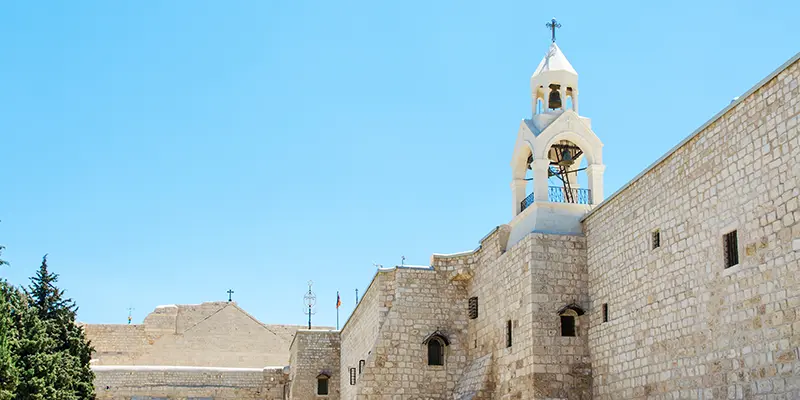
Joseph is present here in a different way than he is in Nazareth. In Nazareth, you see his workshop. In Bethlehem, you see the fruit of his protection—a child born safely into the world because this man did not abandon the woman entrusted to him, did not choose comfort over fidelity, did not let fear of what others might think keep him from doing what he knew God asked. The Nativity site is a Joseph site. Pilgrims who hold that in mind while kneeling at the star often find it opens something unexpected in prayer.
Nearby, the Milk Grotto Chapel honors a tradition that the Holy Family sheltered here during the flight to Egypt—another journey Joseph undertook at angelic instruction, in the middle of the night, to protect a child Herod wanted dead. The chapel is a quiet, limestone space, beloved by pilgrims who come to pray for families under strain. Joseph, the protector of the Holy Family, is the natural patron of every prayer offered here.
Jerusalem: Where He Presented the Child to the Lord
Forty days after the birth in Bethlehem, Joseph brought Mary and the infant Jesus to the Temple in Jerusalem for the rites of purification and presentation (Luke 2:22–38). It was Joseph who made the offering. Joseph who listened as Simeon spoke of a sword piercing Mary's soul. Joseph who stood beside his wife as an elderly prophetess named Anna gave thanks to God.
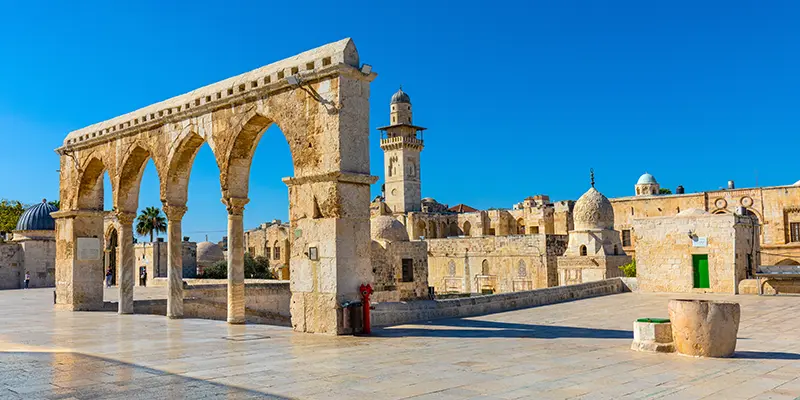
The Temple itself no longer stands, but pilgrims visiting Jerusalem can walk the broad stone steps that led up to the Temple Mount—stairs that archaeologists have confirmed date to the Second Temple period. These are the steps Joseph climbed with his family. The Western Wall Plaza, adjacent to the Temple Mount, allows pilgrims to stand in the shadow of what remains of the Temple enclosure and pray in a place Joseph would have known well. For Jewish-rooted Catholics who feel the Hebrew depth of their faith most keenly in Jerusalem, this is often a particularly moving encounter.
How to Carry Joseph with You Through the Pilgrimage
The sites associated with St. Joseph are not clustered in one corner of the Holy Land. They follow the arc of his life—Nazareth to Bethlehem to Egypt to Jerusalem and back again. His presence on pilgrimage is less about stopping at a particular shrine and more about cultivating a particular disposition throughout the journey.
Before you depart, bring something specific to his intercession. Joseph is patron of fathers, workers, the dying, and families under strain—but he is also, less formally, the patron of people whose faithfulness goes unseen. If that's the weight you're carrying, name it before you board the plane. The Holy Land has a way of meeting intentions that were brought deliberately.
It also helps to read the passages before you arrive. Matthew 1–2 and Luke 2 contain every Scriptural reference to Joseph—brief scenes, maybe twenty minutes of reading in total—but each one repays slow attention. Pilgrims who have sat with those texts before arriving in Nazareth often say that the land becomes a kind of commentary. The obedience in the passages acquires weight and distance. The geography makes the choices feel real.
And not every encounter will happen at a named site. Sometimes it comes on the bus between stops, watching the Galilean hills and realizing you are looking at the same landscape Joseph crossed with his family. Sometimes it comes at the end of an exhausting day, when the discomfort of travel starts to feel less like inconvenience and more like participation—a small share in the labors of a man who got up in the dark and moved when God asked him to. The pilgrims who come home changed are rarely the ones who saw the most sites. They are the ones who were paying attention when grace arrived in an unexpected place.
The Saint Who Guides Pilgrims Through Uncertainty
Joseph never had the full picture. He responded to angelic messages that told him just enough to take the next step—not the whole plan, just the next step. He trusted when the situation looked impossible and obeyed when obedience was costly. Many pilgrims arrive in the Holy Land in a similar position—hoping for clarity about a vocation, a marriage, a decision they've been circling for years, a grief that hasn't resolved. Joseph is a good companion for that kind of journey. He is not the saint of dramatic moments. He is the saint of showing up faithfully in the life God gave him, and discovering that this is enough.
If you walk where he walked—through Nazareth's streets, into Bethlehem's cave, up the steps toward the Temple—you are not ticking sites off a list. You are following someone who carried sacred things carefully through an uncertain world and delivered them where God intended. That is the pilgrimage. And it does not end when you fly home.
Ready to walk where Joseph walked? A Holy Land pilgrimage brings Scripture out of the page and into your hands—and the St. Joseph sites in Nazareth and Bethlehem are among the most quietly transformative on the journey. See All Upcoming Pilgrimages to explore available Holy Land dates and begin planning your encounter.