


Tekton Ministries
Publish Date: February 25, 2026
Of all the moments in a Holy Land pilgrimage, few compare to walking the Via Dolorosa stations of the cross with your parishioners. This is the road Christ walked to Calvary—narrow, crowded, winding through the Old City of Jerusalem from the site of His condemnation to the place of His crucifixion and burial. For the priest who leads his people along this path, it becomes one of the most profound liturgical and pastoral experiences of his ministry.
But leading the Stations of the Cross on the Via Dolorosa is not the same as praying them in your parish church. The route is chaotic. Market vendors call out alongside ancient stone markers. Tour groups jostle for position at each station. The distance between the devotional ideal and the physical reality can disorient pilgrims who arrive expecting a solemn, uninterrupted procession.
This is precisely where your leadership matters most. With the right preparation—spiritual, practical, and pastoral—you can transform what might feel like a disorienting walk through a crowded market into the encounter your pilgrims will carry for the rest of their lives.
Understanding the Route: Fourteen Stations Through the Old City
The traditional Via Dolorosa begins near the Lions' Gate in the Muslim Quarter of Jerusalem's Old City, at the site traditionally identified with the Antonia Fortress where Pilate condemned Jesus. From there, the route winds westward through narrow streets and souks before entering the Church of the Holy Sepulchre, where the final five stations are located.
The first nine stations are marked along the streets themselves—some with small chapels maintained by various Christian communities, others with simple plaques on stone walls. Stations X through XIV are all within the Church of the Holy Sepulchre, culminating at Calvary and the Tomb of Christ. The entire route covers roughly half a mile, though the stops, crowds, and narrow passages make it feel considerably longer.
It's worth noting that the historical accuracy of the route has been debated by scholars for centuries. Some archaeologists believe the actual path of Christ's passion may have followed a different course. But the Via Dolorosa as it exists today has been sanctified by the prayers and tears of countless pilgrims over hundreds of years. The devotional truth of this route runs deeper than any archaeological dispute—and your pilgrims will sense that immediately.
Preparing Your Pilgrims for the Way of the Cross
The most important preparation you can offer your pilgrims happens long before you reach Jerusalem. During your pre-departure formation sessions, dedicate time specifically to the Via Dolorosa experience. Help your people understand what they're about to encounter—and what interior posture will allow them to receive its graces most fully.
Set Expectations Honestly: The Via Dolorosa is not a quiet country road. It passes through active markets, residential neighborhoods, and some of Jerusalem's busiest streets. Pilgrims who expect a hushed, church-like atmosphere will be thrown off. Those who understand the setting in advance can receive it as a gift—the chaos of the souk is not so different from the chaos of the Jerusalem crowds on that first Good Friday. Christ carried His cross through real streets filled with real people going about their daily business, many of them indifferent to His suffering. The modern Via Dolorosa, in its very disorder, preserves something of that original reality.
Invite Intentional Prayer: Encourage each pilgrim to carry a specific intention for the Via Dolorosa. Perhaps they're walking for a loved one who is suffering, for a marriage in crisis, for a child who has left the faith. When the noise and crowds press in, that personal intention becomes an anchor. It transforms the pilgrimage from something they observe into something they live.
Review the Stations: Walk through the fourteen stations with your group before departure, spending time with the Scripture passages and meditations you'll use in Jerusalem. When your pilgrims already know the prayers and have reflected on each station's meaning, they can be fully present on the day itself rather than reading from booklets with their heads down.
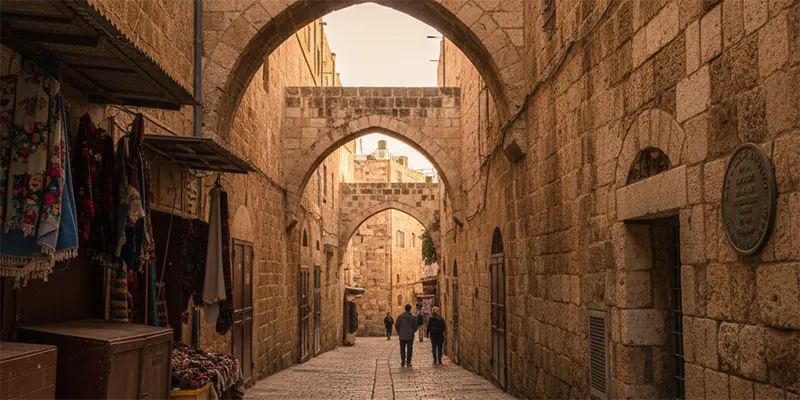
The narrow stone streets of the Via Dolorosa wind through Jerusalem's Old City, passing through active markets and ancient chapels on the way to the Church of the Holy Sepulchre.
Leading the Stations: Practical Guidance for the Day
On the day you lead your pilgrimage through the Via Dolorosa stations of the cross, a few practical decisions will shape the entire experience.
Timing Matters: Early morning is ideal—ideally before 8:00 a.m., when the streets are quieter and the light filtering through the Old City's stone corridors is soft and golden. If your pilgrimage schedule allows, coordinate with your travel provider to prioritize an early start for this day above all others. The difference between walking the Via Dolorosa at 7:00 a.m. and at noon is the difference between prayer and an obstacle course.
The Friday Franciscan Procession: Every Friday afternoon, the Franciscan Custody of the Holy Land leads a public procession along the Via Dolorosa, typically beginning at 3:00 p.m. in winter or 4:00 p.m. in summer. Joining this procession is a powerful option—your group walks alongside pilgrims from around the world, united in prayer as the Franciscans have led this devotion for centuries. The trade-off is that you'll have less control over pacing and the meditations are led by the Franciscans rather than by you. Discuss this option with your pilgrimage coordinator to determine what best serves your group.
Keep Meditations Brief: At each station, resist the temptation to deliver a lengthy reflection. The setting itself is doing much of the work. A short Scripture passage, a few sentences of meditation, and a moment of silence will be more powerful than an extended commentary. Let Jerusalem preach. Your role is to frame the encounter, not to fill every silence.
Manage the Group Physically: Work with your local guide to keep the group together at each station. In narrow streets, it's easy for pilgrims to become separated. Establish a simple system—perhaps gathering in a circle at each stop, with you and the guide bookending the group. For larger parishes, consider a small handheld cross that the group can follow, a tradition many pilgrimage groups observe on the Via Dolorosa.
The Transition into the Holy Sepulchre: The shift from outdoor stations to the final stations within the Church of the Holy Sepulchre is one of the most powerful moments. Prepare your pilgrims for it. The church is vast, dim, and fragrant with incense. Station X (the Stripping of the Garments) is just inside the entrance. From there, you'll ascend the steep staircase to Calvary for Stations XI, XII, and XIII, and then descend to the Tomb itself for Station XIV. This final movement—from the cross to the empty tomb—mirrors the entire arc of our faith. Let it breathe.
Preparing Your Meditations: Scripture, Tradition, and Your People
While many printed guides to the Stations exist, the meditations you prepare yourself—tailored to your parishioners—will resonate far more deeply than anything from a booklet. You know this group. You know who recently lost a spouse, who is carrying a prodigal child in their heart, who is struggling with their own faith. Without naming anyone, your meditations can speak to these realities in ways that open hearts to grace.
Consider grounding each station in the Gospel accounts of the Passion. Luke's tender details—Jesus turning to look at Peter, speaking to the women of Jerusalem, promising paradise to the thief—are particularly suited to devotional meditation. John's theological depth adds another dimension, especially at the foot of the cross where Jesus entrusts Mary to the Beloved Disciple.
At certain stations, you might invite brief participation from your pilgrims. At Station V, where Simon of Cyrene takes up the cross, ask your group to consider: who has carried the cross with you in your life? At Station IV, where Jesus meets His mother, invite a moment of prayer for the mothers in your group and for all who suffer watching a loved one in pain. These small invitations draw pilgrims from observation into participation—from tourists watching a procession into pilgrims entering the mystery.
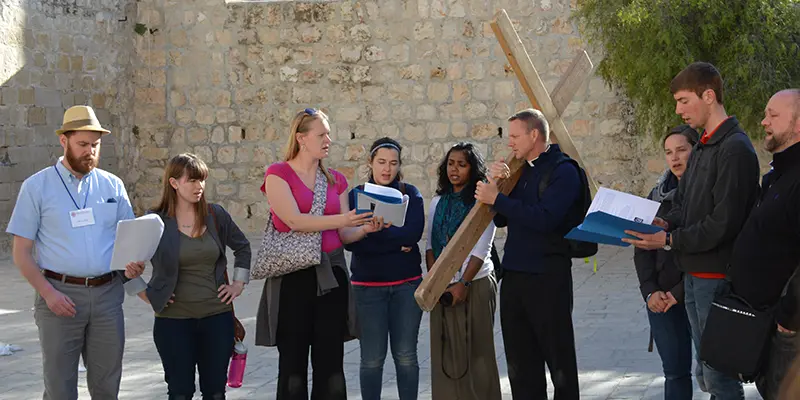
A priest leads pilgrims in prayer along the Via Dolorosa, where brief meditations at each station allow Jerusalem itself to deepen the encounter.
Pastoral Care Along the Way of Sorrows
The Via Dolorosa has a way of surfacing grief, guilt, and longing that pilgrims may not have expected. Walking the path of Christ's suffering gives permission for people to face their own. Be prepared for tears. Be prepared for the pilgrim who needs to step aside and sit on a stone ledge for a moment. Be prepared for the one who cannot speak afterward.
These responses are not problems to be solved—they are signs that grace is at work. Your role is simply to be present, to offer a quiet word or a hand on the shoulder, and to assure your people that what they are feeling is an encounter with the Lord who suffered this road for them.
If any of your pilgrims express a desire for confession after the Via Dolorosa, accommodate that as generously as your schedule allows. The Passion has a way of illuminating the areas of our lives where we most need mercy. The connection between walking the Way of the Cross and receiving the sacrament of forgiveness is one of the most beautiful pastoral opportunities a pilgrimage to Jerusalem can offer.
When You Return: Carrying the Via Dolorosa Home
The deepest fruit of walking the Via Dolorosa often appears weeks or months later, when a pilgrim prays the Stations in their home parish and suddenly finds that the devotion they've known for years has been utterly transformed. The Seventh Station is no longer abstract—it's that particular turn in the road where the stones were uneven and the air smelled of spice. The Twelfth Station is no longer a plaque on the church wall—it's the rock of Calvary under their fingertips.
This is the lasting gift of pilgrimage: not a memory to look back on, but a lens through which every future prayer is deepened. Encourage your pilgrims to continue praying the Stations regularly after returning home, especially during Lent. The Via Dolorosa lives in them now. Each time they pray the Way of the Cross, they walk it again—not as tourists recalling a trip, but as pilgrims whose hearts have been permanently opened by what they encountered in Jerusalem.
And for you, Father—leading your people along the road where Christ carried His cross will change the way you lead the Stations in your own parish forever. You will preach the Passion differently. You will hear confessions during Lent with the memory of Jerusalem's stones beneath your feet. The graces of the Via Dolorosa are not limited to the day you walk it. They continue to unfold in your ministry for years to come.
Ready to lead your parishioners along the Via Dolorosa? We would be honored to help you plan a Holy Land pilgrimage that gives your group the time, preparation, and pastoral space to encounter Christ on the Way of the Cross. See All Upcoming Pilgrimages to explore available dates, or learn more about how to Lead Your Own Group with our dedicated support for clergy.